
What Taxes Should I Consider When Dividing Assets in Divorce?
Last reviewed: July 2026
When dividing assets in divorce, the taxes that matter most are capital gains tax on appreciated property, ordinary income tax on pre-tax retirement accounts, and the rules around the home-sale capital gains exclusion. The division itself is usually tax-free under IRC Section 1041, but every asset carries a different future tax bill. A 50/50 split on paper is rarely a 50/50 split after tax.
Key Takeaways
- Transfers between spouses incident to divorce are tax-free under IRC Section 1041, but future tax liability still travels with each asset.
- A pre-tax 401(k) can be worth 25% to 37% less than its face value once ordinary income tax is applied at withdrawal.
- The home-sale capital gains exclusion is $500,000 for joint filers and $250,000 for single filers under IRC Section 121.
- Cost basis, not account balance, determines what a taxable brokerage account is really worth in a settlement.
About the Author: Jeff Judge, CFP®, AEP®, ChFC®, CLU® is Managing Partner of Chesapeake Financial Planners in Forest Hill, Maryland. He has been helping families and business owners in Harford County and the Baltimore metro area navigate divorce and tax planning since earning his CFP® certification in 2013, by using Chesapeake Financial Planners’ signature process, the R.U.D.D.E.R. method™. Jeff has watched more than one client accept a "fair" settlement that quietly handed the other spouse an extra six figures, all because nobody ran the after-tax math first.
Is Dividing Assets in a Divorce a Taxable Event?
Dividing assets in a divorce is generally not a taxable event when the transfer happens between spouses incident to the divorce. Under IRC Section 1041, property moved from one spouse to the other as part of the settlement passes tax-free, with no immediate gain or loss recognized by either party.
That sounds clean. It isn't the whole story. The tax-free transfer simply moves the future tax bill along with the asset. Whoever ends up holding a pre-tax 401(k) or a low-basis stock position also inherits the tax that comes due when that asset is eventually sold or withdrawn. The IRS doesn't forgive the tax. It just waits.
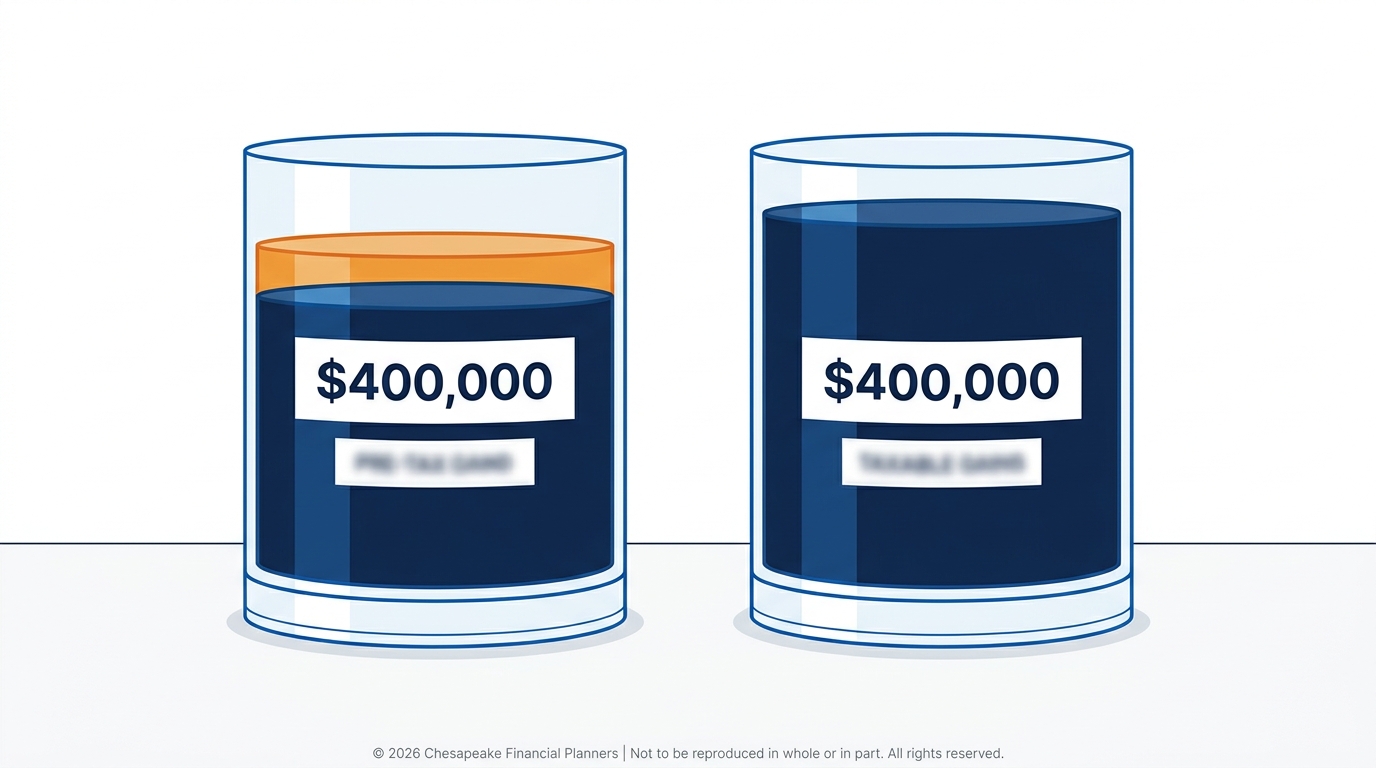
This is the single most misunderstood point in divorce asset division. The settlement spreadsheet shows balances. It does not show the embedded tax that turns one $400,000 asset into $280,000 in your hand and another $400,000 asset into $392,000. Run the after-tax number on every line before you sign anything.
Why Are Retirement Accounts Worth Less Than Their Balance?
A pre-tax retirement account is worth less than its stated balance because every dollar inside it is taxed as ordinary income when you withdraw it. The IRS treats traditional 401(k), traditional IRA, and pension distributions as ordinary income, so a $400,000 traditional 401(k) is really worth $400,000 minus your future tax rate.
At a combined federal-and-state rate of 30%, that $400,000 account delivers roughly $280,000 of spendable money. The top federal ordinary income rate for 2026 is 37%, so a high earner could see even less. Compare that to a Roth 401(k) or Roth IRA, where contributions were already taxed and qualified withdrawals come out completely tax-free. A $400,000 Roth is worth a full $400,000 after tax.
Here is the practical move. When splitting retirement accounts, never trade a Roth dollar for a traditional dollar at face value. The Roth is the most valuable asset on the board. If you take pre-tax accounts, negotiate for a larger share to offset the tax you'll owe later.
Dividing a workplace plan also requires a Qualified Domestic Relations Order, or QDRO. A QDRO is the court order that directs a retirement plan to pay a portion to the non-employee spouse without triggering the early-withdrawal penalty. Skip it, or write it wrong, and a clean transfer can turn into a taxable distribution. This is one place where the Department of Labor guidance is worth reading before your attorney drafts the order. Jeff Judge notes: "A QDRO that's drafted incorrectly or never submitted to the plan administrator can turn what should have been a penalty-free transfer into a fully taxable distribution, and that's a mistake you can't unwind after the divorce is final."

How Does the Home Sale Capital Gains Exclusion Work in Divorce?
The home-sale capital gains exclusion lets you exclude up to $250,000 of gain as a single filer or $500,000 as a married couple filing jointly, provided you meet the ownership and use tests under IRC Section 121. In divorce, the filing status you use when the house sells determines which number applies, and that difference can cost tens of thousands of dollars.
Picture a house bought for $200,000 and now worth $700,000, a $500,000 gain. Sell it while still married and filing jointly, and the full $500,000 exclusion wipes out the entire gain. Tax owed: zero. Keep the house, finalize the divorce, and sell two years later as a single filer, and only $250,000 is excluded. The remaining $250,000 gets taxed at long-term capital gains rates, which reach 20% for high earners, producing a bill of $37,500 to $50,000.
Timing is the lever. If a highly appreciated home is on the table, selling before the divorce is final can preserve the larger exclusion. When one spouse keeps the house, that spouse should negotiate a larger share to cover the future capital gains tax that comes with it. For more on the underlying mechanics, see How Can I Reduce Capital Gains Taxes on My Investments?.
Why Does Cost Basis Matter More Than Account Balance?
Cost basis matters more than account balance because capital gains tax is calculated on the gain, not the total value. Two brokerage accounts can each hold $100,000 and carry wildly different tax bills depending on what was originally paid for the investments inside them.
Take Account A with a $90,000 cost basis and Account B with a $20,000 cost basis. Sell both and Account A produces $10,000 of gain, taxed at 15% for a $1,500 bill. Account B produces $80,000 of gain, an $12,000 bill at the same rate. Same balance, eight times the tax. Anyone accepting "the $100,000 account" without asking about basis is flying blind.
Before agreeing to split any taxable account, request a full cost-basis breakdown. Low-basis positions carry hidden tax weight; high-basis positions are close to cash. Jeff Judge regularly tells clients that the most expensive sentence in a divorce is "it's all the same to me." It almost never is. Smart asset location planning starts with knowing exactly what each position will cost to liquidate. See also How Should I Place Investments Across Taxable and Retirement Accounts?.
How Are Stock Options and RSUs Taxed When Split in Divorce?
Stock options and restricted stock units are taxed differently depending on type, and that tax treatment can slash their real settlement value. Restricted stock units are taxed as ordinary income when they vest, non-qualified stock options are taxed as ordinary income when exercised, and incentive stock options can trigger the Alternative Minimum Tax when exercised.
Say a settlement assigns $200,000 of unvested RSUs. When those shares vest, they're taxed as ordinary income, potentially 32% to 37% federal plus state tax. The after-tax value might land between $120,000 and $136,000, well below the headline number. Treating $200,000 of RSUs as equal to $200,000 of cash is a costly mistake.
Factor the embedded tax into any equity compensation that changes hands. If you're receiving stock comp, push for more shares to offset the future bill. If you're keeping it, recognize the discount. For deeper coverage, see How Do I Avoid Surprise Tax Bills When My RSUs Vest? and What Is Alternative Minimum Tax and How Do I Avoid It?.
Frequently Asked Questions
Is dividing assets in a divorce taxable?
Dividing assets in a divorce is not a taxable event when the transfer happens between spouses incident to the divorce, under IRC Section 1041. No gain or loss is recognized at the time of transfer. The future tax liability, however, travels with each asset to whoever receives it.
How much is a 401(k) really worth in a divorce?
A traditional 401(k) is worth its balance minus the ordinary income tax owed at withdrawal. At a combined 30% rate, a $400,000 pre-tax 401(k) delivers roughly $280,000 in spendable money. A Roth 401(k) of the same balance is worth the full amount, because qualified withdrawals are tax-free.
What is a QDRO and why do I need one?
A QDRO, or Qualified Domestic Relations Order, is a court order directing a workplace retirement plan to pay part of the account to the non-employee spouse. It allows the transfer to happen without triggering the 10% early-withdrawal penalty. Dividing a 401(k) or pension without a proper QDRO can create an unexpected taxable distribution.
Can I avoid capital gains tax on the house after divorce?
You can reduce or eliminate capital gains tax on a home by qualifying for the IRC Section 121 exclusion: $500,000 of gain for joint filers, $250,000 for single filers. Selling while still married and filing jointly captures the larger exclusion. Selling later as a single filer cuts that exclusion in half.
Are RSUs and stock options worth their face value in a settlement?
RSUs and stock options are usually worth less than face value because they're taxed when they vest or are exercised. RSUs and non-qualified options are taxed as ordinary income, often 32% to 37% federal plus state. A $200,000 RSU grant might be worth only $120,000 to $136,000 after tax.
Why are two equal brokerage accounts not actually equal?
Two brokerage accounts with the same balance can carry very different tax bills because capital gains tax applies to the gain, not the total value. A low-cost-basis account holds more embedded gain and therefore more future tax. Always request a full cost-basis breakdown before agreeing to split any taxable account.
The most common divorce planning mistake Jeff Judge sees isn't greed. It's accepting an apples-to-oranges trade because the balances matched and nobody ran the after-tax comparison. A second set of eyes on a settlement, before it's signed, often surfaces a six-figure swing. If you're working through a divorce and want to understand what your proposed division really looks like after tax, the team at Chesapeake Financial Planners runs that analysis for clients regularly. Visit chesapeakefp.com to learn more.
Want to go deeper? Our Financial Considerations Before Your Divorce walks through this step by step.
Disclosures
The information provided is for educational purposes only and should not be construed as investment advice. Investment strategies should be tailored to individual circumstances, risk tolerance, and goals. Past performance doesn't guarantee future results. Consult with qualified financial professionals regarding your specific situation.
This information is not intended to be a substitute for specific individualized tax, investment or legal advice. We suggest that you discuss your specific situation with a qualified tax, legal or financial advisor.
Advisors associated with Chesapeake Financial Planners may be either (1) LPL Financial Registered Representatives offering securities through LPL Financial, Member FINRA and SIPC, and investment advisor representatives offering investment advice through Great Valley Advisor Group; or (2) solely investment advisor representatives offering investment advice through Great Valley Advisor Group and not affiliated with LPL Financial. Great Valley Advisor Group, and Chesapeake Financial Planners are separate entities from LPL Financial.


