

How do you maximize Social Security and Medicare benefits in retirement?
Last reviewed: July 2026
Social security medicare planning is the work of coordinating when you claim Social Security with when you enroll in Medicare so that the two decisions raise your lifetime income and lower your lifetime healthcare costs. The Social Security claim is one permanent decision worth six figures over a retirement; the Medicare decision is an annual one that quietly drains a portfolio if you stop paying attention to it. Coordinating the two means deciding claim timing, choosing enrollment windows, and managing the income that drives Medicare premiums.
On This Page
- Key Takeaways
- What Is Social Security and Medicare Planning?
- When Should You Claim Social Security?
- How Does Medicare Enrollment Work and What Are the Deadlines?
- What Are IRMAA Surcharges and How Do You Avoid Them?
- How Do Social Security and Medicare Affect Each Other?
- How Should Married Couples Coordinate Claiming Strategies?
- Frequently Asked Questions
- Ready to Build a Plan Around Social Security and Medicare?
- Disclosures
Key Takeaways
- The 2026 maximum monthly Social Security benefit at Full Retirement Age is $4,152, and delaying to age 70 lifts that closer to $5,181 per month.
- Medicare's Annual Election Period runs October 15 to December 7 every year, and it's the main window for switching most plans without medical underwriting.
- The 2026 Medicare Part B standard premium is $202.90 per month, up sharply from $185.00 in 2025.
- IRMAA surcharges on Part B and Part D kick in when 2024 MAGI exceeds $109,000 single or $218,000 joint, and they're recalculated each year from a two-year-old tax return.
- The 2026 Social Security COLA is 2.8%, which adds roughly $56 to the average retired worker's monthly check.
About the Author: Jeff Judge, CFP®, AEP®, ChFC®, CLU® is Managing Partner of Chesapeake Financial Planners in Forest Hill, Maryland. He has been helping families and business owners in Harford County and the Baltimore metro area navigate Social Security and Medicare decisions since earning his CFP® certification in 2013, by using Chesapeake Financial Planners’ signature process, the R.U.D.D.E.R. method™. Jeff often tells clients that the Social Security side of this puzzle is one decision you make once; the Medicare side is a decision you make every fall, whether you remember to or not.
What Is Social Security and Medicare Planning?
Social security medicare planning is the disciplined coordination of two federal benefit decisions: when to start your Social Security retirement benefit and how to enroll in (and stay in) the right Medicare plan year after year. The Social Security side is a one-time strategic choice that locks in your benefit floor for life. The Medicare side is a recurring administrative job with hard deadlines, late penalties, and a separate price tag every January.
The R.U.D.D.E.R. Method™ is Chesapeake Financial Planners' six-step planning process: Review and Recognize, Uncover and Understand, Design and Develop, Discuss and Decide, Execute and Empower, and Reassess and Refine. For Social Security and Medicare, the first two steps usually drive the answer. Most clients walk in with a guess about when they should claim and almost no idea how Medicare premiums interact with their tax return. The work is connecting those two pieces.
Why do these two decisions need to be planned together?
Because each one affects the other in ways most retirees don't see until the IRMAA letter arrives. A larger Social Security check raises taxable income, which can drive Medicare premium surcharges. A Roth conversion done in the year before age 65 can lower future RMDs and Social Security taxation, but the same conversion can trigger a Medicare surcharge two years later. Jeff Judge has watched clients save tens of thousands by sequencing these two moves in the right order and then watched the same dollar amount evaporate when they were treated as separate problems. The lever isn't either benefit in isolation; it's the income tax bracket that connects them.
For more on the broader planning framework, see What is the best retirement income planning strategy?.
When Should You Claim Social Security?
The right time to claim Social Security depends on health, marital status, other income, and taxes, but the math is unambiguous: each year you delay between 62 and 70 raises your monthly check, and the increase is permanent. The earliest claiming age is 62, with a roughly 30% reduction from your Full Retirement Age benefit. Each year of delay past FRA adds 8% in delayed retirement credits, up to age 70. After 70, the credits stop.
The numbers for 2026, straight from the Social Security Administration, tell the story:
| Claim age | 2026 max monthly benefit | Compared to FRA |
|---|---|---|
| Age 62 | $2,969 | About 28% lower |
| Full Retirement Age (66-67) | $4,152 | Baseline |
| Age 70 | $5,181 | About 25% higher |
The break-even point between claiming at 62 and waiting until 70 typically lands in the late 70s or early 80s. If you live to 85, delaying wins by a wide margin. If you don't, claiming early wins. For married couples, the answer often isn't symmetric: the higher earner usually benefits most by delaying because that benefit becomes the surviving spouse's benefit for life.
How much does waiting from 62 to 70 actually add to your benefit?
The structural increase from age 62 to age 70 is about 76% of the age-62 amount, before COLAs. The 2026 average retired-worker benefit is roughly $2,071 per month after the 2.8% COLA, and that average reflects a mix of early and late claimers. A high earner who waits until 70 can lock in a benefit that's 24-25% larger than their FRA amount and roughly 75% larger than what they'd have received at 62. The 2026 Social Security wage base is $184,500, so anyone earning at or above that ceiling for 35 years has the inputs to hit the maximum benefit at their claim age.
One caution about working between 62 and FRA: the 2026 earnings test withholds $1 in benefits for every $2 earned above $24,480 for those below FRA. The withheld benefits are restored at FRA in the form of a higher monthly check, so it's not a tax, but it can complicate cash flow planning.
For a deeper look at the singles-and-married math, see social security claiming strategies for singles and married couples.
How Does Medicare Enrollment Work and What Are the Deadlines?
Medicare enrollment is governed by a series of hard windows; missing one can mean lifetime late-enrollment penalties on Part B and Part D. The Initial Enrollment Period is the seven-month window that begins three months before the month you turn 65, includes your birth month, and ends three months after. Most people should enroll in Part A in this window even if they're still working, because Part A is premium-free for anyone with at least 40 quarters of work history.
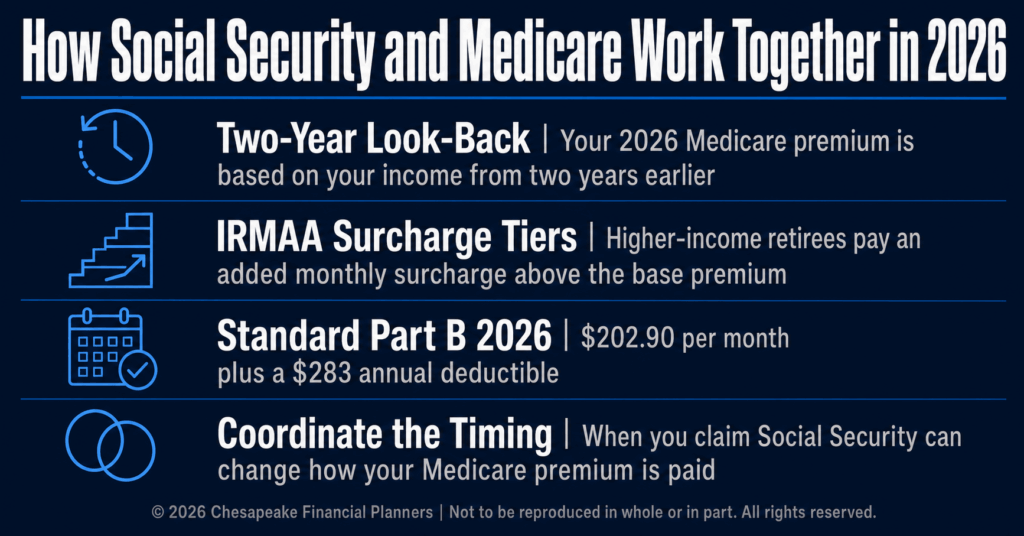
Part B is the one that catches people. The 2026 standard Part B premium is $202.90 per month, with a 2026 annual deductible of $283. The 2026 Part A inpatient hospital deductible is $1,736 per benefit period. If you delay Part B without "creditable coverage" from an employer plan, the late penalty is 10% of the standard premium for every 12 months you could have been enrolled and weren't. That penalty applies for the rest of your life.
The other deadline most retirees should know is the Annual Election Period: October 15 to December 7. That's the window for switching between Original Medicare and Medicare Advantage, changing Part D drug plans, or switching Medicare Advantage plans. Changes made in this window take effect January 1.
What happens if you miss your Initial Enrollment Period?
If you miss your IEP and don't have qualifying employer coverage, the next standard window is the General Enrollment Period from January 1 to March 31, with coverage starting the month after enrollment. The Part B late-enrollment penalty applies for life. A different penalty applies to Part D drug coverage: 1% of the national base premium for each month you went without creditable drug coverage, also for life. Both penalties are avoidable, but only if you know the rules before you turn 65. Jeff Judge tells clients to put their 65th birthday on the calendar twice: once for the celebration and once, three months earlier, for the start of their IEP.
For employees still on a group health plan past 65, see medicare enrollment guide for those still working.
What Are IRMAA Surcharges and How Do You Avoid Them?
IRMAA, the Income-Related Monthly Adjustment Amount, is a Medicare premium surcharge tied to your modified adjusted gross income. It applies to Part B and Part D, it's recalculated every year, and it's based on your tax return from two years earlier. Your 2026 IRMAA determination uses 2024 MAGI.
The 2026 thresholds, per CMS:
| 2024 MAGI (single) | 2024 MAGI (married joint) | 2026 monthly Part B premium |
|---|---|---|
| ≤ $109,000 | ≤ $218,000 | $202.90 (standard) |
| > $109,000 to $137,000 | > $218,000 to $274,000 | $284.10 |
| > $137,000 to $171,000 | > $274,000 to $342,000 | $405.80 |
| > $171,000 to $205,000 | > $342,000 to $410,000 | $527.50 |
| > $205,000 to $500,000 | > $410,000 to $750,000 | $649.20 |
| ≥ $500,000 | ≥ $750,000 | $689.90 |
The big mistake retirees make is treating IRMAA like a tax. It isn't progressive, it's a cliff. Crossing a threshold by one dollar puts the entire premium into the next bracket for the full year. A retired couple with $217,999 of MAGI pays the standard premium; the same couple at $218,001 pays $81.20 more per month, each, for both Part B and Part D.
Jeff Judge puts it plainly: "The clients who save the most on Medicare aren't the ones with the best investments. They're the ones who looked at their income two years before they turned 65 and decided which year to take the Roth conversion, the business sale, or the big capital gain. That choice can be worth more than any market call they'll make in retirement."
How is IRMAA calculated and which year's income matters?
IRMAA looks at MAGI, which is adjusted gross income plus tax-exempt municipal bond interest. It uses your filed return from two tax years before the IRMAA year. That two-year lookback matters because the financial moves that drive IRMAA are usually planned: Roth conversions, lump-sum capital gains, large IRA withdrawals, or a one-time business sale. Done in the wrong year, those moves can push premiums up for two future years. Done in the right year, they can stay in a lower bracket entirely. If your income drops because of retirement, marriage, divorce, or the death of a spouse, you can file Form SSA-44 to request a redetermination based on a "life-changing event," which can cut or eliminate the surcharge.

For the planning playbook that goes deeper on this, see What Is Medicare IRMAA and Why Does It Hit High Earners Two Years Late?.
How Do Social Security and Medicare Affect Each Other?
The connection between Social Security and Medicare runs through three channels: enrollment, premium deduction, and taxable income. First, claiming Social Security before age 65 triggers automatic enrollment in Part A and Part B at 65. Once enrolled, your Part B premium gets deducted from your monthly Social Security check, so the gross benefit on the SSA statement isn't what hits your bank account. Second, the timing of your Social Security claim affects your taxable income, which feeds back into IRMAA two years later through MAGI. Third, working in early retirement can affect both: the earnings test reduces benefits before FRA, while a wage base over the 2026 Social Security cap of $184,500 tells you whether you're still building toward a higher benefit.
In practice, many retirees in Harford County and the Baltimore metro find that the right play is to delay Social Security past 65 and enroll in Medicare on time. Doing so means writing a check for the Part B premium each quarter rather than having it deducted, which feels worse but produces a larger lifetime benefit. See How do Roth conversions affect IRMAA and Medicare Part B premiums? for the income-timing side of that decision.
Should you claim Social Security at 65 just because that's when Medicare starts?
No. The Medicare 65 deadline is unrelated to Social Security claiming. Full Retirement Age for anyone born in 1960 or later is 67, not 65, and there's no penalty for claiming Medicare at 65 while delaying Social Security to 67, 68, 69, or 70. Conflating the two deadlines is one of the most expensive mistakes Jeff sees in client meetings: a sixty-five-year-old who claims Social Security early because they "have to for Medicare" gives up roughly $1,000 a month in lifetime benefits compared to waiting until FRA, and often much more by waiting until 70.
For coordinated tax and withdrawal sequencing, see How can I reduce taxes on my retirement withdrawals?.
How Should Married Couples Coordinate Claiming Strategies?
For married couples, the right strategy is rarely two parallel decisions. Spousal and survivor benefit rules turn a coordinated claim into a math problem that almost always favors the higher earner delaying as long as possible. A spouse can claim a benefit equal to up to 50% of the higher earner's Full Retirement Age benefit, but only after the higher earner has claimed. The survivor benefit, which kicks in when one spouse dies, is the larger of the two benefits. That means the higher earner's claim age sets the survivor's check for life.
The "file and suspend" and Restricted Application strategies from the pre-2016 rules are no longer available to most couples; the Bipartisan Budget Act of 2015 closed them for anyone born on or after January 2, 1954. What remains is the underlying math: the higher earner waits, the lower earner claims as fits their cash flow needs, and the household captures the larger survivor benefit later.
What's the spousal/survivor benefit math?
If one spouse's FRA benefit is $3,500 and the other's is $1,200, the lower earner can claim the greater of their own benefit or up to 50% of the higher earner's FRA benefit ($1,750). Claiming early reduces both. When the higher earner dies, the survivor's benefit converts to the higher of the two, which is the higher earner's actual claimed amount (not the FRA amount). If the higher earner waited to 70 and was receiving $4,340, the survivor's benefit becomes $4,340 even if they had been collecting $1,750 themselves. The longer the higher earner waits, the more the surviving spouse gets, sometimes for decades.
A practice observation: most of the spousal benefit mistakes Jeff sees in his Forest Hill office come from couples who optimized their claim before they understood the survivor rules. By the time the survivor benefit matters, the decision that determines it has already been made.

For the deeper drill-down, see How should married couples coordinate Social Security claiming? and What Financial Steps Should I Take After Losing My Spouse?.
Frequently Asked Questions
Can I work while collecting Social Security?
Yes, you can work and collect Social Security at the same time, but if you claim before your Full Retirement Age and earn above the annual limit, Social Security withholds part of your benefit. For 2026, the SSA withholds $1 in benefits for every $2 you earn above $24,480 if you're below FRA all year. Once you reach FRA, the earnings test goes away and any withheld benefits are restored as a higher monthly amount.
Do I have to enroll in Medicare at 65 if I'm still working?
Not necessarily. If you have qualifying employer health coverage from an employer with 20 or more employees, you can typically delay Part B without penalty and enroll within eight months of leaving that coverage during a Special Enrollment Period. Most people should still enroll in Part A at 65, since it's premium-free with 40 quarters of work history and adds a layer of inpatient coverage on top of the employer plan.
What happens to my spouse's Social Security if I die?
Your surviving spouse receives a survivor benefit equal to your actual claimed benefit, not your FRA benefit, if it exceeds their own. If you delayed Social Security to 70 and were collecting a larger check, that larger amount becomes the survivor's monthly benefit (subject to age-based reductions if the survivor claims before their own FRA). The lower earner's own benefit then stops because survivors collect the higher of the two, not both.
Can I appeal an IRMAA determination?
Yes. If your income has dropped because of a life-changing event such as retirement, marriage, divorce, death of a spouse, or loss of pension income, you can file Form SSA-44 with the Social Security Administration to request a new IRMAA determination based on your current year's projected income rather than your two-year-old return. Approvals are common when the event is documented.
How does claiming Social Security affect my Medicare premium?
Once you're enrolled in both, Medicare deducts your Part B premium directly from your monthly Social Security check, so the gross benefit and the net deposit differ. Claiming Social Security itself doesn't change the premium amount; the 2026 standard Part B premium is $202.90 regardless of when you claimed. What does change the premium is your income two years earlier through the IRMAA surcharge, which is independent of your claim timing.
What's the difference between Medicare Advantage and Original Medicare with a Supplement?
Original Medicare (Parts A and B) plus a Medigap supplement and a standalone Part D drug plan offers nationwide doctor access and predictable out-of-pocket costs at a higher monthly premium. Medicare Advantage (Part C) bundles everything into one plan with a narrower network, often a low or $0 premium, and built-in extras like dental or vision, but with the trade-off that switching back to Medigap later usually requires medical underwriting.
When should I start planning these decisions?
Start at least three years before age 65. The reason is the IRMAA two-year lookback: the income you report on your tax return at age 63 sets your Medicare premium at age 65. Roth conversions, business sales, and large capital gains taken before 63 are usually invisible to Medicare. Anything done at 63 or 64 shows up. Couples who only start thinking about Social Security and Medicare planning at 64 have already locked in their first two years of Medicare premiums.
Ready to Build a Plan Around Social Security and Medicare?
A coordinated claim and enrollment strategy can change household lifetime income by six figures and often pays for itself many times over before the second year of retirement. If you're within five years of 65 or already there and weighing your options, Jeff Judge and the Chesapeake Financial Planners team work through social security medicare planning decisions with families and business owners across Harford County and the Baltimore metro every week. Schedule a free fit call at chesapeakefp.com.
Want to go deeper? Our Medicare and Social Security Guide walks through this step by step.
Disclosures
The information provided is for educational purposes only and should not be construed as investment advice. Investment strategies should be tailored to individual circumstances, risk tolerance, and goals. Past performance doesn't guarantee future results. Consult with qualified financial professionals regarding your specific situation.
Advisors associated with Chesapeake Financial Planners may be either (1) LPL Financial Registered Representatives offering securities through LPL Financial, Member FINRA and SIPC, and investment advisor representatives offering investment advice through Great Valley Advisor Group; or (2) solely investment advisor representatives offering investment advice through Great Valley Advisor Group and not affiliated with LPL Financial. Great Valley Advisor Group, and Chesapeake Financial Planners are separate entities from LPL Financial.


