

How Should Married Couples Coordinate Social Security Claiming?
Last reviewed: July 2026
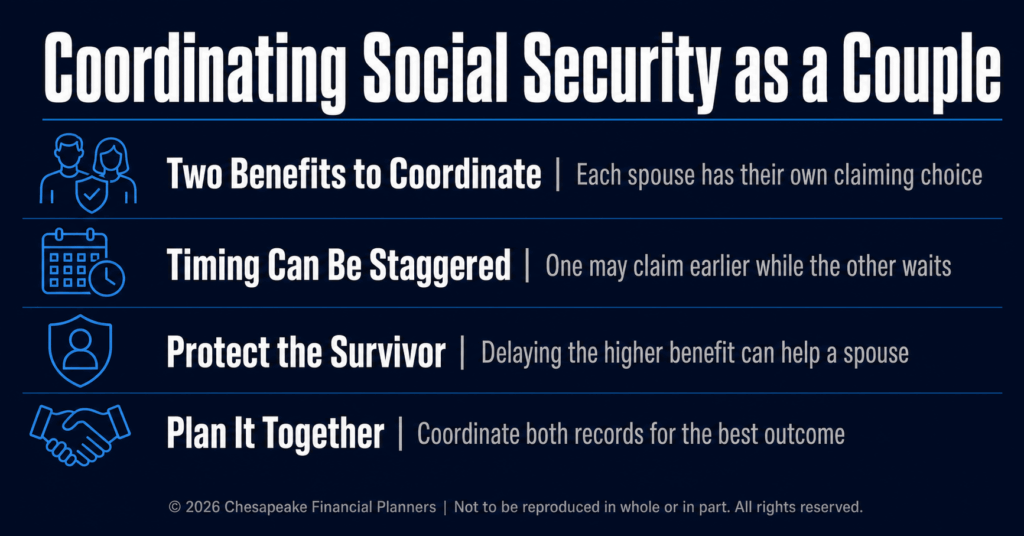
Married couples should coordinate Social Security claiming by treating the two benefits as one combined decision, usually with the lower earner claiming earlier and the higher earner delaying to age 70 to maximize the survivor benefit. The single biggest lever is the higher earner's claiming age, because whatever that person locks in becomes the amount the surviving spouse keeps for the rest of their life. Most couples leave money on the table by claiming separately, on instinct, without running the joint numbers first.
On This Page
- Key Takeaways
- Why Should Married Couples Coordinate Social Security Claiming?
- How Does the Survivor Benefit Change the Math for Couples?
- How Do Spousal Benefits Work for Married Couples?
- When Should the Lower Earner Claim Social Security?
- When Should the Higher Earner Delay to Age 70?
- How Do Taxes, the Earnings Test, and Medicare Affect Timing?
- How Do You Build a Coordinated Claiming Plan?
- Frequently Asked Questions
- Where to Go From Here
- Disclosures
Key Takeaways
- Coordinate as a couple, not as two individuals; the higher earner's claiming age sets the survivor benefit that outlives both spouses.
- Delaying the higher earner's benefit to 70 grows it by 8% per year past full retirement age, per the SSA.
- The spousal benefit can reach up to 50% of the higher earner's full retirement amount, per SSA rules.
- Claiming at 62 instead of full retirement age permanently cuts a benefit by about 30%, according to SSA.
- The 2026 Social Security cost-of-living adjustment is 2.8%, raising every benefit check accordingly.
About the Author: Jeff Judge, CFP®, AEP®, ChFC®, CLU® is Managing Partner of Chesapeake Financial Planners in Forest Hill, Maryland. He has been helping families and business owners in Harford County and the Baltimore metro area navigate Social Security and retirement income decisions since earning his CFP® certification in 2013, by using Chesapeake Financial Planners’ signature process, the R.U.D.D.E.R. method™. Jeff has watched too many couples treat Social Security as a "claim it when you retire" decision, when the bigger question is which spouse should wait, and for how long.
Why Should Married Couples Coordinate Social Security Claiming?
A strong social security claiming strategy married couples can rely on starts with one idea: you are planning two benefits across two lifespans, not picking a date for each person in isolation. When you claim separately, you optimize each benefit against your own life expectancy. When you coordinate, you optimize the combined cash flow across the years you will both be alive, plus the years one of you will likely live alone.
That second window matters more than most people expect. According to the Social Security Administration, a 65-year-old woman today can expect to live to roughly 86, and a 65-year-old man to about 84. In a typical couple, one spouse outlives the other by several years. Those solo years are funded almost entirely by whichever benefit survives, and that is where coordination pays off.
What does coordination actually change?
Coordination changes who waits, who claims early, and how the household sequences income before both benefits are flipped on. Jeff Judge often tells clients that the wrong question is "when should I claim?" The right question is "between the two of us, who should wait, and what do we live on in the meantime?" The answer usually points the higher earner toward delay and gives the lower earner more flexibility to claim sooner.
The decision touches more than Social Security. It interacts with your tax bracket, your Medicare premiums, the earnings test if you keep working, and the order you draw from your other accounts. Get the sequence right and a couple can add tens of thousands of dollars in lifetime, inflation-adjusted income without taking on a dime of investment risk.
How Should Married Couples Coordinate Their Social Security Benefits?
How Does the Survivor Benefit Change the Math for Couples?
The survivor benefit is the reason coordinating matters so much. When one spouse dies, the surviving spouse keeps the larger of the two benefits, not both. The smaller benefit simply goes away. So whatever the higher earner locks in becomes the household's permanent income floor for the survivor's remaining years.
That single fact reframes the entire decision. A delayed benefit is not just a bigger check for the higher earner; it is a bigger check for the surviving spouse, potentially for a decade or more after the first death.
Why does the higher earner's claiming age matter most?
Because the higher earner's benefit is what survives. The SSA explains that a surviving spouse who has reached full retirement age can receive 100% of the deceased worker's benefit, including any delayed retirement credits that were earned. Delayed credits do not disappear at death. They carry into the survivor benefit.
Here is the practical version. If the higher earner claims at 62 and takes a permanent reduction of about 30%, per SSA, that reduced amount becomes the survivor's income floor too. If instead the higher earner delays to 70 and grows the benefit with 8% annual delayed retirement credits past full retirement age, the survivor inherits that larger, COLA-adjusted amount.
Jeff puts it bluntly with clients: "When the higher earner delays to 70, you are buying the best longevity insurance available, and the surviving spouse is the beneficiary." It is one of the few financial decisions where the upside is guaranteed by the federal government and adjusts with inflation every year.
This is also where the R.U.D.D.E.R. Method™ matters. The R.U.D.D.E.R. Method™ is Chesapeake Financial Planners' six-step planning process: Review and Recognize, Uncover and Understand, Design and Develop, Discuss and Decide, Execute and Empower, and Reassess and Refine. The survivor benefit conversation usually surfaces during the "Uncover and Understand" phase, when couples realize their claiming choice is really an estate and longevity decision in disguise.
How does my Social Security claiming decision affect my Medicare premiums?
How Do Spousal Benefits Work for Married Couples?
A spousal benefit lets a lower-earning or non-working spouse claim a benefit based on the higher earner's record. According to the SSA, the spousal benefit can be worth up to 50% of the higher earner's full retirement amount when claimed at the spouse's own full retirement age.
A few rules shape how this plays out for a real social security claiming strategy married couples can use:
- The higher earner generally must have already filed for the spousal benefit to become available.
- The spousal benefit does not grow with delayed retirement credits. There is no reason for the lower earner to delay past their own full retirement age purely to chase a spousal benefit.
- If the spouse claims before full retirement age, the spousal benefit is permanently reduced.
- Social Security pays the higher of your own benefit or the spousal benefit, not both stacked together.
What if both spouses worked and earned benefits?
When both spouses have substantial work records, the spousal benefit often becomes irrelevant because each person's own benefit exceeds 50% of the other's. In those households, the decision shifts entirely to the timing question: who claims early, who delays, and how to fund the gap years.
The 2026 figures help frame the stakes. The SSA set the 2026 cost-of-living adjustment at 2.8%, and the maximum benefit for a worker retiring at full retirement age in 2026 is $4,152 per month. A two-earner couple coordinating well can build a combined, inflation-protected income stream that no annuity on the open market can match.
When Should Single People Claim Social Security Benefits?
When Should the Lower Earner Claim Social Security?
In most coordinated plans, the lower earner claims earlier and the higher earner delays. The logic is straightforward. The lower earner's benefit is the one that will probably disappear at the first death, so optimizing it for maximum lifetime value matters less than getting cash flow flowing while the higher earner waits.
Claiming the smaller benefit earlier does a few useful things at once:
- It provides household income during the years the higher earner is delaying.
- It reduces the need to draw down investment accounts in the gap years, leaving more invested for growth.
- It locks in a benefit that has limited survivor consequences, since the larger benefit is what the survivor keeps anyway.
Does claiming early always make sense for the lower earner?
Not always. If the lower earner is the one expected to live significantly longer, or is much younger and healthier, the math can shift. The earnings test also matters if the lower earner is still working. For 2026, the SSA withholds $1 in benefits for every $2 earned above the annual limit for people below full retirement age, so claiming early while working full-time can backfire.
Jeff has seen this trip up couples repeatedly. "A spouse claims at 62 because that is the number everyone knows," he says, "and then they keep working and lose a chunk of the benefit to the earnings test. We model it out and find waiting two years would have netted them far more." The earnings test withholding is not lost forever; the SSA recalculates and credits it back at full retirement age, but the cash flow disruption surprises people.
Should I Take Social Security at 62 or Wait Until 70?
When Should the Higher Earner Delay to Age 70?
The higher earner should usually delay to 70 when the couple has the resources to bridge the gap years and at least one spouse has reasonable longevity expectations. Delaying past full retirement age earns 8% per year in delayed retirement credits, per the SSA, with no further credits after age 70. That is a guaranteed, government-backed increase that also boosts the survivor benefit.
Think about what an 8% guaranteed, inflation-adjusted return looks like in today's market. There is no bond, CD, or annuity that reliably matches it with the same safety. For the higher earner whose benefit will likely survive both spouses, those credits compound into real money over a long retirement.
What if the higher earner is in poor health?
Health changes the calculus, but maybe not the way people assume. Even if the higher earner has a shorter expected lifespan, delaying can still make sense if the lower-earning spouse is healthy and likely to live many years as a survivor. The delayed credits flow into the survivor benefit. So the decision is less about the higher earner's own life expectancy and more about the joint and survivor timeline.
This is the practice-experience signal I see constantly: couples evaluate the higher earner's delay using only that person's health, forgetting that the surviving spouse inherits the result. The right frame is the longer of the two lives, not the shorter one.
A comparison helps clarify the trade-off between the two common approaches.
| Factor | Higher Earner Claims at 62 | Higher Earner Delays to 70 |
|---|---|---|
| Benefit reduction or increase | Reduced ~30% permanently (per SSA) | Increased ~24-32% via 8%/year credits |
| Survivor benefit impact | Survivor inherits the reduced amount | Survivor inherits the maximized amount |
| Gap-year income need | Lower; benefit starts immediately | Higher; must fund years 62-70 elsewhere |
| Inflation protection | Applies to a smaller base | Applies to a larger base |
| Best fit | Both spouses in poor health, urgent income need | At least one spouse with normal longevity |
How do I create sustainable retirement income streams?
How Do Taxes, the Earnings Test, and Medicare Affect Timing?
Social Security does not exist in a vacuum, and a coordinated claiming plan has to account for three moving parts that timing affects directly: federal taxation of benefits, the earnings test, and Medicare premiums.
On taxation, up to 85% of your Social Security benefits can be subject to federal income tax depending on your combined income, per the SSA. The thresholds that trigger this taxation have not been indexed to inflation, so more retirees cross them every year. Coordinating which spouse claims and when can help manage the combined income that drives this tax.
How does Medicare IRMAA tie into claiming decisions?
Medicare premium surcharges, known as IRMAA, are based on your modified adjusted gross income from two years prior, according to the Centers for Medicare & Medicaid Services. If a Roth conversion, a pension lump sum, or a large IRA withdrawal spikes your income in a given year, it can raise your Medicare premiums two years later. The gap years while the higher earner delays Social Security are often the best window to do Roth conversions, precisely because taxable income is temporarily low, but you have to watch the IRMAA brackets.
The earnings test, covered above, is the third factor. For anyone claiming before full retirement age while still working, the 2026 SSA earnings limit determines how much benefit gets temporarily withheld. Couples where one spouse keeps working part-time need to run this carefully.
Jeff Judge tells clients that the claiming decision is really a five-year tax-planning project, not a single form you submit. "The years you delay are gold for tax efficiency," he says. "We use them to convert pre-tax dollars to Roth, fill up lower brackets, and set the couple up for lower lifetime taxes, including for the surviving spouse who eventually files as single."
That last point is worth sitting with. When the first spouse dies, the survivor files as a single taxpayer, often with similar income but a much less favorable bracket structure. Planning for the "survivor's tax cliff" is one more reason coordination beats claiming on instinct.
How Can Maryland Retirees Reduce Their State Tax Burden?
Should I relocate to another state for retirement tax savings?
How Do You Build a Coordinated Claiming Plan?
Building the plan is a process, not a guess. At Chesapeake Financial Planners, the R.U.D.D.E.R. Method™ gives the work structure, but the core sequence applies to any couple:
- Map both benefit amounts. Pull each spouse's estimated benefits at 62, full retirement age, and 70 from your SSA statements. You cannot coordinate what you have not measured.
- Identify the higher and lower earner. This determines who is the survivor-benefit anchor and who has claiming flexibility.
- Estimate the joint and survivor timeline. Use realistic longevity assumptions for both spouses, weighted toward the longer-lived one.
- Model the gap years. Decide what funds the household while the higher earner delays. This usually blends the lower earner's benefit, taxable account withdrawals, and sometimes a part-time income.
- Layer in tax planning. Use low-income gap years for Roth conversions, watching IRMAA and the earnings test.
- Decide and document. Pick claiming ages, write down the reasoning, and revisit it if health or circumstances change.
What is the most common mistake couples make?
The most common mistake is claiming both benefits as early as possible out of fear that Social Security "won't be there." That fear is understandable, but acting on it permanently shrinks the survivor benefit and the household's inflation-protected income floor. The SSA trustees project the program can pay full scheduled benefits for years and a large majority of scheduled benefits even under the most cautious assumptions. Letting that worry drive an irreversible decision usually costs far more than it saves.
A coordinated plan does not require perfect predictions. It requires running the joint numbers, identifying who should wait, and funding the bridge. Get those three things right and you have done more for your retirement income than most portfolio decisions ever will.
How Do I Create Multiple Income Streams for Retirement?
How Do I Know If I'm On Track for Retirement?

Frequently Asked Questions
Should the higher earner or lower earner claim Social Security first?
In most coordinated plans, the lower earner claims first and the higher earner delays. The lower earner's benefit usually disappears at the first death, so it makes sense to start that income early to fund the household while the higher earner's benefit grows. The higher earner's delayed benefit then becomes the survivor's permanent income floor.
How much can a spousal benefit be worth in 2026?
A spousal benefit can be worth up to 50% of the higher earner's full retirement benefit when claimed at the spouse's own full retirement age, according to the SSA. Claiming the spousal benefit before full retirement age permanently reduces it. Spousal benefits do not earn delayed retirement credits, so there is no reason to wait past full retirement age for one.
Does delaying Social Security to 70 really increase the survivor benefit?
Yes. Delayed retirement credits earned by the higher earner, worth 8% per year past full retirement age according to the SSA, carry into the survivor benefit. When the higher earner dies, the surviving spouse can receive 100% of that delayed amount if they have reached full retirement age. Delaying is one of the strongest longevity protections available to a couple.
What happens to Social Security when one spouse dies?
When one spouse dies, the survivor keeps the larger of the two benefits, not both. The smaller benefit ends. This is why coordinating matters so much: whatever the higher earner locked in becomes the household's income for the survivor's remaining years, which can stretch a decade or more in many couples.
How does the earnings test affect a couple where one spouse still works?
If a spouse claims before full retirement age while still working, the SSA withholds $1 in benefits for every $2 earned above the annual limit in 2026. The withheld amount is credited back at full retirement age, but the temporary cash-flow reduction surprises many couples. Couples with a working spouse should model this before claiming early.
Can a coordinated claiming strategy reduce our taxes?
Yes, indirectly. The years while the higher earner delays often have temporarily low taxable income, creating a window for Roth conversions and filling lower tax brackets. Coordinating also helps plan for the survivor's eventual switch to single-filer status, which usually carries a less favorable bracket structure than married filing jointly.
Is it risky to delay Social Security given the program's funding concerns?
The SSA trustees project the program can pay full scheduled benefits for years and the large majority of scheduled benefits even under cautious long-range assumptions. Letting funding fears drive an early-claim decision permanently shrinks both the benefit and the survivor benefit, which usually costs a couple more than any benefit reduction ever would.
When should we get professional help with Social Security claiming?
Get help when both spouses have meaningful work records, when you are weighing delay against funding gap years, or when claiming interacts with Roth conversions, pensions, or Medicare IRMAA. The coordinated decision involves taxes, longevity, and survivor planning at once, and small timing changes can shift lifetime income by tens of thousands of dollars.
Where to Go From Here
Coordinating Social Security as a couple is one of the highest-return decisions in retirement planning, and the survivor benefit is the reason the higher earner's claiming age deserves the most attention. If you want to see exactly how your two benefits should fit together, our Social Security claiming guide walks through the gap-year funding and tax-planning steps in depth. Download it at chesapeakefp.com and start with the joint numbers, not the instinct to claim early.
Social Security benefit amounts and claiming outcomes depend on individual circumstances and are subject to change. There are no guarantees regarding future benefit levels. Figures cited are based on Social Security Administration data as of 2026.
Want to go deeper? Our Medicare and Social Security Guide walks through this step by step.
Disclosures
The information provided is for educational purposes only and should not be construed as investment advice. Investment strategies should be tailored to individual circumstances, risk tolerance, and goals. Past performance doesn't guarantee future results. Consult with qualified financial professionals regarding your specific situation.
Advisors associated with Chesapeake Financial Planners may be either (1) LPL Financial Registered Representatives offering securities through LPL Financial, Member FINRA and SIPC, and investment advisor representatives offering investment advice through Great Valley Advisor Group; or (2) solely investment advisor representatives offering investment advice through Great Valley Advisor Group and not affiliated with LPL Financial. Great Valley Advisor Group, and Chesapeake Financial Planners are separate entities from LPL Financial.


