
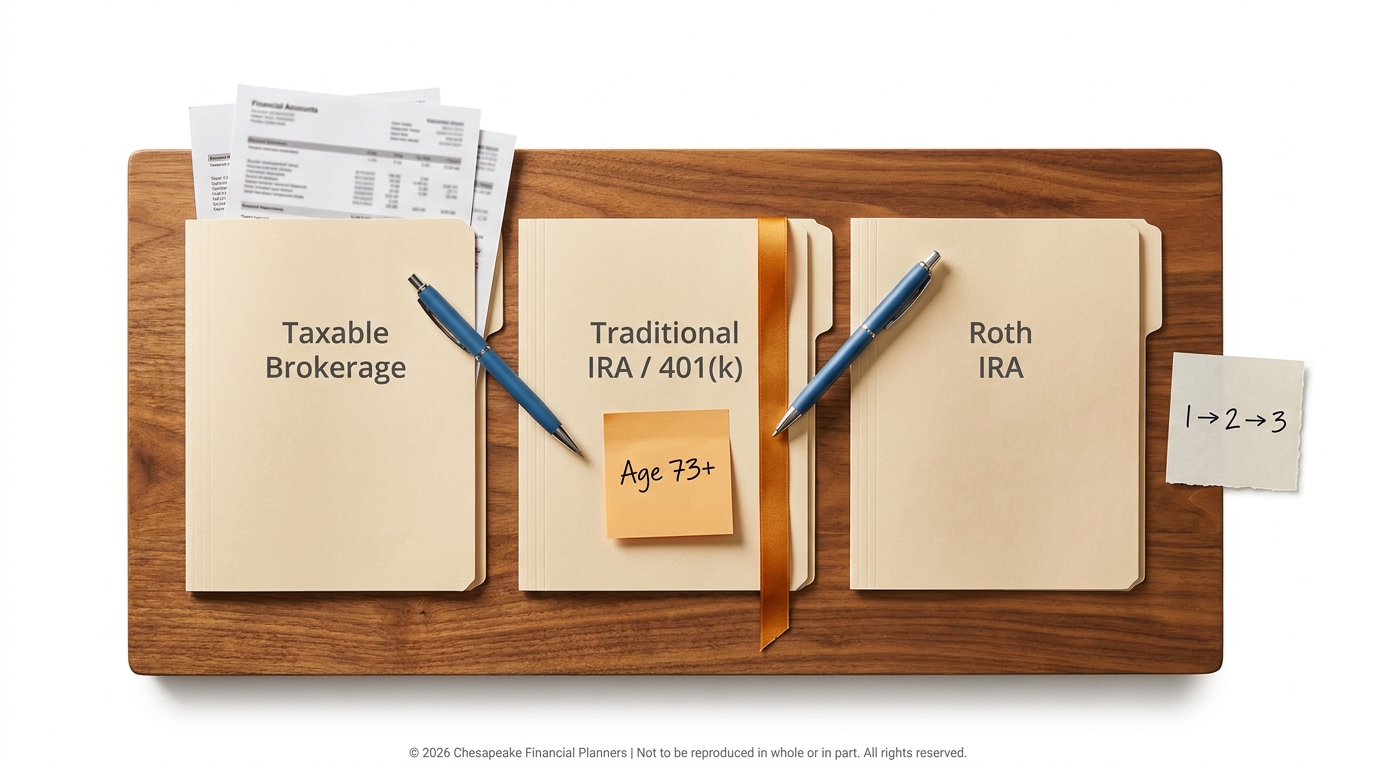
How can I reduce taxes on my retirement withdrawals?
Last reviewed: July 2026
You reduce retirement taxes by controlling which accounts you draw from and when, so you fill up low tax brackets instead of accidentally jumping into high ones. The biggest levers are coordinating traditional, Roth, and taxable withdrawals, doing Roth conversions in low-income years, and keeping your income below the thresholds that tax your Social Security and raise your Medicare premiums. Done well, a withdrawal strategy can save a retired couple tens of thousands of dollars over a 30-year retirement.
Key Takeaways
- The order you tap accounts often matters more than your investment returns when it comes to lifetime taxes.
- Required minimum distributions begin at age 73 for most retirees under current law.
- Up to 85% of Social Security benefits become taxable once your combined income crosses set thresholds.
- Qualified Charitable Distributions of up to $111,000 in 2026 satisfy your RMD without raising taxable income.
- Roth conversions in low-income years move money out of accounts that would otherwise force taxable withdrawals later.
About the Author: Jeff Judge, CFP®, AEP®, ChFC®, CLU® is Managing Partner of Chesapeake Financial Planners in Forest Hill, Maryland. He has been helping families and business owners in Harford County and the Baltimore metro area navigate retirement tax planning since earning his CFP® certification in 2013, by using Chesapeake Financial Planners’ signature process, the R.U.D.D.E.R. method™. Jeff often tells clients that the year they retire is the single best planning window they will ever get, and most people waste it.
Why do retirement taxes surprise so many people?
Retirement taxes catch people off guard because the rules flip the moment your paycheck stops. During your working years, your employer withholds taxes and you file once a year. In retirement, you decide how much income to create, and that control comes with traps most people never see coming.
Here is what trips retirees up. Different accounts carry different tax treatment. A large withdrawal can shove you into a higher bracket. Social Security benefits become partly taxable once your income crosses certain lines. Medicare premiums climb through IRMAA surcharges if your income runs high. And required minimum distributions force money out of traditional accounts whether you need it or not.
Jeff has watched this play out for years. A client retires at 64, coasts for a few years feeling great about low taxes, then gets blindsided at 73 when RMDs and Social Security stack on top of each other and push them into a bracket they never planned for. The mistake was not the RMD. It was failing to use the quiet years in between. Reducing retirement taxes starts with seeing the whole picture before those quiet years disappear.
How does the order I withdraw accounts affect my taxes?
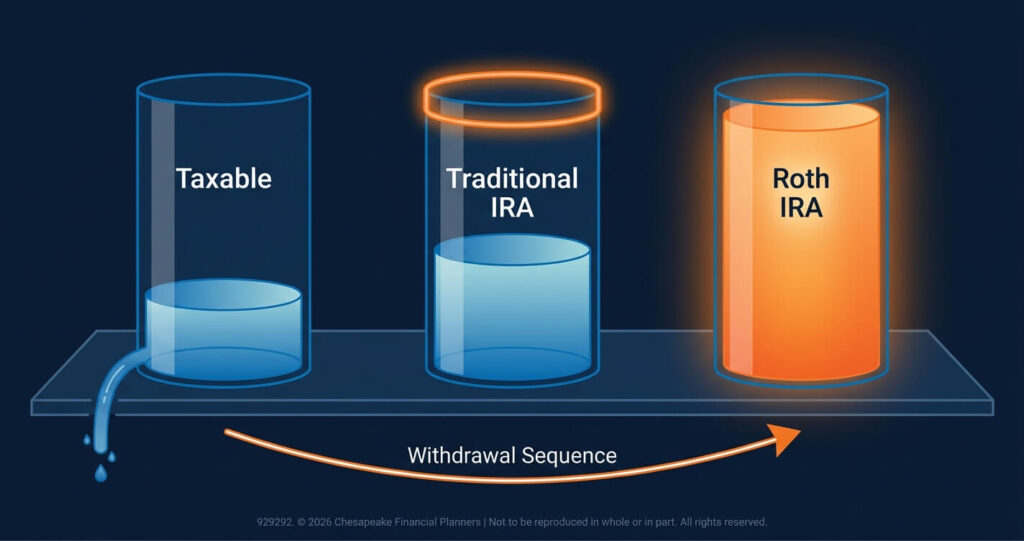
The order you withdraw from accounts directly controls your taxable income each year, and that ordering is the foundation of tax-efficient retirement withdrawals. Not all accounts are taxed the same way, so the sequence matters as much as the amount.
| Account type | How withdrawals are taxed |
|---|---|
| Traditional IRA / 401(k) | Ordinary income rates |
| Roth IRA | Tax-free if over 59½ and past the 5-year rule |
| Taxable brokerage | Long-term capital gains rates, usually lower |
| Pension | Ordinary income rates |
| Social Security | Up to 85% taxable based on combined income |
The conventional sequence pulls from taxable accounts first, then traditional, then Roth last. But that default is not always right. The smarter move is blending withdrawals across account types each year to manage your bracket. According to the Internal Revenue Service, traditional account withdrawals count as ordinary income, which means every dollar you pull can affect your bracket, your Social Security taxation, and your Medicare premiums at once. This is exactly the kind of coordination problem the R.U.D.D.E.R. Method™ is built to solve.
The R.U.D.D.E.R. Method™ is Chesapeake Financial Planners' six-step planning process: Review and Recognize, Uncover and Understand, Design and Develop, Discuss and Decide, Execute and Empower, and Reassess and Refine.
How do I create reliable income from my retirement savings?
What is tax bracket management in retirement?
Tax bracket management means withdrawing just enough income to fill up a lower bracket without spilling into the next one. Instead of taking a fixed dollar amount every year, you look at your marginal rate and decide how much room you have left.
For example, the 12% federal bracket for a married couple filing jointly extends to roughly $100,800 of taxable income in 2026. If your taxable income after deductions sits at $70,000, you have about $30,800 of room before the 22% bracket kicks in. You can withdraw or convert into that gap at 12% instead of paying 22% on those same dollars later. The IRS updates these bracket thresholds annually for inflation, so the room shifts each year.
Jeff describes this to clients as harvesting your low-bracket years. They do not last forever. Once RMDs and Social Security both turn on, your taxable income tends to rise on its own, and the empty bracket space you ignored is gone.
How Can Maryland Retirees Reduce Their State Tax Burden?
When do Roth conversions make sense?
Roth conversions make the most sense in your low-income years, typically between retirement and the start of RMDs. A conversion moves money from a traditional IRA into a Roth IRA. You pay ordinary income tax on the converted amount now, but future growth and withdrawals come out tax-free.
Here is why the timing matters. Once required minimum distributions start at age 73, your traditional accounts begin forcing taxable income out whether you want it or not. Roth IRAs carry no lifetime RMDs, so converting earlier shrinks the future forced withdrawals. Roth withdrawals also do not count toward the income thresholds that tax your Social Security or trigger Medicare surcharges. According to Fidelity, the value of a conversion depends largely on whether your tax rate today is lower than the rate you expect later, which is why the gap years are so valuable.
We model conversions for clients year by year to find the right amount to convert, balancing the tax bill today against the savings down the road.
Should I Take Social Security at 62 or Wait Until 70?
How can I reduce taxes on my Social Security benefits?
You reduce taxes on Social Security by keeping your combined income below the thresholds that trigger taxation. Many retirees do not realize their benefits can be taxed at all. The Social Security Administration calculates combined income as your adjusted gross income, plus nontaxable interest, plus half of your benefits.
Once combined income passes $25,000 for a single filer or $32,000 for a married couple filing jointly, part of your benefits becomes taxable. Above the upper thresholds, up to 85% of benefits can be taxed. Three strategies help keep you under those lines. Draw from Roth accounts, which do not add to combined income. Do Roth conversions before you claim, in years when your income is low. And use Qualified Charitable Distributions to satisfy RMDs without inflating your taxable income.
How does my Social Security claiming decision affect my Medicare premiums?
What is a Qualified Charitable Distribution?
A Qualified Charitable Distribution lets you donate directly from your IRA to a qualified charity and have it count toward your RMD without adding to your taxable income. If you are 70½ or older, you can give up to $111,000 in 2026, a figure the IRS now indexes for inflation.
QCDs are one of the cleanest tax tools available to charitably inclined retirees. The distribution satisfies your RMD but never shows up as taxable income, which keeps your combined income lower for Social Security and IRMAA purposes. You do not even need to itemize deductions to benefit, which matters because most retirees take the standard deduction now. Jeff points out that for clients already giving to their church or a favorite cause, routing those gifts through a QCD instead of a checkbook is often free money left on the table if they skip it.
How Do I Create Multiple Income Streams for Retirement?
Frequently Asked Questions
At what age do required minimum distributions start?
Required minimum distributions currently start at age 73 for most retirees under the SECURE 2.0 law. The first RMD can be delayed until April 1 of the year after you turn 73, but doing so stacks two distributions into one tax year. Most people take the first RMD on time to avoid that bunching.
How much of my Social Security is taxable?
Up to 85% of your Social Security benefits can be taxable, depending on your combined income. Combined income equals your adjusted gross income, plus any nontaxable interest, plus half your benefits. Below $25,000 single or $32,000 married, benefits are generally tax-free. Above the upper thresholds, the 85% maximum applies.
Are Roth IRA withdrawals taxed in retirement?
Qualified Roth IRA withdrawals are completely tax-free in retirement. To qualify, you must be over 59½ and have held the Roth account for at least five years. Because these withdrawals do not count toward combined income, they also help keep your Social Security taxation and Medicare premiums lower than traditional withdrawals would.
Can I avoid taxes on my RMDs entirely?
You cannot avoid RMDs, but you can avoid the tax on a portion of them using a Qualified Charitable Distribution. A QCD sends money directly from your IRA to a qualified charity, counts toward your RMD, and never appears as taxable income. For charitably inclined retirees, this is the most effective way to lower the tax cost of required distributions.
Should I do Roth conversions every year?
Many retirees benefit from converting a measured amount each year rather than all at once. Converting steadily lets you fill up a lower tax bracket annually without spiking your income into a higher one. The right amount depends on your current bracket, your expected future rates, and how a conversion affects your Social Security and Medicare costs.
Does where I live affect my retirement taxes?
Yes, state tax treatment varies widely and can meaningfully change your after-tax income. Some states tax retirement withdrawals and Social Security, while others exempt them entirely. If you are weighing a move, factor state income tax, property tax, and any tax on retirement income into the decision before relocating.
If you are mapping out how to reduce retirement taxes across the next decade, a coordinated withdrawal plan is worth far more than any single tactic. At Chesapeake Financial Planners, we build these plans with clients every week, modeling Roth conversions, bracket management, and Social Security timing together rather than in isolation. If you are weighing these decisions, a second opinion costs you nothing. Visit chesapeakefp.com to learn more.
Want to go deeper? Our Tax Strategies in Retirement Checklist walks through this step by step.
Disclosures
The information provided is for educational purposes only and should not be construed as investment advice. Investment strategies should be tailored to individual circumstances, risk tolerance, and goals. Past performance doesn't guarantee future results. Consult with qualified financial professionals regarding your specific situation.
CFP Board owns the marks CFP®, CERTIFIED FINANCIAL PLANNER®, and CFP® (with plaque design) in the U.S.
Certified Financial Planner Board of Standards Center for Financial Planning, Inc. owns and licenses the certification marks CFP®, CERTIFIED FINANCIAL PLANNER®, and CFP® (with plaque design) in the United States to Certified Financial Planner Board of Standards, Inc., which authorizes individuals who successfully complete the organization’s initial and ongoing certification requirements to use the certification marks.
A Roth IRA offers tax deferral on any earnings in the account. Qualified withdrawals of earnings from the account are tax-free. Withdrawals of earnings prior to age 59 ½ or prior to the account being opened for 5 years, whichever is later, may result in a 10% IRS penalty tax. Limitations and restrictions may apply.
Advisors associated with Chesapeake Financial Planners may be either (1) LPL Financial Registered Representatives offering securities through LPL Financial, Member FINRA and SIPC, and investment advisor representatives offering investment advice through Great Valley Advisor Group; or (2) solely investment advisor representatives offering investment advice through Great Valley Advisor Group and not affiliated with LPL Financial. Great Valley Advisor Group, and Chesapeake Financial Planners are separate entities from LPL Financial.


