

How should married couples coordinate their Social Security benefits?
Last reviewed: July 2026
Married couples should coordinate their Social Security claims around two goals: maximizing combined lifetime income and protecting the surviving spouse, which usually means having the higher earner delay toward age 70 while the lower earner often claims earlier. Because the survivor keeps only the larger of the two benefits, maximizing the higher earner's benefit is the single most important move, it becomes the income that supports whoever lives longer. The right strategy can add tens or even hundreds of thousands of dollars to a couple's lifetime benefits.
Key Takeaways
- When one spouse dies, the survivor keeps the higher of the two benefits, so maximizing the higher earner's benefit protects the survivor for life.
- A spouse can receive a spousal benefit of up to 50% of the higher earner's full retirement age benefit.
- The most common strategy has the higher earner delay to 70 while the lower earner claims earlier for income.
- Claim-and-suspend and the restricted application are no longer available; coordinate based on earnings, age gap, health, and other income.
About the Author: Jeff Judge, CFP®, AEP®, ChFC®, CLU® is Managing Partner of Chesapeake Financial Planners in Forest Hill, Maryland. He has helped married couples across Harford County and the Baltimore area coordinate their Social Security since earning his CFP® certification in 2013, by using Chesapeake Financial Planners’ signature process, the R.U.D.D.E.R. method™. Jeff's view: couples tend to think of Social Security as two separate decisions, but it is really one joint decision, and the part people underweight most is the survivor benefit, which quietly determines how secure the longer-living spouse will be.
Why is Social Security different for married couples?
Social Security is different for married couples because two extra layers, spousal benefits and survivor benefits, turn an individual decision into a coordinated one. A single person balances income now against larger payments later; a couple must also weigh how their choices protect each other.
The first layer is spousal benefits: your spouse may be entitled to a benefit based on your work record, even if they never worked or earned far less than you, and they can collect that if it exceeds their own benefit. The second is survivor benefits: when one spouse dies, the survivor receives the higher of the two benefits, not both, which makes maximizing at least one benefit critical. The third is coordinated claiming: you can stagger your filings, one spouse claiming earlier for income while the other delays to grow a larger benefit.
These layers are why a couple's decision is both more complex and more impactful than a single person's. The choices interact, and the most consequential one, how the higher earner claims, echoes for the rest of the surviving spouse's life. Getting the coordination right is where the real money is.
How do spousal and survivor benefits work?
Spousal benefits let a spouse claim up to 50% of the higher earner's full retirement age benefit, while survivor benefits give the surviving spouse the higher of the couple's two benefits. Understanding both is the foundation of any couple's strategy.
On spousal benefits, your spouse can receive up to 50% of your full retirement age benefit if that is more than their own, and this does not reduce your benefit, it is an additional payment. Your spouse generally must wait until you have filed, and if they claim before their own full retirement age, the spousal benefit is reduced. For example, if your full retirement age benefit is $3,000 a month and your spouse's own benefit is $800, your spouse could claim a spousal benefit of about $1,500 (half of yours) instead of their smaller own benefit.
On survivor benefits, the Social Security Administration explains that "Survivor benefits provide monthly payments to eligible family members of people who worked and paid Social Security taxes before they died." When one spouse dies the survivor keeps the larger benefit and loses the smaller one. If the deceased spouse had delayed past full retirement age, the survivor inherits that increased amount; if the deceased had claimed early, the survivor is left with a permanently reduced benefit. So if the higher earner received $3,500 a month and the lower earner $1,800, the survivor would continue receiving $3,500 and the $1,800 would stop. This is precisely why maximizing the higher earner's benefit, typically by delaying to 70, matters so much: it creates the largest possible lifelong survivor benefit.
What are the main claiming strategies for couples?
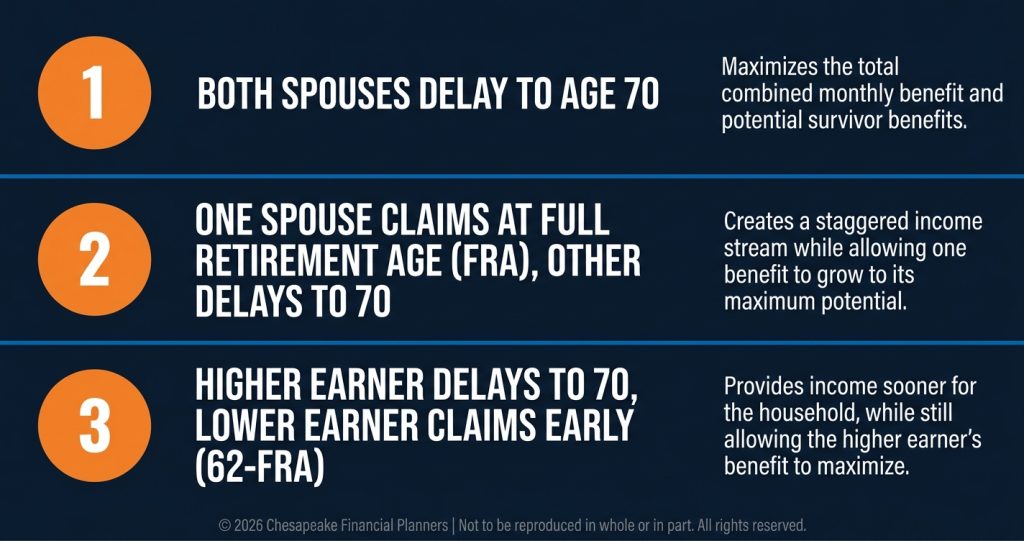
The main strategies are to have the higher earner delay while the lower earner claims earlier, to have both delay to 70, or to have both claim at full retirement age, with the best choice depending on your finances and health. Each fits a different situation.
The most common and often most effective approach is for the higher earner to delay to 70 while the lower earner claims earlier (at 62, full retirement age, or in between). This generates some income now from the lower earner's benefit while maximizing the survivor benefit through the higher earner's delay, and it suits couples where one spouse out-earned the other and who can afford to wait on the larger benefit. Having both spouses delay to 70 maximizes every benefit and produces the highest survivor benefit, ideal for couples with substantial savings or other income, good health, and family longevity. Having both claim at full retirement age provides full benefits without the long wait to 70, a reasonable middle ground for couples who need income at retirement and have average life expectancy and do not want to draw down savings until 70.
Two older tactics are worth noting because they no longer exist. Claim-and-suspend, where one spouse filed and immediately suspended so the other could claim spousal benefits while both grew, was eliminated by Congress in 2016. The restricted application, which let someone born before January 2, 1954 claim only spousal benefits while their own grew to 70, has expired for new claimants. Choosing among the available strategies is exactly the multi-scenario work the R.U.D.D.E.R. Method™ is built for. The R.U.D.D.E.R. Method™ is Chesapeake Financial Planners' six-step planning process: Review and Recognize, Uncover and Understand, Design and Develop, Discuss and Decide, Execute and Empower, and Reassess and Refine, and a couple's claiming plan lives in Design and Develop, modeled across both spouses' ages, earnings, and health.

What factors decide your strategy, and what mistakes should you avoid?
Your strategy is decided by who earned more, your age difference, your health and longevity, your other income, and your cash-flow needs, and the biggest mistakes come from ignoring the survivor benefit. Weighing these factors well is what separates a good plan from a costly default.
The key factors are: earnings history, where the higher earner should generally delay longer to maximize the survivor benefit while the lower earner can claim earlier; age difference, where a significantly older spouse might claim earlier while the younger delays, with extra attention if the older spouse is the higher earner; health and longevity, where good health argues for delaying and poor health may argue for claiming sooner; other income, since pensions, rental income, or savings that can bridge the gap give you the freedom to delay; and realistic financial needs, because you should not drain retirement accounts prematurely just to delay. If you are divorced, note that a marriage of at least 10 years can entitle you to a benefit on an ex-spouse's record, up to 50% of their benefit while living and up to 100% as a survivor, without affecting them, and remarrying after age 60 does not disqualify you from survivor benefits.
The common mistakes are avoidable and expensive: both spouses claiming at 62, which permanently shrinks both benefits and leaves the survivor with far less; the higher earner claiming early, which cuts the survivor benefit for decades; failing to coordinate the two filings at all; claiming before full retirement age while still working and triggering the earnings test; and overlooking spousal benefits that a lower-earning spouse may not realize they qualify for. Avoiding these, and centering the plan on the survivor benefit, is the heart of getting it right.
Related Topics Worth Reading
A couple's claiming decision connects to income, survivor, and Medicare planning. These related topics go deeper.
- The claiming decision when you are single. When Should Single People Claim Social Security Benefits?
- Coordinating Social Security with RMDs and a pension. How do I coordinate all my retirement income sources to minimize taxes and maximize income?
- A widow's guide to survivor benefits. How do Social Security survivor benefits work for a widow?
- Using savings to delay the higher earner's benefit to 70. How do I bridge my income to delay Social Security to 70?
- How income decisions affect Medicare premiums. How does my Social Security claiming decision affect my Medicare premiums?
Frequently Asked Questions
How should married couples claim Social Security?
Married couples should coordinate their claims to maximize combined lifetime income and protect the surviving spouse. The most common effective strategy has the higher earner delay toward age 70, maximizing the benefit that becomes the survivor benefit, while the lower earner often claims earlier for income. The right approach depends on each spouse's earnings, ages, health, and other income, but centering the plan on the survivor benefit is almost always key.
What is a spousal Social Security benefit?
A spousal benefit lets a spouse receive up to 50% of the higher earner's full retirement age benefit if that is more than their own benefit. It does not reduce the worker's benefit; it is an additional payment. The spouse generally must wait until the worker has filed, and claiming before the spouse's own full retirement age reduces the spousal benefit. This often helps a lower-earning spouse receive more than their own record would provide.
How do Social Security survivor benefits work for married couples?
When one spouse dies, the surviving spouse keeps the higher of the couple's two Social Security benefits and loses the smaller one, they do not receive both. If the deceased spouse delayed claiming and built a larger benefit, the survivor inherits that higher amount; if the deceased claimed early, the survivor is left with a permanently reduced benefit. This is why maximizing the higher earner's benefit, usually by delaying to 70, is so important for protecting the survivor.
Should the higher earner or lower earner delay Social Security?
Generally the higher earner should delay, ideally to age 70, because that benefit becomes the survivor benefit and will support whichever spouse lives longer. The lower earner can often claim earlier to provide income while the higher earner waits. Delaying the higher earner's benefit maximizes both the couple's combined lifetime income and the protection for the surviving spouse, which is usually the most valuable outcome.
Can I claim Social Security on an ex-spouse's record?
Yes, if your marriage lasted at least 10 years and you are currently unmarried, you may claim a benefit on your ex-spouse's record, up to 50% of their benefit while they are living and up to 100% as a survivor benefit if they die. This does not affect your ex-spouse or their current spouse. You must be at least 62, and if you have been divorced at least two years, your ex does not need to have filed. Remarrying after age 60 does not disqualify you from survivor benefits.
Protecting both spouses for life
For married couples, the Social Security decision is one of the highest-stakes choices in retirement, because it determines not just your income together but the security of whoever is left. Coordinating your claims, usually by maximizing the higher earner's benefit while the lower earner provides earlier income, can add enormous value and protect the surviving spouse for decades. The right strategy depends on your earnings, ages, health, and resources, so it is worth modeling carefully. Jeff Judge and the Chesapeake Financial Planners team help couples across Harford County and the Baltimore metro coordinate Social Security with the rest of their retirement plan. Schedule a complimentary consultation at chesapeakefp.com.
Want to go deeper? Our 10 Signs You're Ready for a Certified Financial Planner walks through this step by step.
Disclosures
The information provided is for educational purposes only and should not be construed as investment advice. Investment strategies should be tailored to individual circumstances, risk tolerance, and goals. Past performance doesn't guarantee future results. Consult with qualified financial professionals regarding your specific situation.
Advisors associated with Chesapeake Financial Planners may be either (1) LPL Financial Registered Representatives offering securities through LPL Financial, Member FINRA and SIPC, and investment advisor representatives offering investment advice through Great Valley Advisor Group; or (2) solely investment advisor representatives offering investment advice through Great Valley Advisor Group and not affiliated with LPL Financial. Great Valley Advisor Group, and Chesapeake Financial Planners are separate entities from LPL Financial.


