

What Financial Steps Should I Take After Losing My Spouse?
Last reviewed: July 2026
The first financial steps after losing a spouse are simple: secure 10 to 15 certified death certificates, notify Social Security, and move any insurance proceeds into a safe holding account. You do not need to make big, permanent decisions right now. The goal in the early weeks is stability, not optimization. The complex choices around inherited retirement accounts, taxes, and your home can wait until your head is clearer.
Key Takeaways
- Request 10 to 15 certified death certificates early; you will need them for nearly every account transfer.
- Surviving spouses can file as Qualifying Surviving Spouse for two years after the death year if they have a dependent child, per the IRS.
- Wait at least six months before selling your home or making irreversible financial moves.
- As a spouse, you can roll an inherited IRA into your own, an option no other heir gets, per the IRS.
- Inherited assets generally get a step-up in cost basis to the date-of-death value, often erasing capital gains tax.
About the Author: Jeff Judge, CFP®, AEP®, ChFC®, CLU® is Managing Partner of Chesapeake Financial Planners in Forest Hill, Maryland. Jeff has noticed that the widows who do best are the ones who give themselves permission to slow down before deciding anything permanent. He has been helping families and business owners in Harford County and the Baltimore metro area navigate complex financial transitions and protect their financial futures since earning his CFP® certification in 2013, by using Chesapeake Financial Planners’ signature process, the R.U.D.D.E.R. method™.
Grief and money do not mix well. You are being asked to make sharp financial decisions during one of the foggiest stretches of your life, and that is not a fair ask. The good news is that very few of these decisions are actually urgent. Below is the order that works, drawn from real client situations, not a generic checklist.
What Should I Do in the First 30 Days After My Spouse Dies?
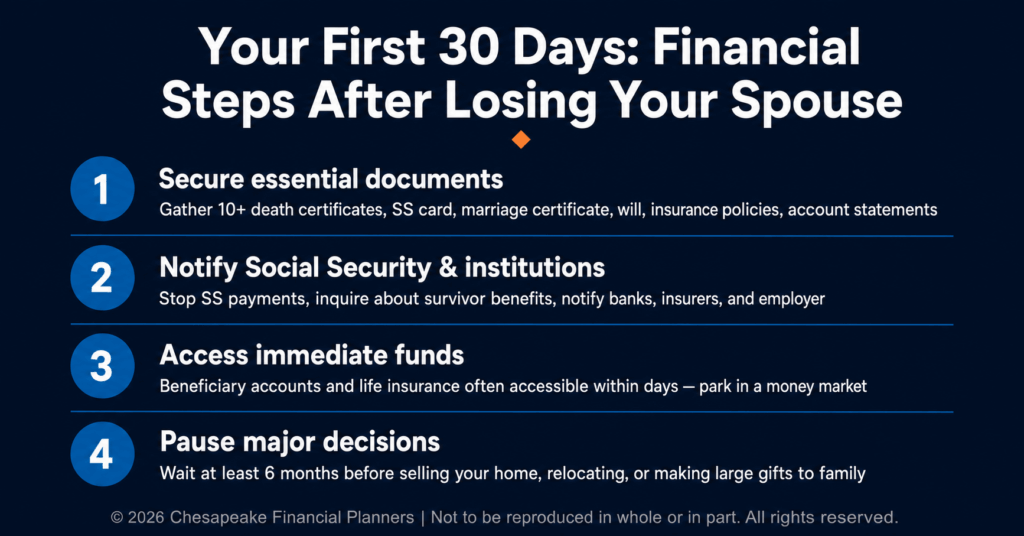
In the first month, your job is to stabilize, not to optimize. Order 10 to 15 certified copies of the death certificate from the funeral home or your state vital records office, because banks, insurers, and the Social Security Administration will each demand an original. Notify Social Security to stop your spouse's benefit and ask about survivor benefits. Tell the banks, the life insurance company, and your spouse's former employer.
If you are the named beneficiary on a bank account or life insurance policy, you can usually access those funds within days to a few weeks. Do not rush to invest insurance proceeds. Park the money in a high-yield savings or money market account while you think. There is no penalty for being patient, and a wrong move here is hard to undo.
One rule I give every widowed client: pause any irreversible decision for at least six months. Selling the house, relocating, gifting money to adult children. Those choices feel urgent in the fog of early grief. They almost never are. The version of you six months out will see them differently.
How Do I Build a Clear Picture of My Finances?
Once the immediate steps are handled, usually around month two, you can start building a full view of what you own and what you owe. Make a complete asset inventory: retirement accounts, brokerage accounts, bank accounts, real estate, business interests, and personal property. List the institution, account number, and rough value for each. This single document becomes the map everything else runs on.
Check the beneficiary designations on every retirement account and life insurance policy. These assets pass directly to the named beneficiary and skip the will entirely, which surprises a lot of people. Then calculate your new income reality. That might include Social Security survivor benefits, a pension survivor benefit, distributions from inherited retirement accounts, and investment income. Two incomes becoming one changes the math, and you need to see the real number before you adjust your spending.
This is also the moment to update your own estate plan. Your will, trust, powers of attorney, and healthcare directives almost certainly named your spouse in the key roles. Those need new names. For a structured way to work through this sequence, our What financial steps should a surviving spouse take in the first year after loss? walks through it month by month.
What Are the Tax Issues a Widow Needs to Know?
Taxes are where losing a spouse quietly costs people the most, and where a few right moves save real money. Three issues stand out.
Your filing status changes. You can file married filing jointly for the year your spouse died. After that, if you have a dependent child living with you, you may qualify as a Qualifying Surviving Spouse for the next two years, keeping the joint tax brackets and standard deduction, according to the IRS. Without a dependent child, you move to single status the following year, which usually means higher rates and a smaller standard deduction on the same income. Jeff Judge notes: "The shift from married filing jointly to single is one of the biggest tax cliff events I see widows face — the brackets compress, the standard deduction drops, and the same pension and Social Security income that looked manageable the year before can suddenly land in a much higher bracket."
Inherited retirement accounts give spouses special options. As a surviving spouse you can treat an inherited IRA as your own, roll it into your existing IRA, or stay a beneficiary. The IRS gives spouses flexibility no other heir gets, including the ability to delay required distributions in some cases. The right choice depends on your age and your income needs.
The step-up in basis is your friend. Assets you inherit generally reset their cost basis to the value on your spouse's date of death. According to the IRS, this step-up can wipe out the capital gains tax on appreciated investments or real estate if you sell soon after. Knowing which assets got the step-up, and selling the right ones, can save thousands.
| Decision | What to know | When it matters |
|---|---|---|
| Filing status | Qualifying Surviving Spouse keeps joint brackets up to two years with a dependent child | The tax year after death |
| Inherited IRA | Spouses can roll into their own IRA; others cannot | Within the first year |
| Step-up in basis | Inherited assets reset to date-of-death value | Before selling appreciated assets |
If the estate goes through probate or includes a business, full settlement can take 12 to 18 months. An estate attorney keeps the transfers clean and tells you when each asset becomes available.
How Do I Rebuild a Financial Plan for One Life Instead of Two?
Eventually you shift from managing the transition to building a plan that fits your new life. Reassess your risk tolerance, because one income instead of two often calls for a steadier approach, though a large insurance payout can give you more room than you had before. Get your estate attorney, tax preparer, and financial advisor talking to each other so you get one coordinated strategy instead of three conflicting ones.
This is the kind of work the R.U.D.D.E.R. Method™ is built for. The R.U.D.D.E.R. Method™ is Chesapeake Financial Planners' six-step planning process: Review and Recognize, Uncover and Understand, Design and Develop, Discuss and Decide, Execute and Empower, and Reassess and Refine. Jeff Judge often tells widowed clients that the goal is not to make every decision at once, but to make them in the right order. Take the house. It carries emotional weight and real costs, from the mortgage to property taxes to upkeep. Give yourself time, then honestly weigh whether it still fits. The same goes for insurance: if you lost a spouse's health coverage and you are under 65, you may need COBRA, a marketplace plan, or coverage through your own employer. Our guide on How do I take control of my finances after divorce or loss? covers more of this rebuilding work, and if you want a partner through it, see Can a financial planner help me navigate a major life transition?.
Frequently Asked Questions
How many death certificates should I order after my spouse dies?
Order 10 to 15 certified copies of the death certificate. Nearly every institution involved in transferring accounts, including banks, life insurance companies, brokerages, and the Social Security Administration, requires an original certified copy rather than a photocopy. Ordering extras up front saves weeks of delay later when you need more.
Can I get Social Security survivor benefits after my spouse passes away?
Yes, surviving spouses can usually claim Social Security survivor benefits, and the amount depends on your age and your spouse's earnings record. According to the Social Security Administration, you may be able to receive the higher of your own benefit or your late spouse's. Contact Social Security promptly, because survivor benefits are not paid automatically.
How long should I wait before selling my home after losing my spouse?
Wait at least six months, and often longer, before selling your home or making other irreversible moves. Decisions that feel urgent during early grief frequently look different once the fog lifts. The family home carries both emotional weight and ongoing costs, so give yourself time to evaluate whether keeping it truly fits your new financial picture.
What happens to my taxes the year after my spouse dies?
The year your spouse dies, you can still file married filing jointly. The following years, you may qualify as a Qualifying Surviving Spouse for up to two years if you have a dependent child, keeping the joint brackets. Otherwise your status becomes single, which typically raises your tax rate and lowers your standard deduction.
What are my options for an inherited IRA as a surviving spouse?
As a surviving spouse you have three choices: treat the inherited IRA as your own, roll it into your existing IRA, or remain a beneficiary. Spouses get flexibility no other heir receives, including delaying required distributions in some cases. The best option depends on your age, your income needs, and your tax bracket.
Should I make big financial decisions while I am still grieving?
No, avoid major irreversible financial decisions while you are still in active grief. Stabilize first by securing documents, accessing immediate funds, and parking insurance proceeds in safe accounts. Save the permanent choices, like selling property or restructuring investments, for after the first six months when your judgment has steadied.
If this overview was helpful, our free Widowhood Financial Checklist breaks the entire first year into a month-by-month sequence you can follow at your own pace. Download it at chesapeakefp.com and keep it somewhere you can reach it on the hard days.
Want to go deeper? Our What To Do When You Lose a Loved One walks through this step by step.
Disclosures
The information provided is for educational purposes only and should not be construed as investment advice. Investment strategies should be tailored to individual circumstances, risk tolerance, and goals. Past performance doesn't guarantee future results. Consult with qualified financial professionals regarding your specific situation.
Contributions to a traditional IRA may be tax deductible in the contribution year, with current income tax due at withdrawal. Withdrawals prior to age 59 ½ may result in a 10% IRS penalty tax in addition to current income tax.
Advisors associated with Chesapeake Financial Planners may be either (1) LPL Financial Registered Representatives offering securities through LPL Financial, Member FINRA and SIPC, and investment advisor representatives offering investment advice through Great Valley Advisor Group; or (2) solely investment advisor representatives offering investment advice through Great Valley Advisor Group and not affiliated with LPL Financial. Great Valley Advisor Group, and Chesapeake Financial Planners are separate entities from LPL Financial.


