

How Can Maryland Retirees Reduce Their State Tax Burden?
Last reviewed: July 2026
Maryland retirees can reduce their state tax burden by using the pension exclusion, keeping Social Security benefits state-tax-free, timing Roth conversions during low-income years, and planning around Maryland's estate and inheritance taxes. Maryland tax planning for retirees comes down to coordinating these levers before, not after, you start drawing income. The state isn't the most tax-friendly in the country, but the tools to lower your bill are real and most retirees leave money on the table by not using them.
Key Takeaways
- Maryland does not tax Social Security benefits at the state level, even when those benefits are taxable on your federal return.
- The 2026 Maryland pension exclusion reaches up to $40,600 per person for taxpayers age 65 and older.
- Maryland's estate tax exemption sits at $5 million per person, far below the federal exemption.
- Combined state and local income tax in Maryland can approach 9%, making withdrawal timing a major lever for retirees.
About the Author: Jeff Judge, CFP®, AEP®, ChFC®, CLU® is Managing Partner of Chesapeake Financial Planners in Forest Hill, Maryland. He has been helping families and business owners in Harford County and the Baltimore metro area navigate state tax planning since earning his CFP® certification in 2013, by using Chesapeake Financial Planners’ signature process, the R.U.D.D.E.R. method™. Jeff sees the same pattern every year: retirees who could have captured the full pension exclusion lose most of it because nobody told them to delay Social Security a few years first.
What Does Maryland's Tax Structure Mean for Retirees in Harford County?
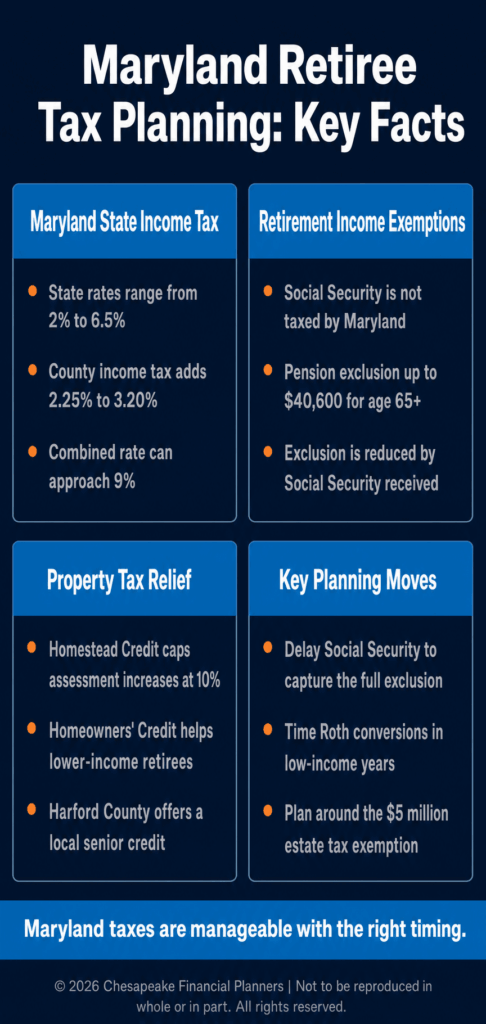
Maryland uses a progressive state income tax with rates running from 2% up to 6.5% — HB 352 (2025) added two new high-income brackets, 6.25% and 6.5%, above the former 5.75% top rate for the 2026 tax year — layered on top of local county income taxes ranging from roughly 2.25% to 3.20% depending on where you live. For a household in Harford County, that combined rate can land near 9%, which is among the highest in the nation according to the Tax Foundation.
Here's the part that catches retirees off guard. Maryland taxes most retirement income, including pension payments, 401(k) and IRA withdrawals, and investment income. But the state also offers specific exemptions that meaningfully shrink your taxable income if you actually use them. The difference between a retiree who plans and one who doesn't can run into thousands of dollars a year.
Jeff Judge often tells clients in Bel Air and Forest Hill that the lever isn't your portfolio return. It's the order and timing of which accounts you tap first. Get that wrong and you can hand Maryland money you never needed to give it.
Does Maryland Tax Social Security Benefits?
No, Maryland does not tax Social Security or Railroad Retirement benefits at the state level. Even when part of your Social Security is taxable on your federal return, Maryland lets you subtract those benefits back out on your state return, according to the Comptroller of Maryland.
That said, your benefits can still be taxable federally depending on your combined income, and higher income can push you into Medicare premium surcharges (IRMAA) down the road. This is where coordination matters. Timing Roth conversions, capital gains, and withdrawal amounts in your early retirement years can help you stay under the federal taxation thresholds and the IRMAA cliffs that quietly raise your costs.
For a deeper look at how claiming timing affects your premiums, see How does my Social Security claiming decision affect my Medicare premiums?.
How Does the Maryland Pension Exclusion Work?
Maryland offers a pension exclusion for taxpayers age 65 and older, totally disabled, or with a totally disabled spouse. For 2026, the maximum exclusion reaches up to $40,600 per person, and it directly reduces your taxable state income.
The exclusion applies to qualifying retirement income reported on your federal return:
- Pension and annuity income from employer retirement plans
- Traditional IRA and 401(k) distributions
- Military retirement pay
- Other qualifying retirement income
There's a catch most retirees miss. The exclusion is reduced dollar-for-dollar by your Social Security and Railroad Retirement benefits. For many retirees already collecting Social Security, that reduction wipes out most or all of the pension exclusion.
This is the planning opportunity Jeff points to most often for Harford County retirees. If you haven't started Social Security yet, you can capture the full pension exclusion while drawing from your retirement accounts and delaying your benefit. This works especially well for early retirees between 62 and 70 who can live on portfolio withdrawals first. It pairs directly with the question of Should I Take Social Security at 62 or Wait Until 70?.
What Property Tax Relief Is Available for Maryland Retirees?
Maryland property taxes vary widely by county, but the state runs several relief programs retirees should know about. The Maryland Homestead Tax Credit caps the annual increase in your taxable assessment for a primary residence at 10% statewide, with some counties setting lower caps. That cushion protects you from sudden tax spikes when home values climb fast.
The State Homeowners' Property Tax Credit helps homeowners with limited income, with eligibility tied to combined gross household income up to $60,000 along with a net worth test. In Harford County specifically, additional local credits exist, including a senior credit, with rules that can differ from the state program. Check the county's current requirements before assuming you qualify.
Should I relocate to another state for retirement tax savings? covers how these property programs compare to neighboring states if you're weighing a move.
How Do Maryland Estate and Inheritance Taxes Affect Your Heirs?
Maryland is one of the few states that imposes both an estate tax and an inheritance tax, though recent reforms eased some of the burden. The Maryland estate tax exemption sits at $5 million per person, with estates above that threshold facing a progressive rate up to 16%.
That $5 million exemption is generous in isolation, but it's far below the federal estate tax exemption of $15 million per person in 2026. A family can owe Maryland estate tax while owing nothing federally. If your estate approaches or crosses $5 million, strategic gifting, irrevocable trusts, and spousal portability planning can reduce your state exposure.
The inheritance tax is separate. Maryland imposes a 10% inheritance tax on property passing to beneficiaries who are not close family. Children, spouses, parents, grandparents, and siblings are exempt. If you plan to leave assets to nieces, nephews, friends, or non-family members, deliberate planning can reduce or eliminate that tax. Jeff has watched families discover this 10% bite only after a loved one passed, when it was too late to plan around it.
What Withdrawal Strategies Lower Taxes for Maryland Retirees?
Given Maryland's combined tax rates, your withdrawal sequence matters as much as your investment choices. A few approaches consistently help:
| Strategy | Why It Works in Maryland |
|---|---|
| Delay Social Security to capture the pension exclusion | Keeps the exclusion from being reduced dollar-for-dollar |
| Time Roth conversions in low-income years | Reduces future taxable RMDs and manages IRMAA |
| Sequence taxable, tax-deferred, then Roth accounts | Smooths taxable income across retirement years |
| Manage capital gains realization | Stays under federal Social Security taxation thresholds |
At Chesapeake Financial Planners, this kind of multi-year sequencing is exactly what the R.U.D.D.E.R. Method™ was built for. The R.U.D.D.E.R. Method™ is Chesapeake Financial Planners' six-step planning process: Review and Recognize, Uncover and Understand, Design and Develop, Discuss and Decide, Execute and Empower, and Reassess and Refine. Tax planning is rarely a one-year decision, and the early retirement window between 62 and 73 is where most of the savings live.
Building reliable income alongside this tax plan is the other half of the equation. See How Do I Create Multiple Income Streams for Retirement? for how the two fit together.
Frequently Asked Questions
Does Maryland tax Social Security benefits for retirees?
No, Maryland does not tax Social Security or Railroad Retirement benefits at the state level. Even if part of your Social Security is taxable on your federal return, Maryland allows you to subtract those benefits on your state return. Your benefits may still be taxable federally depending on your combined income, so withdrawal timing still matters.
What is the Maryland pension exclusion for 2026?
The 2026 Maryland pension exclusion allows taxpayers age 65 and older to exclude up to $40,600 per person of qualifying retirement income from state tax. The exclusion is reduced dollar-for-dollar by Social Security benefits received, which can shrink or eliminate it for retirees already collecting Social Security in Maryland.
How much is the Maryland estate tax exemption?
The Maryland estate tax exemption is $5 million per person in 2026. Estates valued above that threshold face a progressive tax rate up to 16%. This exemption is far lower than the federal estate tax exemption of $15 million per person, meaning a Maryland estate can owe state tax even when no federal estate tax is due.
Can Roth conversions lower taxes for Maryland retirees?
Yes, Roth conversions can lower lifetime taxes for Maryland retirees, especially when done in early retirement years before Social Security and required minimum distributions begin. Converting in lower-income years reduces future taxable RMDs and helps manage Medicare IRMAA surcharges. The strategy works best when coordinated across multiple years rather than done all at once.
Does Harford County offer property tax relief for seniors?
Yes, Harford County offers local property tax credits, including a senior credit, alongside Maryland's statewide programs like the Homestead Tax Credit and the State Homeowners' Property Tax Credit. Eligibility rules differ between the county and state programs, so retirees in Harford County should verify the specific requirements for each credit before applying.
Who is exempt from Maryland's inheritance tax?
Close family members are exempt from Maryland's 10% inheritance tax, including children, spouses, parents, grandparents, and siblings. The tax applies to property passing to non-exempt beneficiaries such as nieces, nephews, friends, and unrelated heirs. Planning with gifting strategies and trusts can reduce or eliminate this tax for those non-exempt beneficiaries.
Maryland gives retirees more tax levers than most people realize, but nearly all of them have to be pulled before you start drawing income, not after. If you live in Harford County or the Baltimore metro and want a plan that actually coordinates Social Security timing, the pension exclusion, and your estate exposure, Jeff Judge and the Chesapeake team can help. Schedule a free fit call at chesapeakefp.com.
Want to go deeper? Our Tax Strategies in Retirement Checklist walks through this step by step.
Disclosures
The information provided is for educational purposes only and should not be construed as investment advice. Investment strategies should be tailored to individual circumstances, risk tolerance, and goals. Past performance doesn't guarantee future results. Consult with qualified financial professionals regarding your specific situation.
A Roth IRA offers tax deferral on any earnings in the account. Qualified withdrawals of earnings from the account are tax-free. Withdrawals of earnings prior to age 59 ½ or prior to the account being opened for 5 years, whichever is later, may result in a 10% IRS penalty tax. Limitations and restrictions may apply.
This information is not intended to be a substitute for specific individualized tax, investment or legal advice. We suggest that you discuss your specific situation with a qualified tax, legal or financial advisor.
Advisors associated with Chesapeake Financial Planners may be either (1) LPL Financial Registered Representatives offering securities through LPL Financial, Member FINRA and SIPC, and investment advisor representatives offering investment advice through Great Valley Advisor Group; or (2) solely investment advisor representatives offering investment advice through Great Valley Advisor Group and not affiliated with LPL Financial. Great Valley Advisor Group, and Chesapeake Financial Planners are separate entities from LPL Financial.


