

Who Should I Name as My Trustee?
Last reviewed: July 2026
To choose a trustee, name someone who can manage money responsibly, stay neutral among your beneficiaries, and commit to the job for years. The best choice is often a person who is organized, financially literate, and emotionally steady, or a professional corporate trustee when the estate is large or the family dynamics are complicated. The wrong trustee can drain a trust through mistakes, delays, or conflict, so this decision deserves more thought than most people give it.
Key Takeaways
- A trustee manages and distributes trust assets according to your instructions, often for years after you are gone.
- Family trustees are free but may lack expertise; corporate trustees charge roughly 0.5% to 1.5% annually of assets managed.
- Naming co-trustees or a successor trustee builds in backup if your first choice cannot serve.
- A trustee owes a legal fiduciary duty to act in the beneficiaries' best interest, not their own.
- Choosing the wrong trustee is one of the most common and costly estate planning mistakes families make.
About the Author: Jeff Judge, CFP®, AEP®, ChFC®, CLU® is Managing Partner of Chesapeake Financial Planners in Forest Hill, Maryland. He has been helping families and business owners in Harford County and the Baltimore metro area navigate trust and estate decisions since earning his CFP® certification in 2013, by using Chesapeake Financial Planners’ signature process, the R.U.D.D.E.R. method™. Jeff has watched well-meaning families name the wrong trustee and spend years untangling the fallout, which is why he treats the trustee choice as seriously as the trust document itself.
A trustee is the person or institution you appoint to hold and manage assets inside a trust for the benefit of your beneficiaries. They follow the rules you wrote into the trust document, file tax returns, keep records, and make distributions. Picking the right one matters as much as the trust itself. A flawless trust with a careless trustee fails the people it was meant to protect.
Here is how to work through the decision step by step.
Step 1: Understand What a Trustee Actually Does
Before you name anyone, get clear on the job. Trustee duties are broader than most people expect, and a trustee who underestimates the workload tends to quit or cut corners.
A trustee manages investments, keeps detailed financial records, files the trust's annual tax return, communicates with beneficiaries, and distributes money according to your instructions. They must treat all beneficiaries fairly and avoid any conflict of interest. According to Fidelity, a trustee is held to a fiduciary standard, which is the highest duty of care recognized in law.
The job can last years or decades, especially with a trust designed to pay out over a child's lifetime. Ask yourself whether the person you have in mind wants this responsibility, not just whether they can handle it. Jeff Judge often reminds clients that being trustworthy and being a good trustee are two different things. Plenty of honest people make poor administrators.
What is a will and do I need one for my estate?

Step 2: Decide Between a Family Trustee and a Corporate Trustee
This is the core fork in the road, and it shapes everything else. The choice between a corporate trustee vs family member depends on the size of your estate, your family's dynamics, and how much complexity the trust carries.
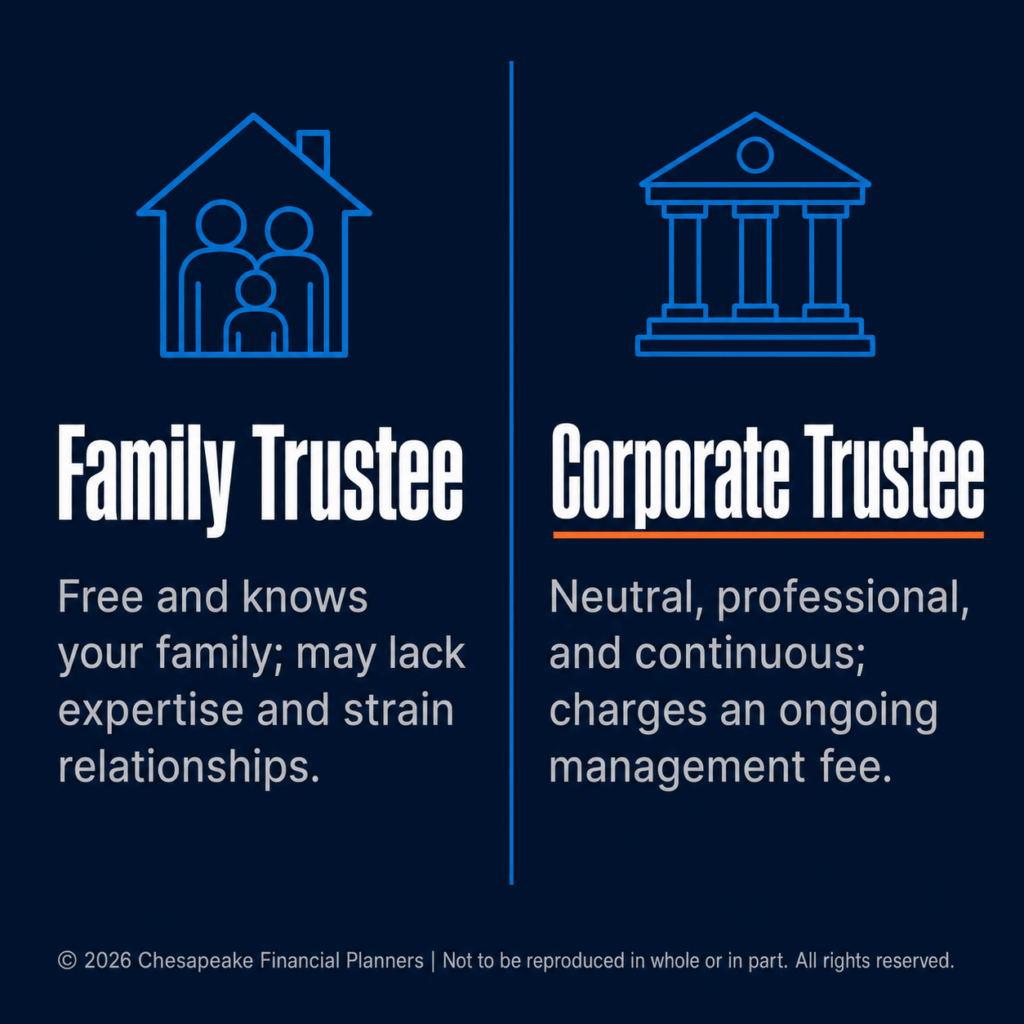
A family trustee, usually a spouse, adult child, or sibling, costs nothing and knows your family personally. The downside is real: they may lack financial expertise, they may favor one beneficiary over another, and they may struggle to say no to relatives who want early distributions. A corporate trustee, such as a bank or trust company, brings professional management, neutrality, and continuity, but charges a fee.
| Factor | Family Trustee | Corporate Trustee |
|---|---|---|
| Cost | Usually unpaid | Roughly 0.5% to 1.5% of assets per year |
| Expertise | Varies widely | Professional, consistent |
| Neutrality | Can be compromised by family ties | Independent third party |
| Continuity | Limited by lifespan and willingness | Institution outlives any individual |
| Personal knowledge | Knows the family intimately | Knows only what you document |
According to Charles Schwab, corporate trustee fees commonly run between 0.5% and 1.5% of the assets under management each year. For a $2 million trust, that is between $10,000 and $30,000 annually, which is meaningful but often worth it when the alternative is family conflict.
How do you create a family wealth governance structure for long-term success?
Step 3: Weigh Your Family Dynamics Honestly
The most expensive trustee mistakes come from ignoring family friction. If your beneficiaries get along, a family trustee can work beautifully. If they do not, you are handing one relative the power to control money for the others, and resentment follows.
Blended families raise the stakes. Naming a second spouse as trustee over assets meant for children from a first marriage is a recipe for litigation. The American Bar Association notes that trustee disputes are among the most common sources of estate litigation. A neutral corporate trustee or a professional co-trustee sidesteps that fight entirely.
Jeff has guided more than one blended family through this exact tension, and his advice is consistent: when children from different marriages share an inheritance, neutrality is worth paying for. The cost of a corporate trustee is almost always less than the cost of a courtroom.
How Do I Protect My Children's Inheritance in a Blended Family?

Step 4: Consider Co-Trustees and Successor Trustees
You are not limited to one name, and you should not be. Building in backup protects the trust if your first choice dies, becomes incapacitated, or simply declines the role.
A co-trustee arrangement pairs two trustees who must act together, often a family member who knows the beneficiaries and a corporate trustee who handles administration. This blends personal insight with professional discipline. A successor trustee is the backup who steps in when your primary trustee can no longer serve. Always name at least one successor. A trust with no available trustee can stall in court while a judge appoints one, which delays distributions and burns through assets in legal fees.
Many of the families Jeff works with use the R.U.D.D.E.R. Method™ to pressure-test these choices. The R.U.D.D.E.R. Method™ is Chesapeake Financial Planners' six-step planning process: Review and Recognize, Uncover and Understand, Design and Develop, Discuss and Decide, Execute and Empower, and Reassess and Refine. The Reassess and Refine step matters here because the right trustee today may not be the right trustee in ten years.
What Is a Financial Power of Attorney and Why Do I Need One?
Step 5: Confirm the Person Is Willing and Able
Once you have a candidate, do not assume. Ask them directly. A trustee who is surprised by the appointment, or who never wanted it, will not serve your beneficiaries well.
Have an honest conversation about the time commitment, the recordkeeping, and the potential for family pushback. Make sure they understand the fiduciary standard they will be held to. Confirm they are organized enough to file tax returns on time and keep clean records, because the IRS requires most trusts to file an annual return once they generate income. A willing, capable, informed trustee is the goal. Anyone less is a risk you can avoid by planning ahead.
What is an Accredited Estate Planner (AEP)?
Frequently Asked Questions
Can I name myself as trustee of my own trust?
Yes, you can name yourself as trustee of a revocable living trust while you are alive and competent, which is the most common setup. You keep full control of the assets. The key is naming a successor trustee to take over when you die or become incapacitated, so the trust keeps functioning without court involvement.
How much does a corporate trustee cost?
A corporate trustee typically charges between 0.5% and 1.5% of the trust's assets each year, according to Charles Schwab. For a $1 million trust, that ranges from $5,000 to $15,000 annually. Some institutions also charge minimum annual fees or transaction fees, so ask for the full fee schedule before you commit.
What happens if my trustee dies or quits?
If your trustee dies, resigns, or becomes incapacitated, your named successor trustee steps in automatically. This is why naming at least one successor is essential. If no successor is named and none is willing to serve, a court must appoint one, which delays trust administration and adds legal expense that the beneficiaries ultimately bear.
Should I name a family member or a professional as trustee?
Name a family member when your estate is straightforward and your beneficiaries get along well. Choose a professional or corporate trustee when the estate is large, the trust is complex, or family dynamics are strained. Many families use both through a co-trustee arrangement, blending personal knowledge with professional management and neutrality.
Do trustees get paid for their work?
Yes, trustees are legally entitled to reasonable compensation for their work, even family members, though many relatives waive the fee. Corporate trustees charge a percentage of assets. The trust document can specify compensation, and if it is silent, state law sets a reasonable standard based on the size and complexity of the trust.
Can I change my trustee later?
Yes, if you have a revocable living trust, you can change your trustee at any time while you are alive and competent. You simply amend the trust document. Irrevocable trusts are harder to change, but many include provisions allowing beneficiaries or a trust protector to remove and replace a trustee under defined conditions.
Choosing a trustee is one of the most consequential decisions in your estate plan, and it is too important to leave to a guess. If you are weighing whether a family member or a corporate trustee fits your situation, the right answer depends on details only a full review can surface. Jeff Judge and the Chesapeake team serve families and business owners across Harford County and the Baltimore metro. Schedule a free fit call at chesapeakefp.com to learn how to choose a trustee who will protect the people you love.
Disclosures
The information provided is for educational purposes only and should not be construed as investment advice. Investment strategies should be tailored to individual circumstances, risk tolerance, and goals. Past performance doesn't guarantee future results. Consult with qualified financial professionals regarding your specific situation.
Advisors associated with Chesapeake Financial Planners may be either (1) LPL Financial Registered Representatives offering securities through LPL Financial, Member FINRA and SIPC, and investment advisor representatives offering investment advice through Great Valley Advisor Group; or (2) solely investment advisor representatives offering investment advice through Great Valley Advisor Group and not affiliated with LPL Financial. Great Valley Advisor Group, and Chesapeake Financial Planners are separate entities from LPL Financial.


