

How Do You Name a Guardian for Minor Children?
Last reviewed: July 2026
A guardian for minor children is the person you legally name to raise your kids if you and the other parent cannot. You name that person in your will, and if you do not, a court decides for you. Naming a guardian for minor children is the most important decision in any parent's estate plan, and it costs nothing but one hard conversation and a signature.
Key Takeaways
- A guardian for minor children is named in your will and steps in if both parents are unavailable.
- If you name no one, a judge who never met your family will choose who raises your children.
- Only about 24% of American adults have a will, so most parents have not named a guardian at all.
- The person who raises your children and the person who manages their money can, and often should, be different.
About the Author: Jeff Judge, CFP®, AEP®, ChFC®, CLU® is Managing Partner of Chesapeake Financial Planners in Forest Hill, Maryland. He has been helping families in Harford County and the Baltimore metro area put protective plans in place since earning his CFP® certification in 2013, by using Chesapeake Financial Planners’ signature process, the R.U.D.D.E.R. method™. Jeff has sat with young parents who have detailed investment plans but have never named a guardian, and he tells them plainly that this one blank line matters more than any portfolio decision.
What Is a Guardian for Minor Children?
A guardian for minor children is the adult legally responsible for raising a child whose parents have died or can no longer care for them, until the child reaches adulthood, typically age 18. The role splits into two distinct jobs, and understanding the split is the key to doing this well.
The guardian of the person raises the child day to day: housing, schooling, healthcare, and love. The guardian of the estate, sometimes handled instead by a trustee, manages any money and property the child inherits. These can be the same person, but they do not have to be. Someone can be a wonderful parent figure and a poor money manager, or the reverse. Separating who raises my kids from who manages their inheritance is often the smartest move a parent can make.
What Happens If You Don't Name a Guardian?
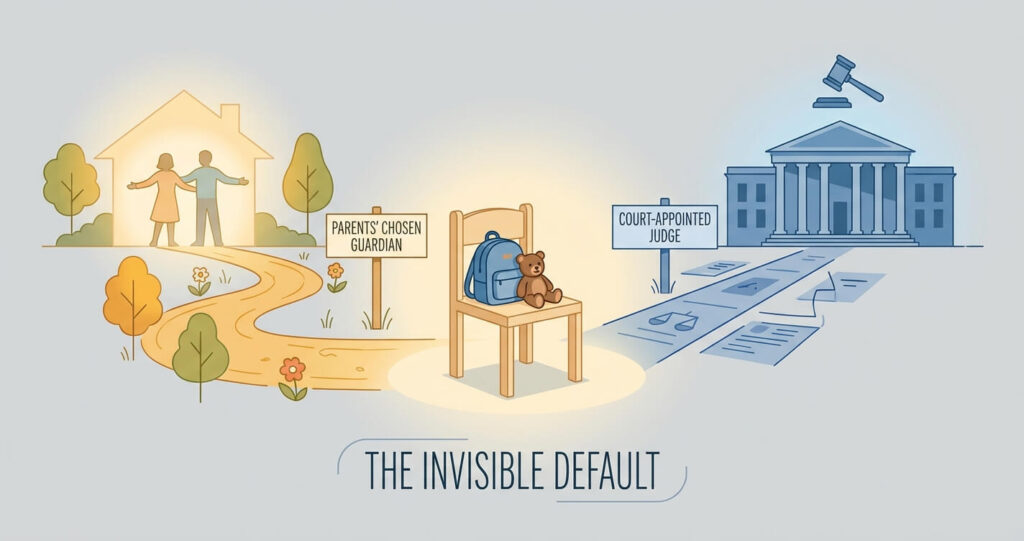
If you do not name a guardian, you do not avoid the decision. You simply hand it to a judge. When parents die without naming a guardian, a court steps in and appoints one, often after relatives put themselves forward and sometimes after they argue about it. The People's Law Library of Maryland explains that a court appoints a guardian for a minor who has none, weighing the child's best interest as the judge sees it, not as you would.
This default is more common than people think. According to Caring.com, only about 24% of American adults had a will in 2025, down from 33% in 2022, which means the large majority of parents have never formally named a guardian. The result is that a stranger in a courtroom, working from incomplete information, ends up making the most personal decision in your family's life.
How Do You Choose the Right Guardian?
Choosing well means looking past the obvious. Start with values and parenting style, since you want someone who will raise your children roughly the way you would. Then weigh the practical factors people skip: the candidate's age and health, where they live and whether a move would uproot your kids, their own family situation, and most importantly, whether they actually want the role.
That last point is non-negotiable. Never name someone without asking them first, because a guardian who feels ambushed is a guardian who may decline. Jeff Judge encourages parents to think in terms of stability over wealth: the right guardian is the one who will provide a loving, steady home, while the money to support the children can be handled separately through a trust. Name a backup guardian too, in case your first choice cannot serve when the time comes. For the financial side, our Revocable vs Irrevocable Trust: What's the Difference? guide explains how to hold and release an inheritance responsibly.
How Do You Legally Name a Guardian?
Naming a guardian is done through your will, which is why a guardianship estate plan starts there. Here is the path most families follow.
First, decide on a primary guardian and at least one alternate, after talking with each of them. Second, name them in a valid will, since a verbal promise or a note on the fridge carries no legal weight. Third, consider creating a trust to hold any life insurance or assets for your children, with a named trustee to manage the money, so the guardian is not also writing checks. Jeff Judge notes: "Separating the caregiving role from the financial role is one of the most protective things a parent can do — the best guardian for your children is rarely the same person you would want managing a $500,000 trust, and naming them separately costs nothing extra in the will." Fourth, revisit the choice after major life changes such as a divorce, a move, or a guardian's own health decline. An out-of-date guardian designation can be as harmful as none at all, because a court may follow a name that no longer fits your family, or disregard the document entirely if it was never properly signed and witnessed. Pairing this with adequate life insurance and a clear plan for the assets is what turns a name on paper into real protection. Our What Are the Basics of Estate Planning for High Net Worth? overview ties these pieces together.
Frequently Asked Questions
How do I name a guardian for my children?
You name a guardian for your minor children in your will, designating a primary choice and at least one backup, ideally after asking each person if they are willing to serve. A will is the legally recognized document for this; informal notes or verbal agreements do not bind a court. Once signed and witnessed properly, your designation guides the judge.
What happens if I don't name a guardian for my kids?
If you do not name a guardian, a court decides who raises your children if both parents are gone. Relatives may petition, and the judge selects based on the child's best interest as the court sees it, which may not match your wishes. The process can be slow, public, and contentious, which is exactly what naming a guardian avoids.
Can I name different people to raise my child and manage their money?
Yes, and it is often wise. The guardian of the person raises your child, while a trustee or guardian of the estate manages the inheritance. Splitting these roles lets you choose a warm, capable caregiver who may not be a strong money manager, and a separate, financially careful person or institution to oversee the funds.
Should the guardian and the money manager be the same person?
Not necessarily, and many families deliberately separate them. Combining both roles in one person who lacks financial discipline can put your child's inheritance at risk, while splitting them adds a healthy check and balance. The right answer depends on the people involved, but you are never required to give one person both the caregiving and the checkbook.
How often should I update my guardian choice?
Review your guardian designation every few years and after any major life event, such as a birth, divorce, move, or a chosen guardian's change in health or circumstances. People's lives change, and a guardian who was a great fit five years ago may no longer be available or appropriate. Keeping the choice current keeps it aligned with your wishes.
Naming a guardian for minor children is the rare estate-planning step that has nothing to do with money and everything to do with love, yet it is the one most parents skip. Put a name on that line, name a backup, and pair it with a plan for the assets. If you want a simple framework for protecting your family across wills, insurance, and savings, our What are the fundamentals of personal financial planning? walks through it step by step. Download it at chesapeakefp.com.
Want to go deeper? Our How to Avoid Common Mistakes With Inherited Wealth walks through this step by step.
This material is for educational purposes only and should not be considered tax or legal advice. Please consult with your tax advisor or attorney regarding your specific situation.
The opinions voiced in this material are for general information only and are not intended to provide specific advice or recommendations for any individual.
All investing involves risk including loss of principal. No strategy assures success or protects against loss.
There is no guarantee that a diversified portfolio will enhance overall returns or outperform a non-diversified portfolio. Diversification does not protect against market risk.
Disclosures
The information provided is for educational purposes only and should not be construed as investment advice. Investment strategies should be tailored to individual circumstances, risk tolerance, and goals. Past performance doesn't guarantee future results. Consult with qualified financial professionals regarding your specific situation.
Advisors associated with Chesapeake Financial Planners may be either (1) LPL Financial Registered Representatives offering securities through LPL Financial, Member FINRA and SIPC, and investment advisor representatives offering investment advice through Great Valley Advisor Group; or (2) solely investment advisor representatives offering investment advice through Great Valley Advisor Group and not affiliated with LPL Financial. Great Valley Advisor Group, and Chesapeake Financial Planners are separate entities from LPL Financial.


