

Published: | Last reviewed:
Will my fees or investments change if my financial advisor sells their practice? They can, but they don't have to, and you usually have a say. What commonly changes isn't the advice itself. It's the structure around it: the fee schedule, the custodian that holds your accounts, the planning platform, the model portfolios and the people who serve you. Ask for the answers in writing.
Key Takeaways
- A sale doesn't automatically change your fees or investments, but a buyer's fee schedule, custodian and models can differ, so ask first.
- SEC staff say clients need enough information to make an informed decision and a chance to withhold consent to an assignment.
- Cerulli Associates reports more than 100,000 advisors, 37.4% of industry headcount, plan to retire over the next decade, according to RightCapital.
- DeVoe & Company counted more than 300 RIA deals closed in 2025, Schwab reports, so many clients will face this.
About the Author: Jeff Judge, CFP®, AEP®, ChFC®, CLU® is Managing Partner of Chesapeake Financial Planners in Forest Hill, Maryland. He has been helping families and business owners in Harford County and the Baltimore metro area navigate transitions in their financial lives since earning his CFP® certification in 2013, by using Chesapeake's signature process, the R.U.D.D.E.R. Method™. "A good transition doesn't ask you to trust blindly. It puts the fee schedule, the custodian and the team on the table before you decide anything."
About Jeff Judge, CFP®: meet Jeff and the Chesapeake Financial Planners team.
Will My Fees or Investments Change If My Financial Advisor Sells Their Practice?
Sometimes, in some ways. Five things most often differ after a practice changes hands, and each comes with a question worth asking.
| What may change | What to ask |
|---|---|
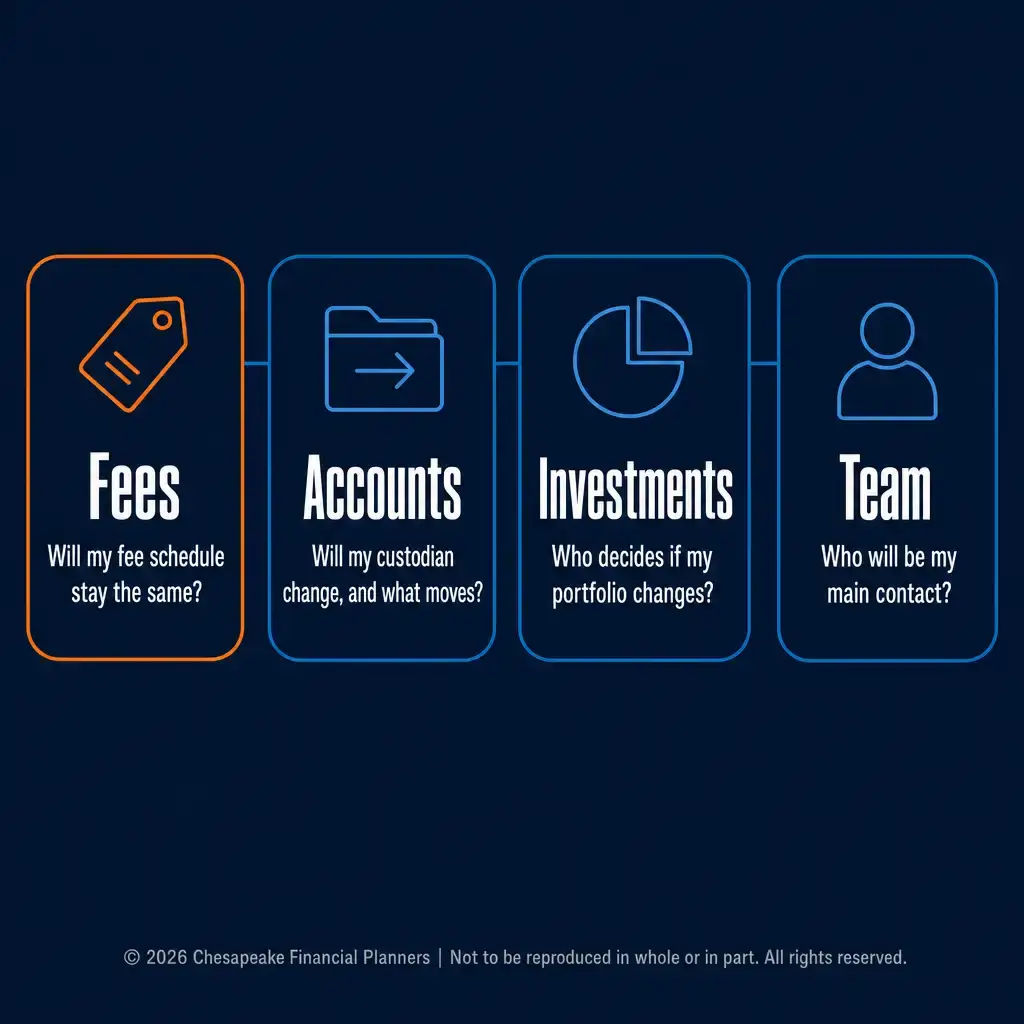
| Advisory fees | Is my fee schedule staying the same, and for how long? Will you put that in writing? |
| Custodian and accounts | Will my accounts move? What paperwork do I sign, and will anything be sold to make the move? |
| Investments and models | Will my portfolio change? Who decides, and why? |
| Planning platform and reports | Will my statements, portal and plan reports change? |
| Service team | Who is my main contact, and will my current advisor still be involved? |
Fees deserve the most attention. Investor.gov notes that you typically pay an adviser an ongoing asset-based fee based on the total value of your account, and a buyer's financial advisor fees may follow a different schedule or add minimums. Investments deserve a close second. A buyer may use different models or a different custodian, and a move can trigger new paperwork even when your goals haven't changed.
Will my fee go up automatically?
That depends on your advisory agreement, which is why you should read it and any new agreement before you sign. Your current contract controls what you pay today. A new agreement with the buyer may carry a different schedule, so compare the two side by side.
What Are My Rights When My Advisor Sells?
You have more say than most clients assume. SEC staff say that Section 205(a)(2) of the Advisers Act "generally makes it unlawful for an SEC-registered adviser to enter into or perform any investment advisory contract unless the contract provides that no assignment of the contract shall be made by the adviser without client consent." The staff add that the adviser "must provide sufficient information to its clients to enable them to make an informed decision, and the opportunity for the clients to withhold consent."
How you're asked depends on the deal, so read any notice closely. In brokerage accounts, FINRA guidance describes negative consent letters, and FINRA says they should include a statement that the customer has the right to object and the manner in which the customer can transfer to another firm.
What if I don't respond to the letter?
Read it before the deadline. FINRA's staff guidance on negative response letters says that if the recipient does not respond, he or she is deemed to have consented to the action. Call the firm, ask your questions, and don't let a deadline pass in silence.
Your information also moves in a sale. Regulation S-P's exceptions allow disclosure "in connection with a proposed or actual sale, merger, transfer, or exchange of all or a portion of a business or operating unit if the disclosure of nonpublic personal information concerns solely consumers of such business or unit." Ask how the buyer will safeguard it.
What Should I Ask the Buyer?
Start with the questions Investor.gov calls conversation starters and add a few about the transition:
- "Help me understand how these fees and costs might affect my investments. If I give you $10,000 to invest, how much will go to fees and costs, and how much will be invested for me?"
- How might your conflicts of interest affect me, and how will you address them?
- As a financial professional, do you have any disciplinary history, and for what type of conduct?
- Who is my primary contact, and who can I talk to if I have concerns?
- Will my current advisor stay involved, and for how long?
Investor.gov also says fees are negotiable in some cases and suggests following up in writing if they seem too high. Our post on how to vet a financial advisor beyond the label goes deeper on what to look for.
What Doesn't Have to Change?
Your goals, your risk tolerance and your plan belong to you, not to the practice. A good buyer should work from what the outgoing advisor already learned about you. Jeff Judge's view: "The best transitions change as little as possible in the first year and explain anything that does."
You can also leave. Switching financial advisors is your right, and a letter about the sale is a reasonable moment to compare your options. Our guide to what happens to a financial advisor's clients when they retire or sell covers that decision, and a well-run announcement should answer the questions above.

Chesapeake Financial Planners acquires advisory practices. Nothing here describes the terms of any acquisition or commits the firm to anything; it is general information to help you ask good questions. The R.U.D.D.E.R. Method™ is Chesapeake Financial Planners' six-step planning process: Review and Recognize, Uncover and Understand, Design and Develop, Discuss and Decide, Execute and Empower, and Reassess and Refine.
Part of our guide: What Happens to Your Financial Advisor’s Clients When They Retire or Sell?
Related service: investment management for individuals and families
More in this guide:
Frequently Asked Questions
Will my fees change if my financial advisor sells their practice?
They might. Your agreement says what you pay today, and a buyer's fee schedule can differ. Ask the buyer whether your fee will stay the same, for how long, and whether any minimums apply. Get the answer in writing before you consent to a new agreement.
Will my investments change after my advisor sells?
They can. A buyer may use different models, products or a different custodian, and moving accounts can involve new paperwork. Ask who decides about any change, why, and whether anything will be sold to make a move. Your goals and risk tolerance should drive the portfolio, not the transition.
Do I have to move my accounts if my advisor sells?
Not necessarily. It depends on the buyer's custodian and on how you're asked to consent. Read the notice, ask whether the accounts move, and find out whether anything is sold to make the move. You can also transfer your accounts elsewhere if you decide not to stay.
Can I leave if I don't like the buyer?
Yes. The account is yours, and FINRA says negative consent letters should explain your right to object and how to transfer to another firm. Compare the buyer's fees, services and background with other options before you decide, and note any deadline in the letter.
How do I check the firm that bought my advisor's practice?
Use the free search tool on Investor.gov, which draws on the SEC's IAPD database, and read the firm's Form CRS and Form ADV. Look at registration status, disciplinary history, fees and conflicts of interest. A firm that welcomes those questions is easier to trust.
Want the Bigger Picture?
If you're asking what changes if your financial advisor sells their practice, start with our guide to what happens to a financial advisor's clients when they retire or sell. If you're weighing this decision, a second opinion costs you nothing.
Sources
- Investor.gov (investor.gov)
- Section 205(a)(2) of the Advisers Act (sec.gov)
- FINRA (finra.org)
- negative response letters (finra.org)
- Investor.gov (investor.gov)
- conversation starters (investor.gov)
Disclosures
The information provided is for educational purposes only and should not be construed as investment advice. Investment strategies should be tailored to individual circumstances, risk tolerance, and goals. Past performance doesn't guarantee future results. Consult with qualified financial professionals regarding your specific situation.
This information is not intended to be a substitute for specific individualized tax, investment or legal advice. We suggest that you discuss your specific situation with a qualified tax, legal or financial advisor.
© 2026 Chesapeake Financial Planners | Not to be reproduced in whole or in part. All rights reserved.


