

Published: | Last reviewed:
An accountable plan is a written policy under which your S-corp reimburses you, as its employee, for business costs you paid out of pocket. Done correctly, the repayment isn't wages, so no income or payroll tax applies to it, and the company still deducts the underlying expense. The IRS ties that treatment to three requirements: a real business connection, documentation within a reasonable time, and the return of anything you were paid beyond what you spent.
Key Takeaways
- An accountable plan reimburses owner expenses without creating wages, but only if it meets three IRS tests: business connection, substantiation, and return of any excess.
- The IRS treats it as reasonable to substantiate within 60 days and return excess within 120 days of the expense.
- A plan that fails the tests turns reimbursements into wages, which carry 7.65% employee payroll tax plus a matching employer share.
- The IRS standard business mileage rate is 76 cents per mile for July through December 2026, and a mileage log is still required.
About the Author: Jeff Judge, CFP®, AEP®, ChFC®, CLU® is Managing Partner of Chesapeake Financial Planners in Forest Hill, Maryland. He has been helping families and business owners in Harford County and the Baltimore metro area navigate S-corp owner compensation and business tax planning since earning his CFP® certification in 2013, by using Chesapeake's signature process, the R.U.D.D.E.R. Method™. "An accountable plan takes a few minutes a month to run, and skipping it leaves a business deduction unclaimed year after year."
About Jeff Judge, CFP®: meet Jeff and the Chesapeake Financial Planners team.
What is an accountable plan for an S-corp owner?
An accountable plan is an arrangement between your company and its employees, you included, that spells out how the business repays expenses employees cover personally. The rules come from Treasury Regulation 1.62-2, which implements section 62(c) of the Internal Revenue Code. When an arrangement meets them, the IRS says "Amounts paid under an accountable plan aren’t wages and aren’t subject to income, social security, Medicare, and FUTA taxes." The company still takes its ordinary deduction for the cost, which is why S-corp expense reimbursement done this way is worth the paperwork.
Once you elect S-corp status, you hold two roles: owner, and employee who receives a W-2. For this topic the employee role is the one that counts, because the tax code treats your home office, phone, and drive to job sites like any other employee's costs. If you're still weighing the structure itself, see our comparison of an LLC and an S-corp and our overview of LLC, S-corp, and C-corp entity selection. Renting your home to your company for a few days a year is a separate rule with its own limits, covered in whether the Augusta Rule is worth it.
Here is the pattern I see. The company is profitable, the owner works from a dedicated room at home a few days a week, runs everything off one phone, and drives a personal vehicle to client sites. The company pays for none of it. Every dollar leaves a personal account after tax, and it feels harmless. It isn't. It is a deduction the company was entitled to and did not take.
Is an accountable plan the same as paying yourself a higher salary? No. A reimbursement for actual costs is not compensation, so it doesn't count toward the reasonable salary you must pay yourself. Our post on how much salary an S-corp owner needs to pay covers the salary side.
What happens if your S-corp doesn't have an accountable plan?
Without one, you absorb the cost or run it through payroll. The IRS states that you can no longer claim miscellaneous itemized deductions subject to the 2%-of-AGI limit, and that group includes unreimbursed employee expenses, so your personal return doesn't rescue you.
Route one: eat the cost. You pay for your office share, phone, and mileage with after-tax dollars, no one deducts anything, and the company's higher profit flows through to your personal return.
Route two: add an "expense allowance" to your paycheck. It feels like a reimbursement, but if the arrangement fails the tests, the payment is wages. The IRS lists the triggers: no timely substantiation, no return of unused advances, or a payment made whether or not you have business expenses. You pay income tax on it, the employee share of Social Security and Medicare tax is 7.65%, and the company owes a matching share. A deductible business cost has become taxable pay.
| Accountable plan | Payroll allowance (nonaccountable) | |
|---|---|---|
| Treated as wages | No | Yes |
| Income tax withholding | None | Applies |
| Social Security and Medicare tax | None | Employee and employer shares |
| Documentation within a reasonable time | Required | Not required |
| Unused money returned | Required | Not required |
"An S-corp owner who pays company bills from a personal card isn't being thrifty. That owner is handing back a deduction the business already earned," says Jeff Judge, CFP®.
The cash is identical under either route. What changes is how it is taxed.
What does the IRS require for an accountable plan to work?
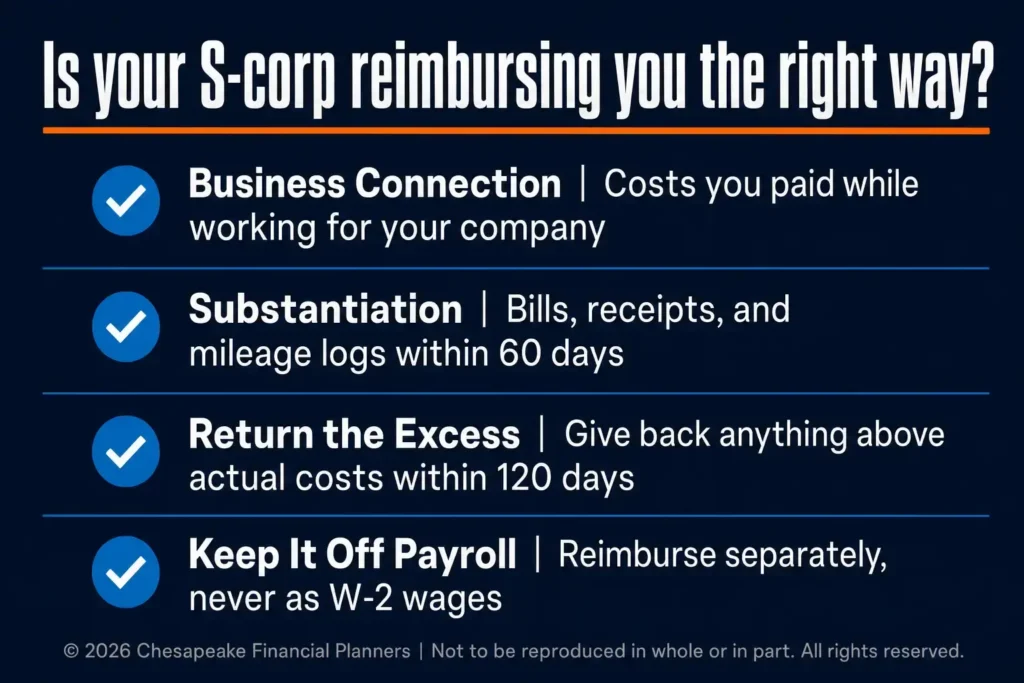
The accountable plan requirements come down to three tests that must each be satisfied, and failing any one turns the arrangement into a wage payment.
- Business connection. You paid or incurred the expense while working as an employee, and it is a cost the business could deduct. A dedicated home office qualifies. Your family's streaming subscriptions do not.
- Substantiation. You give the company enough support within a reasonable period: the square footage math and bills for a home office, the statement and a business-use percentage for a phone, and for mileage a log showing date, destination, business purpose, and miles. The log still matters when the company reimburses at the IRS rate, which is 72.5 cents per mile for January through June 2026 and 76 cents for July 1 through December 31.
- Return of the excess. If the company advances more than your documented costs, you give the difference back within a reasonable period. An allowance you keep no matter what you spent fails this test.
What counts as a reasonable period? Publication 15 describes two timing methods.
| Method | Advance | Substantiate | Return excess |
|---|---|---|---|
| Fixed date | Within 30 days of the expense | Within 60 days of the expense | Within 120 days of the expense |
| Periodic statement | Not specified | Company sends a statement at least quarterly listing amounts outstanding | Account for or return within 120 days of the statement |
You don't have to use either method, but there's no reason to make life harder. Pick one, write it into the plan, and follow it.
Can you use the standard mileage rate instead of tracking actual vehicle costs? Yes, the company can reimburse at the IRS rate, but the log is the substantiation. Without dates, destinations, purposes, and miles, the rate has nothing to rest on.
Which S-corp owner expenses run through an accountable plan?
Three categories cover the bulk of what S-corp owners pay personally, and home office reimbursement is the one that surprises people.
| Expense | What to document | Watch for |
|---|---|---|
| Home office | Square footage of the dedicated space; utility, insurance, and repair bills; mortgage interest and property tax statements | Your CPA should confirm the same costs aren't also itemized on your personal return |
| Cell phone | Monthly statement and a reasonable business-use percentage | Update the percentage when your usage changes |
| Business mileage | Trip log with date, destination, business purpose, and miles | The log is required even at the standard rate |
Put numbers on it. Picture a plumbing contractor in Bel Air whose home is 2,000 square feet, with a 250-square-foot dedicated office, a 12.5% share. If her annual home costs total $24,000, the business share is $3,000. Her phone plan runs $1,500 a year and she documents 60% business use, which adds $900. That is $3,900 before a single mile is counted. These figures are a hypothetical illustration, not a prediction for your situation. Without a plan she pays for it from after-tax money and no one deducts it. With a plan, the company reimburses her, deducts the expense, and the payments stay off her W-2.
Renting space in your home to the company is a different strategy with its own rules, and it doesn't belong inside this plan.

How do you set up and run an accountable plan for a Maryland S-corp?
Start with a written plan the company formally adopts, then run every reimbursement through it the same way each month or quarter. The document is the easy part. Discipline is where plans fall apart.
- Put it in writing and adopt it. Your CPA or attorney can draft a plan naming the covered expense categories, the documentation for each, your timing method, and the rule for returning excess amounts. The company adopts it by board resolution or written consent kept with the corporate records. Ask your CPA how the adoption date affects expenses already incurred this year.
- Build a routine. Submit an expense report monthly or quarterly with the home office calculation, the bills, the phone statement, and your mileage log. The company pays you from the business account and books the expense to the right category.
- Keep the payments out of payroll. Reimbursements get paid separately from your paycheck and recorded as business expenses. If they land on your W-2, your books contradict your plan.
- Pay actual costs, not round numbers. A tidy $500 monthly "home office allowance" with no documentation is the pattern that fails both the substantiation and return-of-excess tests.
- Revisit the numbers each year. Home costs, phone plans, and office setups change, so the business-use percentages should too.
In Jeff's experience, the paperwork is rarely what breaks a plan. It breaks in month three, when the monthly expense report quietly gets skipped and the receipts pile up in a glovebox.
The R.U.D.D.E.R. Method™ is Chesapeake Financial Planners' six-step planning process: Review and Recognize, Uncover and Understand, Design and Develop, Discuss and Decide, Execute and Empower, and Reassess and Refine. An accountable plan fits that rhythm: you review how money moves between you and the company, set the rules, and reassess the numbers every year.
For Harford County business owners this comes up constantly. Contractors, practice owners, and consultants around Forest Hill and Bel Air often work from a home office and drive to job sites, which is the setup this plan is built for. Because your CPA files your federal and Maryland returns, ask them to confirm how the reimbursements flow through each before you rely on the plan.
Once it's running, the plan also tidies the rest of your owner pay. Salary, distributions, and reimbursements each have their own tax treatment, and our post on salary versus distributions shows how they fit together. Clean, documented books also help when you bring in a partner or eventually sell. None of this replaces individualized tax guidance, and your CPA should sign off before you rely on the plan.
Part of our guide: How much salary do I have to pay myself in an S-corp?
Related service: financial planning for business owners
Frequently Asked Questions
Does an accountable plan have to be in writing?
You should put it in writing. A written plan is how you show the IRS that the three requirements are built into the way the company reimburses you, and it names the categories, the documentation, and the timing method in one place. Your CPA or attorney can draft it, and the company adopts it formally.
Can an S-corp owner be reimbursed under an accountable plan?
Yes, when you work for the company as an employee, which is the case for any owner who draws a W-2 salary. Your reimbursements follow the same business-connection, substantiation, and return-of-excess rules as any other employee's, and the paperwork goes to the company, not just to your accountant.
How long do I have to submit receipts to my S-corp?
Under the fixed date method, the IRS treats 60 days after the expense as reasonable for substantiating it, and 120 days as reasonable for returning any excess. Under the periodic statement method, the company sends a statement at least quarterly, and you have 120 days to account for or return the amounts listed.
Do accountable plan reimbursements show up on my W-2?
No. A reimbursement paid under a plan that meets the IRS requirements isn't wages, so it stays off your W-2 and out of payroll withholding. The company records it as a business expense, separate from your paycheck. If the same payment lands on your W-2, the arrangement is being treated as wages.
Can I pay myself a flat monthly allowance instead?
A flat allowance works only if it tracks documented costs. Money you keep regardless of what you spent fails the return-of-excess requirement, and the IRS treats that excess as wages. A round monthly figure with no receipts behind it is a frequent reason a plan doesn't hold up.
What happens if I miss the 60-day or 120-day window?
The amount above your substantiated expenses is treated as paid under a nonaccountable plan. That makes it wages, subject to income, Social Security, Medicare, and FUTA taxes for the first payroll period after the reasonable period ends. Expenses you did substantiate within the window remain valid reimbursements.
Your next step before year-end: add up what you paid personally for the company this year, then bring that number and this article to your CPA. Setting up an accountable plan now means next year's home office, phone, and mileage costs run through the company instead of your after-tax pay. Ready to put a plan around your owner compensation? Jeff Judge and the Chesapeake team serve families and business owners across Harford County and the Baltimore metro, and our complete guide for business owners shows where this fits in the bigger picture. Schedule a fit call at chesapeakefp.com.
A version of this article was originally published on Chesapeake Financial Planners' LinkedIn.
Sources
- substantiate within 60 days and return excess within 120 days (irs.gov)
- 7.65% employee payroll tax (irs.gov)
- IRS standard business mileage rate (irs.gov)
- Treasury Regulation 1.62-2 (ecfr.gov)
- no longer claim miscellaneous itemized deductions (irs.gov)
Disclosures
The information provided is for educational purposes only and should not be construed as investment advice. Investment strategies should be tailored to individual circumstances, risk tolerance, and goals. Past performance doesn't guarantee future results. Consult with qualified financial professionals regarding your specific situation.
This information is not intended to be a substitute for specific individualized tax, investment or legal advice. We suggest that you discuss your specific situation with a qualified tax, legal or financial advisor.
© 2026 Chesapeake Financial Planners | Not to be reproduced in whole or in part. All rights reserved.


