

What is a Roth IRA, and how is it different from a traditional IRA?
Last reviewed: July 2026
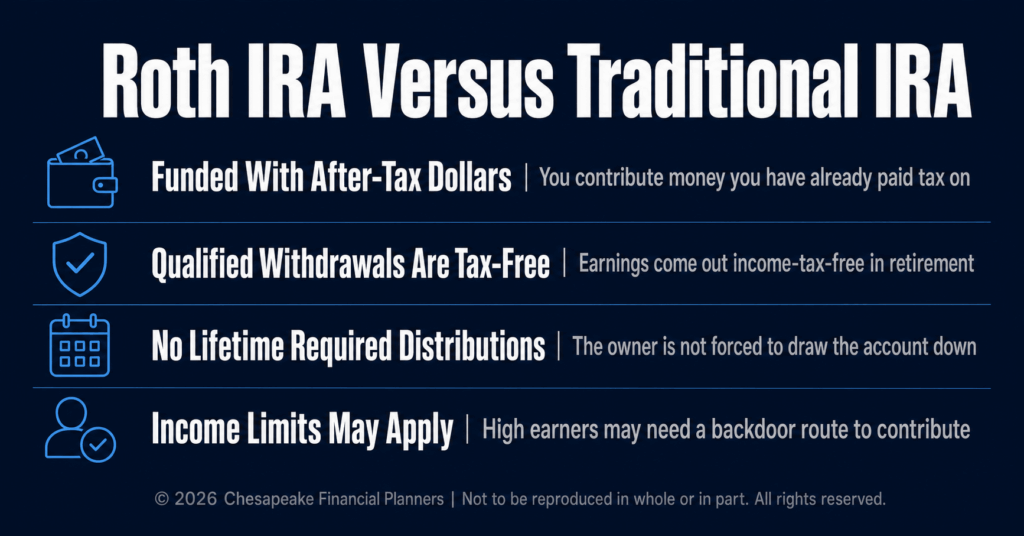
A Roth IRA is an individual retirement account funded with after-tax dollars, where your investments grow without annual taxation and qualified withdrawals in retirement come out income-tax-free. The main difference from a traditional IRA is the order in which you pay tax: a traditional IRA gives you a deduction today and taxes the withdrawal later, while a Roth IRA takes the tax hit now and lets the rest of the money work for you without another tax bill. That single distinction drives almost every decision around when a Roth makes sense for your situation.
Key Takeaways
- A Roth IRA is funded with after-tax money, grows without annual taxation, and qualified withdrawals after age 59½ are income-tax-free.
- The 2026 Roth IRA contribution limit is $7,500 for most savers and $8,600 for those age 50 and older.
- High earners face income phase-outs: Roth contributions phase out from $153,000 to $168,000 (single) and $242,000 to $252,000 (married filing jointly).
- Traditional IRAs may offer a current-year tax deduction; Roth IRAs trade that deduction for income-tax-free distributions later.
- You can pull out Roth IRA contributions (not earnings) at any age without penalty, which gives the account real flexibility.
About the Author: Jeff Judge, CFP®, AEP®, ChFC®, CLU® is Managing Partner of Chesapeake Financial Planners in Forest Hill, Maryland. He has been helping families and business owners in Harford County and the Baltimore metro area work through retirement-account decisions since earning his CFP® certification in 2013, by using Chesapeake Financial Planners’ signature process, the R.U.D.D.E.R. method™. Jeff often says the Roth question rarely comes down to which account is theoretically better. It comes down to which year holds your highest marginal tax rate.
The Definition of a Roth IRA and How It Works
A Roth IRA is a personal retirement account, named after Senator William Roth, that you fund with money you have already paid income tax on. There is no upfront deduction. In exchange, the IRS allows your contributions and any investment growth to be withdrawn income-tax-free once you meet two conditions: you are at least age 59½, and the account has been open for at least five tax years. The IRS calls this a qualified distribution, and it is the structural reason most people open a Roth in the first place.
The account itself is not an investment. It is a wrapper. You choose what to hold inside it: index funds, individual stocks, mutual funds, bonds, ETFs, even certificates of deposit. The tax treatment travels with the account, not the underlying holdings. The IRS publishes the operating rules in Publication 590-A, and the rules apply equally whether your Roth IRA lives at Fidelity, Vanguard, Schwab, or a smaller custodian.
There is one other piece worth understanding before you open one. Roth IRA contributions can come out at any age, for any reason, with no tax and no penalty. Earnings cannot. That distinction makes the Roth IRA one of the few retirement accounts that can serve double duty as a long-term emergency reserve for younger savers, without permanently sacrificing the tax shelter.
Roth IRA Contribution Limits and Income Rules for 2026
The 2026 Roth IRA contribution limit is $7,500 if you are under age 50. If you are 50 or older, you can add a $1,100 catch-up contribution, bringing the total to $8,600. These limits apply to your combined Roth IRA and traditional IRA contributions for the year. If you put $5,000 into a Roth, you can only put another $2,500 into a traditional IRA without crossing the cap.
Eligibility depends on your modified adjusted gross income (MAGI). For 2026, single and head-of-household filers see Roth IRA contributions phase out between $153,000 and $168,000 of MAGI. Once your income hits $168,000, you cannot contribute directly to a Roth IRA. Married couples filing jointly phase out between $242,000 and $252,000 of MAGI, as detailed in IRS Notice 2025-67. Above $252,000, the direct contribution door closes.
You also need earned income to contribute. Wages, salary, self-employment income, and certain commissions count. Investment income, rental income, and Social Security do not. If you have a non-working spouse and you file jointly, your earned income can support a spousal Roth IRA in their name, doubling the household's contribution capacity to $15,000 in 2026 (or $17,200 if both spouses are 50+).
One footnote that catches savers off guard: the calendar year and the contribution year are not the same thing. You have until the federal tax filing deadline in April of the following year to make a prior-year contribution. That means a 2026 Roth IRA contribution can land as late as April 15, 2027, which gives high earners a window to assess their MAGI before deciding how much to contribute.
Roth IRA vs Traditional IRA: The Key Differences
The two accounts share the same structure, the same contribution cap, and the same 59½ withdrawal age. The differences are concentrated in tax treatment, income eligibility, and what happens when you (and your heirs) eventually take the money out.
| Feature | Roth IRA | Traditional IRA |
|---|---|---|
| 2026 contribution limit | $7,500 (under 50) / $8,600 (50+) | $7,500 (under 50) / $8,600 (50+) |
| Tax treatment of contributions | After-tax (no deduction) | May be deductible based on income and workplace plan participation |
| Tax treatment of qualified withdrawals | Income-tax-free | Taxed as ordinary income |
| Income limits to contribute | Yes (phase-out applies) | No income limit to contribute, but deduction phases out if covered by a workplace plan |
| Required Minimum Distributions during owner's life | None | Begin at age 73 |
| Early withdrawal of contributions | Tax- and penalty-free anytime | Subject to tax and 10% penalty before 59½ (with limited exceptions) |
| Inherited account treatment | Generally income-tax-free to heirs (10-year rule still applies) | Distributions taxed as ordinary income to heirs |
Jeff Judge often tells clients that the Roth-versus-traditional choice usually reduces to one question: which year is your tax rate highest? A worker in a 24% federal bracket who expects to retire in a 22% bracket usually keeps more of the money by taking the traditional IRA deduction now and paying the lower rate later. Flip those brackets, where someone is in a low bracket today and expects to retire higher, and the Roth almost always wins on net. The cleanest case for a Roth is the saver with a long runway and current income well below their expected retirement income. The cleanest case against is the late-career, high-bracket saver who already faces a forced glide path into a lower retirement bracket.
That said, the answer is not always either-or. Many of the families Jeff works with hold both kinds of accounts intentionally. A traditional 401(k) at work paired with a Roth IRA on the side gives the retiree two tax sleeves to draw from, which becomes useful when managing Medicare IRMAA brackets, Social Security taxation thresholds, and bracket-management strategies in the years between retirement and required minimum distributions. The decision-tree is the same one we work through using the R.U.D.D.E.R. Method™, Chesapeake Financial Planners' six-step planning process: Review and Recognize, Uncover and Understand, Design and Develop, Discuss and Decide, Execute and Empower, and Reassess and Refine. The tax answer in isolation is rarely the planning answer.
Why Income-Tax-Free Withdrawals in Retirement Matter
The marketing story for a Roth IRA is the tax-free withdrawal in retirement. The planning story is bigger than that. There are three benefits that, in Jeff's work with pre-retirees, the original tax-savings pitch tends to undersell.
The first benefit is tax-rate hedging. No one knows what federal marginal rates will look like 15 or 30 years from now. The current Tax Cuts and Jobs Act provisions are scheduled to expire, the federal debt position is what it is, and political dynamics shift. A Roth IRA locks in today's known tax cost against an unknown future one. That is not a prediction about higher rates. It is a hedge against the uncertainty itself.
The second benefit is that Roth IRAs are not subject to required minimum distributions during the original owner's lifetime. A traditional IRA forces you to start taking taxable distributions at age 73, whether you need the money or not. A Roth IRA can sit untouched indefinitely. For a retiree who has enough income from Social Security, a pension, or a taxable brokerage account, that flexibility is meaningful. The money keeps compounding. The bracket stays clean. And the account doesn't accidentally push you into a higher Medicare premium tier.
The third benefit shows up at the estate level. When a Roth IRA passes to a non-spouse beneficiary, the inheritor generally pays no income tax on the distributions, though they are required under the SECURE Act's 10-year rule to empty the account within a decade of the original owner's death. Compare that to a traditional IRA, where the inheritor pays ordinary income tax on every dollar withdrawn, often during their own peak earning years. Jeff has watched families lose a quarter to a third of an inherited IRA to taxes that better planning could have softened. A Roth conversion strategy during the original owner's lower-bracket retirement years is one of the more effective ways to leave a cleaner inheritance.

Who Benefits Most From a Roth IRA
The simplest test is the marginal-rate question above. If you believe your tax rate today is lower than it will be in retirement, the Roth IRA earns its keep. But that test misses two groups who tend to come out ahead with a Roth even when the marginal-rate math is closer to neutral.
Young workers are the first group. A 28-year-old in the 12% or 22% federal bracket has a tax cost on contributions that is nearly always lower than her tax rate will be when she retires, and the 30-plus-year compounding runway makes the Roth's tax-free growth especially valuable. Even if her bracket in retirement ends up the same as today, she comes out ahead on the math because the dollars she didn't have to give up to taxes in retirement stay invested.
The second group is high earners who use a backdoor Roth conversion to access the account despite being above the direct-contribution income limit. The mechanics are straightforward in theory: make a nondeductible contribution to a traditional IRA, then convert it to a Roth. The execution is where it gets complicated. The pro-rata rule treats every traditional IRA dollar you hold as a blended pool for tax purposes, which can create a partial tax bill on the conversion if you have existing pre-tax IRA balances. Anyone considering a backdoor Roth should work through the timing with a tax advisor or financial planner before making the contribution.
There is also a group for whom the Roth is usually the wrong answer: late-career high earners with no other tax-deferred account at work. For this saver, the deduction value of a traditional IRA contribution today, used to lower a 32% or 35% bracket, often exceeds the present value of decades of tax-free Roth growth. The Roth still has appeal as an estate-planning tool, but as a pure savings-versus-savings comparison, the traditional IRA tends to win.
Related Topics Worth Reading
If you're working through your retirement-account decisions, several CFP guides go deeper on related topics.
How Do High Earners Contribute to a Roth IRA? walks through the contribution-then-conversion strategy for high earners above the direct Roth income limit, including how the pro-rata rule interacts with existing IRA balances.
How Does a Roth Conversion Ladder Work for Early Retirement? covers the multi-year strategy of converting traditional IRA balances to Roth in measured chunks, often used by early retirees to fill lower brackets before Social Security and required distributions begin.
Should I Choose a Roth 401k or Traditional 401k? addresses the workplace version of the same tax-treatment choice, including how the Roth 401(k) interacts with employer matching and required distributions.
How Much Money Do I Actually Need to Retire Comfortably? frames the broader retirement-income question that Roth IRA contributions ultimately serve.
How do I use an HSA for retirement? looks at another tax-advantaged account that often gets used as a Roth supplement once savers hit the IRA limit.
How Do I Know If I'm On Track for Retirement? gives you a benchmark exercise to test where your current savings actually put you.
Frequently Asked Questions
What is a Roth IRA in simple terms?
A Roth IRA is a personal retirement account funded with after-tax dollars where your investments grow without annual taxation and qualified withdrawals after age 59½ come out income-tax-free. Unlike a traditional IRA, you get no current-year tax deduction for your contribution. The trade is upfront tax today in exchange for tax-free retirement income later, which makes it useful when you expect your future tax rate to equal or exceed today's.
How much can I contribute to a Roth IRA in 2026?
The 2026 Roth IRA contribution limit is $7,500 if you are under age 50 and $8,600 if you are 50 or older, thanks to a $1,100 catch-up contribution. This limit applies to your combined Roth IRA and traditional IRA contributions for the year. You also need earned income at least equal to your contribution, and your modified adjusted gross income must fall below the Roth phase-out thresholds.
Who can contribute to a Roth IRA?
Anyone with earned income whose modified adjusted gross income falls below the IRS phase-out thresholds can contribute directly to a Roth IRA. For 2026, single filers can contribute fully up to $153,000 of MAGI and partially up to $168,000. Married couples filing jointly can contribute fully up to $242,000 of MAGI and partially up to $252,000. Above those ceilings, a backdoor Roth conversion is the workaround most planners look at.
What's the difference between a Roth IRA and a traditional IRA?
The core difference is when you pay tax. A Roth IRA is funded with after-tax dollars and qualified withdrawals are income-tax-free. A traditional IRA may give you a current-year tax deduction on the contribution, but every dollar of withdrawal in retirement is taxed as ordinary income. Roth IRAs also have no required minimum distributions during the original owner's lifetime, while traditional IRAs require distributions starting at age 73.
When can I withdraw from a Roth IRA without penalty?
You can withdraw your Roth IRA contributions, the money you originally put in, at any age without tax or penalty. Withdrawing investment earnings tax-free and penalty-free requires meeting two IRS rules: you must be at least 59½ and the account must have been open for at least five tax years. Early earnings withdrawals before age 59½ generally face a 10% penalty plus ordinary income tax, with limited exceptions for first-home purchases, disability, and certain education costs.
Can I convert a traditional IRA to a Roth IRA?
Yes. A Roth conversion lets you move money from a traditional IRA into a Roth IRA, regardless of income. You pay ordinary income tax on the converted amount in the year of the conversion, and there is no annual conversion limit. Conversions matter most for savers in a temporarily low tax bracket, often the years between retiring and starting Social Security or required minimum distributions. Plan the conversion size against your bracket and Medicare IRMAA thresholds before pulling the trigger.
Do Roth IRAs have required minimum distributions?
No, Roth IRAs do not require minimum distributions during the original owner's lifetime. This is one of the more underrated planning advantages compared to a traditional IRA, which forces distributions starting at age 73. Inherited Roth IRAs do come with distribution requirements: non-spouse beneficiaries generally have to empty the account within 10 years of the original owner's death under the SECURE Act, though the distributions themselves remain income-tax-free.
If "what is a Roth IRA" was a starting question and you're now ready to use one as part of a real plan, the CFP Retirement Income Planning Guide covers tax-bracket management, Social Security timing, and Roth conversion strategies in depth. Download it at chesapeakefp.com.
Want to go deeper? Our Retirement Income Blueprint Workbook walks through this step by step.
This material is for educational purposes only and should not be considered tax or legal advice. Please consult with your tax advisor or attorney regarding your specific situation.
A Roth IRA offers tax deferral on any earnings in the account. Qualified withdrawals of earnings from the account are tax-free. Withdrawals of earnings prior to age 59 ½ or prior to the account being opened for 5 years, whichever is later, may result in a 10% IRS penalty tax. Limitations and restrictions may apply.
Contributions to a traditional IRA may be tax deductible in the contribution year, with current income tax due at withdrawal. Withdrawals prior to age 59 ½ may result in a 10% IRS penalty tax in addition to current income tax.
Traditional IRA account owners have considerations to make before performing a Roth IRA conversion. These primarily include income tax consequences on the converted amount in the year of conversion, withdrawal limitations from a Roth IRA, and income limitations for future contributions to a Roth IRA. In addition, if you are required to take a required minimum distribution (RMD) in the year you convert, you must do so before converting to a Roth IRA.
Disclosures
The information provided is for educational purposes only and should not be construed as investment advice. Investment strategies should be tailored to individual circumstances, risk tolerance, and goals. Past performance doesn't guarantee future results. Consult with qualified financial professionals regarding your specific situation.
CFP Board owns the marks CFP®, CERTIFIED FINANCIAL PLANNER®, and CFP® (with plaque design) in the U.S.
Certified Financial Planner Board of Standards Center for Financial Planning, Inc. owns and licenses the certification marks CFP®, CERTIFIED FINANCIAL PLANNER®, and CFP® (with plaque design) in the United States to Certified Financial Planner Board of Standards, Inc., which authorizes individuals who successfully complete the organization’s initial and ongoing certification requirements to use the certification marks.
Contributions to a traditional IRA may be tax deductible in the contribution year, with current income tax due at withdrawal. Withdrawals prior to age 59 ½ may result in a 10% IRS penalty tax in addition to current income tax.
A Roth IRA offers tax deferral on any earnings in the account. Qualified withdrawals of earnings from the account are tax-free. Withdrawals of earnings prior to age 59 ½ or prior to the account being opened for 5 years, whichever is later, may result in a 10% IRS penalty tax. Limitations and restrictions may apply.
Advisors associated with Chesapeake Financial Planners may be either (1) LPL Financial Registered Representatives offering securities through LPL Financial, Member FINRA and SIPC, and investment advisor representatives offering investment advice through Great Valley Advisor Group; or (2) solely investment advisor representatives offering investment advice through Great Valley Advisor Group and not affiliated with LPL Financial. Great Valley Advisor Group, and Chesapeake Financial Planners are separate entities from LPL Financial.


