

Published: | Last reviewed: July 2026 by Jeff Judge, CFP®
Part of our guide: What Not to Put in a Roth IRA: 7 Assets to Keep Out
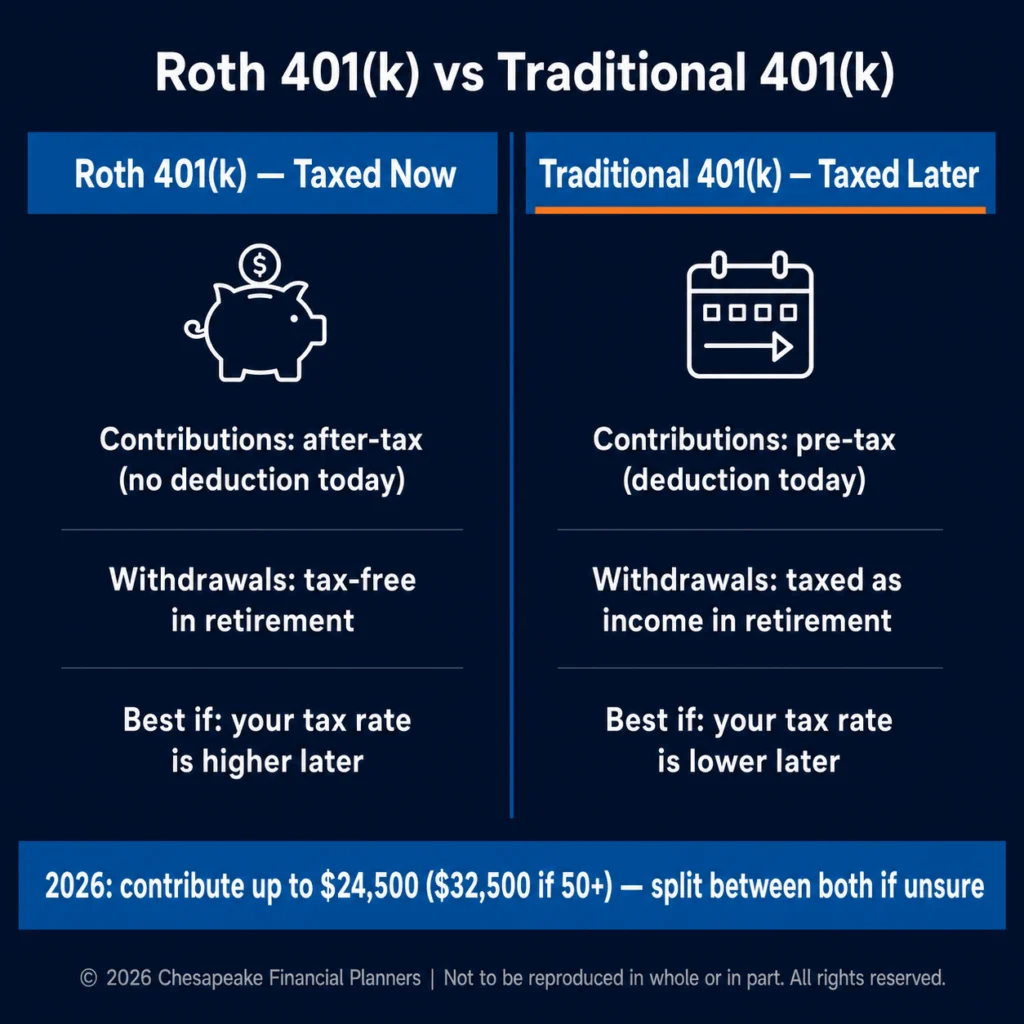
Choose a Roth 401(k) when you expect to be in a higher tax bracket in retirement than you are today, and choose a traditional 401(k) when you expect a lower bracket later. A Roth 401(k) takes the tax hit now and lets the money grow tax-free; a traditional 401(k) gives you a deduction now and taxes every dollar when you withdraw it. For most people, the right answer in the roth 401k vs traditional debate comes down to one question: when will your tax rate be higher?
Key Takeaways
- Roth 401(k) contributions are taxed now and withdrawn tax-free; traditional contributions are deducted now and taxed later.
- The 2026 elective deferral limit is $24,500, with a $8,000 catch-up at age 50 and older.
- Younger or lower-earning savers usually benefit more from Roth; peak earners often favor traditional deductions.
- Many savers split contributions between both to hedge against unknown future tax rates.
About the Author: Jeff Judge, CFP®, AEP®, ChFC®, CLU® is Managing Partner of Chesapeake Financial Planners in Forest Hill, Maryland. He has been helping families and business owners in Harford County and the Baltimore metro area navigate retirement tax decisions since earning his CFP® certification in 2013, by using Chesapeake Financial Planners’ signature process, the R.U.D.D.E.R. method™. Jeff likes to remind clients that the Roth-versus-traditional choice is not permanent. You can change your election any time you want, so the goal is to be right more often than wrong over a long career, not perfect every year.
What Is the Difference Between a Roth 401(k) and a Traditional 401(k)?
A traditional 401(k) is funded with pre-tax dollars, which lowers your taxable income today. A Roth 401(k) is funded with after-tax dollars, so you get no deduction now but pay zero tax on qualified withdrawals later. That single distinction drives every other difference between the two.
With a traditional account, every withdrawal in retirement counts as ordinary income. With a Roth, qualified withdrawals (after age 59½ and a five-year holding period) come out completely tax-free, including all the growth. Both accounts share the same contribution limit, the same employer match rules, and the same penalty structure for early withdrawals.
The math is not as simple as "pay now or pay later." It hinges on the difference between your tax rate today and your tax rate when the money comes out. According to the Social Security Administration, wage growth tends to push people into higher brackets over a career, which is exactly why this decision deserves real thought rather than a default setting. The pre-tax vs roth question is really a bet on your own future tax rate.
What Is the Difference Between Marginal and Effective Tax Rate?
How Much Can You Contribute to a 401(k) in 2026?
You can contribute up to the federal elective deferral limit regardless of whether you choose Roth or traditional, and the limit is shared across both if you split your contributions. The IRS sets the 2026 employee deferral limit at $24,500. Savers age 50 and older can add a catch-up contribution of $8,000, and a special higher catch-up applies to workers ages 60 through 63 under the SECURE 2.0 rules.
Here is where the two account types diverge in a way most people miss. A dollar in a Roth 401(k) is worth more than a dollar in a traditional 401(k) because the Roth dollar has already been taxed. If you max out both account types at $24,500, the Roth version effectively shelters more money from future taxation. Jeff Judge often points this out to high savers who are already maxing their plan: the Roth contribution lets you stuff more real, spendable wealth into the same contribution limit.
One more contrast worth knowing. Beginning in 2026, SECURE 2.0 requires that catch-up contributions for higher earners (those above a wage threshold) be made on a Roth basis. For some workers, the choice is partly made for them.
Workers aged 60 to 63 get an even larger catch-up contribution of $11,250 under SECURE 2.0, on top of the standard employee deferral limit, according to the IRS announcement of 2026 retirement plan limits and IRS Notice 2025-67.
| Feature | Roth 401(k) | Traditional 401(k) |
|---|---|---|
| Tax treatment of contributions | After-tax (no deduction) | Pre-tax (deduction now) |
| Tax treatment of withdrawals | Tax-free if qualified | Taxed as ordinary income |
| 2026 employee limit | $24,500 | $24,500 |
| Age 50+ catch-up | $8,000 | $8,000 |
| Employer match location | Traditional or Roth (plan-dependent) | Traditional |
| Required minimum distributions | None starting 2024 | Yes, at age 73 |
| Best for | Lower bracket now, higher later | Higher bracket now, lower later |
How can I potentially optimize my taxes as my income grows?
Who Should Choose a Roth 401(k)?
A Roth 401(k) makes the most sense for anyone who expects their tax rate to rise. That includes young professionals early in their earning years, savers currently in the 10%, 12%, or 22% brackets, and anyone who believes federal tax rates are likely to climb after the current rate schedule sunsets.
Roth contributions shine when you have decades of growth ahead. Pay tax on the seed, harvest the crop tax-free. A 28-year-old funding a Roth 401(k) might pay tax on $24,500 today and withdraw several times that amount in retirement without owing a dime. That tax-free compounding is the whole point.
Roth accounts also carry a quieter advantage that the IRS confirms: Roth 401(k)s no longer require minimum distributions during your lifetime starting in 2024. That gives you flexibility traditional accounts lack. You control when, or whether, the money comes out, which helps manage taxable income in retirement and can reduce the Medicare premium surcharges and Social Security taxation that high required distributions often trigger. Because there are no lifetime required distributions, a Roth 401(k) can also be useful for estate planning and tax control, not just as a savings account. The IRS required minimum distribution FAQs describe the rule.
How do you use the years between retirement and RMDs to reduce lifetime taxes?
Who Should Choose a Traditional 401(k)?
A traditional 401(k) is the better choice when you are in your peak earning years and expect a meaningfully lower tax bracket in retirement. The deduction is worth the most to people in the 32%, 35%, or 37% brackets, because every pre-tax dollar saves them 32 to 37 cents in current taxes.
Think of it this way. If you are a dual-income household in Maryland clearing $400,000, your marginal rate is high. Deferring tax now at 35% and paying it later at, say, 22% in retirement is a winning trade. That is the traditional playbook, and for many high earners it is simply the math.
Jeff has watched plenty of clients overcomplicate this. His rule of thumb is direct: if you are in the top two federal brackets and you are confident your retirement spending will be lower, take the deduction. The traditional 401(k) also frees up cash flow today, which some families use to pay down high-rate debt or fund a brokerage account for tax diversificationSpreading investments across multiple asset classes, sectors, and geographies so a loss in one area doesn't devastate your entire portfolio. It's the financial equivalent of not putting all your eggs in one basket — and it's one of the few strategies that can reduce risk without necessarily reducing expected returns..
How Can I Reduce Taxes When Earning $200K to $500K?
What is a year-round tax planning calendar for retirees and pre-retirees?

Should You Split Contributions Between Both?
Splitting contributions between Roth and traditional is a legitimate strategy when you genuinely cannot predict your future tax rate, and most people cannot. Putting some dollars in each builds tax diversification, giving you both taxable and tax-free buckets to draw from in retirement.
A blended approach lets you manage your taxable income year by year once you stop working. In a low-income year, pull from the traditional account at a low rate. In a high-income year, lean on the tax-free Roth to avoid spiking your bracket. This is exactly the kind of flexibility Jeff builds into plans through the R.U.D.D.E.R. Method™, Chesapeake Financial Planners' six-step planning process: Review and Recognize, Uncover and Understand, Design and Develop, Discuss and Decide, Execute and Empower, and Reassess and Refine. The "Reassess and Refine" step matters here because the right split changes as your income changes. Jeff Judge notes: "Having both a Roth and a traditional balance gives you a dial to turn in retirement — in a year when Social Security and a pension are already filling your lower brackets, you pull from Roth rather than stack more ordinary income on top."
One note on employer matching. According to FINRA, employer matches have historically gone into the traditional (pre-tax) side of the plan, even when you contribute to the Roth. SECURE 2.0 now allows Roth employer matches if your plan offers them, but many still default to pre-tax. That means even a pure-Roth saver often ends up with a traditional balance, which is its own form of built-in diversification.
How Should I Place Investments Across Taxable and Retirement Accounts?
Frequently Asked Questions
Is a Roth 401(k) better than a traditional 401(k)?
Neither is universally better. A Roth 401(k) wins if your tax rate is higher in retirement than today, and a traditional 401(k) wins if your rate is lower later. The decision depends on your current bracket, expected retirement income, and your view on future tax rates. Many savers hedge by using both.
Can you contribute to both a Roth and traditional 401(k) at the same time?
Yes, you can split contributions between a Roth and traditional 401(k) in the same year, as long as your combined total stays within the annual limit. The IRS caps 2026 employee deferrals at $24,500 across both account types combined, plus catch-up contributions if you qualify.
Do Roth 401(k) withdrawals count as taxable income in retirement?
No, qualified Roth 401(k) withdrawals do not count as taxable income in retirement. To qualify, you must be at least 59½ and have held the account for five years. Because the withdrawals are tax-free, they also do not push up your Medicare premiums or increase the share of Social Security benefits subject to tax.
Does the employer match go into the Roth 401(k)?
Employer matching contributions traditionally go into the pre-tax (traditional) side of your plan, even when you contribute to the Roth. SECURE 2.0 now permits Roth employer matches, but only if your specific plan offers that option. Check with your plan administrator, because many employers still default the match to pre-tax dollars.
Are there income limits to contribute to a Roth 401(k)?
No, a Roth 401(k) has no income limits, unlike a Roth IRA. High earners who are phased out of Roth IRA contributions can still fund a Roth 401(k) at the full annual limit. This makes the Roth 401(k) a valuable tool for tax-free savings when other Roth options are off the table.
What happens to my 401(k) when I switch jobs?
When you leave a job, you can roll your Roth 401(k) into a Roth IRA and your traditional 401(k) into a traditional IRA without triggering taxes. Keeping the two buckets separate during the rollover preserves their tax treatment. Mixing pre-tax and Roth money incorrectly during a rollover can create an unexpected tax bill.
Is a Roth 401(k) better than a Roth IRA?
Neither is strictly better; they serve different roles. A Roth 401(k) has much higher contribution limits and no income restrictions, while a Roth IRA generally offers more investment choices, and the IRS treats withdrawals of your regular Roth IRA contributions as a return of money you already paid tax on, as IRS Publication 590-B explains. Many savers use both. The Roth 401(k) can capture employer matching and large contributions; the Roth IRA adds flexibility. Our guide on what a Roth IRA is covers the IRA side.
The Bottom Line on Roth 401(k) vs Traditional
The roth 401k vs traditional decision is not a one-time, permanent choice. It is a yearly tax bet you can adjust as your income and the tax code change. If you want help mapping out which mix fits your bracket today and your goals at retirement, our guide to tax-smart retirement saving walks through the full framework. Download it at chesapeakefp.com to see how the pieces fit together for your situation.
Want to go deeper? Our Tax-Smart Financial Plan walks through this step by step.
Disclosures
The information provided is for educational purposes only and should not be construed as investment advice. Investment strategies should be tailored to individual circumstances, risk tolerance, and goals. Past performance doesn't guarantee future results. Consult with qualified financial professionals regarding your specific situation.
A Roth IRA offers tax deferral on any earnings in the account. Qualified withdrawals of earnings from the account are tax-free. Withdrawals of earnings prior to age 59 ½ or prior to the account being opened for 5 years, whichever is later, may result in a 10% IRS penalty tax. Limitations and restrictions may apply.
This information is not intended to be a substitute for specific individualized tax, investment or legal advice. We suggest that you discuss your specific situation with a qualified tax, legal or financial advisor.
Advisors associated with Chesapeake Financial Planners may be either (1) LPL Financial Registered Representatives offering securities through LPL Financial, Member FINRA and SIPC, and investment advisor representatives offering investment advice through Great Valley Advisor Group; or (2) solely investment advisor representatives offering investment advice through Great Valley Advisor Group and not affiliated with LPL Financial. Great Valley Advisor Group, and Chesapeake Financial Planners are separate entities from LPL Financial.


