

How Does a Roth Conversion Ladder Work for Early Retirement?
Last reviewed: July 2026
A Roth conversion ladder works by converting portions of your traditional IRA or 401(k) into a Roth IRA across several consecutive years, then waiting five years to withdraw each converted amount penalty-free. Each conversion starts its own five-year clock, which is how early retirees access retirement money before age 59½ without the 10% early withdrawal penalty. You pay ordinary income tax on each conversion in the year you make it, and the strategy works best when you convert during lower-income years.
Key Takeaways
- A Roth conversion ladder lets you tap retirement accounts before 59½ by waiting five years after each annual conversion.
- You pay ordinary income tax on each converted amount in the year of conversion.
- In 2026, the 22% federal bracket runs up to $211,400 for married couples filing jointly.
- Converting between retirement and age 73 reduces future required minimum distributions and Medicare premium exposure.
- Pay conversion taxes from outside accounts, never from the converted funds themselves.
About the Author: Jeff Judge, CFP®, AEP®, ChFC®, CLU® is Managing Partner of Chesapeake Financial Planners in Forest Hill, Maryland. He has been helping families and business owners in Harford County and the Baltimore metro area navigate Roth conversion strategy and early retirement planning since earning his CFP® certification in 2013, by using Chesapeake Financial Planners’ signature process, the R.U.D.D.E.R. method™. Jeff often reminds clients that the ladder isn't about converting everything fast; it's about filling up the right tax bracket year after year without spilling into the next one.
You've saved aggressively in your 401(k) and traditional IRA for decades. Here's the uncomfortable part: every dollar you pull out in retirement gets taxed as ordinary income. And once you hit age 73, required minimum distributions force withdrawals whether you need the money or not. That can shove you into a higher bracket at exactly the wrong time. A Roth conversion ladder gives you a way to take control of that tax bill on your own schedule instead of the IRS's.
What Is a Roth Conversion Ladder?
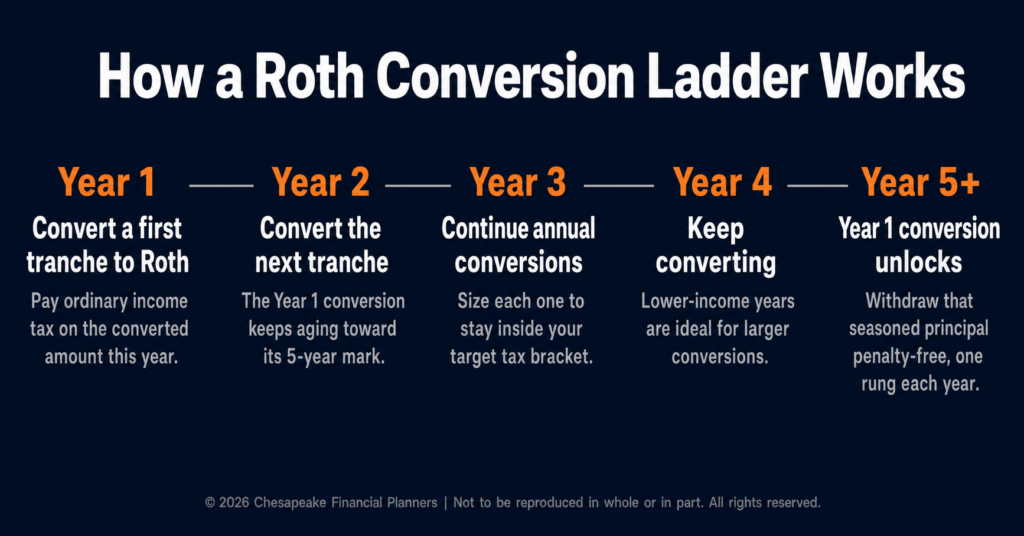
A Roth conversion ladder is a multi-year Roth IRA conversion strategy where you move portions of your traditional IRA or 401(k) into a Roth IRA, one year at a time, paying tax on each conversion as you go. The word "ladder" matters: each annual conversion is a separate rung, and each rung carries its own five-year waiting period before you can touch the principal penalty-free.
The core idea is simple. You convert just enough each year to stay inside a favorable tax bracket. You pay the tax now. Five years later, that specific converted amount becomes available to you tax-free and penalty-free, even if you're nowhere near 59½.
This solves two very different problems depending on when you retire. For early retirees, it cracks open the "access problem": how do you live off retirement accounts in your 50s without eating a 10% penalty? For traditional retirees, the traditional IRA to Roth conversion process becomes a tool to shrink future RMDs and build a pool of money the IRS can never tax again. According to Fidelity, conversions have no annual dollar limit, which is what makes a deliberate, bracket-filling ladder possible in the first place.
How the Five-Year Rule Works for Roth Conversions
The five year rule Roth converters care about is the conversion clock: when you move money from a traditional IRA to a Roth IRA, you must wait five tax years before withdrawing that converted principal penalty-free if you're under 59½. Miss the window and you owe a 10% penalty on the early withdrawal.
Each conversion starts its own separate clock. Convert $40,000 in 2026, and you can withdraw that $40,000 penalty-free in 2031. Convert another $40,000 in 2027, and that batch unlocks in 2032. This staggering is exactly why the strategy looks like a ladder.
Earnings follow a stricter path. The IRS requires that earnings on converted amounts stay in the Roth for five years, and you generally must be at least 59½ to pull those earnings out completely tax-free. Jeff Judge has watched clients confuse the conversion clock with the earnings clock and nearly trigger a penalty they didn't see coming. The principal and the growth play by different rulebooks, and treating them the same is one of the most common mistakes he corrects.
How Do You Build a Roth Conversion Ladder Step by Step?
Building the ladder comes down to four moves you repeat every year. The earlier you start, the sooner the first rung pays off.
First, calculate your annual need. Figure out how much you'll want to withdraw each year once the ladder matures. If you need $50,000 a year beyond your other income, that becomes roughly your target conversion amount.
Second, identify your optimal tax bracket. The whole point is to convert without spilling into a higher rate. For 2026, the IRS sets the top of the 12% bracket at $100,800 for married couples filing jointly and the top of the 22% bracket at $211,400. If you already have $30,000 of other income, you could convert roughly $70,800 and stay inside that 12% band.
Third, start converting at least five years before you'll need the cash. Execute conversions late in the year, once you can see your total income clearly and calibrate the amount precisely.
Fourth, pay the tax from outside money. Never use the converted funds to cover the conversion tax. Doing so shrinks the amount that lands in the Roth and grows tax-free. Pull the tax payment from a taxable brokerage account or cash instead. This is part of how the R.U.D.D.E.R. Method™, Chesapeake Financial Planners' six-step planning process of Review and Recognize, Uncover and Understand, Design and Develop, Discuss and Decide, Execute and Empower, and Reassess and Refine, keeps conversion decisions tied to the full tax picture rather than one isolated number.
What is the best order to withdraw from my 401k, Roth IRA, and taxable accounts in retirement?
The Early Retirement Ladder Strategy
For anyone retiring before 59½, the Roth conversion ladder is the bridge across the penalty gap. It's a centerpiece of serious early retirement planning. Here's how a typical timeline runs:
- Years 1 through 5: Live off taxable account withdrawals while executing annual Roth conversions. Pay conversion taxes from those taxable accounts.
- Year 6 and beyond: Begin withdrawing the now-seasoned converted amounts from your Roth IRA, penalty-free. Keep adding new conversions to extend the ladder.
- Age 59½ and up: Access all Roth funds, contributions, conversions, and earnings, without restriction.
This is what lets someone retire in their early 50s while steadily draining a high-balance traditional IRA into a tax-free Roth account. The five-year head start is the catch, which is why this strategy rewards people who plan it before they walk out the door.
Is Early Retirement (FIRE) Right for Tech Professionals?
The Traditional Retiree Strategy
You don't have to retire early to benefit. Converting systematically between your retirement date and age 73, when RMDs kick in, builds real long-term value and is one of the most reliable ways to reduce required minimum distributions later. The window between retiring and claiming Social Security is often your lowest-income stretch ever, and that's prime conversion territory.
A deliberate ladder in those years lets you:
- Reduce future RMD amounts, so the IRS isn't forcing oversized withdrawals into higher brackets in your 70s and 80s.
- Build tax-free dollars that don't count toward the income thresholds driving Medicare IRMAA surcharges.
- Leave a more tax-efficient legacy, since Roth IRAs carry favorable inheritance treatment for heirs.
- Gain year-by-year flexibility to manage your taxable income in retirement.
How do I coordinate all my retirement income sources to minimize taxes and maximize income?
Frequently Asked Questions
What is the five-year rule for a Roth conversion ladder?
The five-year rule means each Roth conversion must season for five tax years before you can withdraw that converted principal penalty-free if you're under age 59½. Every annual conversion starts its own separate five-year clock, which is why staggered conversions form a ladder of funds that become accessible one year at a time.
How much should I convert each year in a Roth conversion ladder?
Convert enough to fill up your target tax bracket without spilling into the next one. Many retirees aim to fill the 12% or 22% federal bracket. In 2026, the 22% bracket tops out at $211,400 for married couples filing jointly, so you'd subtract your other income from that ceiling to find your conversion room.
Can I withdraw Roth conversion earnings penalty-free after five years?
Not always. Converted principal becomes penalty-free after five years, but earnings face a stricter test. To withdraw earnings completely tax-free and penalty-free, the account generally must be at least five years old and you must be at least 59½. Confusing the principal clock with the earnings clock is a frequent and costly mistake.
Who should consider a Roth conversion ladder?
Two groups benefit most. Early retirees use the ladder to access retirement funds before 59½ without the 10% penalty. Traditional retirees use it between retirement and age 73 to reduce required minimum distributions and build tax-free income. Both groups need low-income years and cash on hand to pay the conversion taxes.
Do I have to pay taxes on a Roth conversion?
Yes. Every traditional IRA to Roth conversion is a taxable event, and the converted amount adds to your ordinary income for that year. There is no annual conversion limit, but the tax bill is why you convert gradually. Always pay that tax from a taxable account, never from the converted funds, to keep the full amount growing tax-free.
Ready to Map Out Your Own Ladder?
A Roth conversion ladder rewards people who plan the timing years in advance, and the difference between a good year to convert and a bad one can be worth tens of thousands of dollars. If you found this helpful, our guide on building tax-efficient retirement income covers the adjacent decisions in depth. Download it at chesapeakefp.com to see how a Roth conversion ladder fits into a full early retirement plan.
What should I do with my 401(k) when I change jobs?
Want to go deeper? Our Roth Conversion Window walks through this step by step.
Disclosures
The information provided is for educational purposes only and should not be construed as investment advice. Investment strategies should be tailored to individual circumstances, risk tolerance, and goals. Past performance doesn't guarantee future results. Consult with qualified financial professionals regarding your specific situation.
Traditional IRA account owners have considerations to make before performing a Roth IRA conversion. These primarily include income tax consequences on the converted amount in the year of conversion, withdrawal limitations from a Roth IRA, and income limitations for future contributions to a Roth IRA. In addition, if you are required to take a required minimum distribution (RMD) in the year you convert, you must do so before converting to a Roth IRA.
A Roth IRA offers tax deferral on any earnings in the account. Qualified withdrawals of earnings from the account are tax-free. Withdrawals of earnings prior to age 59 ½ or prior to the account being opened for 5 years, whichever is later, may result in a 10% IRS penalty tax. Limitations and restrictions may apply.
Advisors associated with Chesapeake Financial Planners may be either (1) LPL Financial Registered Representatives offering securities through LPL Financial, Member FINRA and SIPC, and investment advisor representatives offering investment advice through Great Valley Advisor Group; or (2) solely investment advisor representatives offering investment advice through Great Valley Advisor Group and not affiliated with LPL Financial. Great Valley Advisor Group, and Chesapeake Financial Planners are separate entities from LPL Financial.


