

Should I Choose a Roth IRA or Traditional IRA?
Last reviewed: July 2026
The choice between a Roth IRA vs Traditional IRA comes down to one question: do you want your tax break now or in retirement? A Roth IRA takes your after-tax dollars today and pays out completely tax-free later. A Traditional IRA gives you a deduction now and taxes every dollar you withdraw in retirement. Pick the wrong one and you can hand the IRS tens of thousands of dollars you never needed to pay.
Most people get this decision backward. They chase the immediate deduction because it feels good in April, then watch a lifetime of growth get taxed at withdrawal. Others pour everything into a Roth when a Traditional account would have served them better. The right answer depends on your current tax bracket, your expected retirement income, and a few rules that quietly change the math.
On This Page
- Key Takeaways
- What Is the Difference Between a Roth IRA and a Traditional IRA?
- How Do the 2026 Contribution Limits and Income Rules Work?
- Will Your Tax Rate Be Higher Now or in Retirement?
- When Does a Traditional IRA Make More Sense?
- When Does a Roth IRA Make More Sense?
- How Does the Backdoor Roth IRA Work for High Earners?
- Why Does Tax Diversification Matter for Retirement?
- Frequently Asked Questions
- Ready to Get the Roth Versus Traditional Decision Right?
- Disclosures
Key Takeaways
- A Roth IRA funds with after-tax dollars and grows tax-free, while a Traditional IRA gives an upfront deduction and taxes withdrawals as ordinary income.
- For 2026 you can contribute up to $7,500 to an IRA, or $8,600 if you are 50 or older, according to the IRS.
- Choose Traditional if your tax rate is higher now; choose Roth if you expect higher taxes in retirement.
- Roth IRAs have no required minimum distributions during your lifetime, giving them a lasting flexibility edge.
- High earners locked out of direct Roth contributions can still use the backdoor Roth strategy.
About the Author: Jeff Judge, CFP®, AEP®, ChFC®, CLU® is Managing Partner of Chesapeake Financial Planners in Forest Hill, Maryland. He has been helping families and business owners in Harford County and the Baltimore metro area navigate retirement tax decisions since earning his CFP® certification in 2013, by using Chesapeake Financial Planners’ signature process, the R.U.D.D.E.R. method™. Jeff's view: most clients overweight today's deduction and underweight the value of having tax-free money to draw on when their other income sources are already pushing them into a higher bracket.
What Is the Difference Between a Roth IRA and a Traditional IRA?
A Roth IRA and a Traditional IRA are both retirement savings accounts, but they tax your money at opposite ends. A Traditional IRA gives you a tax deduction the year you contribute and then taxes every withdrawal in retirement as ordinary income. A Roth IRA offers no upfront deduction, but your money grows tax-free and comes out completely tax-free after age 59½.
How does a Traditional IRA work?
With a Traditional IRA, your contributions may be deductible, which lowers your taxable income this year. The money grows tax-deferred, meaning no taxes on dividends or capital gains while it stays invested. When you withdraw in retirement, the full amount, original contribution plus all the growth, gets taxed as ordinary income.
Say you earn $80,000 and contribute $7,000 to a deductible Traditional IRA. Your taxable income drops to $73,000. In the 22% federal bracket, that saves you roughly $1,540 this year. The catch comes decades later when you withdraw that money and the full balance is taxed.
How does a Roth IRA work?
A Roth IRA flips the timing. You contribute after-tax dollars, so there is no deduction now. But the money grows tax-free, and qualified withdrawals in retirement, contributions and gains alike, are 100% tax-free. You can also withdraw your contributions (not earnings) at any time without penalty, which gives a Roth a flexibility a Traditional account cannot match.
Here is the comparison at a glance:
| Feature | Traditional IRA | Roth IRA |
|---|---|---|
| Tax treatment of contributions | May be deductible now | After-tax, no deduction |
| Growth | Tax-deferred | Tax-free |
| Withdrawals in retirement | Taxed as ordinary income | Tax-free if qualified |
| Required minimum distributions | Yes, starting at age 73 | None during your lifetime |
| Early access to contributions | Penalty + tax before 59½ | Contributions withdrawable anytime |
| Income limit to contribute | None to contribute | Phases out at higher incomes |
This is the central design choice behind every IRA tax benefits comparison: pay the IRS now or pay later. Everything else follows from that.
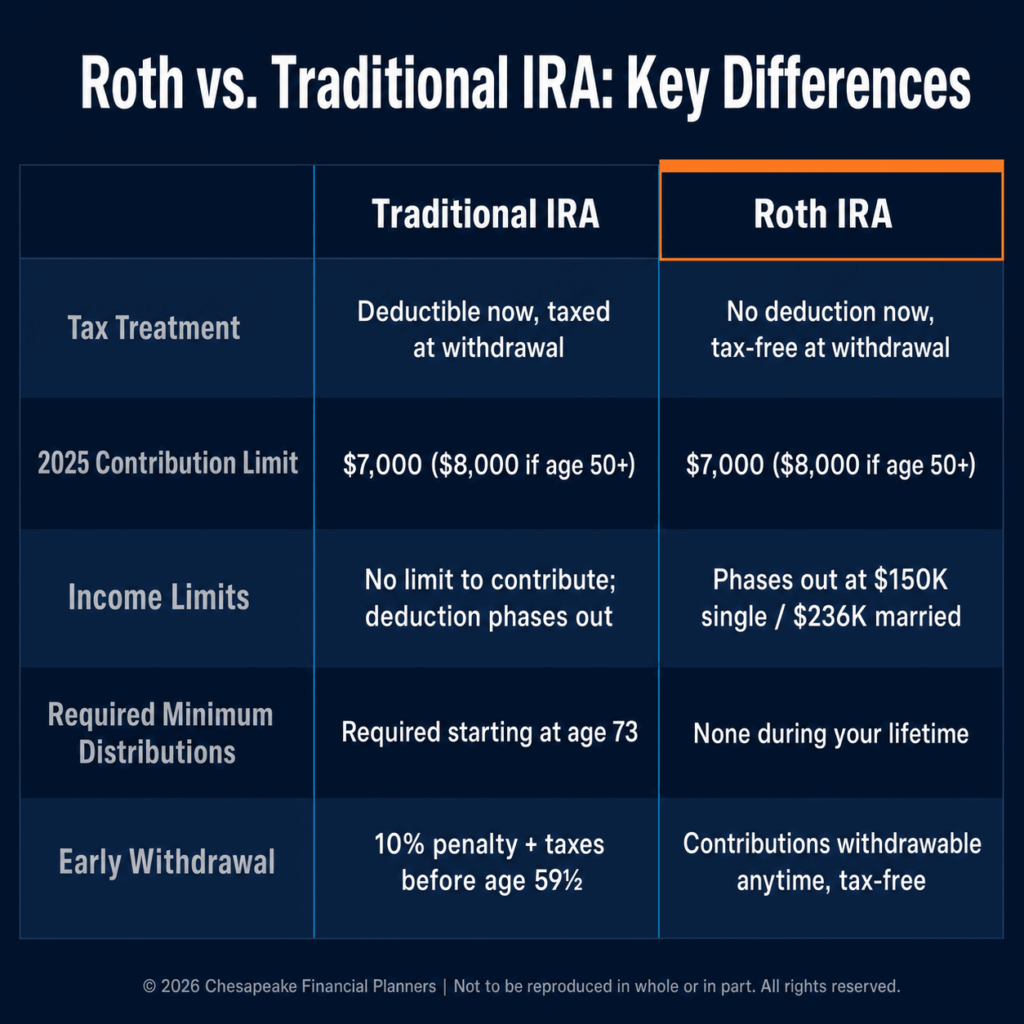
[side-by-side comparison illustrating Roth IRA vs Traditional IRA tax timing]
How Do the 2026 Contribution Limits and Income Rules Work?
For 2026, the IRS sets the annual IRA contribution limit and the income thresholds that determine your deduction and your ability to contribute directly to a Roth. These numbers reset most years, so working from current figures matters.
According to the IRS, the 2026 IRA contribution limit is $7,500, with an additional $1,100 catch-up contribution for anyone age 50 or older, for a total of $8,600. That limit applies across all your IRAs combined, not per account. If you split money between a Roth and a Traditional IRA, the combined total still cannot exceed the annual cap.
What are the Traditional IRA deduction limits?
If neither you nor your spouse is covered by a workplace retirement plan, you can deduct your full Traditional IRA contribution regardless of income. If you are covered by a plan at work, the deduction phases out at higher incomes. The IRS adjusts these phaseout ranges annually, so confirm the current single and married-filing-jointly thresholds before you assume you qualify for the full deduction.
This is where people get tripped up. Jeff Judge often sees clients assume their Traditional IRA contribution is automatically deductible when, because of a 401(k) at work and a solid household income, the deduction is partially or fully phased out. A nondeductible Traditional contribution is usually the worst of both worlds: no deduction now and taxable growth later.
What are the Roth IRA income limits?
Roth IRAs have their own income phaseout. Once your modified adjusted gross income climbs past the IRS threshold for your filing status, your allowed Roth contribution shrinks, then disappears entirely. The IRS publishes the current single and married-filing-jointly phaseout ranges each year. If you earn above those limits, the direct Roth door is closed, but the backdoor Roth IRA strategy, covered below, stays open.
These rules connect directly to how you should think about an old workplace plan. If you are weighing what to do with a former employer's account, the same Roth-versus-Traditional logic applies. See Can I roll my old 401(k) into an IRA instead? and What should I do with my 401(k) when I change jobs? for how rollovers interact with these account types.
Will Your Tax Rate Be Higher Now or in Retirement?
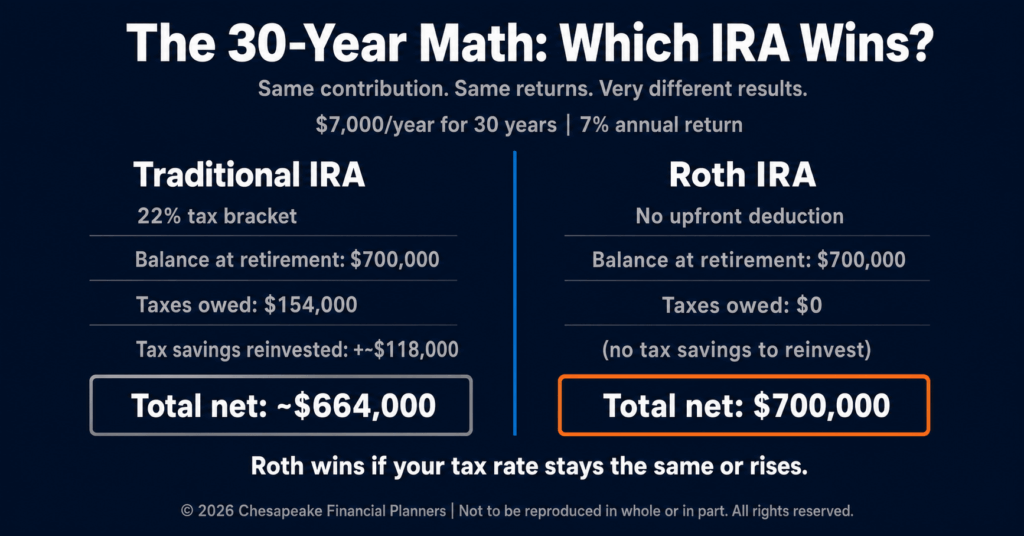
The entire Roth IRA vs Traditional IRA decision reduces to one prediction: will your tax rate be higher now or later? If you pay a higher rate today, deduct now with a Traditional IRA. If you expect a higher rate in retirement, pay the tax now in a Roth and skip the bigger bill later.
The logic is clean even if the prediction is hard:
- Higher tax rate now: Traditional usually wins. Take the deduction while your bracket is high, then withdraw when your bracket is lower.
- Higher tax rate in retirement: Roth usually wins. Lock in today's lower rate and let everything grow tax-free.
- Roughly the same rate: Roth edges ahead, thanks to no required minimum distributions and tax-free flexibility.
Why is predicting your future tax rate so difficult?
Forecasting your retirement tax bracket means guessing at three moving targets: future tax law, your future income, and your future spending. Tax brackets are scheduled to shift, Social Security and required distributions can stack on top of each other, and your spending in your seventies may look nothing like it does today.
This is exactly why retirement tax planning is not a one-time choice. Jeff Judge has watched clients who built up nothing but Traditional accounts get blindsided in their seventies when required minimum distributions, Social Security, and a pension all hit at once and push them into a bracket higher than they ever paid while working. They optimized for the deduction in their forties and paid for it for the rest of their lives. The fix is rarely all-or-nothing; it is building both kinds of accounts so you have levers to pull later.
This decision rarely sits in isolation. It interacts with your full income picture in retirement, which is why we map it inside a broader What is the best order to withdraw from my 401k, Roth IRA, and taxable accounts in retirement?. Coordinating which account you draw from first, and when, can swing your lifetime tax bill substantially.
We work through this exact question using the R.U.D.D.E.R. Method™, which is Chesapeake Financial Planners' six-step planning process: Review and Recognize, Uncover and Understand, Design and Develop, Discuss and Decide, Execute and Empower, and Reassess and Refine. The Roth-versus-Traditional call lands squarely in the Design and Develop step, where the numbers and the tax projections meet.
When Does a Traditional IRA Make More Sense?
A Traditional IRA makes more sense when your current tax rate is high and you expect it to be lower in retirement. The upfront deduction is worth more when it offsets income taxed at 24%, 32%, or higher, and the later tax bill lands when your income, and your bracket, have dropped.
You are in a high tax bracket today
If you sit in the 24% to 37% federal bracket, the deduction delivers real, immediate savings. For most high earners, retirement income falls below working income, so deferring tax to a lower-bracket future is a sound trade. The deduction is a guaranteed return; your future bracket is the variable.
You expect a meaningfully lower retirement income
If you plan to live modestly in retirement, or your retirement income will simply be lower than your peak earning years, a Traditional IRA lets you defer tax from a high-rate year into a low-rate one. That spread is the entire benefit.
You need to lower your taxable income now
Reducing your adjusted gross income can do more than cut your tax bill. A lower AGI can help you qualify for other tax benefits, from education credits to certain deductions that phase out at higher incomes. The deduction can have ripple effects beyond the IRA itself.
You are self-employed and want current-year relief
If you run your own business, reducing taxable income now can ease both your income tax and the sting of self-employment tax. For business owners managing variable income, a Traditional contribution in a high-profit year can be a smart lever. If your wealth is concentrated in your company, this gets more complicated; see How do I plan for retirement when my wealth is tied up in my business?.
A Traditional IRA is not a default, though. It is the right answer for a specific situation: high bracket now, lower bracket expected later, and a real need or benefit from the current deduction.
When Does a Roth IRA Make More Sense?
A Roth IRA makes more sense when you expect your tax rate to be the same or higher in retirement, when you have decades for tax-free growth to compound, or when you value flexibility and want to avoid required minimum distributions. Younger savers and anyone early in their career often land squarely in Roth territory.
You are early in your career or in a lower bracket now
If you are in the 10%, 12%, or 22% bracket, the deduction from a Traditional IRA is worth relatively little. Paying tax now at a low rate and never paying it again is a strong trade, especially when you have thirty or forty years for the account to grow tax-free. The earlier you start, the more lopsided the math becomes in the Roth's favor.
You expect higher taxes in retirement
If you anticipate a sizable nest egg, multiple income streams, or simply believe tax rates will be higher in the future, a Roth lets you pay at today's known rate and skip the unknown future bill. For high earners building substantial wealth, this matters more than the modest deduction they would get today.
You want to avoid required minimum distributions
Traditional IRAs force you to start withdrawing at age 73, whether you need the money or not, and those distributions are taxable. Roth IRAs carry no required minimum distributions during your lifetime. That lets your money keep growing untouched and gives you control over your taxable income in retirement, which can help manage Medicare premiums and the taxation of Social Security. We cover that interplay in How do I coordinate all my retirement income sources to minimize taxes and maximize income?.
You want estate planning flexibility
Because Roth IRAs are not subject to lifetime RMDs and pass to heirs tax-free, they make a powerful wealth transfer tool. Jeff Judge frequently points clients toward Roth dollars for money they do not expect to spend, since leaving a tax-free account to children or grandchildren beats leaving them a tax bill. A Roth is often the most efficient account to inherit.
The same Roth-versus-Traditional logic shows up in your workplace plan, too. If you are weighing the two flavors of 401(k), see Should I Choose a Roth 401k or Traditional 401k?, which mirrors much of this analysis at higher contribution limits.

[timeline showing tax-free Roth growth versus tax-deferred Traditional growth over 30 years]
How Does the Backdoor Roth IRA Work for High Earners?
A backdoor Roth IRA is a legal, two-step strategy that lets high earners who exceed the Roth income limits still get money into a Roth account. You contribute to a nondeductible Traditional IRA, then convert that balance to a Roth IRA. Because there is no income limit on Roth conversions, the income cap that blocks direct contributions simply does not apply.
What are the steps in a backdoor Roth?
The mechanics are straightforward, but the order matters. First, make a nondeductible contribution to a Traditional IRA. Second, convert that amount to a Roth IRA, typically soon after, before much growth accrues. You report the contribution and the conversion on your tax return, and if there is little or no growth and no other pre-tax IRA money, the conversion is largely tax-free.
What is the pro-rata rule trap?
The pro-rata rule is where backdoor Roth strategies go wrong. The IRS treats all your Traditional IRA money as one pool when calculating the taxable portion of a conversion. If you hold pre-tax dollars in any Traditional IRA, a chunk of your conversion becomes taxable, even the part you intended to be a clean nondeductible contribution.
Jeff Judge has seen plenty of do-it-yourself backdoor Roths trigger an unexpected tax bill because the saver still had a rollover IRA full of pre-tax money from an old 401(k). The fix often involves rolling that pre-tax balance into a current employer's 401(k) first, which removes it from the pro-rata calculation. This is one of those moves that looks simple online and gets expensive when executed without coordinating the full picture. According to FINRA, the rules around conversions and the five-year clock reward careful sequencing.
For high earners, the backdoor Roth is one of the cleaner ways to keep funding tax-free growth after the income door closes. Done right, it is a quiet, repeatable win. Done carelessly, it creates a tax mess that takes years to untangle.
Why Does Tax Diversification Matter for Retirement?
Tax diversification means holding your retirement money across accounts that are taxed differently, so you can control which dollars you draw on each year and manage your tax bracket in retirement. It is the reason the answer to Roth versus Traditional is often "both."
Think of it as three buckets: tax-deferred (Traditional IRA and 401(k)), tax-free (Roth), and taxable (brokerage accounts). Each bucket gets taxed at a different moment, and having dollars in all three gives you flexibility no single account can. In a high-income year, you draw from Roth to keep your bracket down. In a low-income year, you might take Traditional withdrawals or even convert some to Roth at a low rate.
How does tax diversification protect you?
Tax diversification protects you against two things you cannot control: future tax rates and your own future income volatility. Nobody knows where brackets will sit in twenty years. Spreading your money across tax treatments means you are not making one giant bet on an unknowable future. You keep options open.
This is the heart of sound retirement tax planning. Jeff Judge tells clients that the goal is not to perfectly predict the future, it is to build a plan that works across several possible futures. Having Roth, Traditional, and taxable dollars side by side is how you do that. When required distributions, Social Security, and other income arrive, you have levers to pull instead of a single fixed outcome.
For the bigger picture on how building the right process beats chasing the perfect account, see Why Does a Financial Planning Process Matter More Than Investment Selection? and Is financial planning worth it if I already have investments?. The account decision is one piece of a coordinated plan.
Frequently Asked Questions
Can I have both a Roth IRA and a Traditional IRA?
Yes, you can own both a Roth IRA and a Traditional IRA at the same time. Your total contributions across both accounts cannot exceed the annual IRS limit, which is $7,500 for 2026, or $8,600 if you are 50 or older. Splitting contributions between the two is a common way to build tax diversification.
What is the 2026 IRA contribution limit?
For 2026, you can contribute up to $7,500 to your IRAs combined, with an additional $1,100 catch-up contribution if you are 50 or older, for a total of $8,600, according to the IRS. This limit is shared across all your Traditional and Roth IRAs, not applied per account, so the combined total still caps at the annual figure.
Is a Roth IRA better than a Traditional IRA?
Neither account is universally better; the right choice depends on whether your tax rate is higher now or in retirement. A Roth IRA usually wins for younger savers, those in lower brackets today, and anyone expecting higher future taxes. A Traditional IRA tends to win for high earners who expect a lower bracket in retirement and want the deduction now.
What happens if I contribute to a Roth IRA but earn too much?
If you contribute to a Roth IRA and your income exceeds the IRS limit, the IRS treats it as an excess contribution subject to a 6% penalty for each year it remains. You can fix it by withdrawing the contribution and earnings before the deadline, or by recharacterizing it. High earners often avoid the issue entirely by using the backdoor Roth strategy instead.
Do I have to take required minimum distributions from a Roth IRA?
No, Roth IRAs have no required minimum distributions during the original owner's lifetime, unlike Traditional IRAs, which require withdrawals starting at age 73. This lets your Roth money keep growing tax-free for as long as you want and gives you more control over your taxable income in retirement, which can help manage Medicare premiums and Social Security taxation.
Can I convert my Traditional IRA to a Roth IRA?
Yes, you can convert a Traditional IRA to a Roth IRA at any time, with no income limit on conversions. You pay ordinary income tax on the converted pre-tax amount in the year you convert. Conversions are most efficient in lower-income years, and they are the engine behind both the backdoor Roth strategy and multi-year tax planning around retirement.
Which IRA is better for a high earner?
High earners often benefit most from a Traditional IRA's deduction during peak earning years, but if a workplace plan phases out that deduction, a backdoor Roth IRA becomes the more useful tool. Many high earners use both over time: deductible Traditional contributions when eligible and backdoor Roth conversions to build tax-free dollars for retirement and estate planning.
Ready to Get the Roth Versus Traditional Decision Right?
The Roth IRA vs Traditional IRA choice is one of the most consequential calls you will make in retirement tax planning, and the wrong answer compounds for decades. If this breakdown was helpful, our retirement tax planning guide walks through tax diversification, conversion timing, and account sequencing in greater depth. Download it at chesapeakefp.com to put a real strategy around your IRA decisions before the next contribution deadline.
Want to go deeper? Our Roth Conversion Window walks through this step by step.
Disclosures
The information provided is for educational purposes only and should not be construed as investment advice. Investment strategies should be tailored to individual circumstances, risk tolerance, and goals. Past performance doesn't guarantee future results. Consult with qualified financial professionals regarding your specific situation.
Contributions to a traditional IRA may be tax deductible in the contribution year, with current income tax due at withdrawal. Withdrawals prior to age 59 ½ may result in a 10% IRS penalty tax in addition to current income tax.
A Roth IRA offers tax deferral on any earnings in the account. Qualified withdrawals of earnings from the account are tax-free. Withdrawals of earnings prior to age 59 ½ or prior to the account being opened for 5 years, whichever is later, may result in a 10% IRS penalty tax. Limitations and restrictions may apply.
This information is not intended to be a substitute for specific individualized tax, investment or legal advice. We suggest that you discuss your specific situation with a qualified tax, legal or financial advisor.
Advisors associated with Chesapeake Financial Planners may be either (1) LPL Financial Registered Representatives offering securities through LPL Financial, Member FINRA and SIPC, and investment advisor representatives offering investment advice through Great Valley Advisor Group; or (2) solely investment advisor representatives offering investment advice through Great Valley Advisor Group and not affiliated with LPL Financial. Great Valley Advisor Group, and Chesapeake Financial Planners are separate entities from LPL Financial.


