

What is step-up in basis, and how are inherited assets taxed?
Last reviewed: July 2026
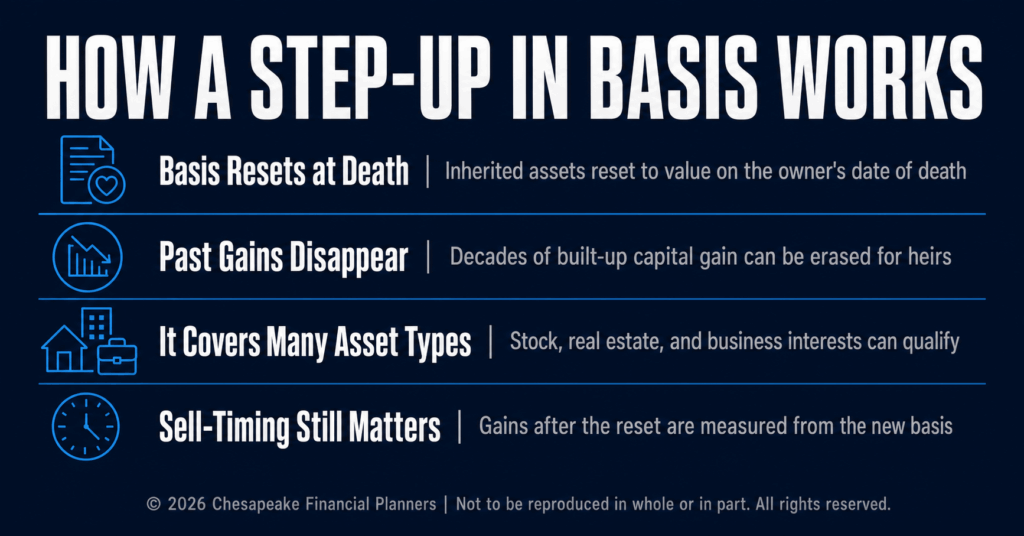
Step up in basis is the federal tax rule that resets the cost basis of inherited assets to fair market value on the date the original owner died. When an heir later sells the asset, capital gains tax is calculated from that new basis, often eliminating decades of accumulated appreciation. The rule lives in IRC § 1014 and is one of the most powerful planning levers for families holding long-appreciated stock, real estate, or private business interests.
Key Takeaways
- Step up in basis resets an inherited asset's cost basis to fair market value at the original owner's date of death.
- Inherited assets benefit; lifetime gifts of the same assets keep the donor's original (carryover) basis.
- The 2026 federal estate tax exemption sits at $15M per person under the One Big Beautiful Bill Act, with a 40% top marginal rate.
- Retirement accounts (IRAs, 401(k)s) do not receive step-up; they pass as income in respect of a decedent (IRD).
- In community property states, both halves of a marital asset can receive a full step-up at the first spouse's death.
About the Author: Jeff Judge, CFP®, AEP®, ChFC®, CLU® is Managing Partner of Chesapeake Financial Planners in Forest Hill, Maryland. He has been helping families and business owners in Harford County and the Baltimore metro area work through inherited assets, estate tax exposure, and step up in basis decisions since earning his CFP® certification in 2013, by using Chesapeake Financial Planners’ signature process, the R.U.D.D.E.R. method™. He has watched families pay tens of thousands in avoidable capital gains tax because nobody walked through which assets to gift now and which to hold until death.
What does step up in basis actually mean?
The mechanics are simple, and the savings can be large. Cost basis is what you paid for an asset, adjusted for things like reinvested dividends, improvements, or stock splits. When you sell, capital gains tax applies to the difference between your sale price and your basis. Step up in basis breaks that link at death. The heir's new basis becomes the asset's fair market value on the date of death, not what the decedent originally paid.
Here is a concrete example. Your father bought 5,000 shares of a stock in 1985 for $10 each. His basis is $50,000. By the time he dies in 2026, the shares trade at $200, for a market value of $1,000,000. If he sold the day before he died, he would owe long-term capital gains tax on $950,000 of appreciation. According to the IRS, long-term capital gains in 2026 are taxed at 0%, 15%, or 20%, with an additional net investment income tax at higher income levels. On a $950,000 gain, that lands between $142,500 and $226,100 in federal tax.
If instead the shares pass to you at his death, your basis steps up to $1,000,000. Sell them the next week, and the taxable gain is zero. Same security, same family, same dollars. The only difference is the timing of the sale relative to death.
This is why holding appreciated assets until death is so often a tax-efficient strategy under current law, and why advisors push back hard before clients gift highly appreciated stock to children during life. Lifetime gifts carry over the donor's original basis. Inheritances reset it. The same asset, gifted vs. inherited, can produce a six-figure tax difference for the same family.
How Much Will I Pay in Capital Gains Tax?
Which inherited assets qualify for step up in basis?
Most capital assets transferred at death qualify. Some do not, and the exceptions are where most families get tripped up. Eligible categories include taxable brokerage securities (stocks, ETFs, mutual funds, bonds held outside retirement accounts), real estate, private business interests, collectibles, and most jointly-owned property at the death of one owner.
The non-step-up category is shorter but financially heavy: traditional IRAs, traditional 401(k)s, 403(b)s, annuities, U.S. Savings Bonds, and most other tax-deferred accounts. These pass as "income in respect of a decedent" (IRD). Heirs inherit the original tax treatment along with the asset, which means distributions are taxed as ordinary income at the heir's bracket. There is no basis reset.
That distinction explains a planning pattern Jeff Judge sees often with clients in their 60s and 70s. When there is a choice about which dollars to spend down, the taxable brokerage account gets held and the IRA gets drawn first. The IRA is going to be taxed as ordinary income whenever it comes out, by you or by your kids. The brokerage account, if held until death, steps up. Spending the IRA first preserves that step-up opportunity.
Roth IRAs are a special case. They do not receive a step up because they are already after-tax, but inherited Roths continue to grow without further income tax for up to ten more years under the SECURE Act inherited account rules. The planning lever is still meaningful, just different.
Real estate gets full step-up too, including primary residences, vacation homes, and rental property. Depreciation recapture is wiped out at death for inherited real estate, a separate benefit for families holding long-held rentals.
Why does the IRS have a 10-year clock on an inherited IRA?
How is step up in basis calculated at death?
The basis is set to fair market value on the date of death. Three pieces of evidence usually establish that figure.
For publicly traded securities, the new basis is the average of the high and low trading prices on the date of death, calculated separately for each lot. Brokerages typically reset cost basis automatically once they receive a death certificate, but heirs should verify the values on the 1099-B before filing.
For real estate, private business interests, and other non-public assets, a qualified appraisal as of the date of death sets the basis. Quality matters here. A defensible appraisal supports the basis the heir uses on any future sale, and the IRS can challenge weak appraisals years later.
For estates large enough to file Form 706 (the federal estate tax return), the asset values reported on Form 706 become the official basis for heirs. The IRS instructions for Form 706 make this clear: under the consistent basis reporting rules in IRC § 1014(f), the basis claimed by the heir cannot exceed the value reported on the estate tax return. Form 8971 and Schedule A transmit those values to beneficiaries.
An alternate valuation election is also available. The executor can elect to value the estate six months after death instead, but only if doing so reduces both the gross estate value and the estate tax due. For estates holding concentrated stock or real estate that drops sharply after death, this election can be material.
A specific practice point Jeff Judge raises with families: when the heir's mother bought the beach house in 1989 and dies in 2026, the basis is the 2026 fair market value at death, not the 1989 purchase price plus improvements. Heirs routinely lose this benefit because nobody pulled an appraisal in the year of death, and a defensible date-of-death value gets harder to reconstruct each year after.
When does step up in basis get limited or eliminated?
Five situations limit or eliminate the step up, and each carries its own planning fingerprint.
Lifetime gifts. Gifts during life carry the donor's basis. If your father gives you the same $1,000,000 stock position before he dies, your basis is his original $50,000. You inherit the appreciation along with the asset. The 2026 federal annual gift tax exclusion sits at $19,000 per donee, so most everyday family gifts fall within the annual exclusion, but the basis question is independent of the gift tax question.
Joint tenancy with non-spouses. When a parent puts a child on a deed as joint tenant with right of survivorship, the IRS generally treats half of the property as a completed gift to the child (carryover basis on that half) and only the parent's half steps up at death. This is one of the more common and expensive mistakes Jeff sees. The intent is usually probate avoidance, and a revocable trust can achieve probate avoidance while preserving full step up.
Community property. In the nine community property states (Arizona, California, Idaho, Louisiana, Nevada, New Mexico, Texas, Washington, Wisconsin), both halves of a marital community property asset receive a full step up at the first spouse's death. This is uniquely valuable for couples in those states holding long-appreciated assets. Maryland and most non-community-property states only step up the deceased spouse's half.
Estate tax-exposed estates. The federal estate tax exemption sits at $15M per person ($30M per couple) for 2026 under the One Big Beautiful Bill Act, with a 40% top marginal rate. Maryland adds its own $5 million state estate tax exemption under separate state law. Estates above either threshold pay estate tax, then heirs still receive the step up on what passes. The combined math has to be modeled, not assumed.
Retirement accounts and IRD assets. Already covered above. These never step up, regardless of how long they have been held.
Revocable vs Irrevocable Trust: What's the Difference?

How does step up in basis fit into estate planning strategy?
The decision tree most families need to walk is which assets to hold, which to gift, and which to spend. Step up in basis at death is one input among several: estate tax exposure, the donor's and heir's income tax brackets, the asset's expected future appreciation, and the family's cash flow needs.
The R.U.D.D.E.R. Method™ is Chesapeake Financial Planners' six-step planning process: Review and Recognize, Uncover and Understand, Design and Develop, Discuss and Decide, Execute and Empower, and Reassess and Refine. For step up decisions, the Review step is where families pull an asset-by-asset list of cost basis vs. fair market value, segregating taxable from tax-deferred. Most families have never done this exercise, and the split between "appreciated taxable" and "tax-deferred" buckets is what drives the rest of the conversation.
A pattern Jeff Judge has watched play out for years involves a 78-year-old widow holding $400,000 in highly-appreciated taxable stock from her late husband's company plus a $600,000 IRA. The kids assume she should liquidate the stock to pay for assisted living. The right answer is usually the opposite. Draw down the IRA first, hold the stock until death so it steps up to heirs at fair market value, and let living costs flow from the tax-inefficient bucket. The family typically keeps tens of thousands more on the back end.
Jeff Judge puts it plainly to clients: "Hold the appreciated taxable assets until death, spend the IRA dollars first, and let the step up do the work."
For families above the $15M federal estate tax threshold, the analysis shifts. Gifting strategies like SLATs, GRATs, and intentionally defective grantor trusts trade away step up at death in exchange for moving future appreciation out of the taxable estate. That trade is worth running on a spreadsheet, not by reflex.
For most families well below the threshold, the playbook is simpler. Hold appreciated taxable assets until death. Gift cash, not appreciated stock, when annual exclusion gifting makes sense. Keep careful basis records on real estate and private business interests. And document the date-of-death values when a parent dies, every single time, even if no estate tax return is required.
Related topics worth reading
Step up in basis decisions touch several adjoining estate planning topics. These deepen the picture if you are working through your own family's situation.
Federal estate tax exemption changes under OBBBA. The One Big Beautiful Bill Act locked in a $15M per-person federal exemption beginning in 2026, replacing the scheduled TCJA sunset. The baseline is indexed for inflation starting in 2027. What Do High Net Worth Families Need to Know About Estate Tax Planning in 2026?
Estate tax portability for surviving spouses. Portability lets a surviving spouse use the unused portion of a deceased spouse's federal exemption, but only if Form 706 is filed within the deadline. This compounds with step up planning. What is estate tax portability, and how do I claim my spouse's unused exemption?
SLATs and gifting trusts. Spousal Lifetime Access Trusts and intentionally defective grantor trusts move future appreciation out of the taxable estate, often at the cost of step up at death. A high-net-worth trade-off, not a default move. What is a SLAT, and how does spousal gifting work?
Frequently asked questions
What is step up in basis in simple terms?
Step up in basis is the federal tax rule that resets the cost basis of an inherited asset to its fair market value on the date the original owner died. The heir then calculates any future capital gains tax from that new basis, not from what the decedent originally paid. The practical result is that decades of accumulated appreciation typically pass to heirs without being subject to capital gains tax.
Do all inherited assets get a step up in basis?
No. Most capital assets passing at death do step up, including taxable brokerage securities, real estate, and private business interests. The major exceptions are traditional IRAs, 401(k)s, 403(b)s, annuities, and other tax-deferred retirement accounts, which pass as income in respect of a decedent and retain their original tax treatment. Roth IRAs also do not step up because they are already after-tax, though they continue to grow without further income tax under the inherited account rules.
How is step up in basis calculated at death?
For publicly traded securities, the new basis is the average of the high and low trading prices on the date of death. For real estate and private business interests, a qualified date-of-death appraisal sets the basis. Estates filing Form 706 must use the same values for basis reporting, per IRC § 1014(f). Executors can also elect alternate valuation, using fair market value six months after death, but only if it reduces both gross estate value and the estate tax due.
Are retirement accounts (IRAs and 401(k)s) eligible for step up in basis?
No. Traditional IRAs, 401(k)s, 403(b)s, and most other tax-deferred retirement accounts are treated as income in respect of a decedent (IRD) and do not receive a step up. Heirs inherit the original tax treatment, meaning distributions are taxed as ordinary income at the heir's bracket. Roth IRAs also do not step up but continue to grow without further income tax, with most non-spouse heirs facing a 10-year distribution window under the SECURE Act.
How does step up in basis work for joint property?
For property held jointly by spouses in non-community-property states, only the deceased spouse's half steps up at death; the surviving spouse keeps the original basis on the other half. In the nine community property states, both halves of a marital community property asset step up at the first spouse's death. For property held jointly with a non-spouse such as a parent and child, the IRS typically treats the addition of the joint owner as a partial gift, and only the deceased owner's interest steps up.
What is carryover basis, and when does it apply?
Carryover basis is the rule that applies when an asset is gifted during life rather than inherited at death. The recipient takes the donor's original cost basis, meaning all of the donor's accumulated appreciation transfers along with the asset. The 2026 federal annual gift tax exclusion is $19,000 per donee, but the carryover basis rule applies regardless of whether the gift exceeds that threshold. This is why gifting highly appreciated stock to children during life is usually a worse tax outcome than letting them inherit it.
Does step up in basis still exist under current tax law?
Yes. The One Big Beautiful Bill Act, signed in July 2025, made the federal estate tax exemption permanent at $15M per person beginning in 2026 and did not modify the step up in basis rule under IRC § 1014. Proposals to repeal step-up have been raised in past tax debates, but no repeal is on the books. Estate planning under 2026 law continues to treat step up at death as a central lever for capital gains inheritance planning.
If you found this helpful, the Chesapeake Financial Planners estate planning guide covers how step up in basis fits with portability, gifting strategies, and the new $15M federal exemption. Download it at chesapeakefp.com to keep the playbook handy when the conversation comes up in your family.
Want to go deeper? Our How to Avoid Common Mistakes With Inherited Wealth walks through this step by step.
This material is for educational purposes only and should not be considered tax or legal advice. Please consult with your tax advisor or attorney regarding your specific situation.
The opinions voiced in this material are for general information only and are not intended to provide specific advice or recommendations for any individual.
Contributions to a traditional IRA may be tax deductible in the contribution year, with current income tax due at withdrawal. Withdrawals prior to age 59 ½ may result in a 10% IRS penalty tax in addition to current income tax.
A Roth IRA offers tax deferral on any earnings in the account. Qualified withdrawals of earnings from the account are tax-free. Withdrawals of earnings prior to age 59 ½ or prior to the account being opened for 5 years, whichever is later, may result in a 10% IRS penalty tax. Limitations and restrictions may apply.
Disclosures
The information provided is for educational purposes only and should not be construed as investment advice. Investment strategies should be tailored to individual circumstances, risk tolerance, and goals. Past performance doesn't guarantee future results. Consult with qualified financial professionals regarding your specific situation.
This information is not intended to be a substitute for specific individualized tax, investment or legal advice. We suggest that you discuss your specific situation with a qualified tax, legal or financial advisor.
Advisors associated with Chesapeake Financial Planners may be either (1) LPL Financial Registered Representatives offering securities through LPL Financial, Member FINRA and SIPC, and investment advisor representatives offering investment advice through Great Valley Advisor Group; or (2) solely investment advisor representatives offering investment advice through Great Valley Advisor Group and not affiliated with LPL Financial. Great Valley Advisor Group, and Chesapeake Financial Planners are separate entities from LPL Financial.


