

What is a SLAT, and how does spousal gifting work?
Last reviewed: July 2026
A spousal lifetime access trust (SLAT) is an irrevocable trust that one spouse creates and funds for the benefit of the other, moving assets out of the taxable estate while preserving indirect access through the beneficiary spouse. The donor spouse gives up direct control of the gifted assets, but distributions can still be made to the beneficiary spouse for health, education, maintenance, and support. The strategy is most often used by high-net-worth families who want to lock in the federal lifetime exemption before it shrinks through inflation drag, divorce, or a future change in law.
On This Page
- Key Takeaways
- Who Should Consider a Spousal Lifetime Access Trust?
- How Does Spousal Gifting Into a SLAT Actually Work?
- What Are the Tax Implications of Funding a SLAT in 2026?
- What Are the Biggest Risks and Mistakes With SLATs?
- Related Topics Worth Reading
- Frequently Asked Questions
- Disclosures
Key Takeaways
- A SLAT lets one spouse gift assets out of their taxable estate while the other spouse can still receive distributions from the trust.
- The 2026 federal estate and gift tax exemption is $15 million per person and $30 million per couple under OBBBA.
- The top federal estate and gift tax rate stays at 40%, so every dollar removed from the taxable estate matters for wealthy families.
- SLATs carry real risks, including divorce, the reciprocal trust doctrine, and the loss of step-up in basis on appreciated assets.
- Maryland still imposes its own estate tax on estates above $5 million, so SLAT planning matters even when federal exemption headroom is generous.
About the Author: Jeff Judge, CFP®, AEP®, ChFC®, CLU® is Managing Partner of Chesapeake Financial Planners in Forest Hill, Maryland. He has been helping families and business owners in Harford County and the Baltimore metro area work through estate and gift tax planning decisions since earning his CFP® certification in 2013, by using Chesapeake Financial Planners’ signature process, the R.U.D.D.E.R. method™. Jeff often sees couples wait years to fund a SLAT, then scramble in the months before a known law change, which is the worst environment for a decision this permanent.
Who Should Consider a Spousal Lifetime Access Trust?
A SLAT may be appropriate for married couples whose combined taxable estate already approaches, or could grow into, the federal estate tax exemption, and who want to push appreciation outside the estate without giving up all economic access. In 2026 the federal exemption is $15 million per person under the One Big Beautiful Bill Act passed in July 2025, with inflation indexing beginning in 2027. That sounds like a lot of room. For a single founder with concentrated stock, a business owner with a rising valuation, or a couple with significant retirement and real estate equity, it can disappear faster than expected.
There is also a more subtle reason to consider a SLAT now: state estate tax. Maryland still levies its own estate tax on estates above $5 million, which is far lower than the federal threshold. A couple in Forest Hill or Bel Air with a $12 million estate has no federal estate tax exposure, but they may have significant Maryland exposure. Moving appreciating assets into a SLAT can reduce both bases at once.
The profile that fits best is a couple in a stable marriage, with assets they do not need for current spending, and a willingness to give up direct ownership in exchange for tax planning value. Jeff Judge often puts it to clients this way: "If you would not write the check to your spouse outright and trust that the money will still be there in 20 years, you should not fund a SLAT." The structure works because the donor spouse genuinely lets go.
This is also where the gifting strategies for high net worth families conversation has to start. A SLAT is one tool. It usually shows up next to direct annual exclusion gifts, charitable gifting strategies, and grantor retained annuity trusts in any thorough plan.
How Does Spousal Gifting Into a SLAT Actually Work?
Funding a SLAT happens in a specific sequence that has to be documented carefully. The donor spouse, working with an estate planning attorney, creates an irrevocable trust naming the other spouse, and usually the couple's children or grandchildren, as beneficiaries. The donor spouse then transfers assets (cash, securities, business interests, real estate) into the trust. That transfer is a completed gift for federal tax purposes, which is what triggers the use of the lifetime exemption.
This is also where Chesapeake's planning process kicks in. The R.U.D.D.E.R. Method™ is Chesapeake Financial Planners' six-step planning process: Review and Recognize, Uncover and Understand, Design and Develop, Discuss and Decide, Execute and Empower, and Reassess and Refine. A SLAT is a Design and Develop output, but it cannot be funded responsibly without the first two steps. We Review the household balance sheet, Uncover the spending needs the donor spouse will still rely on, and only then design a gift amount the donor can live with permanently.
A few mechanical points clients regularly miss:
- The trust is irrevocable. The donor spouse cannot be a beneficiary, cannot serve as trustee in most well-drafted SLATs, and cannot direct distributions back to themselves.
- The beneficiary spouse can receive distributions, typically subject to a HEMS standard (health, education, maintenance, support), and those distributions then flow into the household.
- The trustee should be an independent party or a carefully structured trust protector arrangement. A spouse-as-trustee SLAT exists, but it narrows the distribution standard and introduces complications most families do not need.
- The gift is reported on IRS Form 709, the federal gift tax return, in the year of the transfer.
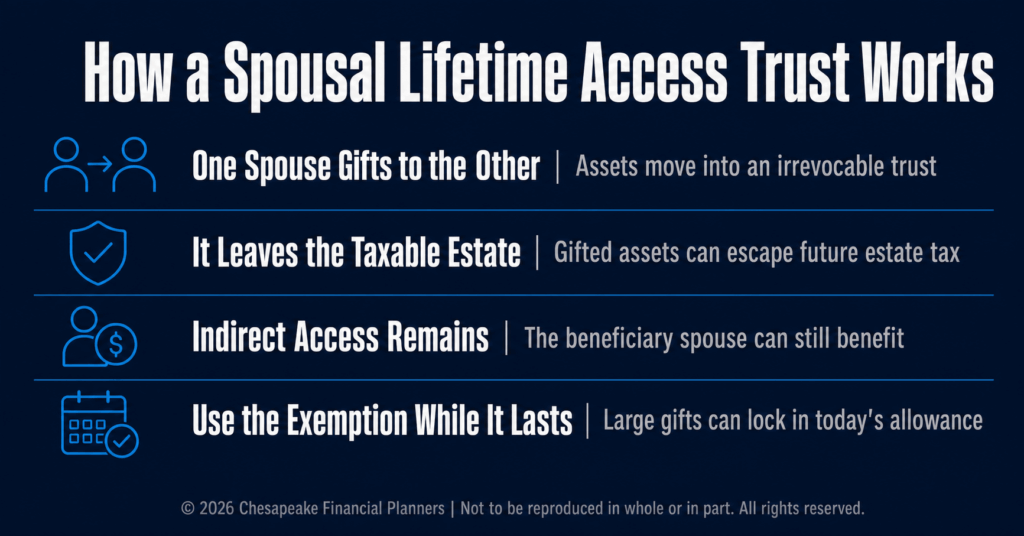
The shorthand version: one spouse gives, the other spouse may receive, and the household keeps indirect access through that beneficiary. If the marriage stays intact, the structure usually works as planned. If it does not, the donor spouse has given up the gift permanently. That is the trade.
What Are the Tax Implications of Funding a SLAT in 2026?
The tax picture has three layers: federal gift tax, federal estate tax, and state estate tax. Get one wrong and the whole strategy can underperform.
On the federal gift tax side, the transfer to a SLAT is a taxable gift, but it is almost never a tax-paying gift. The donor spouse applies the lifetime gift and estate tax exemption, which is $15 million per person in 2026 under OBBBA, against the value of the contribution. As long as cumulative lifetime gifts stay under that exemption, no gift tax is owed at funding. Above the exemption, the top marginal rate is 40%.
On the federal estate tax side, this is where the value shows up. Assets inside a properly structured SLAT, plus all future appreciation, sit outside the donor spouse's taxable estate. If the donor spouse contributes $5 million of stock today and that stock grows to $12 million over the next 20 years, the $7 million of appreciation never enters the estate. For a family already over the exemption, that growth would otherwise be taxed at the top 40% federal rate.
The annual gift tax exclusion still matters separately. In 2026, each donor can give $19,000 per recipient per year without using any lifetime exemption. For a couple gift-splitting, that is $38,000 per recipient per year, on top of whatever lifetime exemption is used for the SLAT contribution. Some families use annual exclusion gifts to fund a SLAT slowly. Most pair a one-time large funding event with smaller annual top-ups.
The state layer is the one most people forget. Maryland's $5 million state estate tax exemption is not indexed to the federal exemption, and Maryland has no state gift tax. A SLAT moves assets out of the Maryland taxable estate the moment the gift completes, and Maryland gets no second bite as a "gift tax." For a Harford County family with a $9 million estate, that distinction can save several hundred thousand dollars at the state level alone.
One more wrinkle for couples worth covering: the loss of step-up in basis. Assets gifted into a SLAT carry over the donor's cost basis. Assets held until death and passed through the What is estate tax portability, and how do I claim my spouse's unused exemption? receive a step-up to fair market value, eliminating built-in capital gains. Families with deeply appreciated low-basis stock have to weigh the estate tax savings against the income tax cost of giving up that step-up.
What Are the Biggest Risks and Mistakes With SLATs?
The structure looks elegant in a diagram. The risks show up in real households.
Divorce is the first one. If the marriage ends, the donor spouse has gifted assets to a trust whose primary beneficiary is the former spouse. Some SLATs include provisions that define "spouse" as the current spouse at the time of distribution, which can soften that risk. Even with careful drafting, divorce can leave the donor on the wrong side of a gift that cannot be undone. Jeff Judge has watched two clients walk back from SLAT planning specifically because they could not get comfortable with this exposure, and that is the right answer when the household is not ready.
The reciprocal trust doctrine is the second. When both spouses each create a SLAT for the other, and the trusts look substantially identical, the IRS can argue that the trusts should be uncrossed, putting each set of assets back in the original donor's estate. Avoiding this requires that the two SLATs differ in meaningful ways: different beneficiaries, different distribution standards, different trustees, different funding dates, different funded amounts, and ideally different trust property. The American College of Trust and Estate Counsel has discussed the doctrine extensively in its commentary on irrevocable trust planning, and most experienced estate attorneys will not draft mirror SLATs without these differentiators.
Death of the beneficiary spouse is the third risk. If the beneficiary spouse dies first, the donor spouse loses the indirect access pathway. The trust continues for the remainder beneficiaries (typically children), but the donor cannot access trust assets. This is why most plans build in a "floating spouse" provision or contingent access paths, and why the funding amount should leave the donor spouse comfortable even if the beneficiary spouse predeceases them by 30 years.
Funding mistakes are the fourth. Funding too little leaves exemption on the table. Funding too much leaves the donor spouse cash-poor. Funding with the wrong asset (low-basis stock that the family did not actually want to gift, or illiquid business equity that the trust cannot administer) creates years of complications. The discipline is to design the SLAT around what the donor spouse can permanently let go of without resentment.
The fifth is a quieter mistake: treating a SLAT as the entire estate plan. A SLAT is one strategy. It works alongside life insurance trusts for liquidity, a revocable living trust for probate avoidance, and core wills, powers of attorney, and healthcare directives. Funding a SLAT without those other pieces in place is a common pattern in families that hire transactional attorneys and skip the planning conversation.

Related Topics Worth Reading
A spousal lifetime access trust does not sit alone in an estate plan. The strategies below either complement, compete with, or build on a SLAT depending on the family's situation.
What is an ILIT, and how does it keep life insurance out of my estate? explains how to keep large life insurance death benefits out of the taxable estate. Many families use a SLAT and an ILIT together. The SLAT removes growing investment assets; the ILIT removes the death benefit windfall.
Maryland estate tax planning walks through the state-specific layer that Harford County and Baltimore-metro households tend to underestimate. Federal exemption headroom does not eliminate Maryland exposure.
Revocable vs Irrevocable Trust: What's the Difference? provides the foundation. If irrevocability still feels uncomfortable in concept, the structural details of a SLAT are not going to land.
estate planning checklist for couples sets the broader frame. A SLAT is one piece next to wills, powers of attorney, healthcare directives, and beneficiary designations on every account.
Frequently Asked Questions
Who should consider a spousal lifetime access trust?
A SLAT may be appropriate for married couples with a combined estate approaching the federal exemption (currently $15 million per person in 2026) and concentrated wealth or rapidly appreciating assets they want to remove from the taxable estate. The strategy fits best when the marriage is stable and the donor spouse can permanently part with the gifted assets.
Can both spouses set up SLATs for each other?
Yes, but with serious caveats. Mirrored SLATs can trigger the reciprocal trust doctrine, which can collapse the planning back into each donor's estate. To avoid that, the two trusts must differ in meaningful ways: different beneficiaries, distribution standards, trustees, funded amounts, and funding dates. Most experienced estate attorneys insist on those distinctions before drafting dual SLATs.
What happens to a SLAT if the beneficiary spouse dies?
If the beneficiary spouse dies first, the SLAT continues for the remainder beneficiaries (typically children or grandchildren), but the donor spouse loses indirect access through their spouse. The trust assets remain outside the donor's taxable estate. This is why proper SLAT planning sizes the gift so the donor spouse remains financially comfortable even if their spouse predeceases them by decades.
What happens to a SLAT in a divorce?
In a divorce, the donor spouse has already made a completed, irrevocable gift to a trust that benefits the (now former) spouse and other remainder beneficiaries. Some SLATs define "spouse" as the current spouse at the time of distribution, which can mitigate the impact, but the donor cannot generally recover the gifted assets. Couples who view divorce risk as material often choose not to fund a SLAT at all.
Is the gift to a SLAT a taxable event?
The transfer into a SLAT is a taxable gift for federal purposes, but in most cases no gift tax is actually paid. The donor spouse applies their $15 million 2026 lifetime gift and estate tax exemption against the value of the transfer. As long as cumulative lifetime gifts stay under that exemption, no gift tax is owed. The gift must still be reported on IRS Form 709 in the year of the transfer.
How is a SLAT different from a regular irrevocable trust?
A SLAT is a specific type of irrevocable trust where the donor's spouse is a current beneficiary, which gives the household indirect access to trust assets through that spouse. A standard irrevocable trust typically names children, grandchildren, or charities as beneficiaries, without ongoing access for either spouse. The spousal beneficiary access is the feature that makes a SLAT distinct.
If you found this helpful, our estate planning briefing for high-net-worth households covers spousal lifetime access trust mechanics, the OBBBA exemption changes, and Maryland estate tax planning in greater depth. Download it at chesapeakefp.com to map your own situation against the strategies discussed here.
Want to go deeper? Our Busy Professional's Guide to Making Financial Progress walks through this step by step.
This material is for educational purposes only and should not be considered tax or legal advice. Please consult with your tax advisor or attorney regarding your specific situation.
The opinions voiced in this material are for general information only and are not intended to provide specific advice or recommendations for any individual.
CFP Board owns the marks CFP®, CERTIFIED FINANCIAL PLANNER®, and CFP® (with plaque design) in the U.S.
The ChFC® is the property of The American College of Financial Services, which reserves sole rights to its use, and is used by permission.
The CLU® is the property of The American College of Financial Services, which reserves sole rights to its use, and is used by permission.
Disclosures
The information provided is for educational purposes only and should not be construed as investment advice. Investment strategies should be tailored to individual circumstances, risk tolerance, and goals. Past performance doesn't guarantee future results. Consult with qualified financial professionals regarding your specific situation.
Advisors associated with Chesapeake Financial Planners may be either (1) LPL Financial Registered Representatives offering securities through LPL Financial, Member FINRA and SIPC, and investment advisor representatives offering investment advice through Great Valley Advisor Group; or (2) solely investment advisor representatives offering investment advice through Great Valley Advisor Group and not affiliated with LPL Financial. Great Valley Advisor Group, and Chesapeake Financial Planners are separate entities from LPL Financial.


