

What Do High Net Worth Families Need to Know About Estate Tax Planning in 2026?
Last reviewed: July 2026
Estate tax planning in 2026 changed in one big way: the federal estate tax exemption rose to $15 million per person under the One Big Beautiful Bill Act, and it was made permanent. That sounds like good news, and for federal tax purposes it mostly is. But the families who think a higher exemption means they can stop planning are the ones who get hurt. State estate taxes, outdated beneficiary forms, and a complete absence of incapacity documents cause more damage than the federal estate tax ever does for most families.
Key Takeaways
- The 2026 federal estate tax exemption is $15 million per person, or $30 million for married couples, and it is now permanent.
- According to the IRS, the 2026 annual gift tax exclusion is $19,000 per recipient.
- Maryland keeps a separate $5 million estate tax exemption, so a Maryland estate can owe state tax with zero federal tax due.
- Beneficiary designations override your will, so an outdated form can send assets to the wrong person entirely.
About the Author: Jeff Judge, CFP®, AEP®, ChFC®, CLU® is Managing Partner of Chesapeake Financial Planners in Forest Hill, Maryland. He has been helping families and business owners in Harford County and the Baltimore metro area navigate estate tax planning since earning his CFP® certification in 2013, by using Chesapeake Financial Planners’ signature process, the R.U.D.D.E.R. method™. Jeff's blunt observation: most families he meets think they're "not rich enough" for estate planning, and that assumption is exactly what leaves their heirs holding a tax bill and a court fight.
Why Does the 2026 Estate Tax Exemption Still Require Planning?
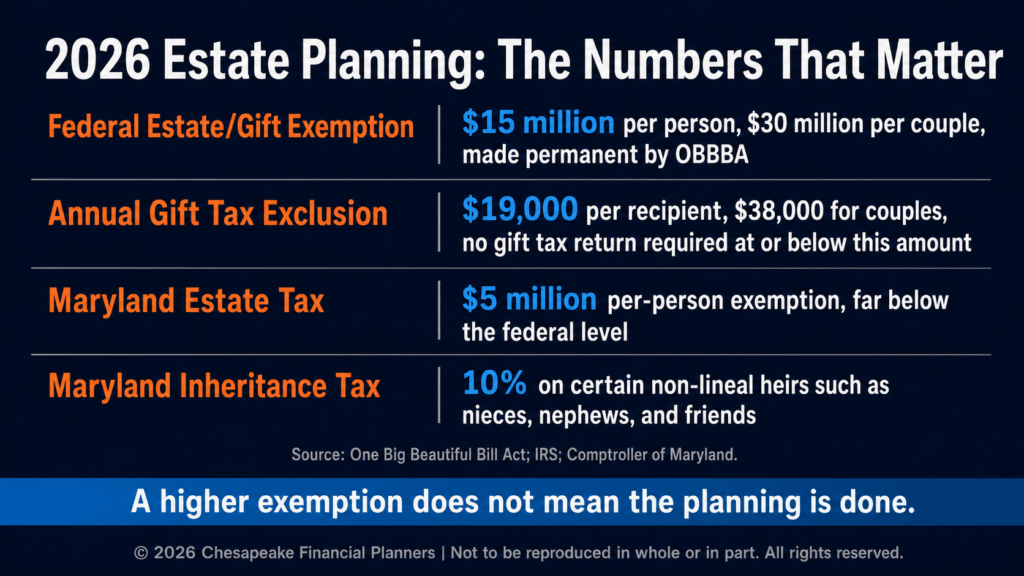
The higher exemption removes federal estate tax from the equation for most families, but it does not remove the work. According to the IRS, the federal estate tax exemption in 2026 is $15 million per individual under the One Big Beautiful Bill Act, which made the elevated amount permanent and indexed it for inflation. Married couples get a combined $30 million.
So if your estate is below $15 million, federal estate tax probably won't touch you. That's where the false comfort starts. Three things still matter regardless of the federal number. State estate and inheritance taxes hit at far lower thresholds. Asset protection through proper ownership structures shields wealth from creditors and lawsuits, which the federal exemption does nothing for. And family coordination prevents the slow-motion wealth destruction that comes from probate, unclear instructions, and sibling conflict.
Jeff Judge often tells clients that the estate tax is the loudest problem and rarely the most expensive one. The quiet costs, probate fees, a frozen account during incapacity, an inheritance routed to an ex-spouse, add up faster than people expect.
How Do State Estate Taxes Change the Picture?
A high federal exemption means nothing if your state taxes estates on its own schedule. Maryland is the example our clients run into most. The state keeps a $5 million estate tax exemption per person, and it also imposes a separate inheritance tax. That means a Maryland resident with a $6 million estate owes zero federal estate tax but still faces Maryland estate tax on the amount above $5 million.
Maryland is unusual because it levies both an estate tax and an inheritance tax. The Comptroller of Maryland administers both. The inheritance tax falls on certain non-lineal heirs at 10%, so leaving assets to a niece, nephew, or friend can trigger a tax that a gift to your child would not.
Other states with their own estate or inheritance taxes include Connecticut, Illinois, Maine, Massachusetts, Minnesota, New York, Oregon, Rhode Island, Vermont, and Washington. If you live in or own property in any of these, your federal exemption is only half the story. Know your state's threshold before you assume you're in the clear.
What Are the Most Common Estate Planning Gaps That Cost Families?
The expensive mistakes are rarely about the estate tax. They're about documents that are missing, outdated, or contradictory. These gaps cost families real money and real time, and almost all of them are preventable.
Outdated beneficiary designations. Your 401(k), IRA, and life insurance pass by beneficiary form, not by your will. If you named an ex-spouse in 2008 and never updated it, your ex inherits, full stop. Review beneficiaries after every marriage, divorce, birth, or death.
No trust structure. Wills go through probate, which is public, slow, and costly. A revocable living trust avoids probate, keeps your affairs private, and gives clear distribution instructions. For minor children, special needs dependents, or heirs who aren't ready to manage money, a trust provides control a will cannot.
Missing powers of attorney and healthcare directives. Estate planning isn't only about death. Without durable financial and healthcare powers of attorney, your family ends up in court to make decisions if you become incapacitated. A healthcare directive spells out your medical wishes when you can't speak for yourself.
What Is a Financial Power of Attorney and Why Do I Need One?
Do I need to update my beneficiary designations after a divorce or major life change?
Which Advanced Strategies Help High Net Worth Families Reduce Estate Size?
Once the basics are in place, families with larger estates can move to strategies that actively shrink the taxable estate. These are not do-it-yourself tools, but the savings justify the setup work.
Gifting strategies. The annual gift tax exclusion lets you give $19,000 per recipient per year in 2026 without using any lifetime exemption, and married couples can give $38,000 per recipient. According to the IRS, gifts within the annual exclusion don't even require a gift tax return. Systematic gifting to children and grandchildren reduces your taxable estate and lets you watch your heirs use the money during your lifetime.
Irrevocable life insurance trusts (ILITs). Life insurance death benefits are income-tax-free but are counted in your taxable estate. An ILIT removes the policy from your estate, preserving more wealth for heirs. ILITs need careful setup and ongoing administration, but for families with large policies the estate tax savings can be substantial.
This is where Chesapeake's planning framework matters. The R.U.D.D.E.R. Method™ is Chesapeake Financial Planners' six-step planning process: Review and Recognize, Uncover and Understand, Design and Develop, Discuss and Decide, Execute and Empower, and Reassess and Refine. Advanced estate tools fail when they're bolted on without that structure, because the ILIT or gifting plan has to fit the rest of the financial picture.
How can I potentially optimize my taxes as my income grows?
How do you create a family wealth governance structure for long-term success?
Frequently Asked Questions
What is the federal estate tax exemption in 2026?
The federal estate tax exemption in 2026 is $15 million per individual, or $30 million for a married couple, under the One Big Beautiful Bill Act. According to the IRS, this elevated amount was made permanent and is indexed for inflation, so estates below that threshold generally owe no federal estate tax.
Does Maryland have its own estate tax in 2026?
Yes, Maryland has a separate estate tax with a $5 million per-person exemption, far below the federal level. A Maryland estate above $5 million can owe state estate tax even when it owes no federal tax. Maryland also imposes an inheritance tax of 10% on certain non-lineal heirs, such as nieces, nephews, and friends.
How much can I gift tax-free in 2026?
In 2026 you can gift $19,000 per recipient per year under the annual gift tax exclusion without using any of your lifetime exemption, and a married couple can give $38,000 per recipient. Gifts within this annual limit don't require a gift tax return and reduce your taxable estate over time.
Do I still need a trust if my estate is under $15 million?
Yes, a trust does much more than reduce estate tax. A revocable living trust avoids probate, keeps your affairs private, and gives clear instructions for distributing assets. For minor children, special needs dependents, or heirs who aren't ready to manage money, a trust provides control and protection a will alone cannot offer.
What happens if my beneficiary designations are outdated?
Outdated beneficiary designations override your will, so your retirement accounts and life insurance go to whoever is named on the form, even an ex-spouse. This is one of the most common and costly estate mistakes. Review your designations after every marriage, divorce, birth, or death to keep them current.
Ready to Make Your Estate Plan Match the 2026 Rules?
The 2026 exemption gives families room to plan with less federal tax pressure, but state taxes, beneficiary forms, and incapacity documents still decide what your heirs actually keep. If you want a clearer picture of where your plan stands, our guide on estate planning essentials for families walks through the documents and decisions in depth. Download it at chesapeakefp.com.
Want to go deeper? Our Busy Professional's Guide to Making Financial Progress walks through this step by step.
Disclosures
The information provided is for educational purposes only and should not be construed as investment advice. Investment strategies should be tailored to individual circumstances, risk tolerance, and goals. Past performance doesn't guarantee future results. Consult with qualified financial professionals regarding your specific situation.
This information is not intended to be a substitute for specific individualized tax, investment or legal advice. We suggest that you discuss your specific situation with a qualified tax, legal or financial advisor.
Advisors associated with Chesapeake Financial Planners may be either (1) LPL Financial Registered Representatives offering securities through LPL Financial, Member FINRA and SIPC, and investment advisor representatives offering investment advice through Great Valley Advisor Group; or (2) solely investment advisor representatives offering investment advice through Great Valley Advisor Group and not affiliated with LPL Financial. Great Valley Advisor Group, and Chesapeake Financial Planners are separate entities from LPL Financial.


