
What Are the Basics of Taxation for Business Owners?
Last reviewed: July 2026
The basics of taxation for business owners come down to four things: how your entity is taxed, the self-employment tax you owe on top of income tax, the quarterly estimated payments you must send the IRS, and the deductions that legally lower your bill. Get those four right and you keep more of what you earn. Get them wrong and you hand the government money you never owed.
Most business owners learn this the expensive way. They find out about self-employment tax after their first profitable year, or they get hit with an underpayment penalty because nobody told them W-2 withholding doesn't apply to them anymore.
Key Takeaways
- Self-employment tax runs 15.3% on net business income up to the Social Security wage base, on top of regular income tax.
- For 2026, the Social Security wage base rises to $184,500, per the Social Security Administration.
- Business owners must make quarterly estimated tax payments or face IRS underpayment penalties.
- Your entity structure — sole proprietor, S-Corp, or C-Corp — directly drives how much tax you pay.
About the Author: Jeff Judge, CFP®, AEP®, ChFC®, CLU® is Managing Partner of Chesapeake Financial Planners in Forest Hill, Maryland. He has been helping families and business owners in Harford County and the Baltimore metro area navigate business and investment taxation since earning his CFP® certification in 2013, by using Chesapeake Financial Planners’ signature process, the R.U.D.D.E.R. method™. Jeff's view: most owners obsess over their investment returns and ignore the five-figure tax bill they could have shaved with a couple of structural decisions made before December.
What Is Self-Employment Tax and Why Does It Surprise Business Owners?
Self-employment tax is the Social Security and Medicare tax that business owners pay on their net business income, totaling 15.3% — 12.4% for Social Security and 2.9% for Medicare. When you were a W-2 employee, your employer paid half of this. As an owner, you pay both halves yourself, which is why it catches so many people off guard in their first profitable year.
The Social Security portion only applies up to the annual wage base. According to the Social Security Administration, that base is $184,500 for 2026. Income above that is still subject to the 2.9% Medicare portion, and high earners owe an additional 0.9% Medicare surtax above certain thresholds, as the IRS explains.
Here is the part that helps: you deduct half of your self-employment tax when calculating your adjusted gross income. That deduction softens the blow, but it does not eliminate it. Plan for 15.3% on top of your income tax until your net income clears the wage base.
For more on how tax rates layer together, see What Is the Difference Between Marginal and Effective Tax Rate?.
How Do Estimated Tax Payments Work for Business Owners?
Estimated tax payments are quarterly installments business owners send the IRS to cover income tax and self-employment tax, because no employer is withholding for them. The 2026 due dates fall in April, June, September, and the following January. Miss them, underpay them, or send them late, and the IRS charges an underpayment penalty calculated as interest on the shortfall.
The safe harbor rule is your friend here. The IRS lets you avoid penalties if you pay at least 90% of the current year's tax or 100% of last year's tax — 110% if your prior-year adjusted gross income exceeded $150,000. Paying the prior-year safe harbor is the simplest way to stay penalty-proof when your income is climbing or unpredictable.
Jeff Judge often tells clients to treat estimated payments like a non-negotiable bill, not an afterthought. He has watched business owners with a great year spend the cash, then scramble in April when the tax bill lands. The fix is boring and it works: move a fixed percentage of every deposit into a separate tax account the day the money arrives.
For a full schedule of when to act on tax moves throughout the year, see What is a year-round tax planning calendar for retirees and pre-retirees?.

How Does Your Business Entity Structure Affect Your Taxes?
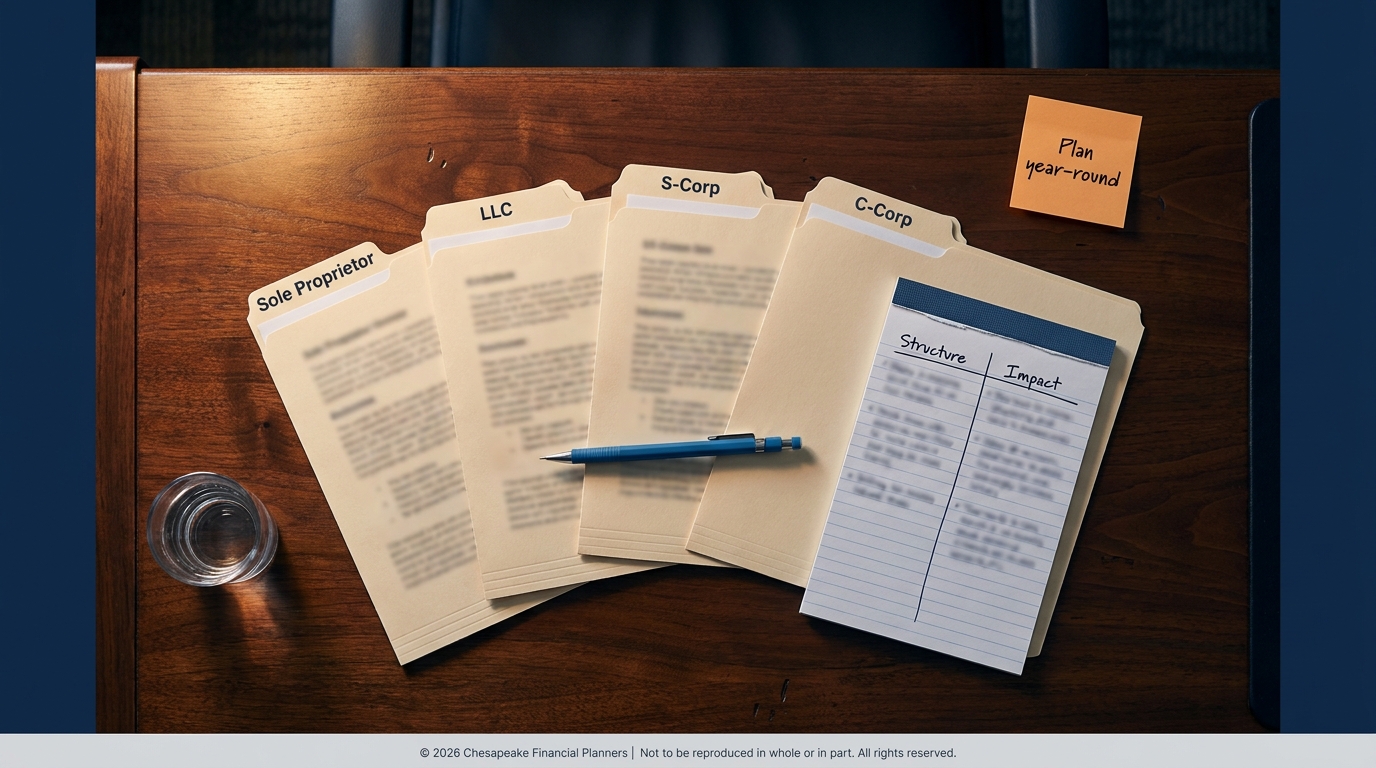
Your entity structure is the single biggest tax lever most owners control, and it determines whether you pay self-employment tax on all your profit or only part of it. Sole proprietorships and partnerships pass income through to your personal return, where the full net profit is subject to self-employment tax. An S-Corp changes the math by splitting your income into salary and distributions.
Here is how the common structures compare on the tax dimensions that matter most:
| Entity Type | Income Tax Treatment | Self-Employment Tax | Key Tradeoff |
|---|---|---|---|
| Sole Proprietor / LLC | Pass-through to personal return | On full net profit | Simple, but no SE tax relief |
| S-Corporation | Pass-through; salary + distributions | Only on reasonable salary | Saves SE tax; requires payroll and reasonable comp |
| C-Corporation | Taxed at corporate level | None at entity level | Double taxation on dividends; flat 21% corporate rate |
The S-Corp election is where many growing businesses find real savings. You pay yourself a reasonable salary subject to payroll taxes, then take the rest as distributions that escape self-employment tax. The catch is "reasonable" — pay yourself too little and the IRS can reclassify your distributions as wages, with penalties attached.
This decision deserves real analysis with your tax professional, because the right answer changes as your profit grows. For owners earning in the higher brackets, structure and salary strategy compound over time. See How Can I Reduce Taxes When Earning $200K to $500K?.
What Deductions and Strategies Lower a Business Owner's Tax Bill?
The deductions and strategies that lower your tax bill fall into two buckets: expenses you can legitimately write off, and timing moves that shift income into lower-tax years. Both require documentation and intent. The home office deduction, vehicle expenses, health insurance premiums, and retirement plan contributions are among the most valuable, but each has rules about what qualifies and how you prove it.
Retirement accounts do double duty. Business owners can use a SEP-IRA or Solo 401(k) to contribute far more than a standard employee 401(k) allows. According to the IRS, Solo 401(k) total contributions can reach $72,000 for 2026 (plus catch-up amounts for those 50 and older). Every dollar contributed reduces your current taxable income while building tax-advantaged wealth.
The qualified business income (QBI) deduction is another major one. The IRS allows eligible pass-through owners to deduct up to 20% of qualified business income, subject to income thresholds and business-type limits. For many owners this is the largest single deduction on the return.
At Chesapeake Financial Planners, we run business owners through the R.U.D.D.E.R. Method™ — Chesapeake Financial Planners' six-step planning process: Review and Recognize, Uncover and Understand, Design and Develop, Discuss and Decide, Execute and Empower, and Reassess and Refine. Tax planning lives across all six steps, not just at filing time. To see how exit timing affects taxes, see What's the most tax-efficient way to exit my business?. Jeff Judge notes: "Business owners who only think about taxes in April are leaving money on the table, because the moves that actually reduce your bill, like funding a Solo 401(k) or timing income between years, have to be made before December 31."
Frequently Asked Questions
How much is self-employment tax for business owners?
Self-employment tax is 15.3% of net business income — 12.4% for Social Security and 2.9% for Medicare. The Social Security portion applies only up to the wage base, which the Social Security Administration set at $184,500 for 2026. You can deduct half of the self-employment tax you pay when calculating your adjusted gross income.
Do business owners have to pay quarterly estimated taxes?
Yes, business owners generally must pay quarterly estimated taxes because no employer withholds tax from their income. You make four payments across the year covering both income tax and self-employment tax. To avoid IRS underpayment penalties, pay at least 90% of the current year's tax or 100% of last year's — 110% if your prior-year income exceeded $150,000.
Does an S-Corp save business owners money on taxes?
An S-Corp can save business owners money by reducing self-employment tax. You pay yourself a reasonable salary subject to payroll tax, then take remaining profit as distributions that avoid the 15.3% self-employment tax. The savings only work if your salary is genuinely reasonable for your role, because the IRS can reclassify underpaid salaries as wages.
What is the best retirement account for self-employed business owners?
The best retirement account depends on your income, but Solo 401(k)s and SEP-IRAs let self-employed owners contribute far more than a standard 401(k). The IRS allows Solo 401(k) total contributions up to $72,000 for 2026, plus catch-up amounts after age 50. These contributions reduce current taxable income while building tax-advantaged retirement savings.
Can business owners deduct a home office?
Yes, business owners who use part of their home regularly and exclusively for business can deduct home office expenses. You can use the simplified method, which applies a set rate per square foot, or the regular method, which allocates actual costs like utilities and mortgage interest. Keep clear records, since this deduction draws IRS attention when documentation is weak.
When should a business owner hire a financial advisor for tax planning?
A business owner should bring in a financial advisor once income, complexity, or a major transition raises the stakes — variable income, multiple revenue streams, a business sale, or significant investments. An advisor who coordinates with your CPA plans across multiple years, not just at filing time, catching opportunities that a once-a-year tax return review will miss entirely.
Ready to Stop Overpaying?
Understanding the basics of taxation is the first step; building a plan around them is where the real money lives. If you want a clear framework for keeping more of what your business earns, our tax planning guide walks through the moves that matter most for owners and high earners. Download it at chesapeakefp.com.
Want to go deeper? Our Tax Strategy Readiness Quiz walks through this step by step.
Disclosures
The information provided is for educational purposes only and should not be construed as investment advice. Investment strategies should be tailored to individual circumstances, risk tolerance, and goals. Past performance doesn't guarantee future results. Consult with qualified financial professionals regarding your specific situation.
This information is not intended to be a substitute for specific individualized tax, investment or legal advice. We suggest that you discuss your specific situation with a qualified tax, legal or financial advisor.
Advisors associated with Chesapeake Financial Planners may be either (1) LPL Financial Registered Representatives offering securities through LPL Financial, Member FINRA and SIPC, and investment advisor representatives offering investment advice through Great Valley Advisor Group; or (2) solely investment advisor representatives offering investment advice through Great Valley Advisor Group and not affiliated with LPL Financial. Great Valley Advisor Group, and Chesapeake Financial Planners are separate entities from LPL Financial.


