

What Should I Do With My Company Stock Options?
Last reviewed: July 2026
Your first move with company stock options is to identify whether you hold incentive stock options (ISOs) or non-qualified stock options (NSOs), because the tax treatment is completely different. From there, you build a plan around three decisions: when to exercise, when to sell, and how to manage the tax bill at each step. Most people lose money on company stock options not by picking the wrong company, but by mishandling the timing and the taxes.
Key Takeaways
- Identify your option type first: ISOs and NSOs are taxed differently, and the gap can cost you tens of thousands.
- ISOs can trigger Alternative Minimum Tax at exercise; the 2026 AMT exemption for single filers is $90,100.
- NSOs are taxed as ordinary income on the spread at exercise, with no AMT surprise.
- Holding ISO shares one year after exercise and two years after grant unlocks long-term capital gains rates.
- Never let a concentrated stock position grow past a comfortable share of your net worth.
About the Author: Jeff Judge, CFP®, AEP®, ChFC®, CLU® is Managing Partner of Chesapeake Financial Planners in Forest Hill, Maryland. He has been helping families and business owners in Harford County and the Baltimore metro area navigate equity compensation and stock option decisions since earning his CFP® certification in 2013, by using Chesapeake Financial Planners’ signature process, the R.U.D.D.E.R. method™. Jeff often tells clients the biggest mistake he sees is treating stock options as a lottery ticket instead of a taxable asset that needs a plan years before any liquidity event.
What Are Company Stock Options and How Do They Work?
Company stock options give you the right to buy a set number of company shares at a fixed price, called the strike price, after you meet a vesting schedule. They are not shares you own outright. They are a contract that lets you buy shares later, ideally when the stock is worth more than your strike price.
Most option grants vest over four years with a one-year cliff. That means you earn nothing for the first 12 months, then a quarter of your grant vests, and the rest vests monthly or quarterly afterward. Options typically expire 10 years from the grant date, or 90 days after you leave the company, whichever comes first.
The two main types are ISOs and NSOs. ISOs carry a potential tax advantage but come with the risk of Alternative Minimum Tax. NSOs are simpler but taxed less favorably. Knowing which you hold is the foundation for every decision that follows. Your grant agreement spells this out, so save that document.
ISO vs NSO: How Are Company Stock Options Taxed?
The ISO vs NSO distinction drives your entire tax outcome. With incentive stock options, if you hold the shares at least one year after exercise and two years after the grant date, your entire gain is taxed at long-term capital gains rates rather than ordinary income rates. With NSOs, the spread between fair market value and your strike price at exercise is taxed as ordinary income, and you owe payroll taxes on it too.
Here is the side-by-side comparison:
| Feature | Incentive Stock Options (ISOs) | Non-Qualified Stock Options (NSOs) |
|---|---|---|
| Tax at exercise | None for regular tax; may trigger AMT | Spread taxed as ordinary income |
| Tax at sale | Long-term capital gains if holding rules met | Capital gains on appreciation after exercise |
| Annual limit | $100,000 worth becomes exercisable per year | No limit |
| AMT exposure | Yes | No |
| Payroll taxes | No | Yes |
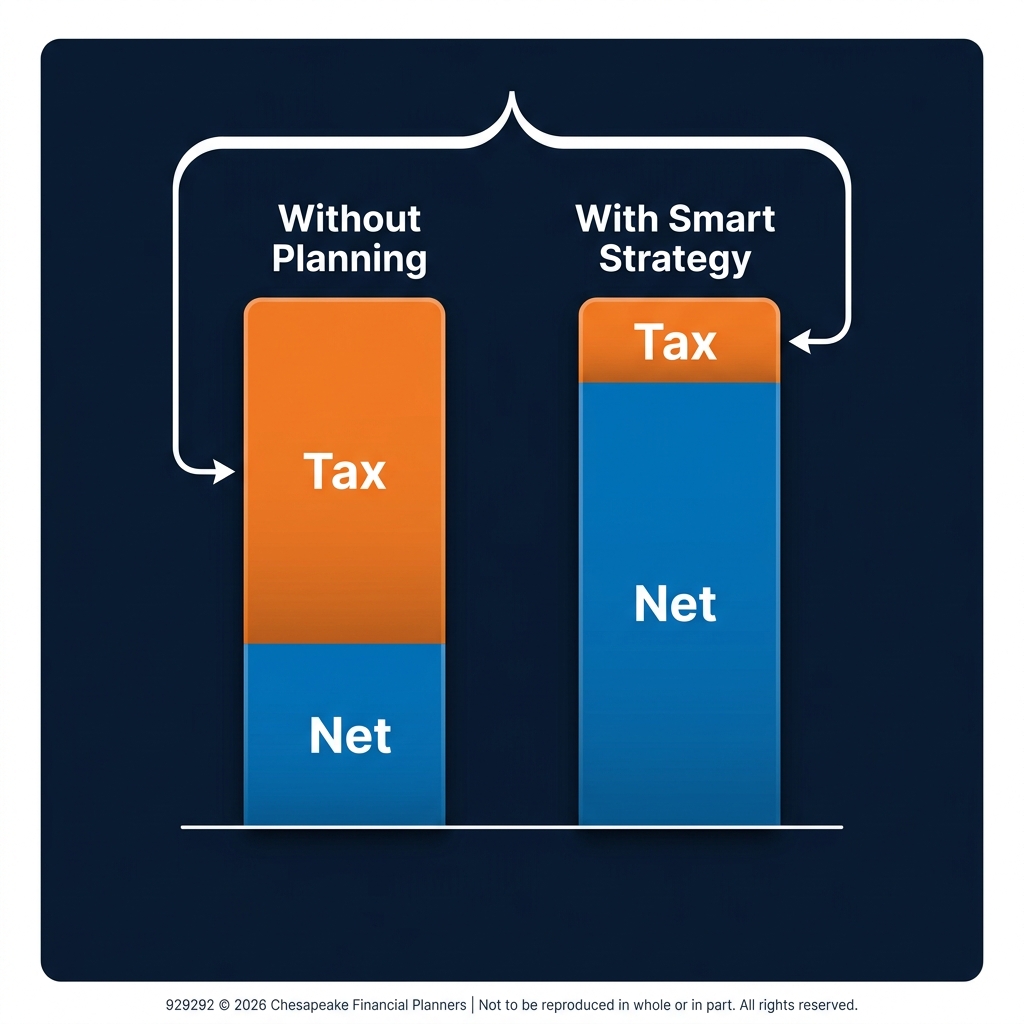
According to the IRS, the top long-term capital gains rate is 20%, compared to a top ordinary income rate of 37%. That spread is why option holders fight to qualify for capital gains treatment. The tax difference on a large exercise can easily reach six figures.
Jeff Judge has watched clients exercise a year of ISOs without modeling the AMT and get hit with a tax bill they could not cover in cash. Exercising ISOs is the step where people get hurt, because you can owe tax on a paper gain you have not actually pocketed.
When Should You Exercise Your Stock Options?
Exercise timing depends on three things: your company's stage, your strike price relative to fair market value, and your cash reserves. There is no single right answer, but there is a clear framework.
If your company is private and your strike price equals the current fair market value, early exercise can make sense. It starts your capital gains holding clock and, for ISOs, avoids future AMT because the spread is zero at exercise. The downside is real: you spend cash buying shares that could become worthless if the company fails.
If your company is public, the decision is cleaner because there is a market to sell into. You can exercise and sell in the same transaction to cover costs, or exercise and hold to chase long-term capital gains treatment. The hold-and-pray approach is where concentration risk creeps in.
For NSOs at a private company, most people wait until a liquidity event like an IPO or acquisition, because exercising early means paying ordinary income tax on a gain you cannot yet sell. The R.U.D.D.E.R. Method™ is Chesapeake Financial Planners' six-step planning process: Review and Recognize, Uncover and Understand, Design and Develop, Discuss and Decide, Execute and Empower, and Reassess and Refine. We use the Design and Develop step to model several exercise scenarios before a client commits cash.
How Do You Avoid the AMT Trap With ISO Stock Options?
The Alternative Minimum Tax is the single most common stock option mistake, and it is avoidable with planning. When you exercise ISOs and hold the shares, the spread between fair market value and your strike price counts as income for AMT purposes, even though you have not sold anything.
The 2026 AMT exemption is $90,100 for single filers and $140,200 for married couples filing jointly, per the IRS. The strategy is to exercise enough ISOs each year to stay under or near the threshold where AMT kicks in, spreading exercises across multiple tax years rather than exercising everything at once. This is sometimes called exercising "up to the AMT crossover point."
If you do trigger AMT, the tax you pay can generate an AMT credit you recover in future years, but that recovery can take a long time. According to the Tax Foundation, the AMT was designed to ensure high earners pay a minimum level of tax, and stock option exercises are one of the most common triggers. The practical takeaway: model your AMT exposure before you exercise, not after.
What Happens to Stock Options When You Leave a Company?
When you leave a company, you typically have a short window, often just 90 days, to exercise any vested options before they expire. Unvested options are usually forfeited entirely. This deadline catches people off guard, especially when leaving for a new job during a busy transition.
If you have valuable vested options and limited cash, the 90-day clock forces a hard decision: come up with the exercise cash quickly, or walk away from the options. Some companies offer extended exercise windows, but most do not. Check your grant agreement before you give notice, not after.
This is also the moment concentration risk becomes urgent. If your options are worth a meaningful share of your net worth, exercising and holding everything ties your financial future to one company's stock at the exact moment you are leaving it.
Frequently Asked Questions
What is the difference between ISO and NSO stock options?
Incentive stock options (ISOs) can qualify for long-term capital gains treatment if you hold shares one year after exercise and two years after grant, but they may trigger Alternative Minimum Tax. Non-qualified stock options (NSOs) are taxed as ordinary income on the spread at exercise, with no AMT exposure, making them simpler but generally less tax-favorable.
Do I pay taxes when I exercise stock options?
With NSOs, yes: the spread between fair market value and your strike price is taxed as ordinary income at exercise, plus payroll taxes. With ISOs, you owe no regular income tax at exercise, but the spread can count toward Alternative Minimum Tax. The actual sale of shares is a separate taxable event with its own treatment.
How do I avoid AMT on incentive stock options?
You avoid or limit AMT by spreading ISO exercises across multiple tax years and staying near the AMT exemption threshold, which is $90,100 for single filers in 2026 per the IRS. Modeling your AMT crossover point before exercising lets you exercise the maximum number of shares each year without triggering a surprise tax bill on paper gains.
Should I exercise stock options early at a private company?
Early exercise can make sense if your strike price equals fair market value, you believe in the company long term, and you have cash you can afford to lose. It starts your capital gains holding clock and avoids future AMT for ISOs. The risk is real: you spend cash on shares that become worthless if the company fails.
What happens to my stock options when I quit my job?
When you leave a company, vested options usually must be exercised within a short window, often 90 days, or they expire. Unvested options are typically forfeited entirely. Some employers offer extended exercise windows, but most do not, so review your grant agreement before giving notice to avoid losing valuable options on a tight deadline.
How much of my net worth should be in company stock?
There is no universal number, but holding a large share of your net worth in a single company's stock exposes you to concentration risk that can wipe out years of gains. Many advisors suggest trimming a position once it grows beyond a level you would be uncomfortable losing, then diversifying the proceeds across a broader portfolio.
If you are weighing what to do with your company stock options, the right answer depends on your option type, your tax bracket, and your timeline. At Chesapeake Financial Planners, we model these decisions with clients every week, mapping out exercise scenarios years before any liquidity event. If you want a second opinion on your equity compensation strategy, visit chesapeakefp.com to learn more.
How does equity compensation affect my financial plan?
How do I diversify a concentrated company stock position without a huge tax bill?
How Much of My Portfolio Should Be in One Stock?
Should I Sell My Company Stock When the IPO Lockup Period Expires?
Want to go deeper? Our Stock Option Strategy Worksheet walks through this step by step.
Disclosures
The information provided is for educational purposes only and should not be construed as investment advice. Investment strategies should be tailored to individual circumstances, risk tolerance, and goals. Past performance doesn't guarantee future results. Consult with qualified financial professionals regarding your specific situation.
Advisors associated with Chesapeake Financial Planners may be either (1) LPL Financial Registered Representatives offering securities through LPL Financial, Member FINRA and SIPC, and investment advisor representatives offering investment advice through Great Valley Advisor Group; or (2) solely investment advisor representatives offering investment advice through Great Valley Advisor Group and not affiliated with LPL Financial. Great Valley Advisor Group, and Chesapeake Financial Planners are separate entities from LPL Financial.


