

What Is a Retirement Planning Checklist and What Should It Include?
Last reviewed: July 2026
A retirement planning checklist is a structured sequence of decisions and actions that moves you from saving for retirement to actually living in it. It covers income, taxes, healthcare, Social Security timing, required withdrawals, and your estate, in the order they need attention. The point is simple: retirement isn't one decision, it's about thirty of them, and the order you make them in changes the outcome by tens of thousands of dollars.
Most people walk into retirement with a pile of accounts and no map. A good retirement planning checklist gives you the map. It tells you what to handle five years out, what to handle the year before, and what to handle the moment your last paycheck clears.
Key Takeaways
- A retirement planning checklist sequences income, tax, healthcare, and estate decisions in the order they actually need attention.
- The 2026 IRS 401(k) employee contribution limit is $24,500, with higher catch-up amounts for those age 50 and older.
- Delaying Social Security past full retirement age increases your benefit by 8% per year until age 70.
- Required minimum distributions now begin at age 73 under SECURE 2.0.
- Coordinating the order of these decisions, not picking better investments, is where most retirement value is won or lost.
About the Author: Jeff Judge, CFP®, AEP®, ChFC®, CLU® is Managing Partner of Chesapeake Financial Planners in Forest Hill, Maryland. He has been helping families and business owners in Harford County and the Baltimore metro area navigate retirement transitions since earning his CFP® certification in 2013, by using Chesapeake Financial Planners’ signature process, the R.U.D.D.E.R. method™. Jeff often tells clients that the biggest retirement mistakes aren't investment mistakes; they're sequencing mistakes, made quietly in the two or three years before someone stops working.
What This Checklist Covers
- What a retirement planning checklist is
- Step 1: Map your retirement income sources
- Step 2: Build your tax strategy before you retire
- Step 3: Decide when to claim Social Security
- Step 4: Lock in your healthcare and Medicare plan
- Step 5: Plan for required minimum distributions
- Step 6: Update your estate and risk protection
- How the R.U.D.D.E.R. Method™ turns this checklist into a plan
- Frequently asked questions
Step 1: Map Your Retirement Income Sources
How do I know if I have enough income to retire?
Start by listing every income source you'll have in retirement and what it pays per month, not per year. Most retirees draw from three buckets: guaranteed income (Social Security, pensions, annuities), tax-deferred accounts (401(k)s, traditional IRAs), and after-tax accounts (Roth IRAs, brokerage accounts, savings). You can't plan a withdrawal strategy until you can see all three on one page.
The gap between your guaranteed income and your actual monthly spending is what your savings have to cover. If you spend $7,000 a month and Social Security plus a pension covers $4,000, your portfolio needs to produce $3,000 a month, adjusted for inflation, for the rest of your life. That number drives everything else.
A common benchmark is that retirees need to replace roughly 80% of pre-retirement income to maintain their standard of living, though the real figure depends on your debt, healthcare, and lifestyle. Jeff has watched clients underestimate spending in the first two years of retirement, when travel and home projects spike, then overestimate it later. Build for the early surge.
Run the numbers across a full year, including irregular costs: property taxes, insurance premiums, and the new roof you've been putting off. A retirement income plan that only counts the predictable bills always falls short.
Step 2: Build Your Tax Strategy Before You Retire
Why does tax planning matter more right before retirement?
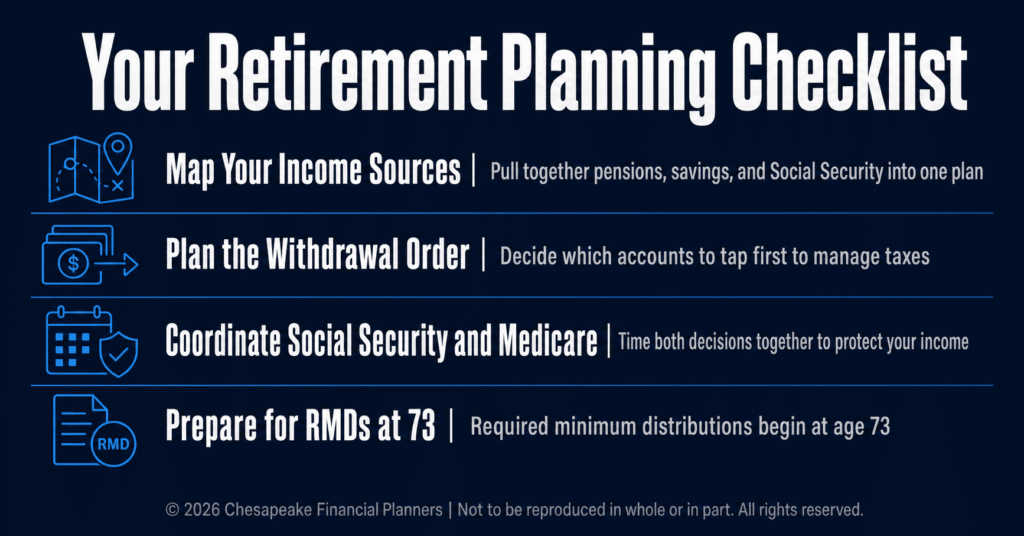
The years right before and right after you stop working are the most valuable tax-planning window of your life, because your income often drops before required withdrawals and Social Security push it back up. This is the window where a retirement planning checklist earns its keep.
Here's the lever most people miss. If you retire at 64 and don't claim Social Security until 70, you may have several years of unusually low taxable income. Those are the years to consider Roth conversions, moving money from a traditional IRA to a Roth and paying tax now at a low rate, instead of later at a higher one when RMDs kick in.
For 2026, the IRS set the employee 401(k) contribution limit at $24,500, and workers age 50 and older can add catch-up contributions on top. If you're still working in your early sixties, maxing these accounts can lower this year's tax bill while you finish building the balance.
The mistake Jeff sees repeatedly: clients optimize their investment returns and ignore the six-figure tax bill they're building inside their traditional IRA. The IRS is your silent partner in every pre-tax dollar you saved. A tax-aware withdrawal order, after-tax first, then tax-deferred, then Roth last, can stretch a portfolio years longer than drawing accounts in the wrong sequence.
What are the most common Roth IRA mistakes and how do I avoid them?
According to the IRS, Roth IRA withdrawals of contributions are tax-free and penalty-free at any age, which is what makes the Roth bucket the one you want to touch last. Map your conversions against the top of your current tax bracket so you never push income into the next one accidentally.
Should I max out my 401(k) or invest somewhere else?
Step 3: Decide When to Claim Social Security
What is the best age to claim Social Security?
There is no single best claiming age, but for most people in good health, waiting past full retirement age pays the highest lifetime return. Every year you delay claiming between full retirement age and 70 increases your benefit by 8% per year, a guaranteed, inflation-adjusted raise you can't buy anywhere else.
Full retirement age is 67 for anyone born in 1960 or later, according to the Social Security Administration. Claim at 62 and you permanently reduce your benefit by up to 30%. Claim at 70 and you lock in the maximum. For a married couple, the higher earner's claiming decision is the most important, because it sets the survivor benefit the surviving spouse keeps for life.
How do I coordinate all my retirement income sources to minimize taxes and maximize income?
The catch is that claiming early can make sense for people with health concerns, no spousal benefit at stake, or an immediate income need. This is exactly the kind of decision that doesn't belong in a vacuum. Your Social Security timing interacts with your tax strategy and your Roth conversion window. Claim too early and you fill up the low-income years you needed for conversions.
Jeff frames it this way for clients: Social Security is the only inflation-protected, government-backed income you'll ever own. Treat the claiming decision with the seriousness it deserves, because it's irreversible after the first year.
Step 4: Lock In Your Healthcare and Medicare Plan
What do I need to know about Medicare before retiring?
Medicare eligibility begins at age 65, and missing your enrollment window can trigger lifelong penalties, so this belongs on every retirement planning checklist with a hard deadline attached. Your initial enrollment period spans the seven months around your 65th birthday.
If you retire before 65, you need a plan to bridge the healthcare gap, whether that's COBRA, a spouse's plan, or a marketplace policy. Healthcare is one of the largest and most underestimated retirement costs. A 65-year-old couple retiring in 2024 could expect to need roughly $330,000 saved to cover healthcare costs throughout retirement, according to Fidelity's annual estimate.
Higher-income retirees face an extra wrinkle called IRMAA, the income-related monthly adjustment that raises Medicare Part B and Part D premiums. The Centers for Medicare & Medicaid Services ties these surcharges to your income from two years prior, which is precisely why your Roth conversion and withdrawal decisions in Steps 2 and 3 ripple into your Medicare premiums here. Everything connects.
What is the best order to withdraw from my 401k, Roth IRA, and taxable accounts in retirement?

Step 5: Plan for Required Minimum Distributions
When do I have to start taking money out of my retirement accounts?
Required minimum distributions now begin at age 73 for most retirees, under the SECURE 2.0 Act, and the age rises to 75 for those born in 1960 or later. An RMD is the minimum amount the IRS forces you to withdraw from tax-deferred accounts each year, whether you need the money or not.
Miss an RMD and the penalty is steep. Under current rules, the excise tax is 25% of the amount you failed to withdraw, reduced to 10% if you correct the shortfall promptly. That's a tax you never have to pay if you simply track the deadline.
Here's why RMDs belong on the checklist years before they hit. Once they start, they can push you into a higher bracket, raise your Medicare premiums, and tax more of your Social Security. The conversions you did in Step 2 shrink the traditional balance that RMDs are calculated against. This is the payoff for sequencing your decisions instead of making them in isolation.
Roth IRAs have no RMDs during the owner's lifetime, which is another reason the Roth bucket is the last one you spend. Charitable retirees can also satisfy RMDs through qualified charitable distributions, sending money directly to a charity and keeping it off their taxable income entirely.
Step 6: Update Your Estate and Risk Protection
What estate documents do I need before I retire?
Before you retire, you need at minimum a current will, a durable power of attorney, a healthcare directive, and updated beneficiary designations on every retirement account and insurance policy. Beneficiary forms override your will, so a stale designation naming an ex-spouse will hand them the account no matter what your will says.
This is the step people skip because it's uncomfortable, not because it's hard. Jeff has seen well-built financial plans unravel because a beneficiary form was twenty years out of date or a power of attorney didn't exist when a spouse became incapacitated. The paperwork costs a few hours. The absence of it costs families months in probate court.
Should I update my financial plan after a big life event?
Risk protection rounds out the checklist. Review your life insurance to confirm it still matches your obligations, and seriously evaluate long-term care coverage, because the U.S. Department of Health and Human Services estimates that someone turning 65 today has about a 70% chance of needing some form of long-term care. A single year in a private nursing-home room can erase a meaningful slice of a portfolio.
For Maryland residents, state-specific estate rules and tax considerations add another layer worth reviewing with an advisor who knows the local landscape.
How the R.U.D.D.E.R. Method™ Turns This Checklist Into a Plan
A checklist tells you what to do. A process tells you how to do it in the right order, with the right tradeoffs, for your specific situation. The R.U.D.D.E.R. Method™ is Chesapeake Financial Planners' six-step planning process: Review and Recognize, Uncover and Understand, Design and Develop, Discuss and Decide, Execute and Empower, and Reassess and Refine.
The reason this matters is everything you just read interacts. Your Social Security timing affects your tax strategy. Your tax strategy affects your Medicare premiums. Your conversions affect your RMDs. A checklist handled item by item, in isolation, misses those connections. A process built around them captures the value.
Why Does a Financial Planning Process Matter More Than Investment Selection?
Jeff puts it plainly: most people sweat the investment returns and ignore the $40,000 they're giving back in unnecessary taxes and mistimed claims. The retirement planning checklist above is the raw material. The plan is what happens when you sequence it correctly.
How Does a Financial Plan Actually Get Built?

Frequently Asked Questions
When should I start using a retirement planning checklist?
Start using a retirement planning checklist at least five years before your target retirement date. That window gives you time to execute Roth conversions during low-income years, coordinate Social Security timing, and close any income gaps. Waiting until the year you retire eliminates the most valuable tax-planning opportunities and forces rushed decisions you can't reverse.
How much money do I need to retire?
The amount you need depends on your annual spending and guaranteed income, not a single magic number. A common benchmark is replacing roughly 80% of your pre-retirement income, but the real figure is whatever covers the gap between your Social Security and pension income and your actual monthly expenses, adjusted for inflation across a thirty-year retirement.
What is the biggest mistake people make in retirement planning?
The biggest mistake is treating retirement decisions in isolation instead of sequencing them. People claim Social Security early, then lose the low-income years needed for Roth conversions, then get surprised by RMDs and higher Medicare premiums. Each decision affects the others, and the order you make them in can change your lifetime outcome by tens of thousands of dollars.
Do I have to take money out of my retirement accounts at a certain age?
Yes, required minimum distributions begin at age 73 for most retirees under the SECURE 2.0 Act, rising to 75 for those born in 1960 or later. RMDs apply to traditional IRAs and 401(k)s, and the penalty for missing one is 25% of the shortfall. Roth IRAs have no RMDs during the owner's lifetime.
When is the best time to claim Social Security?
For most people in good health, waiting until age 70 produces the highest lifetime benefit, because delaying past full retirement age increases your payment by 8% per year. Claiming at 62 permanently reduces your benefit by up to 30%. The right age depends on your health, marital status, and whether you have other income to bridge the gap.
Should I do Roth conversions before retirement?
Roth conversions often make the most sense in the low-income years between retiring and starting Social Security or RMDs. Converting traditional IRA money to a Roth means paying tax now, at a low rate, instead of later at a higher one. Done correctly, conversions shrink your future RMDs and can lower your Medicare premiums down the road.
How does Medicare fit into retirement planning?
Medicare eligibility begins at age 65, and your initial enrollment period spans the seven months around your birthday. Missing it can trigger lifelong premium penalties. If you retire before 65, you need a bridge plan such as COBRA or a marketplace policy. Higher earners also face IRMAA surcharges tied to income from two years prior.
Ready to Turn This Checklist Into a Plan?
A checklist gets you organized. A plan gets you across the finish line. At Chesapeake Financial Planners, we work through this retirement planning checklist with pre-retirees every week, sequencing the tax, Social Security, Medicare, and estate decisions so they work together instead of against each other. If you're within a few years of retirement and want a second opinion on your sequencing, it costs you nothing. Visit chesapeakefp.com to learn more.
Disclosures
The information provided is for educational purposes only and should not be construed as investment advice. Investment strategies should be tailored to individual circumstances, risk tolerance, and goals. Past performance doesn't guarantee future results. Consult with qualified financial professionals regarding your specific situation.
Advisors associated with Chesapeake Financial Planners may be either (1) LPL Financial Registered Representatives offering securities through LPL Financial, Member FINRA and SIPC, and investment advisor representatives offering investment advice through Great Valley Advisor Group; or (2) solely investment advisor representatives offering investment advice through Great Valley Advisor Group and not affiliated with LPL Financial. Great Valley Advisor Group, and Chesapeake Financial Planners are separate entities from LPL Financial.


