

What Are the Most Common Roth IRA Mistakes and How Do I Avoid Them?
Last reviewed: July 2026
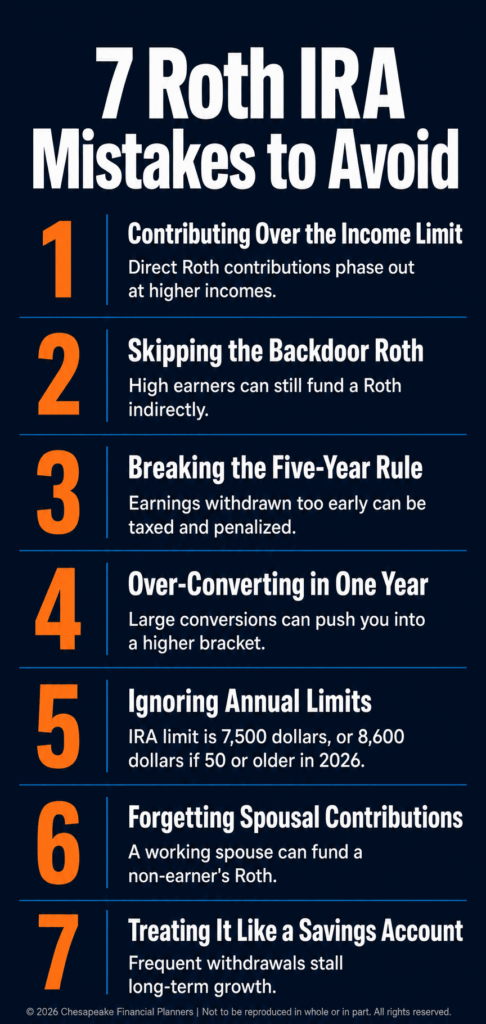
The most common Roth IRA mistakes to avoid are contributing when your income is too high, missing the five-year rule, forgetting the backdoor strategy when you earn too much, and over-converting in a single year. Each one is fixable if you catch it early, and most cost real money only when they go unnoticed for years. This guide walks through the mistakes we see most often and tells you exactly what to do instead.
Key Takeaways
- The 2026 Roth IRA contribution limit is $7,500, with a $1,100 catch-up for those 50 and older.
- Direct Roth contributions phase out for single filers with MAGI above certain thresholds, so high earners need the backdoor approach.
- The five-year rule applies separately to contributions and conversions, and missing it can trigger taxes and penalties.
- Over-converting in one year can push you into a higher bracket and raise your Medicare premiums two years later.
About the Author: Jeff Judge, CFP®, AEP®, ChFC®, CLU® is Managing Partner of Chesapeake Financial Planners in Forest Hill, Maryland. He has been helping families and business owners in Harford County and the Baltimore metro area navigate Roth IRA decisions since earning his CFP® certification in 2013, by using Chesapeake Financial Planners’ signature process, the R.U.D.D.E.R. method™. Jeff often tells clients that the Roth IRA is one of the few accounts where small mistakes early compound into large tax bills later, which is exactly why catching them matters.
A Roth IRA is one of the best retirement accounts available, but the rules trip people up constantly. The account grows tax-free, qualified withdrawals come out tax-free, and there are no required minimum distributions during your lifetime. Those benefits are real. They also create a set of traps that catch high earners, late savers, and anyone moving fast without a plan. Here are the seven Roth IRA mistakes to avoid, and what to do instead for each one.
1. Contributing When Your Income Is Too High
The biggest Roth IRA mistake we see is making a direct contribution when your income disqualifies you. Direct Roth contributions phase out above certain modified adjusted gross income (MAGI) levels. According to the IRS, once you cross the upper limit of the phase-out range for your filing status, you cannot contribute directly at all.
If you contribute anyway, the IRS treats it as an excess contribution and charges a 6% penalty for every year it sits in the account uncorrected. That penalty repeats annually until you fix it.
What to do instead: Check your MAGI before you contribute, not after. If you are above the limit, remove the excess contribution (plus earnings) before your tax filing deadline, or recharacterize it. Better yet, plan your contribution method around your income from the start. Want to see how this fits a broader plan? Should I max out my 401(k) or invest somewhere else?
2. Skipping the Backdoor Roth When You Earn Too Much
High earners often assume they are simply locked out of a Roth IRA. They are not. The backdoor Roth IRA is a perfectly legal two-step move: you make a nondeductible contribution to a traditional IRA, then convert it to a Roth. There is no income limit on conversions, which is what makes this work.
The mistake is either not knowing the strategy exists or executing it wrong. Jeff has watched clients leave thousands in future tax-free growth on the table simply because no one told them the backdoor existed.
What to do instead: If your income is too high for a direct contribution, use the backdoor method. Just watch the pro-rata rule, which is the next mistake on this list.
3. Ignoring the Pro-Rata Rule on Conversions
The pro-rata rule is the trap inside the backdoor strategy. When you convert money from a traditional IRA to a Roth, the IRS looks at all of your traditional IRA balances combined, not just the dollars you are converting. If you have existing pre-tax money in any traditional IRA, SEP-IRA, or SIMPLE IRA, part of your conversion becomes taxable.
Here is a simple comparison of how the rule plays out:
| Situation | Pre-tax IRA balance | Backdoor result |
|---|---|---|
| Clean backdoor | $0 in pre-tax IRAs | Conversion is mostly tax-free |
| Pro-rata triggered | $90,000 pre-tax + $7,500 new | Most of the conversion is taxable |
What to do instead: Before doing a backdoor Roth, consider rolling existing pre-tax IRA balances into your employer 401(k) if the plan allows it. That removes them from the pro-rata calculation. Can I roll my old 401(k) into an IRA instead?
4. Misunderstanding the Five-Year Rule
The five-year rule confuses almost everyone, partly because there are two of them. One applies to contributions: your Roth account must be open at least five years before earnings can come out tax-free. The other applies to each conversion: converted amounts have their own five-year clock before you can withdraw them penalty-free if you are under 59½.
People assume that because they are over 59½, withdrawals are automatically fine. That is not always true for recently converted dollars or a newly opened account.
What to do instead: Open a Roth IRA sooner rather than later, even with a small contribution, to start the clock. Track the date of each conversion separately. The IRS guidance lays out qualified distribution rules in detail.

5. Over-Converting in a Single Year
A Roth conversion is taxable in the year you do it. Convert too much at once and you can push yourself into a higher tax bracket, increase the taxable portion of your Social Security, and trigger higher Medicare premiums through IRMAA two years later. The conversion that looked smart in isolation can cost more than it saves.
This is where Jeff sees pre-retirees get burned most often. A large one-time conversion feels efficient, but the second-order effects on brackets and Medicare surprise people the following year.
What to do instead: Convert in measured amounts across several years, filling up a target tax bracket each year rather than blowing past it. This is the kind of decision the [R.U.D.D.E.R. Method™ is Chesapeake Financial Planners' six-step planning process: Review and Recognize, Uncover and Understand, Design and Develop, Discuss and Decide, Execute and Empower, and Reassess and Refine] is built to handle, because the right conversion amount depends on your whole picture. What is the best order to withdraw from my 401k, Roth IRA, and taxable accounts in retirement? Jeff Judge notes: "Converting just enough each year to fill your current bracket costs far less than one large conversion that hands a portion of your savings to a higher bracket while quietly triggering IRMAA surcharges two years down the road."
6. Withdrawing Earnings Too Early
You can always pull out your direct Roth contributions tax-free and penalty-free, because you already paid tax on that money. The mistake is assuming earnings work the same way. Withdraw earnings before you are 59½ and before the account has been open five years, and you owe income tax plus a 10% penalty on those earnings.
What to do instead: Treat the Roth as a long-term account, not an emergency fund. If you genuinely need cash, withdraw only your contributions and leave the earnings to keep compounding tax-free. For short-term cash needs, build a separate cushion. How much should I save in an emergency fund during a job change?
7. Forgetting Spousal and Catch-Up Opportunities
Two Roth opportunities get missed regularly. The first is the spousal Roth IRA: a non-working or low-earning spouse can still contribute based on the working spouse's income, as long as the couple files jointly. The second is the catch-up contribution. The IRS allows an additional $1,100 for savers age 50 and older in 2026, on top of the $7,500 base limit.
What to do instead: If you are married and only one spouse works, fund two Roth IRAs, not one. If you are 50 or older, contribute the full $8,600 you are eligible for. These are the easiest wins on this list and the most often skipped. Should I update my financial plan after a big life event?
Frequently Asked Questions
What is the Roth IRA contribution limit for 2026?
The Roth IRA contribution limit for 2026 is $7,500 for savers under age 50, according to the IRS. Those 50 and older can add a $1,100 catch-up contribution, bringing their total to $8,600. These limits apply across all of your traditional and Roth IRAs combined, not per account.
Can I contribute to a Roth IRA if I make too much money?
You cannot contribute directly to a Roth IRA once your modified adjusted gross income exceeds the IRS phase-out range for your filing status. However, you can use the backdoor Roth strategy: contribute to a traditional IRA, then convert it to a Roth. There is no income limit on conversions, which keeps the door open for high earners.
What is the five-year rule for Roth IRAs?
The five-year rule requires your Roth IRA to be open at least five years before earnings can be withdrawn tax-free. A separate five-year clock applies to each Roth conversion if you are under 59½. Missing either rule can trigger income tax and a 10% penalty on the affected amount, so tracking dates matters.
Is a Roth conversion always a good idea?
A Roth conversion is not always a good idea, because the converted amount is taxable in the year you do it. Converting too much at once can push you into a higher bracket and raise Medicare premiums two years later. Converting smaller amounts across several years usually produces a better outcome than one large conversion.
Can I withdraw money from my Roth IRA early?
You can withdraw your direct Roth IRA contributions at any time, tax-free and penalty-free, since you already paid tax on that money. Earnings are different: withdrawing them before age 59½ and before the account has been open five years triggers income tax plus a 10% penalty on the earnings portion only.
Can both spouses contribute to a Roth IRA?
Both spouses can contribute to separate Roth IRAs even if only one spouse works, as long as the couple files a joint return and the working spouse earns enough to cover both contributions. This spousal Roth IRA strategy lets a non-working spouse build tax-free retirement savings that would otherwise be missed.
Avoiding These Mistakes Starts With a Plan
Most Roth IRA mistakes to avoid come down to the same thing: a fast decision made without the full picture. The contribution limit, the pro-rata rule, the five-year clock, and the timing of conversions all interact, and getting one wrong can quietly cost you for years. The good news is that every mistake on this list is preventable with a little planning before you act.
If you found this helpful, our retirement planning resources go deeper on how Roth accounts fit into your full income strategy. Visit chesapeakefp.com to learn more and download our retirement planning guide.
Want to go deeper? Our Roth Conversion Window walks through this step by step.
Disclosures
The information provided is for educational purposes only and should not be construed as investment advice. Investment strategies should be tailored to individual circumstances, risk tolerance, and goals. Past performance doesn't guarantee future results. Consult with qualified financial professionals regarding your specific situation.
Contributions to a traditional IRA may be tax deductible in the contribution year, with current income tax due at withdrawal. Withdrawals prior to age 59 ½ may result in a 10% IRS penalty tax in addition to current income tax.
A Roth IRA offers tax deferral on any earnings in the account. Qualified withdrawals of earnings from the account are tax-free. Withdrawals of earnings prior to age 59 ½ or prior to the account being opened for 5 years, whichever is later, may result in a 10% IRS penalty tax. Limitations and restrictions may apply.
Advisors associated with Chesapeake Financial Planners may be either (1) LPL Financial Registered Representatives offering securities through LPL Financial, Member FINRA and SIPC, and investment advisor representatives offering investment advice through Great Valley Advisor Group; or (2) solely investment advisor representatives offering investment advice through Great Valley Advisor Group and not affiliated with LPL Financial. Great Valley Advisor Group, and Chesapeake Financial Planners are separate entities from LPL Financial.


