
How Does a Financial Plan Actually Get Built?
Last reviewed: July 2026
A financial plan gets built through a structured design process where strategies for retirement income, investments, taxes, insurance, and estate planning get tied to one specific person's situation, then sequenced into an ordered action plan. Knowing how to build a financial plan starts with understanding that the building happens third, not first. At Chesapeake Financial Planners, the Design & Develop step of the R.U.D.D.E.R. Method™ only begins after a full review of the client's finances and a direct conversation about what they actually want. The plan that comes out of it is a working roadmap with specific actions, priorities, and timing, not a formatted document full of general observations.
On This Page
- Key Takeaways
- How to Build a Financial Plan, Step by Step
- Step 1: Design the Retirement Income Strategy
- Step 2: Design the Investment Allocation and Tax Plan
- Step 3: Design Insurance, Estate, and Business Exit Coverage
- Step 4: Develop the Sequenced Action Plan
- Frequently Asked Questions
- Disclosures
Key Takeaways
- A financial plan is built across six areas: retirement income, investments, taxes, insurance, estate planning, and business exit.
- The Design step comes third in the planning process, after the situation is fully understood, not first.
- Sequencing matters: the same strategies in a different order can produce materially different outcomes.
- Roughly 38% of U.S. adults report being on track with retirement savings, underscoring the value of a structured plan.
- The 2026 IRA contribution limit is $7,500, a figure the design step builds around.
About the Author: Jeff Judge, CFP®, AEP®, ChFC®, CLU® is Managing Partner of Chesapeake Financial Planners in Forest Hill, Maryland. He has been helping families and business owners in Harford County and the Baltimore metro area build real financial plans since earning his CFP® certification in 2013, by using Chesapeake Financial Planners’ signature process, the R.U.D.D.E.R. method™. Jeff's view is blunt: most plans fail not because the strategies are wrong, but because nobody sequenced them or said what to do first.
How to Build a Financial Plan, Step by Step
A plan gets built by working through six areas in a deliberate order, then turning the resulting strategies into a sequenced action list. Here is the actual sequence the Design & Develop step follows.
The reason sequence matters this much is simple. A strategy designed before the full picture is understood is a guess dressed up as a plan. Jeff Judge puts the distinction directly: "Anyone can design a financial plan. The question is whether it's designed for this person's specific situation or for a generic version of someone in their age range and income bracket. Our Design step only starts when we actually know the answer to that."
The R.U.D.D.E.R. Method™ is Chesapeake Financial Planners' six-step planning process: Review and Recognize, Uncover and Understand, Design and Develop, Discuss and Decide, Execute and Empower, and Reassess and Refine. Design is step three. By the time the plan gets built, the firm already knows the client's full balance sheet and what they care about.
Step 1: Design the Retirement Income Strategy
The first question the plan answers is when the client stops working and how income flows after that. This means mapping every income source: Social Security with its timing decision, any pension, 401(k) and IRA distributions, Roth accounts, brokerage accounts, and continuing rental or business income.
The plan then designs the withdrawal sequence to support the client's lifestyle with as much tax efficiency and longevity as possible. According to the Social Security Administration, claiming at 62 versus full retirement age permanently reduces the monthly benefit by up to 30%, which is exactly the kind of decision the income strategy locks down rather than leaves to chance. For deeper detail, see What is the best order to withdraw from my 401k, Roth IRA, and taxable accounts in retirement?.


Step 2: Design the Investment Allocation and Tax Plan
Allocation gets designed around time horizon, the client's actual risk tolerance from the Uncover step, income needs, and tax position. Different accounts often hold different asset types for tax-location reasons. This step produces a specific allocation tied to the situation, not a default portfolio pulled from a questionnaire.
Tax planning runs alongside it and looks past the current year's return. The Design step addresses multi-year strategy: Roth conversion windows before required minimum distributions begin, capital gains management across accounts, and income timing for business owners. The 2026 IRA contribution limit is $7,500, and the plan builds contribution and conversion decisions around limits like this one. How investments fit a broader plan is covered in Why Does a Financial Planning Process Matter More Than Investment Selection?.
Step 3: Design Insurance, Estate, and Business Exit Coverage
Three more areas get built into the plan with specifics, not general suggestions.
Insurance and risk management. What type and amount of life insurance makes sense given income, liabilities, and dependents? Is disability coverage adequate? Is there a case for long-term care planning given health history? These get answered with numbers.
Estate planning coordination. The plan identifies which estate documents should be in place, whether existing ones reflect current goals, and how titling and beneficiary designations interact with everything else. Chesapeake coordinates with estate attorneys where documents need drafting. The plan does not stop at noting a will would be nice to have.
Business exit planning, where applicable. For business owners, exit strategy, valuation implications, owner compensation, and succession all enter the same frame as the personal plan. This is almost always the least developed piece of a business owner's financial picture. If that describes you, see How do I plan for retirement when my wealth is tied up in my business?.
Step 4: Develop the Sequenced Action Plan
Design produces strategies. Develop turns them into a specific, sequenced action plan. Not every recommendation gets implemented at once. Priorities, dependencies, and timing decide the order: what has the most impact first, what depends on something else being in place, and what can reasonably wait.
The order matters more than most people realize. Two clients could implement identical strategies in different sequences and end up with materially different outcomes. A client within a few years of retirement might benefit from Roth conversions during their final earning years, before required minimum distributions begin at age 73 under IRS rules. That window is narrow. Identifying it in the design and treating it as a priority produces better tax outcomes than addressing it after retirement has already started.
Jeff is clear about what the deliverable is not: "I've seen plans that are beautifully formatted and completely unactionable. They describe the situation. They note areas for improvement. Then they stop. That's not a plan. A plan tells you what to do next."
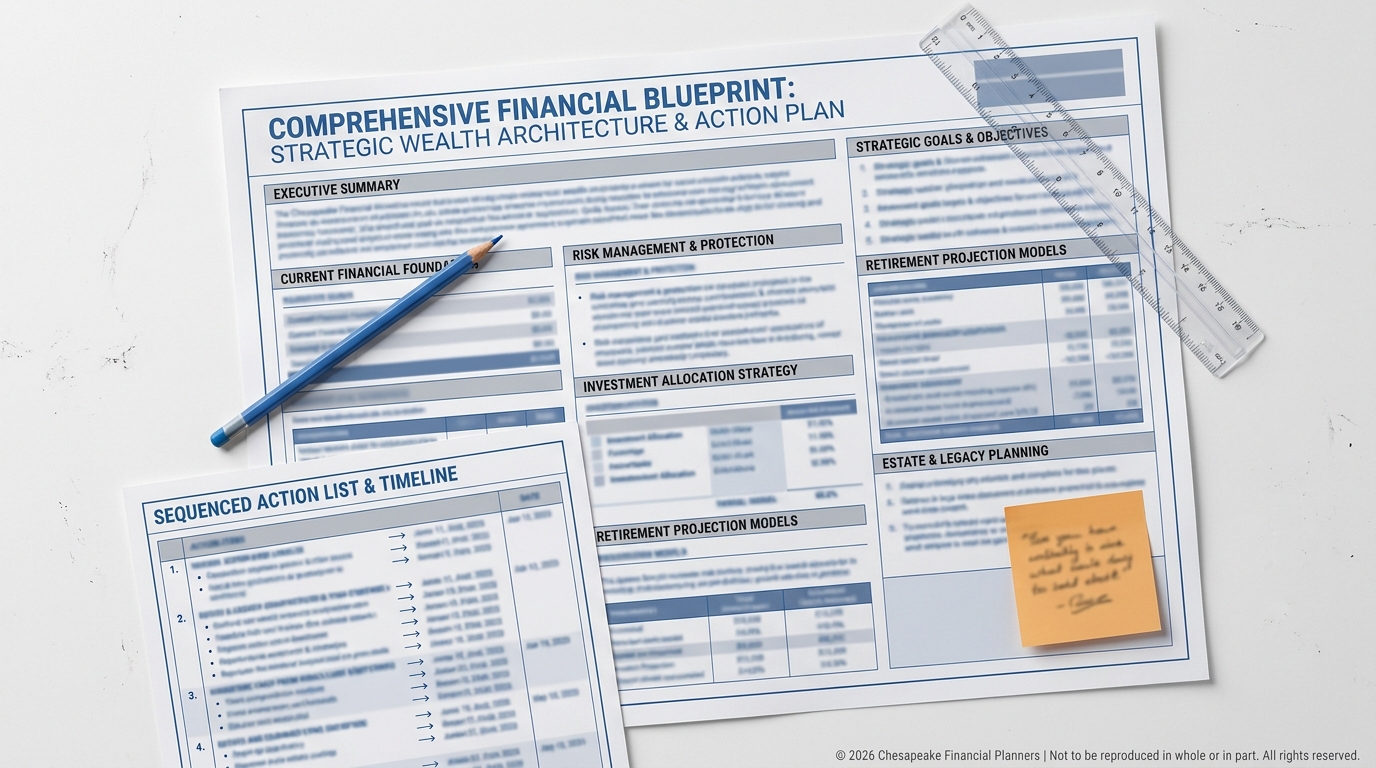
The output is a written plan with a summary of the current situation, confirmed priorities, recommended strategies by area, a sequenced action list with responsibilities, and the assumptions behind each recommendation. It becomes the working document for the next two steps: Discuss & Decide, where decisions get made, and Execute & Empower, where implementation happens. Major life changes can send you back through this loop, which is why Should I update my financial plan after a big life event? matters.
Frequently Asked Questions
Does Chesapeake use financial planning software to build the plan?
Yes, Chesapeake uses financial planning software to model scenarios, run projections, and test assumptions during the Design step. But the software is a tool, not the deliverable. The analysis feeds human judgment about the client's specific situation rather than replacing it with a generic automated output.
What if my situation is in transition when the Design step begins?
A plan can be built even when your situation is in transition, and this is common. The plan accounts for likely near-term changes such as a job change, a planned home purchase, or a business decision in progress. The goal is to design for the realistic future, not freeze a static snapshot that will be wrong within months.
How specific are the investment recommendations in the plan?
Investment recommendations in the plan are specific enough to implement directly. The plan describes target allocation, account-level positioning, and any changes recommended to existing accounts. It is an actual allocation with rationale tied to your situation, time horizon, and tax position, not a generic portfolio label pulled from a risk questionnaire.
What if I disagree with something in the plan design?
Disagreement with the design is expected and built into the process through the Discuss & Decide step. The Design step is not the final word. It is a fully developed proposal. The next step is a direct conversation where every element gets questioned and adjusted before anything is implemented or finalized.
How long does it take to build a financial plan?
Building a financial plan typically takes a few weeks from the start of the Design step, depending on complexity and how many areas apply to your situation. A business owner with exit planning needs takes longer than a salaried pre-retiree. The timeline reflects doing the analysis properly rather than rushing to a deliverable.
If you found this helpful, our guide to the full planning process covers what happens before and after the Design step in depth. Download it at chesapeakefp.com to see how the R.U.D.D.E.R. Method™ builds a plan around your specific situation.
Want to go deeper? Our R.U.D.D.E.R. Method guide walks through this step by step.
Disclosures
The information provided is for educational purposes only and should not be construed as investment advice. Investment strategies should be tailored to individual circumstances, risk tolerance, and goals. Past performance doesn't guarantee future results. Consult with qualified financial professionals regarding your specific situation.
This information is not intended to be a substitute for specific individualized tax, investment or legal advice. We suggest that you discuss your specific situation with a qualified tax, legal or financial advisor.
Advisors associated with Chesapeake Financial Planners may be either (1) LPL Financial Registered Representatives offering securities through LPL Financial, Member FINRA and SIPC, and investment advisor representatives offering investment advice through Great Valley Advisor Group; or (2) solely investment advisor representatives offering investment advice through Great Valley Advisor Group and not affiliated with LPL Financial. Great Valley Advisor Group, and Chesapeake Financial Planners are separate entities from LPL Financial.


