

What Is the Best Medigap Plan for New Medicare Beneficiaries?
Last reviewed: July 2026
For most new Medicare beneficiaries, Plan G is the best Medigap plan because it covers nearly every gap in Original Medicare except the small annual Part B deductible. If you want lower premiums and can handle minor copays, Plan N is the strong runner-up. The right Medigap plan depends on your health, your budget, and how much financial unpredictability you can tolerate in retirement.
Key Takeaways
- Plan G is the most comprehensive Medigap plan available to new beneficiaries and covers everything except the 2026 Part B deductible of $283.
- Medicare supplement insurance plans are federally standardized, so a Plan G is identical across every insurer; only price and service differ.
- Plan G vs Plan N comes down to trading slightly higher premiums for fewer copays and no excess-charge exposure.
- Your Medigap open enrollment window lasts six months and is the only time you are guaranteed coverage regardless of health.
- High Deductible Plan G offers catastrophic protection with a 2026 deductible of $2,950 for healthy, low-utilization retirees.
About the Author: Jeff Judge, CFP®, AEP®, ChFC®, CLU® is Managing Partner of Chesapeake Financial Planners in Forest Hill, Maryland. He has been helping families and business owners in Harford County and the Baltimore metro area navigate Medicare and retirement healthcare decisions since earning his CFP® certification in 2013, by using Chesapeake Financial Planners’ signature process, the R.U.D.D.E.R. method™. Jeff often reminds clients that the cheapest Medigap premium today can become the most expensive choice over a 20-year retirement if it leaves them exposed to uncapped costs.
You've just enrolled in Medicare Parts A and B, and you finally feel covered. Then you learn about the gaps: the 20% Medicare Part B coinsurance, the Part A hospital deductible, and the absence of any out-of-pocket maximum. That last one surprises people most. Original Medicare alone has no ceiling on what you can spend in a bad health year. Medigap plans exist to close those gaps and make your costs predictable.
What Do Medigap Plans Actually Cover?
Medigap plans, also called Medicare supplement insurance, are sold by private insurers but standardized by the federal government. A Plan G from one company covers exactly what Plan G covers from any other company. The only real differences are price and customer service. That standardization is the single most useful fact for shoppers, because it turns a confusing market into a price comparison.
Depending on the plan, Medigap can cover the Part A hospital deductible, Part B coinsurance, skilled nursing facility coinsurance, Part B excess charges, the first three pints of blood, and foreign travel emergency care. With comprehensive coverage, you can see any doctor in the country who accepts Medicare, with no networks and no referrals.
What Medigap does not cover matters just as much. It does not cover prescription drugs, so you still need a separate Part D plan. It also excludes long-term care, routine dental, vision, and hearing aids. Jeff Judge regularly sees new retirees assume Medigap handles drug costs, then face a Part D late-enrollment penalty that follows them for life. Plan for the drug coverage separately from day one.

How Do Plan G and Plan N Compare?
The plan G vs plan N decision is the one most new beneficiaries actually face, since Plans C and F are no longer available to anyone who became Medicare-eligible after January 1, 2020. Both plans deliver strong coverage. The difference is how you pay for routine care.
| Feature | Plan G | Plan N |
|---|---|---|
| Part A hospital deductible | Covered | Covered |
| Part B coinsurance (20%) | Covered | Covered (with copays) |
| Part B deductible | You pay $283 | You pay $283 |
| Office visit copay | $0 | Up to $20 |
| ER copay | $0 | Up to $50 (waived if admitted) |
| Part B excess charges | Covered | Not covered |
| Typical monthly premium | Higher | $20-$50 lower |
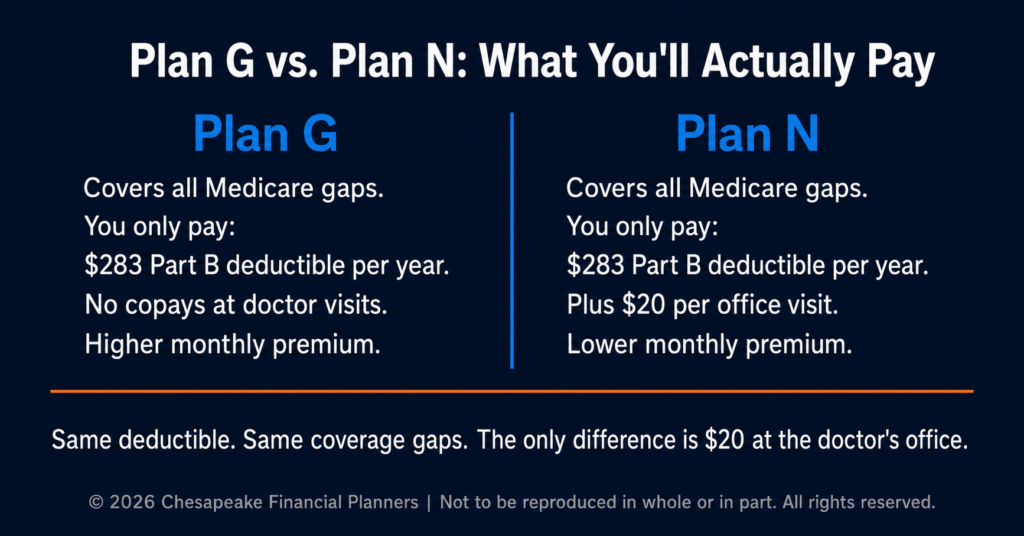
Plan G covers everything except the 2026 Part B deductible of $283. Once you clear that, your out-of-pocket exposure for Medicare-covered services is essentially zero. That predictability is why Plan G remains the default recommendation for people who want to stop thinking about medical bills.
Plan N trades that simplicity for lower premiums. You pay the Part B deductible, up to $20 per office visit, and up to $50 for an emergency room visit that does not lead to admission. You also lose coverage for Part B excess charges, which apply when a provider bills more than the Medicare-approved amount.
Here is the math that decides it. Suppose Plan N saves you $40 a month, or $480 a year. If you see doctors eight times a year at $20 each, that is $160 in copays, and you still come out ahead. But a client who manages a chronic condition and visits specialists twice monthly can rack up $480 or more in copays, erasing the savings entirely. Jeff Judge runs this exact calculation with clients before recommending either plan, because the right answer depends on how often you actually walk into a doctor's office.
Who Should Consider High Deductible Plan G?
High deductible Plan G is built for healthy retirees who rarely use medical services and want catastrophic protection at the lowest possible premium. You pay all Medicare-covered costs up to the 2026 deductible of $2,950, then the plan covers everything standard Plan G covers. Premiums often run a fraction of standard Plan G.
The trade-off is real. In a year with significant medical needs, you absorb the full deductible plus premiums before coverage kicks in. This plan works best for someone who can comfortably write a $2,950 check in a bad year without disrupting their retirement income plan. If that deductible would force you to sell investments at a bad time, the lower premium is a false economy.
How Do I Choose Between Medigap and Medicare Advantage?
The bigger fork in the road is Original Medicare plus Medigap versus Medicare Advantage. They are fundamentally different products, and the choice shapes your healthcare experience for years.
Medigap pairs with Original Medicare to give you provider freedom. You can see any physician in the country who accepts Medicare, with no networks and no referrals, and your costs stay predictable. The tradeoff is a monthly premium on top of your Part B premium. Medicare Advantage often carries a low or zero premium and may bundle dental and vision, but it confines you to a network, frequently requires referrals and prior authorizations, and exposes you to annual out-of-pocket maximums that can reach several thousand dollars.
According to Medicare.gov, the most important practical difference is timing. During your Medigap open enrollment window, you can buy any Medigap policy with guaranteed issue. Switch from Advantage back to Medigap years later, and an insurer can charge more or decline you based on health. Jeff frames it this way for clients: Medicare Advantage is easy to get into and can be hard to leave once your health changes. Choose deliberately at the start.
This is exactly the kind of decision the R.U.D.D.E.R. Method™ is built for. The R.U.D.D.E.R. Method™ is Chesapeake Financial Planners' six-step planning process: Review and Recognize, Uncover and Understand, Design and Develop, Discuss and Decide, Execute and Empower, and Reassess and Refine. We use it to weigh your health history, income plan, and risk tolerance before locking in a Medicare path.
For a complete picture, pair this with What Are the Different Parts of Medicare and What Do They Cover? and How Much Should I Budget for Healthcare Costs in Retirement?.
Frequently Asked Questions
What is the best Medigap plan for someone new to Medicare?
Plan G is the best Medigap plan for most new Medicare beneficiaries because it covers nearly every gap in Original Medicare except the annual Part B deductible. It offers comprehensive protection, full provider freedom nationwide, and predictable out-of-pocket costs. Plan N is the strongest lower-premium alternative for healthier, lower-utilization retirees.
When can I enroll in a Medigap plan?
Your Medigap open enrollment period is a six-month window that starts the month you turn 65 and are enrolled in Medicare Part B. During this window you have guaranteed issue rights, meaning insurers cannot deny you coverage or charge more based on health. Missing it can make coverage harder and pricier to obtain later.
Does Medigap cover prescription drugs?
No, Medigap plans do not cover prescription drugs. You need a separate Medicare Part D prescription drug plan for medication coverage. Enrolling in Part D when you first become eligible matters, because a late-enrollment penalty applies for every month you go without creditable drug coverage and stays with you permanently.
What is the difference between Plan G and Plan N?
The main difference between Plan G and Plan N is cost structure. Plan G covers everything except the Part B deductible, leaving you with virtually no out-of-pocket costs. Plan N has lower premiums but adds copays of up to $20 per office visit and $50 per ER visit, and it does not cover Part B excess charges.
How much does a Medigap plan cost in 2026?
Medigap premiums vary widely by location, age, gender, and insurer, since the coverage itself is federally standardized. Plan G typically runs higher than Plan N, while High Deductible Plan G carries a much lower premium paired with a 2026 deductible of $2,950. Because benefits are identical across insurers, comparing price for the same plan letter is the smart move.
Can I switch Medigap plans later?
Yes, you can apply to switch Medigap plans at any time, but outside your open enrollment window insurers can use medical underwriting to charge more or deny you based on health. Some states offer additional guaranteed-issue rights, so check your state rules before assuming a switch will be approved on favorable terms.
If you want to go deeper on managing the full cost of healthcare in retirement, our retirement healthcare guide breaks down premiums, supplements, and Part D in one place. Download it at chesapeakefp.com to see how Medigap fits your broader retirement income plan.
Disclosures
The information provided is for educational purposes only and should not be construed as investment advice. Investment strategies should be tailored to individual circumstances, risk tolerance, and goals. Past performance doesn't guarantee future results. Consult with qualified financial professionals regarding your specific situation.
Advisors associated with Chesapeake Financial Planners may be either (1) LPL Financial Registered Representatives offering securities through LPL Financial, Member FINRA and SIPC, and investment advisor representatives offering investment advice through Great Valley Advisor Group; or (2) solely investment advisor representatives offering investment advice through Great Valley Advisor Group and not affiliated with LPL Financial. Great Valley Advisor Group, and Chesapeake Financial Planners are separate entities from LPL Financial.


