

How Do I Plan for Rising Healthcare Costs in Retirement?
Last reviewed: July 2026
Plan for rising healthcare costs in retirement by funding a dedicated health reserve, maximizing your HSA before age 65, understanding what Medicare does and does not cover, and protecting against long-term care expenses. Retirement healthcare costs rise faster than general inflation, so the number you budget today will not be the number you spend at 80. The earlier you build a specific plan around these costs, the less they can wreck the rest of your retirement income strategy.
Key Takeaways
- Retirement healthcare costs climb faster than general inflation, so budget for medical inflation, not the standard CPI rate.
- The standard 2026 Medicare Part B premium is $202.90 per month per person before you use any care.
- HSAs offer triple tax advantages and work best when funded aggressively and left untouched until retirement.
- Long-term care is the costliest gap Medicare leaves open, and planning for it early keeps premiums affordable.
About the Author: Jeff Judge, CFP®, AEP®, ChFC®, CLU® is Managing Partner of Chesapeake Financial Planners in Forest Hill, Maryland. He has been helping families and business owners in Harford County and the Baltimore metro area navigate retirement income and healthcare planning since earning his CFP® certification in 2013, by using Chesapeake Financial Planners’ signature process, the R.U.D.D.E.R. method™. Jeff sees the same gap every year: people stress-test their portfolios but never stress-test their medical costs, and that one blind spot does more damage than a bad market.
Healthcare is the retirement expense most people underestimate. You can model your withdrawal rate down to the decimal and still get blindsided, because medical spending does not behave like the rest of your budget. It is lumpy, it accelerates with age, and it climbs faster than the price of almost everything else you buy. Here is how to build a plan that holds up.
Why Do Retirement Healthcare Costs Rise Faster Than Everything Else?
Medical costs have a habit of outpacing general inflation, which means the gap compounds against you over a 25- or 30-year retirement. When general prices rise around 3% a year and healthcare rises faster, that differential can double or triple your projected medical spending by the time you are in your 80s.
According to the Bureau of Labor Statistics, medical care services have repeatedly tracked above the broader Consumer Price Index. That is the part most plans get wrong. They inflate healthcare at the general rate, and the projection looks fine on paper while quietly understating the real bill by tens of thousands of dollars.
Healthcare spending is also unpredictable on a year-to-year basis. You might spend almost nothing in your late 60s, then face a wave of chronic-condition management and acute care in your 80s. You cannot simply average the cost across retirement. You have to plan for the years when it spikes.
What Will Medicare Actually Cost Me in Retirement?
Medicare is not free, and the premiums alone add up before you ever see a doctor. For 2026, the standard Part B premium is $202.90 per month per person, which runs to roughly $4,870 a year for a couple on basic coverage. Part D prescription coverage adds more depending on the plan you choose.
Higher-income retirees pay an income-related surcharge called IRMAA, which can more than double those premiums. Your modified adjusted gross income from two years prior determines the surcharge, which is exactly why tax planning and Medicare planning belong in the same conversation. A large Roth conversion or capital gain can quietly raise your premiums two years later.
Original Medicare also leaves gaps: deductibles, coinsurance, and no annual out-of-pocket cap. Most retirees fill those gaps with a Medigap policy or a Medicare Advantage plan. This is the kind of decision the R.U.D.D.E.R. Method™ is built for: Chesapeake Financial Planners' six-step planning process of Review and Recognize, Uncover and Understand, Design and Develop, Discuss and Decide, Execute and Empower, and Reassess and Refine. It forces you to map the coverage decision before the enrollment deadline rather than scrambling at 64.
For a deeper breakdown of how surcharges work, see How do Roth conversions affect IRMAA and Medicare Part B premiums? and our full What Are the Different Parts of Medicare and What Do They Cover?.
How Should I Use an HSA to Prepare for Healthcare Costs?
A Health Savings Account is the single most tax-efficient tool for retirement healthcare, and it works best when you treat it as a long-term medical fund rather than a checking account. HSAs offer a rare triple tax advantage: contributions are deductible, growth is tax-free, and qualified medical withdrawals are tax-free.
For 2026, the IRS allows HSA contributions of $4,400 for individuals and $8,750 for families, plus a $1,000 catch-up contribution if you are 55 or older. If you can pay current medical bills from other money and leave the HSA invested, it compounds untouched into a dedicated, tax-free healthcare reserve for retirement.
Jeff Judge tells clients to think of the HSA as the only account on the menu that never gets taxed coming or going, as long as the money goes toward care. One catch worth knowing: once you enroll in Medicare, you can no longer contribute to an HSA, so the window to load it up closes at 65. Plan your final contributions accordingly. For more, see How Much Should I Budget for Healthcare Costs in Retirement?.
How Do I Protect Against Long-Term Care Costs?
Long-term care is where healthcare costs turn catastrophic, and Medicare provides almost no coverage for it. According to Genworth's Cost of Care data, the median annual cost of a private room in a nursing home now exceeds six figures, and even in-home care runs $30 or more per hour. A few years of care can erase a substantial portion of a retirement nest egg.
You have a few ways to address it. Traditional long-term care insurance covers the risk directly, and the sweet spot to buy is usually your mid-50s to early 60s, when premiums are still manageable and underwriting is friendlier. Hybrid policies that pair life insurance with a long-term care rider have grown popular because they remove the "use it or lose it" worry: if you never need care, the policy still pays a death benefit.
In Jeff's experience, the clients who wait until their late 60s to shop for coverage often find it either unaffordable or unavailable, because a single diagnosis can disqualify them. The time to make this decision is before you think you need it. Compare your options in What is long-term care insurance and do I need it? and What Are the Best Alternatives to Long-Term Care Insurance?.
How Do I Build a Healthcare Budget That Actually Works?
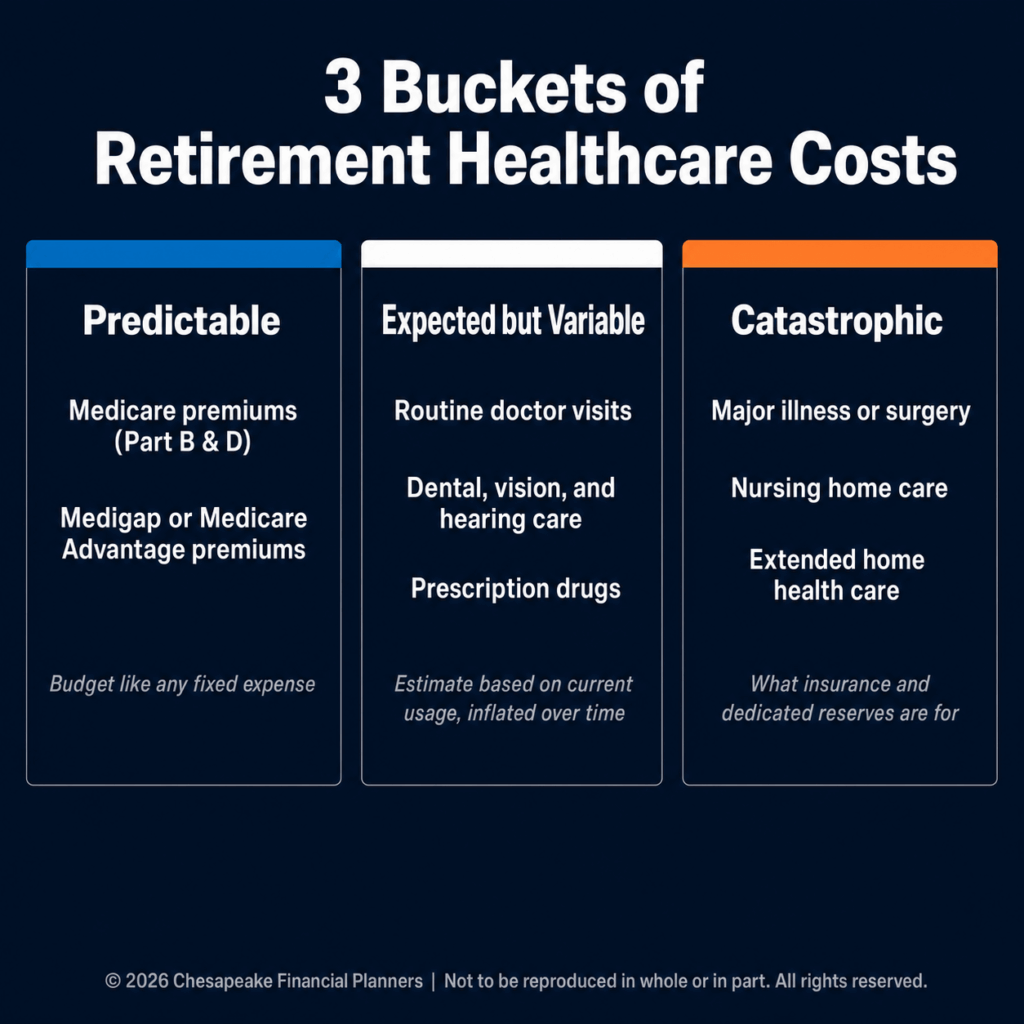
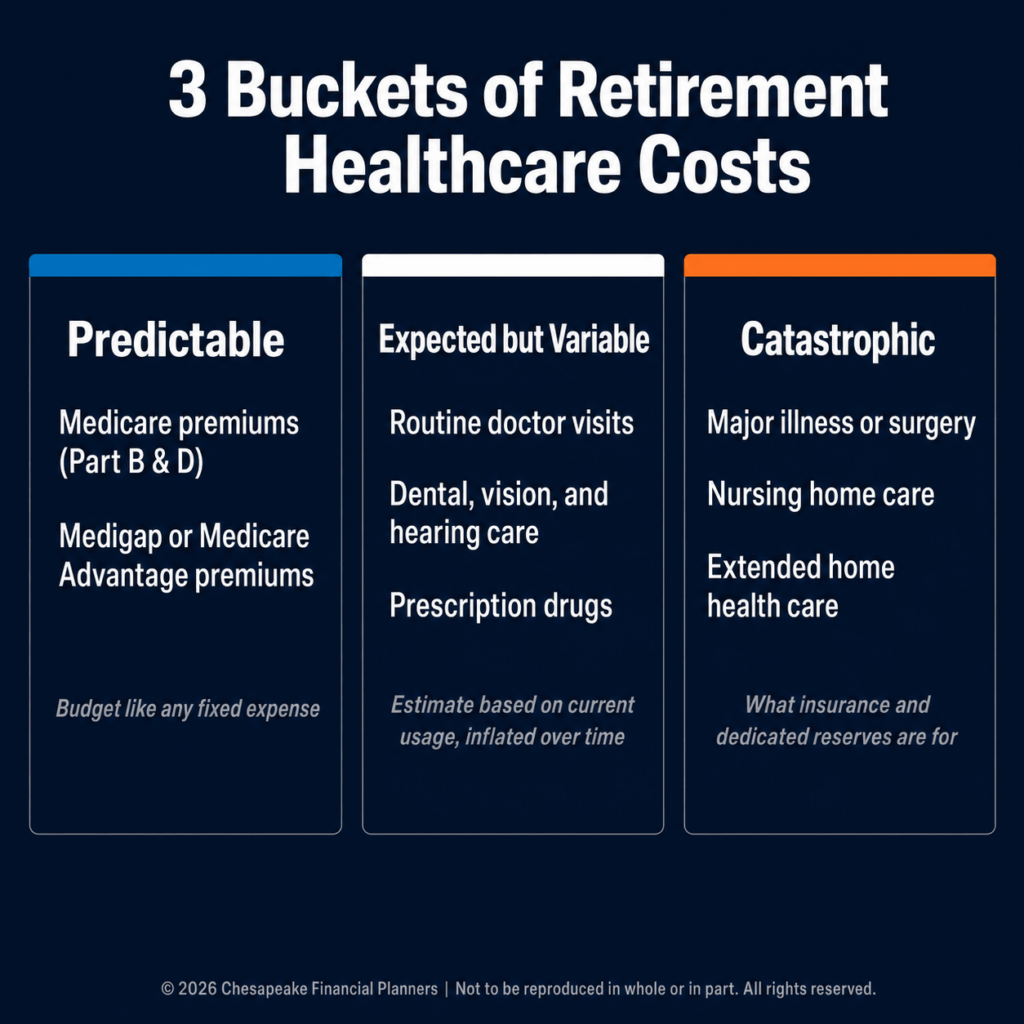
Treat healthcare as a non-negotiable essential expense and fund it first, then split it into three buckets so each gets the right tool:
- Predictable costs (Medicare premiums, Medigap): budget these annually like any fixed bill.
- Expected but variable costs (routine visits, prescriptions, dental, vision, hearing): estimate from current usage and inflate at the medical rate, not the general rate.
- Catastrophic costs (major illness, long-term care): this is what insurance and a dedicated reserve exist to absorb, and it needs the largest safety margin.
Use a healthcare cost estimator from a major provider like Fidelity to get a baseline, then build in a conservative cushion. The goal is to overestimate and end with a surplus rather than underestimate and face a shortfall when you have the least flexibility to fix it. Coordinate this budget with your withdrawal plan in What Should You Prioritize Financially in the 5 Years Before Retirement?.
Frequently Asked Questions
How much should I budget for healthcare in retirement?
Budget conservatively and assume medical inflation rather than general inflation. A healthy 65-year-old couple should plan for substantial lifetime medical spending before long-term care is even considered. Use a provider cost estimator as a baseline, then add a cushion for the high-spending years that typically arrive in your 80s.
Does Medicare cover all of my healthcare costs in retirement?
No. Medicare leaves significant gaps including deductibles, coinsurance, and no out-of-pocket maximum on Original Medicare. It also excludes most dental, vision, hearing, and long-term care. Most retirees add a Medigap or Medicare Advantage plan and budget separately for the services Medicare does not cover at all.
When should I buy long-term care insurance?
The most cost-effective window to buy long-term care insurance is generally your mid-50s to early 60s. At that age premiums stay manageable and underwriting is friendlier. Waiting until your late 60s often means higher premiums or outright denial, since a single health diagnosis can make you ineligible for affordable coverage.
Can I use my HSA for Medicare premiums?
Yes. After age 65, you can use HSA funds tax-free to pay Medicare Part B, Part D, and Medicare Advantage premiums, though not Medigap premiums. This makes a well-funded HSA a flexible reserve for retirement healthcare. Remember you cannot contribute to an HSA once you enroll in Medicare.
Why is healthcare inflation higher than regular inflation?
Healthcare inflation runs above general inflation because of rising service costs, advancing medical technology, prescription drug pricing, and growing demand from an aging population. According to the Bureau of Labor Statistics, medical care services have repeatedly outpaced the broader Consumer Price Index, which compounds the gap over a long retirement.
Ready to Put a Real Plan Around Your Healthcare Costs?
Healthcare is too big a variable to leave to a rough guess. At Chesapeake Financial Planners, we work through retirement healthcare costs with clients every week, coordinating Medicare decisions, HSA strategy, and long-term care protection inside one income plan. If you are weighing how to prepare for rising healthcare costs in retirement, a second opinion costs you nothing. Visit chesapeakefp.com to learn more.
Want to go deeper? Our Medicare and Social Security Guide walks through this step by step.
Disclosures
The information provided is for educational purposes only and should not be construed as investment advice. Investment strategies should be tailored to individual circumstances, risk tolerance, and goals. Past performance doesn't guarantee future results. Consult with qualified financial professionals regarding your specific situation.
Advisors associated with Chesapeake Financial Planners may be either (1) LPL Financial Registered Representatives offering securities through LPL Financial, Member FINRA and SIPC, and investment advisor representatives offering investment advice through Great Valley Advisor Group; or (2) solely investment advisor representatives offering investment advice through Great Valley Advisor Group and not affiliated with LPL Financial. Great Valley Advisor Group, and Chesapeake Financial Planners are separate entities from LPL Financial.


