
What Is the Difference Between ISOs and NSOs?
Last reviewed: July 2026
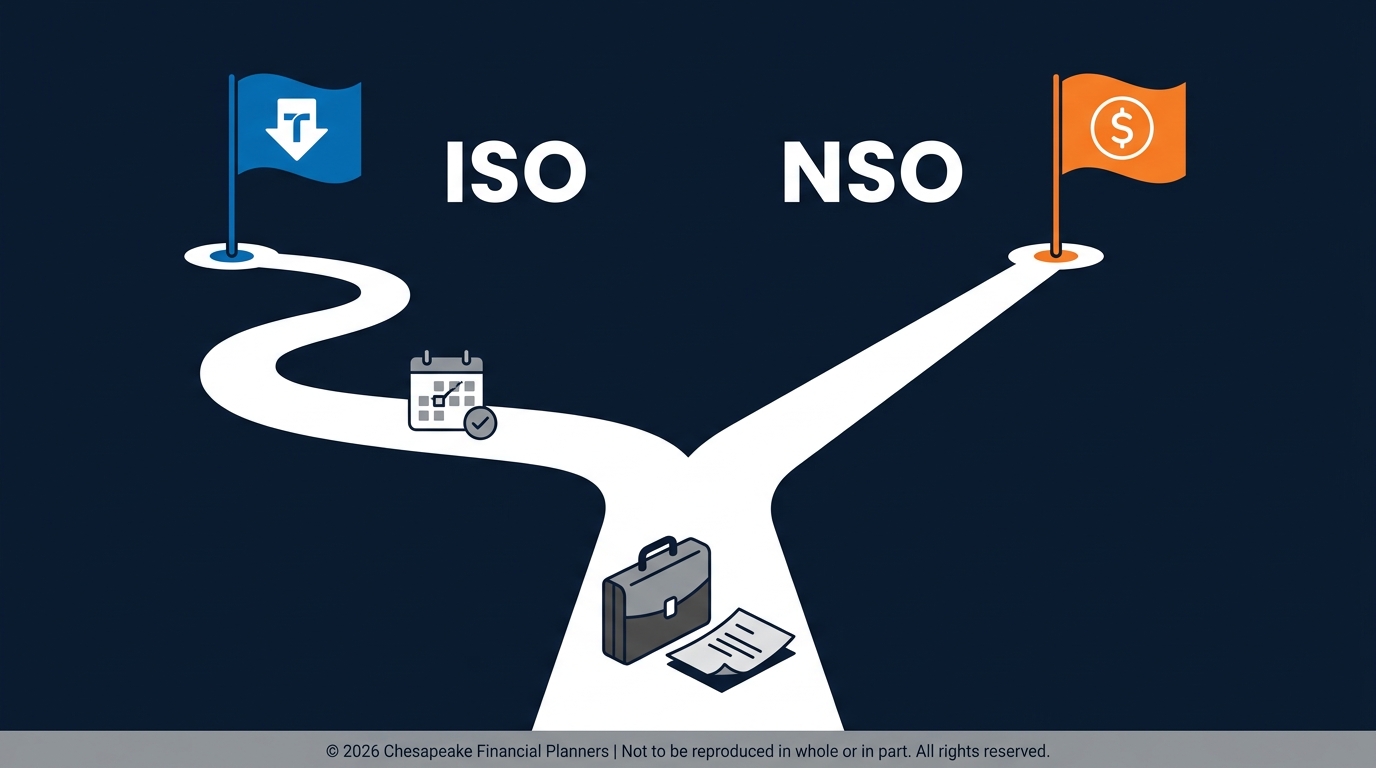
ISOs vs NSOs comes down to one thing: how the IRS taxes your stock options. Incentive stock options (ISOs) can convert ordinary income into long-term capital gains if you follow strict holding rules, but they can trigger the Alternative Minimum Tax. Non-qualified stock options (NSOs) get taxed as ordinary income the moment you exercise, with no AMT and no limits. The type you hold can swing your tax bill by tens of thousands of dollars.
Key Takeaways
- ISOs can qualify for long-term capital gains treatment, taxed at a top federal rate of 20% versus 37% for ordinary income.
- NSOs are taxed as ordinary income on exercise and are available to contractors and board members, not just employees.
- ISOs can trigger AMT on exercise, even before you sell a single share.
- Only $100,000 of ISOs (by grant-date value) can vest per calendar year; the excess converts to NSOs automatically.
- Missing the ISO holding period creates a disqualifying disposition that erases the tax advantage entirely.
About the Author: Jeff Judge, CFP®, AEP®, ChFC®, CLU® is Managing Partner of Chesapeake Financial Planners in Forest Hill, Maryland. He has been helping families and business owners in Harford County and the Baltimore metro area navigate equity compensation since earning his CFP® certification in 2013, by using Chesapeake Financial Planners’ signature process, the R.U.D.D.E.R. method™. Jeff has watched more clients lose money to a botched ISO exercise than to a bad stock pick, and the difference almost always traces back to one overlooked detail: the AMT.
Your offer letter says you're getting stock options. It rarely says whether they're ISOs or NSOs. That single distinction can change your tax bill by $50,000 or more, and most recruiters can't explain it because they were never taught it. Here's how the two actually work.
What Are ISOs and NSOs, and How Do They Differ?
Incentive stock options are a tax-advantaged form of equity compensation available only to employees. Non-qualified stock options carry no special tax treatment and can be granted to employees, contractors, advisors, and board members alike. The core difference is timing and rate: ISOs defer taxation and may qualify for capital gains rates, while NSOs are taxed as ordinary income at exercise.
| Feature | ISOs (Incentive Stock Options) | NSOs (Non-Qualified Stock Options) |
|---|---|---|
| Who can receive them | Employees only | Employees, contractors, advisors, board members |
| Tax at exercise | None for regular tax; spread counts for AMT | Spread taxed as ordinary income |
| Tax at sale | Long-term capital gains if rules met | Capital gains on post-exercise growth only |
| AMT exposure | Yes, on the bargain element | No |
| Annual limit | $100,000 vesting per year (grant-date value) | No limit |
| Best-case federal rate | 20% long-term gains | 37% ordinary income |
The headlines make ISOs look like the obvious winner. In practice, the answer depends on your cash, your timeline, and whether the company is public.
When Does the ISO Tax Advantage Actually Work?
The ISO advantage works when you can exercise early, hold long enough, and afford to wait. If you exercise ISOs when the spread between strike price and fair market value is small, then hold the shares for at least one year from exercise and two years from grant, your entire gain qualifies for long-term capital gains treatment under IRC Section 422. That converts a 37% ordinary income hit into a 20% capital gains rate.
Consider a clean example. You exercise 10,000 ISOs at a $1 strike price and sell two years later at $30 per share. Your gain is $290,000. At the top long-term capital gains rate of 20%, you owe roughly $58,000 in federal tax. Had those been NSOs taxed as ordinary income at 37%, you'd owe roughly $107,000. That's a $49,000 difference on a single grant.
But there's a cost to that benefit. You have to follow the holding rules perfectly, and you have to be able to sit on illiquid stock you've already paid tax on. The math only works if you survive the traps below.
What Are the Biggest ISO Traps?
The ISO advantage comes wrapped in four risks that catch unprepared employees every year. Understanding each one before you exercise is the whole game. Jeff often tells clients that the people who get burned by ISOs aren't the ones who took risk knowingly; they're the ones who never knew the AMT clock was running.
1. AMT on exercise. Even though ISOs aren't taxed as ordinary income when you exercise, the spread between your strike price and fair market value gets added to your Alternative Minimum Tax income. The 2026 AMT exemption is $90,100 for single filers and $140,200 for married couples filing jointly, and exercising a large ISO grant can blow right past it. Exercise $200,000 of ISOs with a $180,000 spread and you could owe $50,000 in AMT before selling a single share.
2. Rigid holding periods. To keep favorable treatment you must hold the shares at least one year from exercise and at least two years from the grant date. Sell before hitting both marks and the IRS calls it a disqualifying disposition, taxing the gain like an NSO. You lose the entire advantage.
3. Illiquidity risk. If the company is still private, that one-to-two-year hold means sitting on stock you can't sell while having already paid AMT in cash. If the company stumbles, you can lose the shares and still owe the tax.
4. The $100,000 annual limit. Only $100,000 of ISOs, measured by fair market value at the grant date, can vest in any calendar year. Anything above that automatically becomes an NSO regardless of what your paperwork says.
This is also where a structured process pays off. The R.U.D.D.E.R. Method™ is Chesapeake Financial Planners' six-step planning process: Review and Recognize, Uncover and Understand, Design and Develop, Discuss and Decide, Execute and Empower, and Reassess and Refine. Mapping an exercise plan against those steps is how you avoid an AMT surprise.
Are NSOs Ever Better Than ISOs?
Yes, NSOs can be the smarter choice when simplicity, liquidity, or cash flow matter more than the maximum tax break. Because NSOs are taxed at exercise as ordinary income, there's no AMT to model, no disqualifying-disposition trap, and no $100,000 ceiling. You also build a higher cost basis immediately, so only future growth gets taxed when you sell, potentially at long-term capital gains rates if you hold a year. For employees who plan to sell shortly after exercise, or who can't afford to tie up cash, NSOs remove a lot of moving parts. High earners between $200,000 and $500,000 in income should also remember the 3.8% Net Investment Income Tax can apply to gains on either type.
Frequently Asked Questions
What is the main difference between ISOs and NSOs?
The main difference is how and when they're taxed. ISOs can qualify for long-term capital gains treatment and are taxed only when you sell, while NSOs are taxed as ordinary income the moment you exercise. ISOs are limited to employees; NSOs can go to contractors, advisors, and board members.
Do ISOs trigger the Alternative Minimum Tax?
Yes, ISOs can trigger AMT on exercise. The spread between your strike price and the stock's fair market value is added to your AMT income, even though it isn't taxed under the regular system. A large exercise can create a substantial AMT bill before you've sold any shares, so modeling the exercise in advance is essential.
What happens if I sell ISO shares too early?
Selling ISO shares before meeting both holding periods creates a disqualifying disposition. You must hold at least one year from exercise and two years from the grant date. If you sell early, the gain is taxed like an NSO at ordinary income rates, and you forfeit the long-term capital gains advantage entirely.
Is there a limit on how many ISOs I can receive?
Yes, only $100,000 worth of ISOs, measured by fair market value at the grant date, can become exercisable in any single calendar year. Any amount above that threshold automatically converts to non-qualified stock options. The limit is set by federal tax law and applies regardless of how your grant is labeled.
Which is better for tax purposes, ISOs or NSOs?
ISOs offer better tax treatment on paper because qualifying gains are taxed at long-term capital gains rates instead of ordinary income rates. But that advantage requires holding the shares, surviving AMT, and accepting illiquidity. For employees who need cash sooner or want simplicity, NSOs often produce a cleaner, more predictable outcome.
Do I owe taxes when my stock options vest?
No, vesting alone usually doesn't create a tax bill for either ISOs or NSOs. The taxable event is exercise, not vesting. With NSOs, ordinary income tax applies when you exercise. With ISOs, exercise can trigger AMT, while regular income tax is deferred until you sell the underlying shares.
Stock option taxes reward planning and punish guessing. If you found this helpful, our equity compensation planning guide walks through ISO and NSO exercise timing, AMT modeling, and cash-flow planning in depth. Download it at chesapeakefp.com to map your own grant before your next exercise window.
What Is Alternative Minimum Tax and How Do I Avoid It?
How Do I Avoid Surprise Tax Bills When My RSUs Vest?
How Can I Reduce Capital Gains Taxes on My Investments?
How Can I Reduce Taxes When Earning $200K to $500K?

Want to go deeper? Our Stock Option Strategy Worksheet walks through this step by step.
Disclosures
The information provided is for educational purposes only and should not be construed as investment advice. Investment strategies should be tailored to individual circumstances, risk tolerance, and goals. Past performance doesn't guarantee future results. Consult with qualified financial professionals regarding your specific situation.
This information is not intended to be a substitute for specific individualized tax, investment or legal advice. We suggest that you discuss your specific situation with a qualified tax, legal or financial advisor.
Advisors associated with Chesapeake Financial Planners may be either (1) LPL Financial Registered Representatives offering securities through LPL Financial, Member FINRA and SIPC, and investment advisor representatives offering investment advice through Great Valley Advisor Group; or (2) solely investment advisor representatives offering investment advice through Great Valley Advisor Group and not affiliated with LPL Financial. Great Valley Advisor Group, and Chesapeake Financial Planners are separate entities from LPL Financial.


