

How Does Alternative Minimum Tax Work for Stock Options?
Last reviewed: July 2026
The alternative minimum tax hits incentive stock options because exercising ISOs creates "phantom income" the regular tax system ignores. When you exercise, the spread between the strike price and the fair market value gets added to your AMT income, even if you never sell a single share. That paper gain can trigger a tax bill of tens of thousands of dollars on money you haven't actually received.
Key Takeaways
- The alternative minimum tax adds your ISO bargain element to income, creating a tax bill on gains you have not cashed in.
- The 2026 AMT exemption is $90,100 for single filers and $140,200 for joint filers.
- AMT exemptions phase out starting at $500,000 (single) and $1,000,000 (married filing jointly) in 2026.
- AMT paid on ISO exercise often becomes a credit you can recover in later years.
About the Author: Jeff Judge, CFP®, AEP®, ChFC®, CLU® is Managing Partner of Chesapeake Financial Planners in Forest Hill, Maryland. He has been helping families and business owners in Harford County and the Baltimore metro area navigate stock option taxation since earning his CFP® certification in 2013, by using Chesapeake Financial Planners’ signature process, the R.U.D.D.E.R. method™. Jeff has watched more than one tech client get blindsided by an AMT bill on shares that later dropped below the exercise price, which is the worst version of this trap.
What Is the Alternative Minimum Tax?
The alternative minimum tax is a parallel tax system that runs alongside the regular income tax and ensures higher earners pay a baseline amount even after deductions. You calculate your tax two ways, regular and AMT, and you pay whichever number is larger. Most people never touch it. But stock option holders, residents of high-tax states, and people with large capital gains often do.
Here is the mechanics in three steps. First, you calculate your regular taxable income. Second, you recalculate income under AMT rules, which add back certain deductions and include income items the regular system leaves out. Third, you pay the higher of the two figures. The IRS describes AMT as a tax "designed to ensure that taxpayers who benefit from certain exclusions, deductions, or credits pay at least a minimum amount of tax."
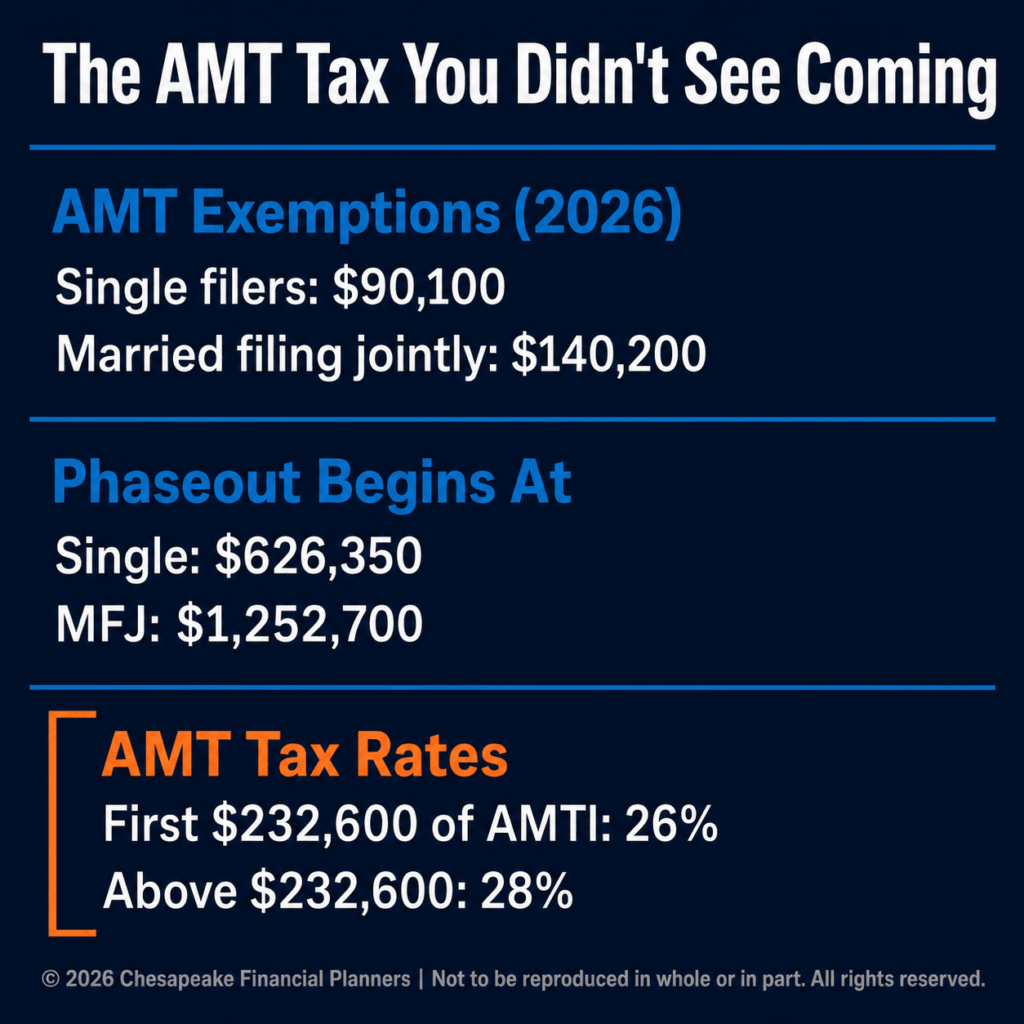
The AMT applies a 26% rate to income up to a threshold and 28% above it. For 2026, that crossover point sits around $244,500. The exemption shields a chunk of income from AMT entirely, but it shrinks as your income climbs.
How Do Incentive Stock Options Trigger AMT?
When you exercise incentive stock options, the bargain element gets added to your AMT income but not your regular income. The bargain element is the fair market value of the shares minus your strike price, multiplied by the number of options exercised. You owe AMT on that spread even though you have not sold the shares and have not received any cash.
Here is a concrete example. Say you exercise 10,000 ISOs with a $5 strike price when the stock trades at $35. Your bargain element is $30 per share times 10,000 shares, or $300,000 of AMT income. At the 28% AMT rate, that is roughly $84,000 of additional tax, due in the year you exercised. You still hold every share. You have spent money to exercise. And now you owe the IRS a large bill on paper gains.
The worst-case scenario is the one that keeps Jeff up at night for clients. The stock drops after you exercise, the paper gain evaporates, and you are still on the hook for AMT calculated on a value that no longer exists. This is the difference between understanding ISO timing and learning it the hard way.
This is exactly the kind of decision the R.U.D.D.E.R. Method™, Chesapeake Financial Planners' six-step planning process, is built to handle: reviewing your equity position, uncovering the AMT exposure before you exercise, and designing an exercise plan that spreads the tax hit instead of absorbing it all in one brutal year.
Who Actually Gets Hit by AMT?
The alternative minimum tax tends to catch a predictable set of taxpayers, and stock option holders sit at the top of the list. If you exercise ISOs, hold appreciated assets, or live in a high-tax state, you should run an AMT projection before year-end rather than discovering the bill in April.
The most common AMT-exposed groups include:
- Anyone exercising incentive stock options, especially tech employees and executives with large grants
- Taxpayers with significant capital gains that push income into the exemption phaseout range
- Residents of high-tax states like California, New York, and New Jersey who lose large state tax deductions under AMT rules
- Households with substantial private activity bond interest, which is tax-free for regular tax but taxable for AMT
The 2026 AMT exemption amounts are $90,100 for single filers and $140,200 for married couples filing jointly. The exemption phases out at 25 cents per dollar of income above $500,000 for single filers and $1,000,000 for joint filers. Once you cross those thresholds, more of your income becomes exposed to the AMT calculation, which is why high earners with ISOs feel it most acutely.
How Do AMT Credits Work for ISO Exercises?
When you pay AMT because of an ISO exercise, the IRS often treats that payment as a prepayment you can recover in future years through the minimum tax credit. The portion of AMT caused by "timing" items like ISO exercises generates a credit you can claim in years when your regular tax exceeds your tentative AMT. Over time, you may recover much of what you paid.
This is the part of the AMT story that gets lost in the panic of a surprise bill. The AMT on an ISO exercise is frequently not a permanent loss. It is money parked with the IRS that comes back as you sell the shares and your tax picture normalizes. According to FINRA, understanding the long-term tax treatment of equity compensation is essential before exercising, because the timing of exercise and sale drives the entire outcome.
The recovery is not automatic or instant, and it does not happen in a single year. That is why exercise timing matters so much. Spreading ISO exercises across multiple tax years can keep you under the AMT line, smooth the credit recovery, and avoid the cash crunch of an $84,000 bill on shares you cannot sell yet. Jeff often tells equity clients that the goal is not to avoid AMT at all costs, but to control when and how much of it you trigger.
What Is the Difference Between ISOs and NSOs?
How Do I Avoid Surprise Tax Bills When My RSUs Vest?
How Can You Reduce Your AMT Exposure?
You reduce AMT exposure by controlling the timing and size of the income items that trigger it, with ISO exercises being the most controllable lever. A planned exercise strategy can keep your bargain element below the threshold where AMT kicks in, letting you capture equity value across several years instead of one painful season.
A few proven approaches work for most equity holders. Exercise ISOs in smaller annual tranches to stay under your AMT crossover point. Coordinate exercises with years when your other income is lower. Consider a same-day sale or disqualifying disposition when holding for long-term treatment is not worth the AMT cash drain. And always model the exercise before you pull the trigger, not after.
The mistake Jeff sees most often is treating a stock option grant like free money and exercising everything the moment it vests. The tax tail can wag the entire dog. A modest amount of planning before December 31 turns an $84,000 surprise into a manageable, multi-year strategy.
How Can I Reduce Taxes When Earning $200K to $500K?
What Is Alternative Minimum Tax and How Do I Avoid It?
Frequently Asked Questions
What is the AMT exemption for 2026?
The 2026 AMT exemption is $90,100 for single filers and $140,200 for married couples filing jointly, according to IRS inflation adjustments. The exemption begins phasing out at income above $500,000 for single filers and $1,000,000 for joint filers, reducing by 25 cents for every dollar over those thresholds.
Do I owe AMT if I exercise ISOs but never sell?
Yes, you can owe AMT on incentive stock options even if you never sell a single share. The bargain element, which is the fair market value minus your strike price, gets added to your AMT income in the year you exercise. This creates a tax bill on paper gains you have not yet converted to cash.
Can I get back the AMT I paid on stock options?
Often yes, because AMT paid on an ISO exercise typically generates a minimum tax credit you can recover in future years. When your regular tax exceeds your tentative AMT in a later year, you claim the credit against that regular tax. The recovery happens gradually as your tax picture normalizes, not all at once.
What income triggers the alternative minimum tax?
The alternative minimum tax is triggered by ISO bargain elements, large state and local tax deductions that AMT disallows, private activity bond interest, and capital gains large enough to phase out your exemption. Stock option exercises are the single most common AMT trigger for high earners and tech employees with equity compensation.
How is AMT calculated on incentive stock options?
AMT on incentive stock options is calculated by adding the bargain element to your AMT income, then applying the 26% or 28% AMT rate. For example, exercising 10,000 ISOs with a $30 spread adds $300,000 of AMT income, producing roughly $84,000 in additional tax even though no shares were sold.
Should I exercise all my ISOs at once?
Generally no, because exercising all your ISOs in a single year often pushes a large bargain element into AMT income and creates a major tax bill. Spreading exercises across multiple years can keep you under the AMT threshold, smooth your tax liability, and avoid owing cash on shares you cannot yet sell.
If your alternative minimum tax planning feels like guesswork, you are not alone. Our guide to navigating equity compensation and tax timing breaks down exactly how to model an ISO exercise before you commit. Download it at chesapeakefp.com to start planning your next move with real numbers instead of an April surprise.
Want to go deeper? Our Stock Option Strategy Worksheet walks through this step by step.
Disclosures
The information provided is for educational purposes only and should not be construed as investment advice. Investment strategies should be tailored to individual circumstances, risk tolerance, and goals. Past performance doesn't guarantee future results. Consult with qualified financial professionals regarding your specific situation.
This information is not intended to be a substitute for specific individualized tax, investment or legal advice. We suggest that you discuss your specific situation with a qualified tax, legal or financial advisor.
Advisors associated with Chesapeake Financial Planners may be either (1) LPL Financial Registered Representatives offering securities through LPL Financial, Member FINRA and SIPC, and investment advisor representatives offering investment advice through Great Valley Advisor Group; or (2) solely investment advisor representatives offering investment advice through Great Valley Advisor Group and not affiliated with LPL Financial. Great Valley Advisor Group, and Chesapeake Financial Planners are separate entities from LPL Financial.


