
How Can I Reduce Capital Gains Taxes on My Investments?
Last reviewed: July 2026
You can reduce capital gains taxes on your investments by holding assets longer than a year, harvesting losses to offset gains, using tax-advantaged accounts, timing sales across tax years, and donating appreciated stock instead of cash. These capital gains tax strategies can save you thousands over an investing lifetime. The right mix depends on your tax bracket, your timeline, and what's already inside your accounts.
Key Takeaways
- Long-term capital gains rates of 0%, 15%, or 20% apply to assets held more than one year, far below ordinary income rates.
- Single filers with taxable income up to $49,450 in 2026 pay 0% on long-term gains.
- Tax-loss harvesting lets you deduct up to $3,000 in net losses against ordinary income each year, with the rest carrying forward.
- Donating appreciated stock held over a year skips the capital gains tax entirely and gives you a deduction.
About the Author: Jeff Judge, CFP®, AEP®, ChFC®, CLU® is Managing Partner of Chesapeake Financial Planners in Forest Hill, Maryland. He has been helping families and business owners in Harford County and the Baltimore metro area navigate investment tax planning since earning his CFP® certification in 2013, by using Chesapeake Financial Planners’ signature process, the R.U.D.D.E.R. method™. Jeff sees the same pattern every year: people obsess over which fund to buy and ignore the tax drag that quietly eats a chunk of their gains.
Capital gains taxes get triggered when you sell an investment for more than you paid. Most people only think about it in April, after the sale is already done. By then your options are mostly gone. The investors who keep more of their money plan the sale before they pull the trigger, not after.
What Are Capital Gains and How Are They Taxed?
A capital gain is the profit you make when you sell an asset for more than your cost basis. Buy a stock for $10,000, sell it for $25,000, and you have a $15,000 capital gain. That gain is what gets taxed, not the full sale price.
Capital gains apply to stocks, bonds, mutual funds, real estate, business interests, collectibles, and cryptocurrency. Primary homes get special treatment: a single filer can exclude up to $250,000 of gain, and married couples up to $500,000, when they meet the ownership and use tests, according to the IRS.
The tax you owe depends almost entirely on one factor: how long you held the asset. That single variable separates a punishing tax bill from a manageable one. Jeff Judge often tells clients that the holding period is the cheapest tax strategy available, because it costs nothing but patience.
What's the Difference Between Short-Term and Long-Term Capital Gains?
Hold an investment one year or less, and the profit is a short-term capital gain taxed as ordinary income at your regular bracket. For someone in the 24% bracket, a $10,000 short-term gain means $2,400 in federal tax, before any state tax.
Hold it longer than a year, and you qualify for preferential long-term capital gains rates. The 2026 long-term capital gains brackets from the IRS work like this:
| Long-Term Rate | Single Filer Taxable Income | Married Filing Jointly |
|---|---|---|
| 0% | Up to $49,450 | Up to $98,900 |
| 15% | $49,451 to $545,500 | $98,901 to $613,700 |
| 20% | Above $545,500 | Above $613,700 |
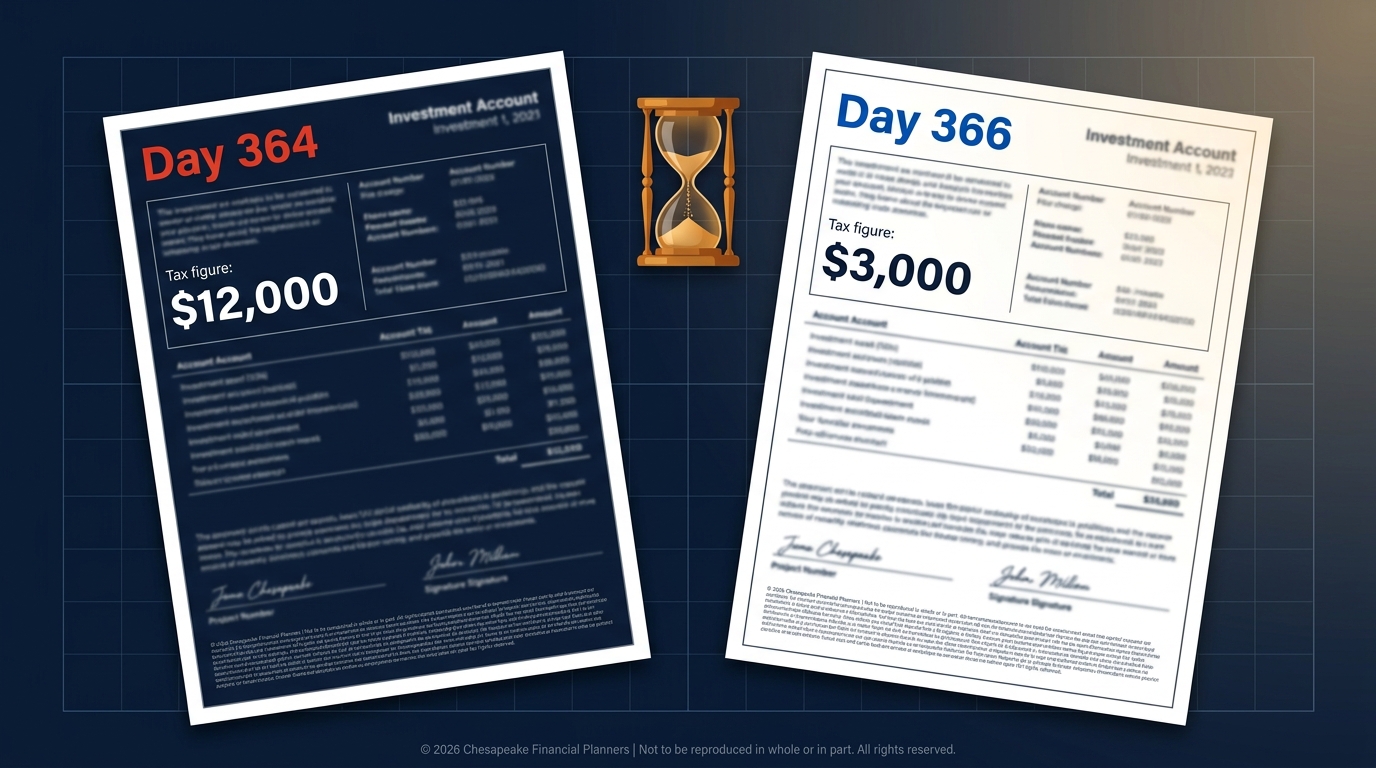
That same $10,000 gain taxed at 15% costs $1,500 instead of $2,400. The difference is real money for doing nothing but waiting. Selling at 364 days gets you ordinary rates; waiting until day 366 cuts the bill. I've watched clients almost give away $900 because they were two days early on a sale.

What Are the Best Capital Gains Tax Strategies to Use Right Now?
There are five investment tax planning moves that do most of the heavy lifting. Each works on its own, and several stack together.
1. Hold investments longer than one year. The simplest reduce capital gains tax move is patience. When a sale is close to the 12-month mark, check the purchase date before you act. Crossing into long-term territory can cut your rate by a third or more.
2. Use tax-loss harvesting. Sell positions that have dropped to offset positions that have gained. Sell Stock A for a $10,000 gain and Stock B for a $7,000 loss, and you owe tax on only the net $3,000. You can apply up to $3,000 in net losses against ordinary income each year, and any excess carries forward indefinitely, per IRS guidance. Watch the wash sale rule: buy the same or a substantially identical security within 30 days before or after the loss sale, and the loss is disallowed. Jeff Judge notes: "The wash sale rule catches people who think they're harvesting a loss and immediately buy back in — if you repurchase the same security within that 30-day window, the IRS disallows the loss and you've done the paperwork for nothing."
3. Hold appreciating assets in tax-advantaged accounts. Buying and selling inside a 401(k), traditional IRA, or Roth IRA does not trigger capital gains tax. A Roth IRA grows tax-free, so decades of gains come out untaxed in retirement when withdrawals are qualified. Keep high-turnover or high-growth holdings in these accounts and put tax-efficient index funds in your taxable brokerage.
4. Spread large gains across tax years. Selling $100,000 of appreciated stock in one year can push you into a higher capital gains bracket and trigger other thresholds. Selling $50,000 in December and $50,000 in January can keep you in the 15% rate both years instead of crossing into 20%.
5. Donate appreciated stock instead of cash. Give a qualified charity stock you have held more than a year, and you skip the capital gains tax entirely while deducting the full fair market value, subject to AGI limits. This is one of the most underused charitable stock donations strategies, and it works especially well for concentrated positions you have held a long time.
These strategies are part of a broader What is a year-round tax planning calendar for retirees and pre-retirees? that maps out when each move belongs in the year. Many of them also tie into tax-efficient fund placement and asset location strategies, which decides what goes where.
How Do Capital Gains Taxes Fit Into a Bigger Tax Plan?
Capital gains rarely sit in isolation. A large realized gain can raise your modified adjusted gross income, which affects Medicare premiums, the net investment income tax, and how much of your other income is taxed. That is why we run these decisions through the R.U.D.D.E.R. Method™, Chesapeake Financial Planners' six-step planning process: Review and Recognize, Uncover and Understand, Design and Develop, Discuss and Decide, Execute and Empower, and Reassess and Refine.
The order matters. Harvesting a loss in November is worthless if you triggered a needless gain in March. Understanding the difference between your What Is the Difference Between Marginal and Effective Tax Rate? helps you see which bracket a sale actually lands in. For higher earners weighing several moves at once, How Can I Reduce Taxes When Earning $200K to $500K? covers how these strategies interact at scale.
Frequently Asked Questions
What is the capital gains tax rate for 2026?
Long-term capital gains in 2026 are taxed at 0%, 15%, or 20% depending on your taxable income, with single filers up to $49,450 paying 0%, according to the IRS. Short-term gains on assets held one year or less are taxed at your ordinary income rate, which can run much higher.
Does tax-loss harvesting really save money?
Yes, tax-loss harvesting saves money by using investment losses to offset taxable gains and up to $3,000 of ordinary income each year. The rest of any unused loss carries forward to future years indefinitely. The catch is the wash sale rule, which disallows the loss if you repurchase the same or a substantially identical security within 30 days.
How long do I have to hold an investment to avoid short-term capital gains?
You must hold an investment more than one year, meaning at least 366 days, to qualify for long-term capital gains rates instead of short-term rates. Short-term gains apply to anything held one year or less and are taxed as ordinary income. Even a single day past the one-year mark moves you into the lower long-term brackets.
Is it better to donate stock or cash to charity?
Donating appreciated stock you have held more than a year is usually better than donating cash because you avoid the capital gains tax on the appreciation and still deduct the full fair market value. This double benefit can make charitable stock donations far more efficient than selling first and donating the proceeds, especially for long-held positions with a low cost basis.
Do capital gains affect my Social Security or Medicare costs?
Yes, large capital gains can raise your modified adjusted gross income, which may increase the taxable portion of your Social Security benefits and trigger higher Medicare premiums through IRMAA surcharges. This is why timing a big sale across tax years matters, since spreading the gain can keep you under the thresholds that drive those added costs.
If you want a clear, plain-English breakdown of the moves that keep more of your gains in your pocket, our investment tax planning guide walks through tax-loss harvesting, charitable giving, and account placement step by step. Download it free at chesapeakefp.com and put a real plan around your next sale.
Want to go deeper? Our Tax Strategy Readiness Quiz walks through this step by step.
Disclosures
The information provided is for educational purposes only and should not be construed as investment advice. Investment strategies should be tailored to individual circumstances, risk tolerance, and goals. Past performance doesn't guarantee future results. Consult with qualified financial professionals regarding your specific situation.
This information is not intended to be a substitute for specific individualized tax, investment or legal advice. We suggest that you discuss your specific situation with a qualified tax, legal or financial advisor.
Advisors associated with Chesapeake Financial Planners may be either (1) LPL Financial Registered Representatives offering securities through LPL Financial, Member FINRA and SIPC, and investment advisor representatives offering investment advice through Great Valley Advisor Group; or (2) solely investment advisor representatives offering investment advice through Great Valley Advisor Group and not affiliated with LPL Financial. Great Valley Advisor Group, and Chesapeake Financial Planners are separate entities from LPL Financial.


