

How Do I Avoid Surprise Tax Bills When My RSUs Vest?
Last reviewed: July 2026
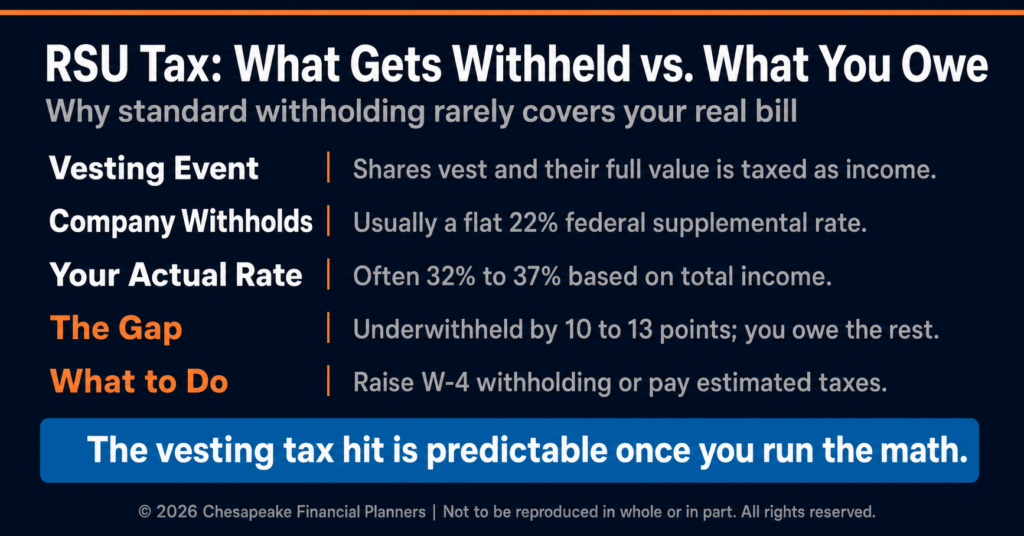
RSU tax planning starts with one uncomfortable truth: the taxes your company withholds when your shares vest almost never cover what you actually owe. RSUs are taxed as ordinary income at vesting, but most employers withhold federal tax at a flat 22% supplemental rate. If your marginal bracket is higher, you are underwithheld from the moment those shares hit your account. The fix is a system of increased withholding or quarterly estimated payments set up before the gap turns into an April penalty.
Key Takeaways
- RSUs are taxed as ordinary income on the vesting date, not when you sell the shares.
- Most companies withhold federal tax at a flat 22% supplemental rate, well below many tech professionals' actual marginal bracket.
- For 2026, the Social Security wage base is $184,500, which changes how RSU withholding stacks on top of salary.
- Closing the withholding gap with a new W-4 or quarterly estimated payments prevents penalties and cash-flow shocks.
About the Author: Jeff Judge, CFP®, AEP®, ChFC®, CLU® is Managing Partner of Chesapeake Financial Planners in Forest Hill, Maryland. He has been helping families and business owners in Harford County and the Baltimore metro area navigate equity compensation since earning his CFP® certification in 2013, by using Chesapeake Financial Planners’ signature process, the R.U.D.D.E.R. method™. Jeff sees the same pattern every spring: high earners treat RSU vesting as a windfall, then get blindsided by a five-figure tax bill the withholding never came close to covering.
How Are RSUs Taxed When They Vest?
RSU tax planning is confusing because two separate taxable events are easy to blur together. The first happens at vesting. The second happens at sale.
When restricted stock units vest, the fair market value of those shares on the vesting date becomes ordinary income, taxed exactly like your salary. When you later sell the shares, you owe capital gains tax only on the appreciation between the vesting price and the sale price. The grant itself is not a taxable event.
Here is the sequence:
- Grant date: You receive a promise of future shares. Nothing is taxable yet.
- Vesting date: Shares become yours. Their fair market value that day is taxable ordinary income.
- Withholding: Your company withholds shares to cover taxes, usually at the 22% federal supplemental rate plus state, Social Security, and Medicare. You keep the net shares.
- Sale date: You owe capital gains tax on any gain from the vesting price to the sale price.
The trouble is restricted stock units taxes rarely match that flat 22% withholding. The IRS sets 22% as the standard supplemental wage withholding rate for amounts under $1 million. If your marginal bracket is 32% or 35%, you are underwithheld by 10 to 13 percentage points before state tax even enters the picture. That gap is the surprise tax bill.
What Will I Actually Owe on a Large RSU Vest?
Run the math on a realistic example. You earn $200,000 in base salary, and this quarter $100,000 in RSUs vest.
| Tax component | Rate | Amount |
|---|---|---|
| Federal income tax (marginal) | 32% | $32,000 |
| State income tax (example, CA) | 9.3% | $9,300 |
| Social Security | 6.2% to wage base | $0 (base already met) |
| Medicare | 1.45% | $1,450 |
| Additional Medicare | 0.9% | $900 |
| Total tax on the vest | $43,650 | |
| Company withheld (est.) | ~30% | ~$30,000 |
| Still owed at tax time | ~$13,650 |
For 2026, the Social Security wage base is $184,500, so a high earner has often already maxed that tax before RSUs vest. The Additional Medicare Tax of 0.9% applies to wages above $200,000 for single filers and $250,000 for joint filers, which adds another layer most people forget.
If you do not make estimated tax payments to close that $13,650 gap, you can owe an underpayment penalty on top of it. Jeff Judge has watched clients lose thousands to that penalty for a problem that takes twenty minutes to solve in advance.
Should I Sell My RSUs at Vest or Hold Them?
Sell-at-vest is the cleanest default, and here is why. The shares already vested at full value, and you were already taxed on that value as income. Holding them is now an active investment decision, not a continuation of your compensation.
The case for selling at vest:
- You have already been paid. Holding asks whether this one stock will beat a diversified portfolio.
- Concentration risk is real. If RSUs are 30% to 50% of your comp and you hold every vest, your salary, benefits, and net worth all ride on one company.
- Tax simplicity. Your cost basis equals the vesting price, so selling immediately creates little or no capital gain.
The case for holding:
- Upside if the stock appreciates meaningfully after vesting.
- Long-term capital gains rates (0%, 15%, or 20%) apply to gains if you hold more than one year from the vesting date.
The balanced approach most professionals take: sell enough at vest to cover the tax and reduce concentration, then set a hard limit, such as never letting employer stock exceed 15% of your net worth. As Jeff puts it, the goal is to avoid both regrets, missing upside and blowing up your net worth on a single ticker.
How Do I Stop the Surprise Tax Bills?
The withholding gap will not fix itself. Your employer withholds a flat 22% federally because that is the supplemental rate, and they have no idea about your full income, state obligations, or marginal bracket. You need a system. This is also where the R.U.D.D.E.R. Method™, Chesapeake Financial Planners' six-step planning process of Review and Recognize, Uncover and Understand, Design and Develop, Discuss and Decide, Execute and Empower, and Reassess and Refine, keeps RSU strategy tied to the rest of your plan instead of treated as a one-off.
Follow these steps:
- Project your full-year income. Add base salary, bonus, and every scheduled RSU vest for the year. This is the number your company will never see.
- Estimate the tax shortfall. Apply your real marginal federal rate plus state tax to RSU income, then subtract what your employer will withhold at 22%. The difference is your gap.
- Increase withholding on your base salary. File a new W-4 requesting additional withholding. Divide the gap by remaining pay periods and smooth it across the year so no single April bill lands.
- Make estimated quarterly payments if needed. For substantial RSU income, pay the IRS and your state directly. The 2026 estimated tax due dates are April 15, June 17, September 16, and January 15, 2027.
- Use the safe harbor to avoid penalties. Paying 110% of your prior-year tax if your AGI exceeded $150,000 (or 90% of the current year) generally shields you from underpayment penalties even if you still owe at filing.
Increasing withholding through your W-4 has a quiet advantage: withholding counts as paid evenly throughout the year, which can cure an early-year shortfall that quarterly estimates cannot.
If you also have stock options, the planning gets more layered. See What Is the Difference Between ISOs and NSOs? and What Is Alternative Minimum Tax and How Do I Avoid It? before assuming RSU rules apply. For broader bracket strategy at this income level, How Can I Reduce Taxes When Earning $200K to $500K? covers how RSU income stacks with everything else.
Frequently Asked Questions
When are RSUs taxed, at grant or at vest?
RSUs are taxed at vesting, not at grant. On the vesting date, the fair market value of the shares becomes ordinary income, taxed like salary. The grant itself creates no tax. A second, separate tax applies later on any gain when you sell the vested shares.
Why does my company only withhold 22% on RSUs?
Companies withhold 22% because that is the IRS standard supplemental wage withholding rate for amounts under $1 million. It is a flat default, not a calculation based on your actual bracket. If your marginal rate is 32% or 35%, this flat rate leaves you underwithheld and owing the difference at tax time.
Do I need to make estimated tax payments on RSU income?
You likely do if your RSU income is substantial and the 22% withholding falls short of your real tax rate. Estimated payments to the IRS and your state, made quarterly, close the gap and help you avoid underpayment penalties. Increasing your W-4 withholding is often the simpler alternative.
Is it better to sell RSUs immediately or hold them?
Selling at vest is the cleaner default because you were already taxed on the full value and your cost basis equals the vesting price, creating little capital gain. Holding is an active bet on one stock. Most professionals sell enough to cover taxes and reduce concentration, then cap any held shares.
How can I avoid an underpayment penalty on RSU taxes?
Pay enough during the year to meet a safe harbor: generally 90% of your current-year tax, or 110% of your prior-year tax if your AGI exceeded $150,000. Increasing W-4 withholding is especially effective because withholding counts as paid evenly across the year.
RSU tax planning is not complicated once you treat vesting as the taxable event it is and close the withholding gap on purpose. If this was useful, our guide to equity compensation and tax-smart selling walks through the full decision framework. Download it at chesapeakefp.com.
Want to go deeper? Our Stock Option Strategy Worksheet walks through this step by step.
Disclosures
The information provided is for educational purposes only and should not be construed as investment advice. Investment strategies should be tailored to individual circumstances, risk tolerance, and goals. Past performance doesn't guarantee future results. Consult with qualified financial professionals regarding your specific situation.
This information is not intended to be a substitute for specific individualized tax, investment or legal advice. We suggest that you discuss your specific situation with a qualified tax, legal or financial advisor.
Advisors associated with Chesapeake Financial Planners may be either (1) LPL Financial Registered Representatives offering securities through LPL Financial, Member FINRA and SIPC, and investment advisor representatives offering investment advice through Great Valley Advisor Group; or (2) solely investment advisor representatives offering investment advice through Great Valley Advisor Group and not affiliated with LPL Financial. Great Valley Advisor Group, and Chesapeake Financial Planners are separate entities from LPL Financial.


