

What Are the Biggest Mistakes People Make With an Inheritance?
Last reviewed: July 2026
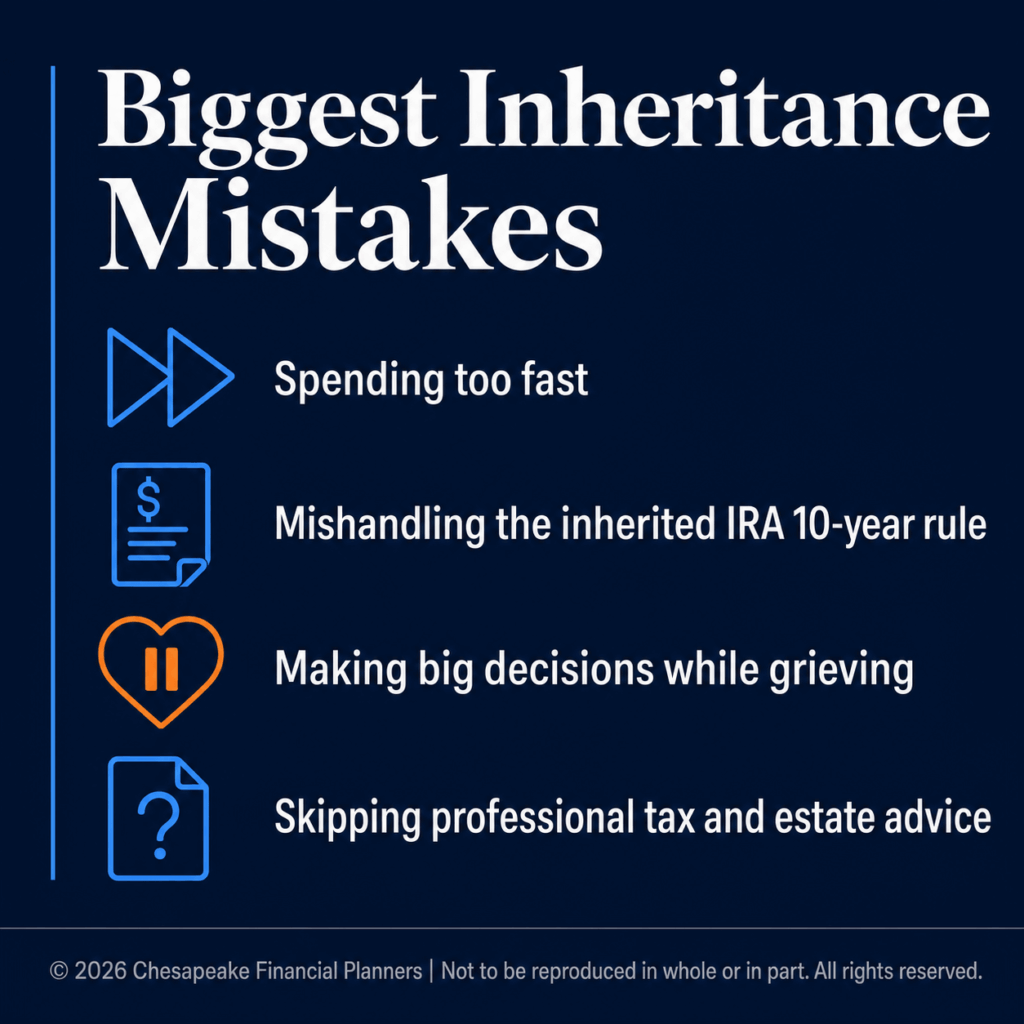
The biggest mistakes people make with an inheritance are spending it too fast, mishandling an inherited IRA and triggering a tax bill, and making permanent decisions during the first months of grief. Most inheritances disappear faster than people expect, often because nobody slowed down to build a plan before the money started moving. The fix is simple to say and hard to do: park the money, wait, and get the tax rules right before you touch a retirement account.
Key Takeaways
- The most expensive inheritance mistakes are emotional spending, blowing the inherited IRA tax rules, and acting before grief settles.
- Most non-spouse heirs must empty an inherited IRA within 10 years under the SECURE Act rule.
- The 2026 federal estate tax exemption is $15 million per person, so most families owe no federal estate tax.
- Parking the money in a high-yield account for several months prevents the worst irreversible decisions.
About the Author: Jeff Judge, CFP®, AEP®, ChFC®, CLU® is Managing Partner of Chesapeake Financial Planners in Forest Hill, Maryland. He has been helping families and business owners in Harford County and the Baltimore metro area navigate inheritances and wealth transfers since earning his CFP® certification in 2013, by using Chesapeake Financial Planners’ signature process, the R.U.D.D.E.R. method™. Jeff has watched more inheritances erode from quiet, avoidable tax errors than from any dramatic spending spree.
Why Do So Many People Mishandle an Inheritance?
Most people inherit money once or twice in a lifetime, so there's no learning curve. The money often arrives during the worst emotional stretch a person ever goes through. That combination, a large sum and a grieving mind, produces decisions people regret for years.
Research from the National Bureau of Economic Research on wealth transfers shows that a meaningful share of inherited assets is spent or given away within a few years of receipt. The pattern isn't recklessness. It's the absence of a plan. Money with no assignment tends to get assigned by default, usually toward whatever feels urgent that month.
Jeff Judge often tells clients that the inheritance itself is rarely the problem. The problem is the silence around it. Nobody named the goal, so the money drifted. A spouse pays off the mortgage, helps a kid, buys a car, donates to a cause, and twelve months later the account is half its original size with nothing structural to show for it.
The single best move is also the most boring one. Move the cash into a high-yield savings account or money market fund and leave it there for several months. No major purchases. No new investments. No loans to relatives. That waiting period is not wasted time. It's the cheapest insurance you'll ever buy against an irreversible decision.
What Are the Inherited IRA Rules After the SECURE Act?
The inherited IRA rules changed dramatically under the SECURE Act, and getting them wrong is one of the most expensive inheritance mistakes you can make. Most non-spouse beneficiaries who inherited an IRA after 2019 must empty the entire account within 10 years of the original owner's death. The old "stretch IRA," which let heirs draw the account down slowly over their own lifetime, is gone for most people.
Here's where it gets sharp. The IRS finalized rules confirming that if the original owner had already started required minimum distributions, the non-spouse heir must take annual RMDs in years one through nine and still empty the account by year 10. Miss those annual distributions and you face a penalty on the amount you should have withdrawn.
Every dollar pulled from an inherited traditional IRA is taxed as ordinary income. Cram a six-figure account into one or two tax years and you can push yourself into a higher bracket, trigger higher Medicare premiums, and surrender tens of thousands in unnecessary tax. The smarter approach for many heirs is spreading withdrawals evenly across the 10-year window, especially during lower-income years.
Who is exempt from the 10-year rule?
A few beneficiaries still qualify for the older lifetime stretch treatment. Surviving spouses, minor children of the deceased (until they reach majority), disabled or chronically ill heirs, and beneficiaries less than 10 years younger than the deceased are treated as "eligible designated beneficiaries." If you fall into one of these categories, your options are broader, and you should confirm them before withdrawing a dime.
How Do High Earners Open a Backdoor Roth IRA in 2026?
How Should You Handle the Money Emotionally?
The emotional side of an inheritance drives more bad decisions than the math does. Grief compresses judgment. People want to honor a parent by paying off a debt the parent once worried about, or they feel guilt about the money and give it away too fast. Both impulses are understandable, and both can be costly when acted on in month one.
The fix is a forced delay. Treat the first six to twelve months as a no-major-decisions zone. Pay the bills, keep the lights on, and let the cash sit. Decisions made at month nine are almost always better than decisions made at week two, because the fog has lifted and you can see the full picture, including taxes, your own retirement, and any obligations you forgot in the early weeks.
Jeff has watched clients freeze a windfall in place for a year and then make calm, deliberate choices that compounded for decades. He's also watched the opposite, where speed cost real money. The difference was never intelligence. It was whether someone built in a pause.
Do I need to update my beneficiary designations after a divorce or major life change?
What Are the Tax Traps Beyond the Inherited IRA?
Inherited retirement accounts get the headlines, but other tax rules quietly trip people up. Knowing them up front prevents the kind of mistake you only discover at tax time.
Step-up in basis on inherited assets. When you inherit a taxable brokerage account or real estate, the cost basis usually resets to the value on the date of death. Sell shortly after and your taxable gain is often small or zero. Many heirs don't realize this and either hold an asset they should sell or panic-sell something with built-in protection.
Federal estate tax rarely applies. The 2026 federal estate tax exemption is $15 million per person, per IRS inflation adjustments. The overwhelming majority of families owe no federal estate tax at all. State-level inheritance and estate taxes are a different story and depend on where the deceased lived.
State inheritance tax can surprise non-lineal heirs. A handful of states levy an inheritance tax on what certain heirs receive. Maryland, for example, taxes inheritances passing to non-lineal heirs like nieces, nephews, and friends. If you inherit from someone outside your direct family line, check the state rules before you assume the full amount is yours.
Who owes Maryland's 10% inheritance tax and what planning options protect non-lineal heirs?
This is also where a structured planning process earns its keep. The R.U.D.D.E.R. Method™ is Chesapeake Financial Planners' six-step planning process: Review and Recognize, Uncover and Understand, Design and Develop, Discuss and Decide, Execute and Empower, and Reassess and Refine. Applied to an inheritance, it forces you to map the tax picture before you move money, not after. Jeff Judge notes: "The step-up in basis is one of the most valuable benefits an heir can receive, and we've seen people give it away by selling too slowly or, just as often, by holding on to an asset they should have sold the week after the estate settled."

How Do You Turn an Inheritance Into Lasting Wealth?
The goal isn't to lock the money away and never enjoy it. The goal is to make sure that 10 years from now you can point to something the inheritance built. According to Vanguard research on investor behavior, disciplined long-term allocation consistently outperforms reactive moves. An inheritance is the most reactive moment most people will ever face, which is exactly why a plan matters.
Start by funding the gaps in your own financial life. Top off the emergency fund, knock out high-interest debt, and check whether you're on track for your own retirement. Once the foundation is solid, the remaining funds can go to work in a diversified portfolio matched to your timeline and risk tolerance.
Jeff often reminds clients that the kindest thing you can do with money someone left you is to make it last. A thoughtful plan honors the person more than a fast gesture ever could. Fidelity guidance echoes this, noting that heirs who pause and plan retain far more of the inheritance than those who act immediately.
What Are the Best Tax Strategies for High Net Worth Individuals?
Frequently Asked Questions
What should I do first when I receive an inheritance?
When you receive an inheritance, move the cash into a high-yield savings or money market account and make no major financial decisions for at least six months. This pause prevents emotional spending and irreversible mistakes. Use the time to understand the tax rules, especially for any inherited retirement accounts, before you touch the money.
How does the 10-year rule work for an inherited IRA?
The 10-year rule requires most non-spouse beneficiaries to empty an inherited IRA within 10 years of the original owner's death. According to the IRS, if the deceased had already started required minimum distributions, heirs must also take annual distributions in years one through nine. Spreading withdrawals across the decade usually minimizes the tax hit.
Do I have to pay taxes on inherited money?
It depends on what you inherit. Cash, life insurance proceeds, and most inherited brokerage assets generally are not taxed as income, partly because of the step-up in basis. Inherited traditional IRA and 401(k) withdrawals, however, are taxed as ordinary income. A few states also levy inheritance taxes on certain non-lineal heirs.
What is a step-up in basis on inherited property?
A step-up in basis resets the cost basis of inherited assets to their fair market value on the date of the original owner's death. If you sell soon after inheriting, your taxable gain is often small or zero. This rule applies to most taxable brokerage accounts and real estate, but not to retirement accounts.
How quickly do most inheritances get spent?
Most inheritances are spent or given away faster than heirs expect, often within a few years. Research from the National Bureau of Economic Research on wealth transfers shows a meaningful share of inherited assets disappears quickly. The cause is usually the absence of a plan rather than reckless spending.
Can I avoid taxes by leaving an inherited IRA untouched?
No. Leaving an inherited IRA untouched does not avoid taxes and can trigger penalties. Most non-spouse heirs must empty the account within 10 years, and many must take annual distributions in the interim. Skipping required withdrawals exposes you to an IRS penalty on the amount you should have taken.
Where to Go From Here
The heirs who keep their inheritance share one habit: they slow down, they get the inherited IRA rules right, and they build a plan before the money starts moving. Avoiding these inheritance mistakes is less about discipline and more about giving yourself the time to make calm decisions. If you want a framework for handling a windfall the right way, our guide on managing a major financial transition walks through every step. Download it at chesapeakefp.com.
Want to go deeper? Our How to Avoid Common Mistakes With Inherited Wealth walks through this step by step.
Disclosures
The information provided is for educational purposes only and should not be construed as investment advice. Investment strategies should be tailored to individual circumstances, risk tolerance, and goals. Past performance doesn't guarantee future results. Consult with qualified financial professionals regarding your specific situation.
Contributions to a traditional IRA may be tax deductible in the contribution year, with current income tax due at withdrawal. Withdrawals prior to age 59 ½ may result in a 10% IRS penalty tax in addition to current income tax.
This information is not intended to be a substitute for specific individualized tax, investment or legal advice. We suggest that you discuss your specific situation with a qualified tax, legal or financial advisor.
Advisors associated with Chesapeake Financial Planners may be either (1) LPL Financial Registered Representatives offering securities through LPL Financial, Member FINRA and SIPC, and investment advisor representatives offering investment advice through Great Valley Advisor Group; or (2) solely investment advisor representatives offering investment advice through Great Valley Advisor Group and not affiliated with LPL Financial. Great Valley Advisor Group, and Chesapeake Financial Planners are separate entities from LPL Financial.


