
How Do High Earners Open a Backdoor Roth IRA in 2026?
Last reviewed: July 2026
You earn too much for a direct Roth IRA contribution. The backdoor Roth IRA is the IRS-approved workaround: high earners make a non-deductible contribution to a traditional IRA, then convert that balance to a Roth IRA within a few days. Both steps are documented in IRS Publication 590-A, and neither has an income limit, which is how the strategy bypasses the 2026 Roth IRA income limits.
Key Takeaways
- The backdoor Roth IRA lets high earners fund a Roth even when their income exceeds the 2026 Roth IRA phase-out range of $242,000 to $252,000 for married filing jointly.
- The strategy works cleanly only when you have no existing pre-tax IRA balances, since the pro-rata rule otherwise creates a surprise tax bill.
- Rolling existing pre-tax IRA balances into your current 401(k) before the conversion is the most common way to clear the pro-rata problem.
- Form 8606 is the IRS paperwork that documents your after-tax basis and protects the conversion from being taxed twice.
- For 2026, the IRA contribution limit is $7,500, or $8,600 with the age-50 catch-up, which sets the annual size of a standard backdoor Roth move.
About the Author: Jeff Judge, CFP®, AEP®, ChFC®, CLU® is Managing Partner of Chesapeake Financial Planners in Forest Hill, Maryland. He has been helping families and business owners in Harford County and the Baltimore metro area execute backdoor Roth IRA strategies since earning his CFP® certification in 2013, by using Chesapeake Financial Planners’ signature process, the R.U.D.D.E.R. method™. Most high-earning households Jeff sits down with assume the Roth door is closed to them. In practice, it is open more often than they expect.
Table of Contents
- What Is a Backdoor Roth IRA?
- Who Should Consider a Backdoor Roth IRA in 2026?
- How Does the Backdoor Roth IRA Strategy Actually Work?
- What Is the Pro-Rata Rule and Why Does It Wreck Backdoor Roth Plans?
- How Do You Execute a Clean Backdoor Roth IRA Step by Step?
- What Is the Mega Backdoor Roth IRA?
- When Should You Reconsider the Backdoor Roth Strategy?
- Frequently Asked Questions
What Is a Backdoor Roth IRA?
A backdoor Roth IRA is not a separate account type. It is a sequence of two transactions that achieves the same outcome as a direct Roth contribution for someone whose income is above the limit. You contribute to a traditional IRA on a non-deductible basis, then convert the balance to a Roth IRA. The IRS does not impose an income cap on either step, which is the part that makes it work.
Why does the IRS allow this when there is an income limit on direct Roth contributions?
The income limit applies only to direct Roth IRA contributions. Roth conversions, by statute, have had no income limit since 2010, when Congress removed the prior $100,000 modified adjusted gross income cap on conversions. The backdoor strategy combines these two rules into a single planning move. Congress has had years to close the loophole and has chosen not to, which is why most financial planners treat the backdoor Roth as a stable, mainstream tool rather than an aggressive position. The IRS's own Roth IRA reference page outlines the contribution and conversion rules side by side.
Why does this matter even at a high income? Roth dollars carry three structural advantages that pre-tax dollars do not. Qualified distributions from a Roth IRA are federally tax-free once you have held the account at least five years and reached age 59½ (or are deceased, disabled, or a first-time homebuyer up to $10,000). The account owner is not subject to Required Minimum Distributions during their lifetime. And Roth balances pass to heirs free of federal income tax, although heirs are still subject to the 10-year payout window under the SECURE Act.
Should I Choose a Roth IRA or Traditional IRA?
Who Should Consider a Backdoor Roth IRA in 2026?
Use the backdoor Roth in 2026 if your modified adjusted gross income makes a direct Roth contribution either reduced or fully blocked under the Roth IRA income limits. Per the IRS, the 2026 Roth IRA MAGI phase-out for married filing jointly is $242,000 to $252,000, and the single or head of household range runs from $153,000 to $168,000. Above the top of each range, direct Roth contributions are not permitted.
Is the backdoor Roth IRA a good fit for everyone who exceeds the income limit?
Not quite. Three preconditions matter more than the income test itself.
First, you need earned income at least equal to the contribution you plan to make. Investment income alone does not qualify.
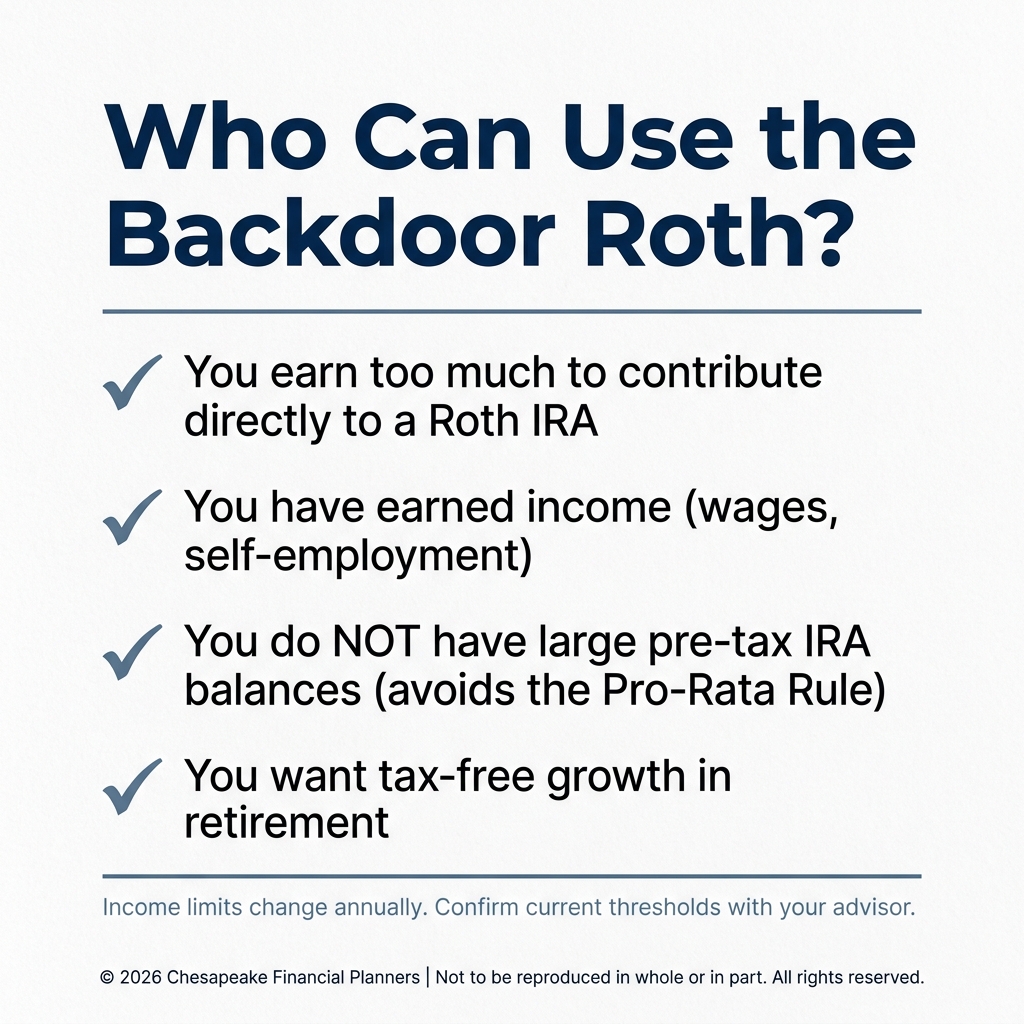
Second, you should have little or no balance in any traditional IRA, SEP IRA, or SIMPLE IRA. Pre-existing pre-tax IRA balances trigger the pro-rata rule, which can erase the tax benefit you came for. We get into that math in the next section.
Third, you should expect to be in a similar or higher tax bracket in retirement. If you genuinely expect a much lower retirement bracket, pre-tax 401(k) and traditional IRA contributions may serve you better. Most of the high-earning households Jeff sits with at Chesapeake Financial Planners are looking at the opposite scenario: a retirement bracket equal to or above today's, because they are sitting on substantial pre-tax 401(k) balances and will face large taxable Required Minimum Distributions starting at age 73.
For 2026, the IRA contribution limit is $7,500, plus a $1,100 catch-up if you are age 50 or older, bringing the over-50 limit to $8,600. That is the maximum you can move through a single backdoor Roth in a year.
How Does the Backdoor Roth IRA Strategy Actually Work?
The mechanics are straightforward when you have no existing pre-tax IRA balances. You make a non-deductible contribution to a traditional IRA, then convert that balance to a Roth IRA shortly after. Because your contribution was after-tax, the conversion generates little or no additional tax liability beyond a few cents of incidental interest that may accrue between the two steps.
What does a clean backdoor Roth look like in real dollars?
Walk through a 2026 example. You and your spouse have a combined MAGI of $310,000. You are both above the Roth IRA MFJ phase-out, so direct contributions are off the table.
You each open a traditional IRA (if you do not have one already). You each contribute $7,500 in cash to that traditional IRA and leave it uninvested for a few days. You then convert each $7,500 traditional IRA balance to a Roth IRA. If a few dollars of interest accrued during the wait, that small amount is taxable, and you report it on your return. The principal $7,500 was already taxed, so it converts without additional tax.
The result: $15,000 of Roth IRA funding for the year, sitting in the household's Roth accounts where future earnings can compound under Roth rules. Repeat annually and the contributions stack. Over 20 years at $15,000 per household per year, indexed for future limit increases, the cumulative Roth principal alone exceeds $300,000 before any investment growth.

What Is the Pro-Rata Rule and Why Does It Wreck Backdoor Roth Plans?
The pro-rata rule is the single biggest reason backdoor Roth contributions get botched. It says the IRS does not let you cherry-pick which dollars to convert when you have both pre-tax and after-tax money in your traditional IRA, SEP IRA, or SIMPLE IRA. Instead, the rule treats all of those accounts as one combined pool, then applies a percentage-based calculation across the entire balance.
How does the pro-rata math actually play out?
Take a worked example. Suppose you have $97,500 already sitting in a traditional IRA from an old 401(k) rollover. All of that money is pre-tax. You then contribute $7,500 on a non-deductible basis to a traditional IRA for the year, bringing the combined traditional IRA total to $105,000. Of that combined balance, $7,500 (about 7%) is after-tax and $97,500 (about 93%) is pre-tax.
Now you convert $7,500 to a Roth IRA, hoping to move only the non-deductible piece. The IRS instead applies the 7% / 93% split to the conversion itself. Only 7% of the $7,500 conversion, about $525, comes out tax-free as a return of basis. The other 93%, roughly $6,975, is treated as a taxable distribution at your ordinary income rate.
You set out to move $7,500 into a Roth and you ended up with a $6,975 taxable event on top of the conversion. As Jeff Judge often tells clients, "The pro-rata rule is the silent killer of backdoor Roth plans. People come in thinking they made a clean $7,500 Roth contribution, and they walk out owing tax on $6,975 they never meant to convert."
The pro-rata rule applies to the December 31 balance of the year you do the conversion, not the day of the conversion itself. So you cannot fix the problem by rolling the pre-tax balance out the day after the conversion. The fix has to happen before year-end.
How Do You Execute a Clean Backdoor Roth IRA Step by Step?
A clean backdoor Roth has six discrete steps. Walk through them in order. The order matters more than the calendar timing.
Is there a single right way to sequence this each year?
There is a sequence Jeff Judge walks clients through during the planning phase, and it follows the same shape every year. It is part of the R.U.D.D.E.R. Method™, which is Chesapeake Financial Planners' six-step planning process: Review and Recognize, Uncover and Understand, Design and Develop, Discuss and Decide, Execute and Empower, and Reassess and Refine. The backdoor Roth sits in the Execute step, but the analysis of whether to do it at all happens in Review and Uncover.
The mechanical sequence is as follows.
Step 1: Audit your pre-tax IRA balances. Pull statements for every traditional IRA, SEP IRA, and SIMPLE IRA you hold. If the combined balance is non-zero, you have a pro-rata problem to clear before contributing.
Step 2: Clear pre-tax IRA balances if you have them. The most common move is to roll those balances into your current employer's 401(k) plan if the plan accepts rollovers. Most do. Verify with your plan administrator. Once the pre-tax money is inside the 401(k), it is no longer included in the pro-rata calculation, because the rule only looks at IRAs.
Step 3: Open a traditional IRA if you do not already have one. Most major brokerages offer this online in fifteen minutes. Leave the account funded only with the contribution amount, in cash or a money market fund. Do not invest the contribution yet.
Step 4: Make the non-deductible contribution. Contribute up to the 2026 IRA limit of $7,500, or $8,600 with the age-50 catch-up. Mark it as non-deductible on your tax return.
Step 5: Convert the traditional IRA to a Roth IRA within a few days. Initiate the conversion through your brokerage. Confirm in writing that it is processed as a "Roth conversion," not a recharacterization. Conversions cannot be reversed, but they also are not subject to an income limit.
Step 6: File Form 8606 for both the contribution and the conversion. IRS Form 8606 is the form that documents your after-tax basis and tells the IRS the conversion was largely a return of already-taxed dollars. Skip Form 8606 and the IRS has no record of your basis, which can lead it to treat the full converted amount as taxable.
After step 6, invest the Roth IRA balance according to your overall portfolio allocation. The earlier you invest after the conversion, the more time the dollars have to compound under Roth rules.
What Is the Mega Backdoor Roth IRA?
The mega backdoor Roth is a different mechanism that lives entirely inside an employer 401(k) plan. It uses two features that many plans do not offer: after-tax contributions above the regular 401(k) elective deferral limit, and either an in-service withdrawal or an in-plan Roth conversion of those after-tax dollars.
How much can you move through a mega backdoor Roth in 2026?
The total 2026 cap on contributions to a defined contribution plan is $72,000 under IRS Notice 2025-67. That cap is the sum of employee elective deferrals, employer matching and profit-sharing contributions, and employee after-tax contributions.
Start with the employee elective deferral limit, which is $24,500 for 2026. Add whatever employer match and profit-sharing show up in your plan. Whatever space is left between the sum of those items and the $72,000 plan cap is the room available for after-tax contributions, which become the mega backdoor source.
A representative example: a high earner contributes the full $24,500 in elective deferrals, receives $10,000 of employer match, and has $37,500 of remaining headroom under the $72,000 cap. That $37,500 can be contributed on an after-tax basis, then converted to Roth (either inside the plan or rolled to a Roth IRA), funding roughly five times what a standard backdoor Roth allows in the same year.
How does the mega backdoor compare to the other Roth-funding routes?
| Strategy comparison | Direct Roth IRA | Backdoor Roth IRA | Mega Backdoor Roth |
|---|---|---|---|
| 2026 annual contribution ceiling | $7,500 ($8,600 if 50+) | $7,500 ($8,600 if 50+) | Up to ~$47,500 (depends on plan, match, deferrals) |
| Income limit | $242K-$252K phase-out (MFJ); $153K-$168K (single) | None | None |
| Where the dollars live | Roth IRA at any brokerage | Traditional IRA, then converted to Roth IRA | Inside employer 401(k), optionally rolled to Roth IRA |
| Plan-design dependent | No | No | Yes (after-tax + conversion features required) |
| Pro-rata rule applies | Not applicable | Yes, if other pre-tax IRAs exist | No, operates inside the 401(k) |
| Typical fit | Anyone under the income limit | High earners above the income limit | High earners whose plan supports after-tax + conversion |
This strategy depends entirely on plan design. Two questions for your plan administrator: does the plan allow after-tax contributions above the elective deferral limit, and does it allow either in-service withdrawals or in-plan Roth conversions of those after-tax dollars? Both answers must be yes. If either is no, the mega backdoor is not available in your current plan.
Should I Choose a Roth 401k or Traditional 401k?
When Should You Reconsider the Backdoor Roth Strategy?
The backdoor Roth is not the right move for every high earner every year. Three situations warrant a second look before contributing.
What scenarios make the backdoor Roth less attractive?
The first is unresolved pre-tax IRA balances. If you cannot clear them through a 401(k) rollover, the pro-rata tax cost may erase the benefit of the contribution. Some households still do the contribution and accept partial taxation because the long-horizon Roth growth is worth it. Others wait a year to clear the IRA first.
The second is a high-income year that you expect to be temporary. If you are in your single highest-earning year of your career, your marginal tax rate now is the highest it will ever be. Pre-tax 401(k) contributions arguably do more work in that year, since the deduction is most valuable when the marginal rate is highest. The backdoor Roth still has merit, but pre-tax 401(k) contributions take priority.
The third is a year in which you plan to do a large pre-tax to Roth conversion separately. A six-figure Roth conversion already moves taxable income into the current year. Stacking a backdoor Roth on top is fine mechanically, but the pro-rata math gets messy if the conversion is from an IRA rather than a 401(k). Coordinate the sequence with your CPA.
The R.U.D.D.E.R. Method™ exists in part to keep these moving parts in view. The backdoor Roth is one piece of a larger puzzle that includes tax-deferred contributions, taxable brokerage drawdown strategy, RMD planning, IRMAA-aware Medicare income thresholds, and estate transfer goals. Jeff Judge has seen clients spend more time deciding whether to do a backdoor Roth than the dollar impact justifies, while ignoring six-figure decisions elsewhere in the plan. Get the framework right first; the backdoor Roth then becomes a routine annual checkbox.

Frequently Asked Questions
Is the backdoor Roth IRA legal in 2026?
Yes, the backdoor Roth IRA is fully legal under current IRS rules in 2026 and has been a standard high-earner strategy since Congress removed the income cap on Roth conversions in 2010. There is no income limit on Roth conversions, and there is no income limit on non-deductible traditional IRA contributions. The combination is described in IRS Publication 590-A. Confirm the steps with your tax professional before executing in a given year.
Do I have to wait between the contribution and the conversion?
No required waiting period exists in the IRS rules for a backdoor Roth IRA, though most advisors recommend waiting a few business days for the contribution to settle. A longer wait can backfire if the traditional IRA accrues taxable interest before the conversion. The practical rule of thumb: contribute, let the cash settle, then convert within the same week so the moving parts stay synced.
What happens if I forget to file Form 8606?
Skipping Form 8606 does not invalidate the backdoor Roth, but it removes the IRS's record of your after-tax basis, which means the IRS may treat the entire conversion as taxable income. The fix is to file Form 8606 for the affected year as soon as you notice the omission. A late-filed 8606 carries a $50 penalty under IRS guidance, which is small relative to the tax exposure the form prevents.
Can I do a backdoor Roth IRA if I already maxed out my 401(k)?
Yes, the IRA contribution limit and the 401(k) contribution limit are entirely separate, so a maxed-out 401(k) does not foreclose IRA contributions. For 2026, you can contribute up to $24,500 to a 401(k) and an additional $7,500 to an IRA (or $8,600 if age 50 or older), as long as you have earned income covering the IRA contribution. The backdoor Roth uses the IRA path, separately from your workplace 401(k) deferrals.
How does the pro-rata rule work with a SEP IRA or SIMPLE IRA?
The pro-rata rule combines your traditional IRA, SEP IRA, and SIMPLE IRA balances into a single pool when calculating the taxable portion of a backdoor Roth conversion. A SEP IRA balance from prior self-employment income, or an active SIMPLE IRA, will dilute the after-tax portion of a backdoor Roth conversion the same way a regular traditional IRA balance would. The only IRA type that does not count in the pro-rata calculation is an inherited IRA held in a separate account.
What is the difference between a backdoor Roth and a Roth conversion?
A backdoor Roth is a specific type of Roth conversion that uses after-tax non-deductible IRA contributions, designed so the conversion creates little or no additional tax liability. A standard Roth conversion moves pre-tax dollars from a traditional IRA or 401(k) into a Roth IRA and generates taxable income on the full converted amount. Both are governed by IRS rules in Publication 590-A and Publication 590-B, but they serve different strategic purposes.
Can my spouse do a backdoor Roth too?
Yes, your spouse can run a separate backdoor Roth as long as they have earned income equal to at least the contribution amount, or you file jointly and the working spouse's income covers both contributions under the spousal IRA rules. Each spouse must use a separately-owned traditional IRA and Roth IRA, since IRAs cannot be held jointly. This is how dual-income and single-income households alike double the annual backdoor Roth volume on a single tax filing.
Retirement planning for high earners involves more than the backdoor Roth, but executing it well each year is one of the cleanest annual habits we recommend. If the backdoor Roth IRA is on your list for 2026 and you want a second set of eyes before you click the conversion button, our planning team can review your IRA balances and tax projections together. Visit chesapeakefp.com to download our High Earner Tax Planning Checklist, which walks through the full sequence including pro-rata cleanup, Form 8606 mechanics, and the mega backdoor Roth screening questions.
What Are the Best Tax Strategies for High Net Worth Individuals?
Please consult your tax professional regarding your specific tax situation.
Roth IRA distributions of earnings are tax-free as long as the distribution is made more than five years after your first Roth IRA contribution and you are at least 59½, or as a result of your disability or death.
A Roth IRA conversion may not be suitable for your situation. The conversion will result in taxation of the converted amount if you have pre-tax IRA balances. You should consult with a tax advisor before implementing any Roth IRA conversion strategy.
Want to go deeper? Our Tax Moves for High Earners walks through this step by step.
Disclosures
The information provided is for educational purposes only and should not be construed as investment advice. Investment strategies should be tailored to individual circumstances, risk tolerance, and goals. Past performance doesn't guarantee future results. Consult with qualified financial professionals regarding your specific situation.
Contributions to a traditional IRA may be tax deductible in the contribution year, with current income tax due at withdrawal. Withdrawals prior to age 59 ½ may result in a 10% IRS penalty tax in addition to current income tax.
A Roth IRA offers tax deferral on any earnings in the account. Qualified withdrawals of earnings from the account are tax-free. Withdrawals of earnings prior to age 59 ½ or prior to the account being opened for 5 years, whichever is later, may result in a 10% IRS penalty tax. Limitations and restrictions may apply.
This information is not intended to be a substitute for specific individualized tax, investment or legal advice. We suggest that you discuss your specific situation with a qualified tax, legal or financial advisor.
Advisors associated with Chesapeake Financial Planners may be either (1) LPL Financial Registered Representatives offering securities through LPL Financial, Member FINRA and SIPC, and investment advisor representatives offering investment advice through Great Valley Advisor Group; or (2) solely investment advisor representatives offering investment advice through Great Valley Advisor Group and not affiliated with LPL Financial. Great Valley Advisor Group, and Chesapeake Financial Planners are separate entities from LPL Financial.


