

How Do You Create a Family Wealth Governance Structure for Long-Term Success?
Last reviewed: July 2026
Family wealth governance is the set of agreed-upon processes, policies, and structures a family uses to make decisions about managing, investing, and transferring wealth across generations. You build it by defining who decides what, writing down shared values, and creating communication habits before a crisis forces the issue. It is less about legal documents and more about preventing money from quietly tearing a family apart.
Most families with real wealth never build this. They assume good intentions and mutual trust will carry them through. Then one sibling wants aggressive growth, another wants preservation, the next generation wants to invest by their values, and nobody can agree on who actually gets to call the shot. That is the gap family wealth governance closes.
Key Takeaways
- Family wealth governance defines decision-making authority, communication rules, and shared values across generations before conflict starts.
- Roughly 70% of wealth transfers fail by the third generation, usually from broken trust and communication, not bad investing.
- The five core elements are a mission statement, decision framework, communication protocol, investment policy statement, and distribution policy.
- Governance scales down: families with $1 million or more benefit, not just ultra-wealthy dynasties.
- Start by framing governance as protecting relationships, not controlling people, to reduce resistance from family members.
About the Author: Jeff Judge, CFP®, AEP®, ChFC®, CLU® is Managing Partner of Chesapeake Financial Planners in Forest Hill, Maryland. Jeff has watched families with strong balance sheets fall apart over decisions nobody ever agreed on in advance, and he has seen modest families thrive simply because they wrote the rules down early. He has been helping families and business owners in Harford County and the Baltimore metro area navigate major wealth events and protect their legacies since earning his CFP® certification in 2013, by using Chesapeake Financial Planners’ signature process, the R.U.D.D.E.R. method™.
What Is Family Wealth Governance?
Family wealth governance is the system of processes, policies, and structures that guide how wealth is managed, invested, and transferred across generations. It answers the questions families avoid until it is too late: Who makes investment decisions? How do we educate the next generation? What happens when family members disagree? How do we balance one person's needs against the family's collective goals?
Without governance, families default to whoever is loudest or whoever controls the accounts. That breeds resentment and produces poor decisions made under pressure. With governance, a family creates clarity and fairness, and the wealth has a far better chance of surviving the people who built it.
The stakes are real. Research summarized by the Williams Group, which studied thousands of families over decades, found that roughly 70% of wealth transfers fail by the end of the second generation and 90% by the third. The cause in the large majority of cases was not bad investing or taxes. It was a breakdown in trust and communication, exactly what governance is built to prevent.
Why Do Families Avoid Wealth Governance?
Families avoid governance because it feels unnecessary, awkward, or premature, and every one of those instincts is expensive. The most common objections sound reasonable on the surface but fall apart under pressure.
"We are not that wealthy." Governance benefits any family coordinating assets across multiple members, not just nine-figure dynasties. The Federal Reserve's 2023 Survey of Consumer Finances reported a median net worth of about $192,700 for U.S. families, so any household well above that is already in territory where coordination matters. "We trust each other." Trust does not prevent disagreement, and governance is what protects trust once disagreement shows up. "It feels too corporate." Governance means agreed-upon processes, not rigid bureaucracy. "We will figure it out when we need to." Waiting until a death or a market crash forces the conversation is the single worst environment for making it.
Jeff Judge often tells clients that the families who refuse to talk about this are the ones who end up in a lawyer's conference room a decade later, paying attorneys to settle what a single weekend conversation could have resolved for free.
What Are the Five Core Elements of Family Wealth Governance?
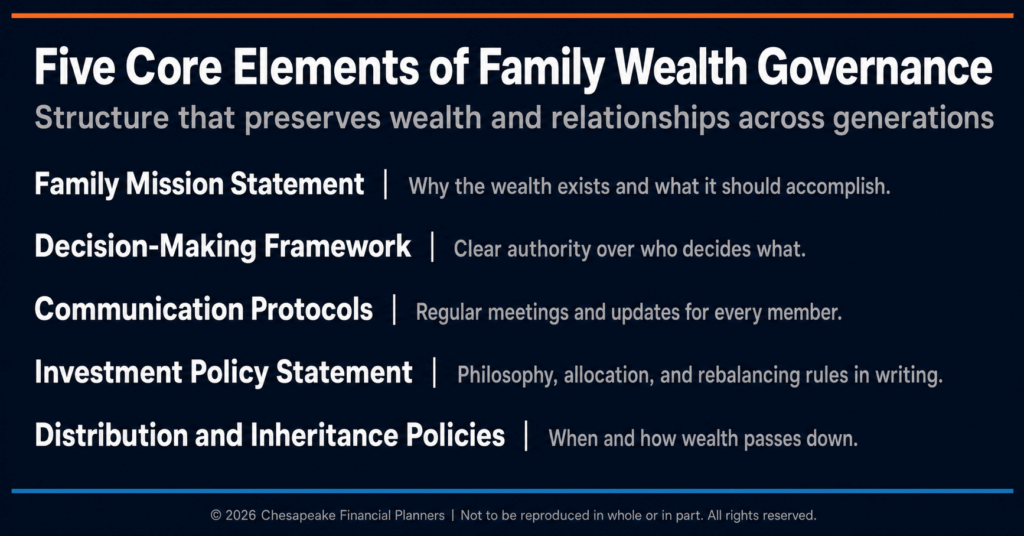
Family wealth governance rests on five elements that work together: a mission statement, a decision-making framework, communication protocols, an investment policy statement, and distribution policies. Each one answers a question that otherwise gets argued in the moment.
1. Family Mission Statement. This articulates why your wealth exists and what it should accomplish. It is the North Star when family members disagree. A workable example: "Our family wealth exists to provide security, enable education, support entrepreneurship, and give back to our community. We believe in living below our means and responsible stewardship." When a conflict arises, you return to the statement and ask whether the proposal aligns with it.
2. Decision-Making Framework. Clear authority prevents conflict. Many families use tiered decisions: small choices under a set dollar amount are handled individually, medium ones require a family council vote, and large ones need broad consent. Others use role-based authority, where an investment committee handles investments and a separate group manages giving. Document who decides what so the answer is settled before anyone asks.
3. Communication Protocols. Regular, structured communication kills the assumptions that poison family relationships. Annual family meetings review performance, goals, and next-generation education. Quarterly financial summaries go to every family member. Define what counts as urgent enough to trigger an immediate call versus what waits for the next scheduled meeting.
4. Investment Policy Statement (IPS). An IPS codifies your investment philosophy, allocation targets, risk tolerance, and rebalancing rules, which removes emotion from decisions. When markets crash or a relative wants to put everything into one speculative bet, the IPS gives you a documented answer instead of an argument. A sound IPS also supports tax efficiency; the IRS taxes long-term capital gains at preferential rates of 0%, 15%, or 20% depending on income, and a disciplined rebalancing policy helps a family hold positions long enough to qualify. Jeff Judge notes: "An investment policy statement is the document that lets a family say 'no' to a bad idea before emotions are running high — without one, every market drop and every eager relative with a hot tip becomes a governance crisis."
5. Distribution and Inheritance Policies. Clear rules about when and how wealth passes down prevent both resentment and entitlement. Decide the ages or milestones that trigger distributions, whether shares are equal or needs-based, and how much autonomy heirs receive. If distributions are not equal, document the reasoning. Transparency is what reduces resentment, not equality.
These five elements map cleanly onto the structured planning process we use with clients. The R.U.D.D.E.R. Method™ is Chesapeake Financial Planners' six-step planning process: Review and Recognize, Uncover and Understand, Design and Develop, Discuss and Decide, Execute and Empower, and Reassess and Refine. Governance is not a one-time document. It is a cycle you revisit as the family changes.
What Governance Structures Work for Multi-Generational Families?
Multi-generational families typically formalize governance through one or more named bodies, sized to the family's wealth and complexity. The right structure depends on how many people are involved and how much there is to coordinate.
A family council or board is a formal body of three to seven members with representation across generations and term limits to keep perspectives fresh. It reviews performance, approves major decisions, and coordinates family meetings. A family investment committee is a smaller subset focused on setting investment policy, selecting managers, and approving allocation changes. A charitable committee suits families with a donor-advised fund or foundation, identifying causes, evaluating grants, and pulling the next generation into giving.
For families above roughly $20 million, a single-family office provides a dedicated team handling investments, taxes, and estate coordination. Smaller families often get similar value at far lower cost through a multi-family office or a virtual family office that assembles outside advisors into one coordinated team. According to FINRA, confirming how any advisor or team is compensated and credentialed is a basic step before handing them family-wide authority.

How Do You Implement Governance Without Starting a Family Fight?
You implement governance by starting with "why" and framing it as protection rather than control. Lead with the relationship, not the rulebook: "We want to preserve our family relationships and make sure this wealth serves everyone fairly." That single reframe lowers defenses faster than any agenda.
From there, go slowly. Begin with a mission statement conversation before touching dollars or distributions, because values are easier to agree on than money. Bring in a neutral third party when emotions run high, since an outside facilitator absorbs tension that would otherwise land on one family member. Document decisions as you go, and revisit the whole structure on a set schedule rather than only when something breaks. The families who succeed treat governance as a living habit, not a binder that gets shelved.
Frequently Asked Questions
What is family wealth governance in simple terms?
Family wealth governance is the set of agreed-upon rules a family uses to decide how shared wealth is managed, invested, and passed down. It covers who makes decisions, how the family communicates, and what values guide choices. The point is to prevent money from creating conflict that damages family relationships over time.
Do you need to be ultra-wealthy to use family governance?
No. While single-family offices generally suit households above $20 million, governance scales down effectively to families with $1 million or more in coordinated assets. Any family with multiple members making joint decisions about investments, property, or inheritance benefits from a clear decision framework, written values, and regular communication, regardless of the total dollar figure involved.
What is a family investment committee?
A family investment committee is a small group, often three to seven people, responsible for setting investment policy, selecting and monitoring managers, and approving allocation changes for the family's shared assets. It usually operates under a written investment policy statement and reports to the broader family council, keeping investment decisions disciplined and removed from emotion during volatile markets.
Why do so many family wealth transfers fail?
Most family wealth transfers fail because of breakdowns in trust and communication, not poor investment returns. Research from the Williams Group found roughly 70% of transfers fail by the second generation. Heirs are often unprepared, families never align on values, and decisions get made in crisis. Governance structures address these specific human failures directly.
What should a family mission statement include?
A family mission statement should explain why the wealth exists, what responsibilities come with it, how it should serve the family, and which values guide decisions. Keep it short and usable. It works as a reference point when family members disagree, letting you ask whether a proposed decision actually aligns with the values the family already committed to.
How often should families hold governance meetings?
Most families hold a full annual meeting to review performance, goals, and next-generation education, supplemented by quarterly financial updates sent to every member. Committees that handle investments or giving may meet quarterly to make decisions. Define separately what counts as urgent enough to trigger an immediate conversation versus what can wait for the next scheduled gathering.
If you are starting to think through how your own family should structure these decisions, our estate planning guide walks through the building blocks in more depth. Download it at chesapeakefp.com to map out your next step before the conversations get harder.
What Are the Best Tax Strategies for High Net Worth Individuals?
How does a donor-advised fund work and who should consider using one?
How Do I Protect My Children's Inheritance in a Blended Family?
What is an Accredited Estate Planner (AEP)?
Want to go deeper? Our 10 Signs You're Ready for a Certified Financial Planner walks through this step by step.
Disclosures
The information provided is for educational purposes only and should not be construed as investment advice. Investment strategies should be tailored to individual circumstances, risk tolerance, and goals. Past performance doesn't guarantee future results. Consult with qualified financial professionals regarding your specific situation.
Advisors associated with Chesapeake Financial Planners may be either (1) LPL Financial Registered Representatives offering securities through LPL Financial, Member FINRA and SIPC, and investment advisor representatives offering investment advice through Great Valley Advisor Group; or (2) solely investment advisor representatives offering investment advice through Great Valley Advisor Group and not affiliated with LPL Financial. Great Valley Advisor Group, and Chesapeake Financial Planners are separate entities from LPL Financial.


