

What Is a Will and Do I Need One for My Estate?
Last reviewed: July 2026
A will is a legal document that directs how your property gets distributed after death, names a guardian for your minor children, and appoints the person who will settle your estate. Yes, you almost certainly need one. The basics of wills come down to this: without a valid will, state law decides who inherits your assets and who raises your kids, and that outcome rarely matches what you actually wanted.
Key Takeaways
- A will directs asset distribution, names guardians for minor children, and appoints an executor to settle your estate.
- Dying without a will means state intestacy laws control who inherits, often against your real wishes.
- Probate can cost 3% to 7% of an estate's value and take months to over a year.
- As of 2026, the federal estate tax exemption is $15 million per person, so most estates owe no federal estate tax.
- Beneficiary designations on retirement and insurance accounts override your will, so they must be coordinated.
About the Author: Jeff Judge, CFP®, AEP®, ChFC®, CLU® is Managing Partner of Chesapeake Financial Planners in Forest Hill, Maryland. Jeff has watched more family conflicts erupt over a missing or outdated will than over almost any other planning gap, and most of them were avoidable. He has been helping families and business owners in Harford County and the Baltimore metro area create comprehensive estate plans and wills since earning his CFP® certification in 2013, by using Chesapeake Financial Planners’ signature process, the R.U.D.D.E.R. method™.
What Is a Will and What Does It Do?
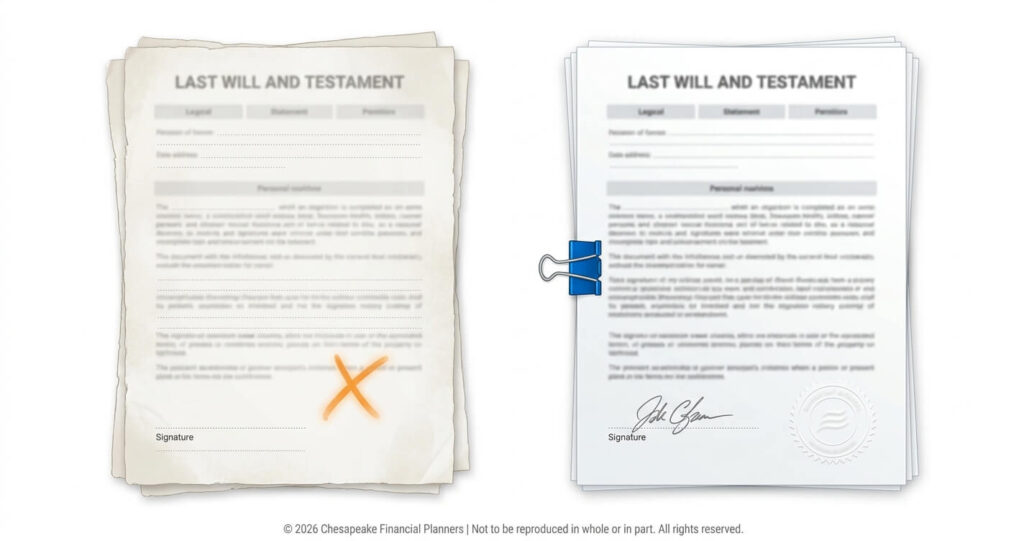
A will, formally a last will and testament, is a legal document that specifies how your property is distributed after death, who serves as guardian for your minor children, and who manages your estate through the probate process. It is the foundation document in nearly every estate plan.
A will only takes effect after you die. During your lifetime it has no legal force. You can change it as often as you like, and it does not affect how you use or manage your property today. That is one of the clearest differences between a will and a trust, which takes effect the moment it is funded.
To be valid, a will must meet state requirements. These vary, but typically the document must be in writing, signed by you, and witnessed by at least two people who are not beneficiaries. Some states permit holographic (handwritten) wills, though those invite challenges. According to FINRA, an estate plan is more than a will alone, but the will is where most people start.
Jeff Judge often tells clients that a will is the cheapest insurance policy they will ever buy against family chaos. It does three jobs no account beneficiary form can do: it speaks for your whole estate, it names a guardian, and it appoints someone you trust to wind everything down.
What Is a Financial Power of Attorney and Why Do I Need One?
What a Will Accomplishes and Who It Protects
A will accomplishes four core jobs, and understanding each one tells you why the basics of wills matter for almost every adult.
First, it directs asset distribution. You decide who receives what, whether by specific gift, percentage, or a more layered plan. Second, it lets you name a guardian for minor children. If you have kids under 18, this is the single most important reason to have a will. A trust cannot appoint a guardian, only a will can. Third, it names your executor, the person responsible for gathering assets, paying debts and taxes, and distributing what remains. Fourth, it can capture charitable bequests and sentimental items that otherwise spark disputes.
For families with real wealth, the federal estate tax exemption is $15 million per person in 2026, according to the IRS. Most estates fall well under that and owe no federal estate tax, but a will still directs the assets and coordinates with the rest of the plan. The basics of wills hold whether you have a modest estate or a complex one.
Do I need to update my beneficiary designations after a divorce or major life change?
How the Probate Process Works
When you die with a will, your estate goes through probate, the court-supervised process of validating the will, paying debts, and distributing assets. Your executor files the will, the court grants authority, and the executor then inventories assets, notifies creditors, settles obligations, and distributes the remainder to your beneficiaries.
Probate takes time and money. Depending on the state and the complexity of the estate, it can run several months to over a year, and AARP reports probate costs typically range from 3% to 7% of the estate's value in legal fees, executor fees, and court costs. Probate is also a public process, your will becomes a court record anyone can read.
Different states run probate differently. Some offer streamlined procedures for smaller estates; others require full formal probate regardless of size. If you own property in more than one state, your estate may need ancillary probate in each, which adds cost and delay. This is one reason many families pair a will with a revocable living trust. Jeff Judge notes: "If you own a vacation home in another state, your family could be looking at two separate probate proceedings running simultaneously, which is one of the clearest arguments I know for pairing your will with a revocable living trust."
Who owes Maryland's 10% inheritance tax and what planning options protect non-lineal heirs?
Will vs. Trust: What Is the Difference?
Wills and trusts are not competitors. Many strong estate plans use both. The difference is in timing, privacy, and what each controls. The table below lays out the core distinctions in the will vs trust comparison.
| Feature | Will | Revocable Living Trust |
|---|---|---|
| When it takes effect | At death | During your lifetime |
| Goes through probate | Yes | No |
| Public or private | Public once probated | Private |
| Names guardian for minor kids | Yes | No |
| Helps if you become incapacitated | No | Yes |
| Controls which assets | All assets you own at death | Only assets transferred into it |
| Upfront cost and effort | Lower | Higher |
A will covers everything you own at death but must go through probate. A trust avoids probate and stays private, but it only controls assets you actually move into it. A will can name a guardian; a trust cannot. For many families, the right answer is a will plus a trust, each doing the job it does best.
How do you create a family wealth governance structure for long-term success?
What Happens If You Die Without a Will?
Dying without a valid will means dying intestate, and state intestate succession laws then decide who inherits your property. That distribution may not match your wishes at all. Intestacy formulas typically prioritize a spouse and children, but the exact split varies by state, and if you are unmarried with no children, assets may flow to parents, siblings, or distant relatives. With no findable heirs, property eventually escheats to the state.
Without a will, you also lose any say over who serves as executor and who raises your minor children. The court appoints both. Jeff has seen this play out the hard way: a young couple with two kids and no will, leaving a judge to choose a guardian from competing relatives who barely spoke. The kids were fine in the end, but the family fight lasted years. A one-page guardian designation would have prevented all of it.
Common Mistakes With Wills
The most common mistake is failing to update a will. Marriage, divorce, a new child, a death, a big change in wealth, or a move to a new state all warrant a review. A will written 20 years ago may name an ex-spouse or a deceased executor.
The second mistake is ignoring coordination. Life insurance, retirement accounts, and payable-on-death accounts pass directly to named beneficiaries no matter what your will says. If your will leaves everything to your kids but your old 401(k) still names your sibling, the sibling wins. This is why beneficiary review is part of the basics of wills, not a separate afterthought.
Other frequent errors include unsigned or improperly witnessed documents that are invalid, DIY templates that miss state-specific requirements, and trying to use a will to control assets it does not govern, such as property held in a trust or owned jointly with right of survivorship.
What is an Accredited Estate Planner (AEP)?
Frequently Asked Questions
Do I really need a will if my estate is small?
Yes, you almost certainly need a will even with a small estate. A will names a guardian for minor children, appoints an executor you trust, and directs where your belongings go. Without one, state intestacy laws decide everything, and the court appoints both the executor and any guardian, often not the person you would have chosen.
What is the difference between a will and a trust?
A will takes effect at death and must pass through probate, while a revocable living trust takes effect during your lifetime and avoids probate. A will is public once probated; a trust stays private. A will can name a guardian for minor children; a trust cannot. Many families use both documents together, each handling the job it does best.
How much does probate cost and how long does it take?
Probate typically costs between 3% and 7% of the estate's value in legal fees, executor fees, and court costs, according to AARP. The timeline ranges from several months to more than a year, depending on the state, the size of the estate, and whether any disputes arise. Owning property in multiple states can add ancillary probate and increase both cost and delay.
What happens to my property if I die without a will?
If you die without a will, you die intestate, and state intestate succession laws decide who inherits. The formula usually favors a spouse and children but varies by state. If you have no living relatives, your property eventually passes to the state. You also lose any say over who serves as executor or who becomes guardian for your minor children.
Can a will name a guardian for my children?
Yes, a will is the only standard estate planning document that lets you name a guardian for your minor children. A trust cannot appoint a guardian. If you have children under 18, this single feature makes having a valid will essential. Without it, a court selects the guardian, which may not reflect your wishes or the relationships your children have.
Do beneficiary designations override my will?
Yes, beneficiary designations override your will for the accounts they cover. Life insurance, retirement accounts, and payable-on-death accounts pass directly to the named beneficiaries regardless of what your will states. This is why coordinating beneficiary forms with your overall estate plan matters as much as the will itself. Outdated designations are one of the most common and costly estate planning mistakes.
Your Next Step Toward a Complete Estate Plan
A will is where almost every estate plan begins, but it works best as part of a coordinated set of estate planning documents, beneficiary designations, and, for many families, a trust. The basics of wills are simple; getting them coordinated with everything else is where good planning earns its keep. If you found this helpful, our estate planning starter guide walks through every document you need and the order to tackle them. Download it at chesapeakefp.com.
Disclosures
The information provided is for educational purposes only and should not be construed as investment advice. Investment strategies should be tailored to individual circumstances, risk tolerance, and goals. Past performance doesn't guarantee future results. Consult with qualified financial professionals regarding your specific situation.
Advisors associated with Chesapeake Financial Planners may be either (1) LPL Financial Registered Representatives offering securities through LPL Financial, Member FINRA and SIPC, and investment advisor representatives offering investment advice through Great Valley Advisor Group; or (2) solely investment advisor representatives offering investment advice through Great Valley Advisor Group and not affiliated with LPL Financial. Great Valley Advisor Group, and Chesapeake Financial Planners are separate entities from LPL Financial.


