
How much of my net worth should be in company stock?
Last reviewed: July 2026
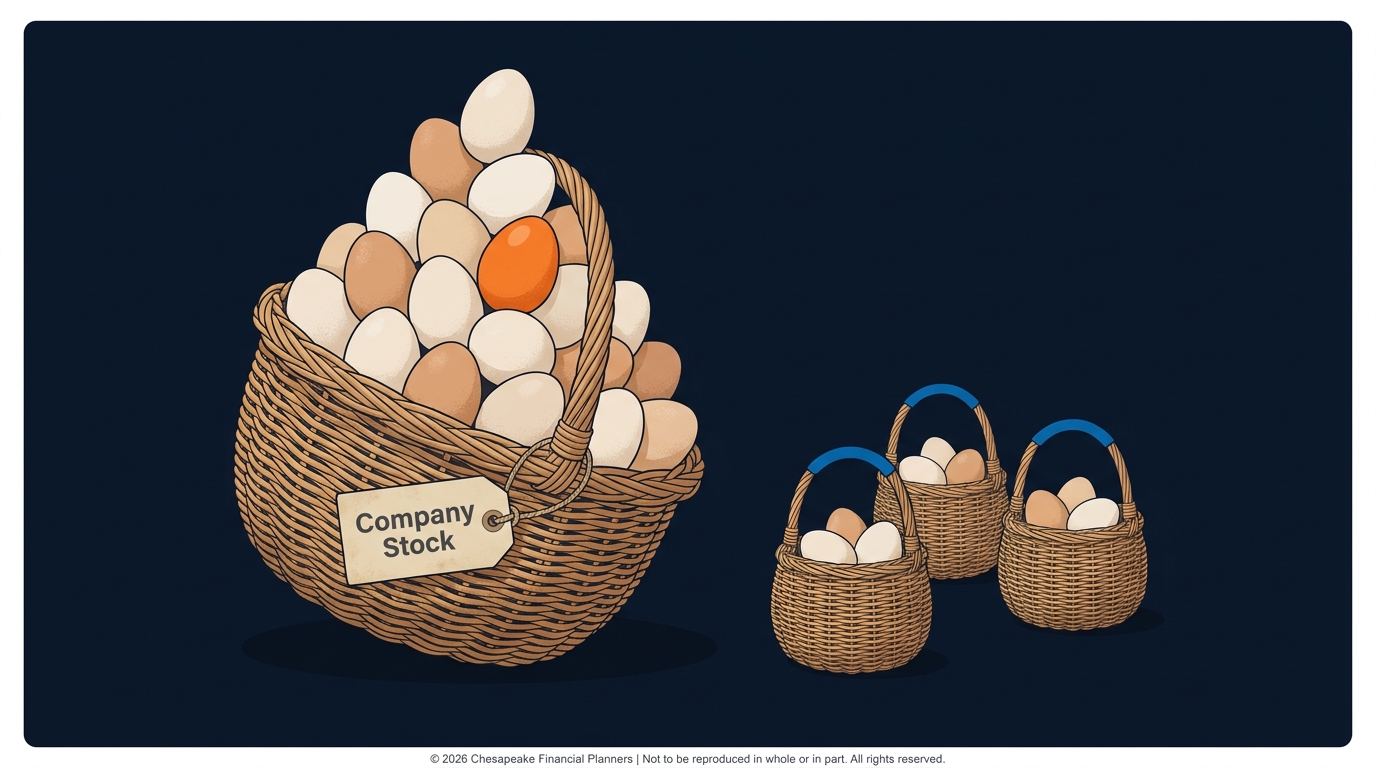
As a rule of thumb, no single stock should make up more than 10 to 15 percent of your net worth, and that ceiling applies most strictly to your employer's stock. Company stock concentration is dangerous because your paycheck and your savings both ride on the same company. When that stock makes up a third or more of your net worth, you are no longer diversified. You are making a leveraged bet on one employer.
Key Takeaways
- Most advisors cap any single stock at 10 to 15 percent of net worth, and employer stock at the lower end of that range.
- Holding company stock means your income and your wealth depend on one company, doubling your risk.
- The FINRA rule of thumb is to limit any single stock to a small slice of your portfolio.
- Your concentration target should shrink as you approach retirement, from 15 to 25 percent in your 20s down to under 5 percent within a decade of retiring.
About the Author: Jeff Judge, CFP®, AEP®, ChFC®, CLU® is Managing Partner of Chesapeake Financial Planners in Forest Hill, Maryland. He has been helping families and business owners in Harford County and the Baltimore metro area navigate equity compensation and concentration risk since earning his CFP® certification in 2013, by using Chesapeake Financial Planners’ signature process, the R.U.D.D.E.R. method™. Jeff has watched clients fall in love with their own company stock right up until a bad quarter erased years of savings, and the pattern almost never breaks on its own.
Why Is Company Stock Concentration So Risky?
Company stock concentration is risky because it stacks two bets on the same outcome. Your salary depends on the company staying healthy. Your savings depend on the same thing. When the company stumbles, both can fall at once.
Financial advisors typically recommend keeping any single stock below 5 to 10 percent of an investment portfolio. For employer stock, the comfort zone sits below 10 to 15 percent at most. The reason is what planners call double jeopardy: if your employer hits trouble, you can lose your job and your portfolio in the same week.
History is not short on examples. Employees at Enron, Lehman Brothers, and Bear Stearns lost both their paychecks and their retirement savings when those companies failed. Even stable, well-known firms produce painful lessons. General Electric stock fell roughly 70 percent between 2016 and 2020, and longtime employees who held concentrated positions watched decades of accumulated wealth evaporate. According to FINRA, concentration is one of the most overlooked risks individual investors carry, precisely because it feels safe when the stock is climbing.
Jeff Judge often tells clients a hard truth: the better your company has performed, the harder this conversation gets. Success breeds attachment, and attachment is the enemy of clear-eyed risk management. The market does not reward loyalty.
How Much of My Portfolio Should Be in One Stock?

How Do I Calculate My Company Stock Concentration?
Calculate your company stock concentration by dividing the value of your employer stock by your total investable assets, then multiplying by 100. The result tells you what percentage of your portfolio rides on a single company.
The formula is simple: (company stock value ÷ total investable assets) × 100. Run it once and the number usually surprises people, because vested RSUs, ESPP shares, and exercised options accumulate quietly over years.
Here is a healthy example. Suppose you hold $200,000 in a 401(k), $50,000 in an IRA, $100,000 in a diversified brokerage account, and $50,000 in company stock. Your total is $400,000, and your company stock represents 12.5 percent. That sits inside the acceptable range.
Now a dangerous one. Suppose you hold $75,000 in a 401(k), $25,000 in a diversified brokerage account, and $300,000 in company stock. Your total is $400,000, and your company stock is 75 percent of it. A 40 percent drop in the stock would erase 30 percent of your entire net worth in a single move. That is not an investment. That is exposure. Jeff Judge notes: "When 75 percent of your investable assets sit in a single employer's stock, you are not holding a diversified portfolio, you are holding a concentrated bet that one company's board, earnings, and industry headwinds all break your way simultaneously."
If you are managing RSU diversification or ESPP concentration risk, run this number every quarter. New shares vest, and the percentage creeps up without you noticing.
Is my portfolio diversified enough to handle market volatility?
What Are the Warning Signs That I Hold Too Much Company Stock?
You hold too much company stock when its rise or fall meaningfully changes your financial life, and when you find yourself defending the position with conviction rather than analysis. Emotional attachment is the clearest red flag.
Watch for these signs:
- You check the stock price several times a day, and your mood tracks it.
- You cannot make a major purchase, like a home down payment, without selling company shares first.
- You defend the position emotionally, telling yourself you understand the company better than the market does.
- A 50 percent drop in the stock would derail your financial plan, not just dent it.

Here is a detail worth sitting with. Company executives sell their own shares regularly through pre-arranged 10b5-1 plans, which let insiders schedule sales in advance to avoid trading on inside information. The people who know the company best diversify on a calendar. If they are trimming, treating your own equity compensation risk as a permanent hold deserves a second look.
This is exactly the kind of decision the R.U.D.D.E.R. Method™ is built for. The R.U.D.D.E.R. Method™ is Chesapeake Financial Planners' six-step planning process: Review and Recognize, Uncover and Understand, Design and Develop, Discuss and Decide, Execute and Empower, and Reassess and Refine. Concentration decisions live in the Discuss and Decide stage, where emotion and math have to meet in the middle.
How do I diversify a concentrated company stock position without a huge tax bill?
How Much Company Stock Is Appropriate at Different Life Stages?
The appropriate amount of company stock shrinks steadily as you age, because the closer you are to retirement, the less time you have to recover from a major loss. A younger investor can tolerate concentration that would be reckless for someone five years from their last paycheck.
| Life Stage | Reasonable Concentration | Why |
|---|---|---|
| 20s to early 30s | 15 to 25 percent | Time to recover, higher risk tolerance, smaller absolute dollars |
| Mid-30s to 40s | 10 to 15 percent | Peak earning years, but growing financial obligations |
| Late 40s to 50s | 5 to 10 percent | Approaching retirement, reducing portfolio risk |
| Within 10 years of retirement | 0 to 5 percent | No time to recover from a major loss |
These are guidelines, not gospel. A 28-year-old at a profitable, mature company is in a different spot than a 28-year-old at a pre-IPO startup. Your stock concentration limits should account for the volatility of the specific company, not just your age. The SEC flags concentrated positions as a core risk regardless of age, so treat the table as a ceiling, not a target.
How should my investment mix change as I get closer to retirement?
How Do I Reduce an Overconcentrated Company Stock Position?
Reduce an overconcentrated company stock position by selling shares on a fixed schedule until you reach your target percentage, which removes emotion and market-timing guesswork from the decision. A systematic plan beats waiting for the "right" moment, because the right moment rarely announces itself.
Two practical approaches work well. The first is systematic liquidation: sell a fixed percentage of your holdings every quarter until you hit your target. If you are at 60 percent concentration and want to reach 15 percent, selling 10 percent of your holdings each quarter gets you diversified in roughly five quarters, or a little over a year. You spread the tax impact and you stop trying to outguess the chart.
The second is a hard dollar cap. Decide on a maximum, say $500,000 in company stock, and anytime vesting or appreciation pushes you above it, sell the excess immediately. The cap does the deciding for you. There is no quarterly debate, just a rule.
Before you sell, talk to a tax advisor about the impact, especially if you have appreciated shares or are weighing the special tax treatment available on certain employer stock inside a 401(k). The goal is diversification, but the path runs through your tax return. Jeff has seen clients rush to diversify and trigger an avoidable tax bill that a few months of planning would have softened.
How does equity compensation affect my financial plan?
Frequently Asked Questions
What percentage of my net worth should be in company stock?
Most advisors recommend keeping company stock below 10 to 15 percent of your net worth, and many push for the lower end because employer stock carries concentration risk on top of the income risk you already hold. The closer you are to retirement, the lower that ceiling should fall, ideally under 5 percent within a decade of stopping work.
Why is holding too much employer stock dangerous?
Holding too much employer stock is dangerous because your paycheck and your savings both depend on a single company, so a business setback can hit your income and your portfolio at the same time. Employees at Enron and Lehman Brothers lost jobs and retirement savings together. Diversifying separates those two risks so one bad year does not unravel your whole financial plan.
How do I calculate my company stock concentration?
Calculate your company stock concentration by dividing the total value of your employer shares by your total investable assets, then multiplying by 100. Include vested RSUs, ESPP shares, and exercised options. For example, $50,000 in company stock against $400,000 in total assets is 12.5 percent concentration, which falls within the generally accepted range.
Should I sell all my company stock at once?
You generally should not sell all your company stock at once, because a single large sale can create an unnecessary tax bill and lock in poor timing. A systematic approach, selling a fixed percentage each quarter until you reach your target, spreads the tax impact and removes the pressure of guessing the perfect exit point. Consult a tax advisor before you start.
Does company stock concentration include my 401(k) shares?
Yes, company stock concentration includes employer shares held inside your 401(k), your ESPP, vested RSUs, and any exercised options. All of it ties back to the same company, so all of it counts toward your concentration percentage. Employer stock sitting in a retirement account is not safer than the same stock in a taxable brokerage account; it carries identical concentration risk.
Take the Next Step
Company stock concentration is one of those problems that feels fine until the day it does not. If your equity compensation has quietly grown into a large slice of your net worth, a clear-eyed plan beats hoping the stock keeps climbing. For a deeper walkthrough of how concentrated positions fit into a full financial picture, our investment planning resources at chesapeakefp.com cover diversification, tax-smart selling, and equity compensation in detail. Download the guide and see where your number really stands.
Disclosures
The information provided is for educational purposes only and should not be construed as investment advice. Investment strategies should be tailored to individual circumstances, risk tolerance, and goals. Past performance doesn't guarantee future results. Consult with qualified financial professionals regarding your specific situation.
Advisors associated with Chesapeake Financial Planners may be either (1) LPL Financial Registered Representatives offering securities through LPL Financial, Member FINRA and SIPC, and investment advisor representatives offering investment advice through Great Valley Advisor Group; or (2) solely investment advisor representatives offering investment advice through Great Valley Advisor Group and not affiliated with LPL Financial. Great Valley Advisor Group, and Chesapeake Financial Planners are separate entities from LPL Financial.


