

What Are the Basics of Investment Diversification?
Last reviewed: July 2026
Investment diversification is a risk management strategy that spreads your money across different assets so that one bad investment does not sink your whole portfolio. You hold a mix of stocks, bonds, sectors, and geographies that do not all move the same way at the same time. The goal is not to chase the highest return. It is to earn reasonable returns while taking less risk than a concentrated bet would force on you.
Key Takeaways
- Investment diversification spreads risk across assets that respond differently to economic conditions, smoothing your portfolio's ride.
- A single low-cost total stock market index fund holds thousands of companies, delivering instant diversification for a small expense ratio.
- The 2026 401(k) employee contribution limit is $24,500, per the IRS, giving you room to build a diversified portfolio tax-efficiently.
- Owning five similar large-cap funds is redundancy, not diversification, and leaves you exposed to one slice of the market.
About the Author: Jeff Judge, CFP®, AEP®, ChFC®, CLU® is Managing Partner of Chesapeake Financial Planners in Forest Hill, Maryland. He has been helping families and business owners in Harford County and the Baltimore metro area navigate investment and portfolio decisions since earning his CFP® certification in 2013, by using Chesapeake Financial Planners’ signature process, the R.U.D.D.E.R. method™. Jeff often reminds clients that the most dangerous risk in a portfolio is the one you already own and never counted, like a stock-heavy 401(k) at the company that also signs your paycheck.
What Does Investment Diversification Actually Mean?
Investment diversification means owning a mix of assets that do not all rise and fall together. When stocks struggle during a downturn, bonds often hold their value or gain. When U.S. markets stall, international holdings may keep climbing. By spreading your money across investments that behave differently, you reduce the chance that any single event wipes out a large chunk of your wealth.
This works because of correlation, or how closely two investments move in relation to each other. The lower the correlation between your holdings, the smoother your overall ride. You give up the chance to capture the single best-performing asset's full gain in any given year. In exchange, you protect yourself from the kind of concentrated loss that can set a retirement plan back a decade.
Diversification does not eliminate risk. Nothing does if you want meaningful growth. According to the U.S. Securities and Exchange Commission, spreading investments among different kinds of assets can lower your risk, but it cannot guarantee a profit or protect against loss in a declining market. The point is calculated risk that matches your goals and timeline, not the false promise of a risk-free portfolio.
What Are the Main Types of Diversification?
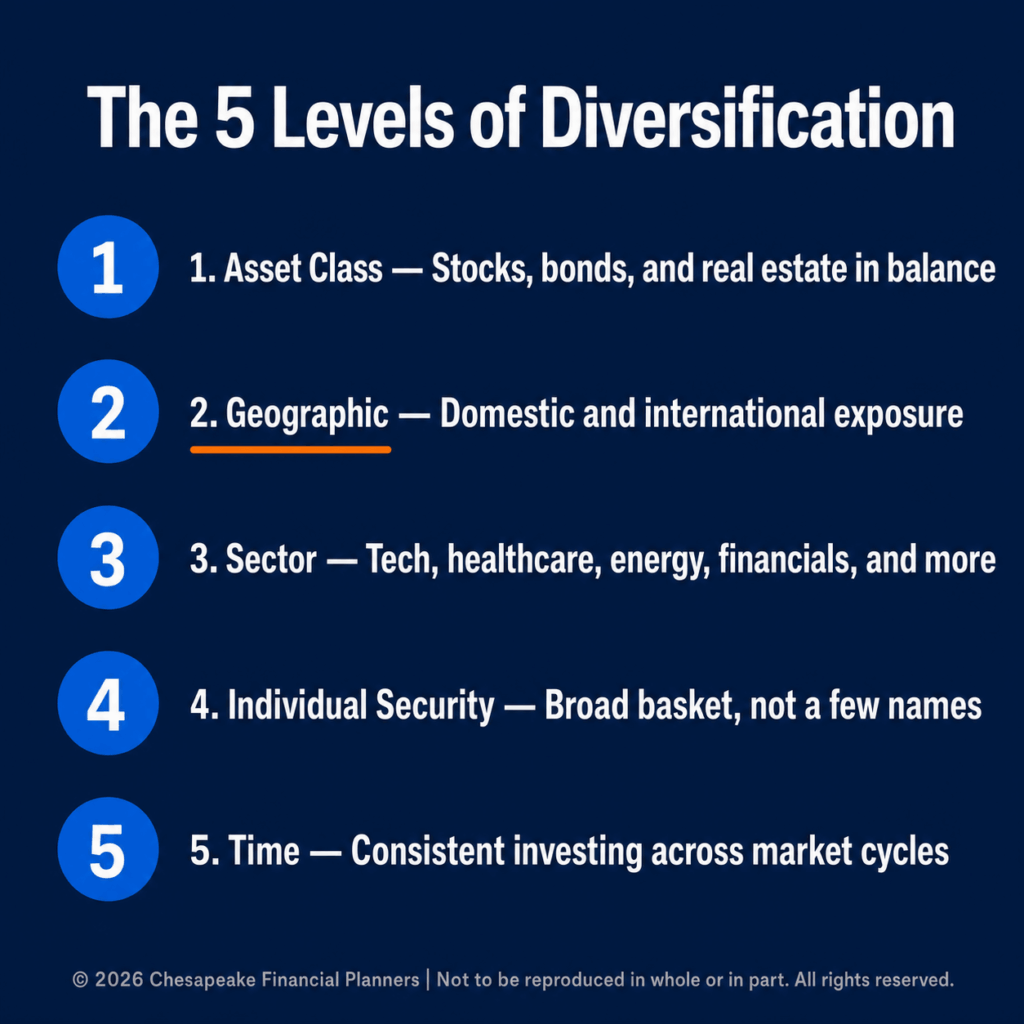
There are several layers, and a strong portfolio uses all of them together. Treating any one layer as the whole strategy leaves gaps.
| Type | What it spreads across | Why it matters |
|---|---|---|
| Asset class | Stocks, bonds, real estate, cash | Different classes respond differently to growth and recession |
| Geographic | U.S., developed international, emerging markets | Reduces dependence on one country's economy |
| Sector | Technology, healthcare, financials, energy | No single industry carries your whole portfolio |
| Security | Many companies via funds, not a few stocks | One company's failure does not derail you |
| Time | Investing steadily rather than all at once | Buying at many price points lowers timing risk |
Asset class diversification is the foundation. Stocks offer growth with volatility. Bonds offer income and stability with lower long-run returns. The right blend depends on your age, your goals, and how much swing you can stomach without selling at the wrong moment.
Geographic and sector diversification work inside your stock allocation. International stocks, both developed markets like Japan and Europe and emerging markets like India, add a dimension that pure U.S. exposure cannot. Sector spread keeps you from accidentally betting your future on one corner of the economy. This connects to a broader truth about money decisions, which you can read more about in Why Do Your Money Values Matter More Than Your Investment Choices?.
What Are the Most Common Diversification Mistakes?
The biggest mistakes are not exotic. They are quiet errors that feel safe until a downturn proves otherwise.
The first is fake diversification. Owning five U.S. large-cap growth funds is not five investments. It is one investment bought five times, since those funds hold mostly the same companies. True diversification requires assets that behave differently, not a longer list of similar ones.
The second is ignoring concentration in your career. Jeff Judge has watched this trip up smart professionals for years. If you work in tech and your portfolio leans heavily into tech stocks, you are not diversified. You are doubling down. If the industry contracts, your income and your portfolio both take the hit at the same moment. Business owners face the sharpest version of this, since their wealth, their salary, and often their real estate all ride on one enterprise.
The third is over-diversification. Yes, that is real. Holding dozens of overlapping funds adds cost and complexity without lowering risk further. Past a point, each new holding does almost nothing except make your portfolio harder to manage. The fourth is neglecting to rebalance, which lets your winners quietly grow into an oversized, riskier position. The fifth is abandoning the plan during a bull market to chase whatever is hot. Investors who went all-in on tech in 1999 or real estate in 2006 learned what concentration costs.
How Do You Build a Diversified Portfolio?
Start with asset allocation, the single most important decision you will make. Set your stock-to-bond mix based on your timeline, goals, and tolerance for volatility. A common rule of thumb is 110 minus your age as your stock percentage, but treat it as a starting point, not gospel. Your personal situation outweighs any formula.
Then use low-cost index funds to do the heavy lifting. A total stock market index fund holds thousands of companies in one purchase. A total bond market fund does the same for bonds. Add a total international stock fund, and you have covered the core of a globally diversified portfolio with three holdings. According to the Financial Industry Regulatory Authority, index funds and ETFs give individual investors access to broad diversification at low cost that was once hard to achieve.
Cost matters more than most people realize. The IRS confirms the 2026 401(k) employee contribution limit is $24,500, and the IRA limit rises to $7,500. Filling those tax-advantaged accounts with low-fee diversified funds compounds your advantage year after year. If you want a hands-off route, a target-date fund automatically shifts toward conservative holdings as you near retirement, built entirely on diversification principles. Whichever path you pick, fees deserve scrutiny, which is why understanding How much does it cost to hire a financial planner in 2026? pays off.
Finally, account for everything you own, not just your brokerage account. Your business equity, your home, and your future earning power are all part of your financial picture. A real plan diversifies around them. This is where a structured process helps, and at Chesapeake Financial Planners we use the R.U.D.D.E.R. Method™, our six-step planning process: Review and Recognize, Uncover and Understand, Design and Develop, Discuss and Decide, Execute and Empower, and Reassess and Refine. It keeps the whole picture in view, not just one account. For the broader foundation, see What are the fundamentals of personal financial planning?.
Frequently Asked Questions
What is the simplest way to diversify my investments?
The simplest way to diversify is to own three low-cost index funds: a total U.S. stock market fund, a total international stock fund, and a total bond market fund. Together they hold thousands of securities across asset classes and countries. This gives most investors broad, low-cost diversification without picking individual stocks or managing dozens of holdings.
How many funds do I need to be diversified?
Most investors are fully diversified with three to five well-chosen index funds. A total U.S. stock fund, an international stock fund, and a bond fund cover the essentials. Adding more overlapping funds rarely reduces risk further and usually just raises cost and complexity, which works against you over time.
Does diversification guarantee I will not lose money?
No, diversification does not guarantee against loss. It reduces the chance that one bad investment causes catastrophic damage, but a broadly declining market can still drop a diversified portfolio. The SEC is explicit that diversification lowers risk without promising profit or protecting against loss in a falling market. It manages risk rather than eliminating it.
Can I be too diversified?
Yes, you can over-diversify. Holding dozens of overlapping mutual funds or hundreds of individual stocks adds cost and complexity without meaningfully lowering risk. Past a certain point, each additional holding does little except make your portfolio harder to track and rebalance. A focused set of broad-market funds usually beats a sprawling, redundant collection.
Why is rebalancing important for diversification?
Rebalancing matters because your best-performing assets grow into an oversized share of your portfolio over time, quietly increasing your risk. Selling some winners and buying underperformers returns you to your target allocation. This keeps you diversified and forces a buy-low, sell-high discipline without trying to time the market, which most investors cannot do reliably.
Is my 401(k) already diversified?
Not necessarily. A 401(k) is only diversified if the funds inside it spread across asset classes and geographies. If you hold mostly company stock or a single aggressive fund, you are concentrated, not diversified. Review your holdings, and remember that company stock in your employer's plan ties your portfolio and your paycheck to the same business.
Ready to Take the Next Step?
Diversification sounds simple, then gets complicated fast once you factor in concentrated company stock, multiple accounts, and taxes. If you found this helpful, our free guide on building a resilient portfolio walks through asset allocation and rebalancing in depth. Download it at chesapeakefp.com and put these basics to work in your own plan.
Want to go deeper? Our Why Financial Advice Isn’t Just for Retirees walks through this step by step.
Disclosures
The information provided is for educational purposes only and should not be construed as investment advice. Investment strategies should be tailored to individual circumstances, risk tolerance, and goals. Past performance doesn't guarantee future results. Consult with qualified financial professionals regarding your specific situation.
There is no guarantee that a diversified portfolio will enhance overall returns or outperform a non-diversified portfolio. Diversification does not protect against market risk.
Advisors associated with Chesapeake Financial Planners may be either (1) LPL Financial Registered Representatives offering securities through LPL Financial, Member FINRA and SIPC, and investment advisor representatives offering investment advice through Great Valley Advisor Group; or (2) solely investment advisor representatives offering investment advice through Great Valley Advisor Group and not affiliated with LPL Financial. Great Valley Advisor Group, and Chesapeake Financial Planners are separate entities from LPL Financial.


