
Is My Portfolio Diversified Enough to Handle Market Volatility?
Last reviewed: July 2026
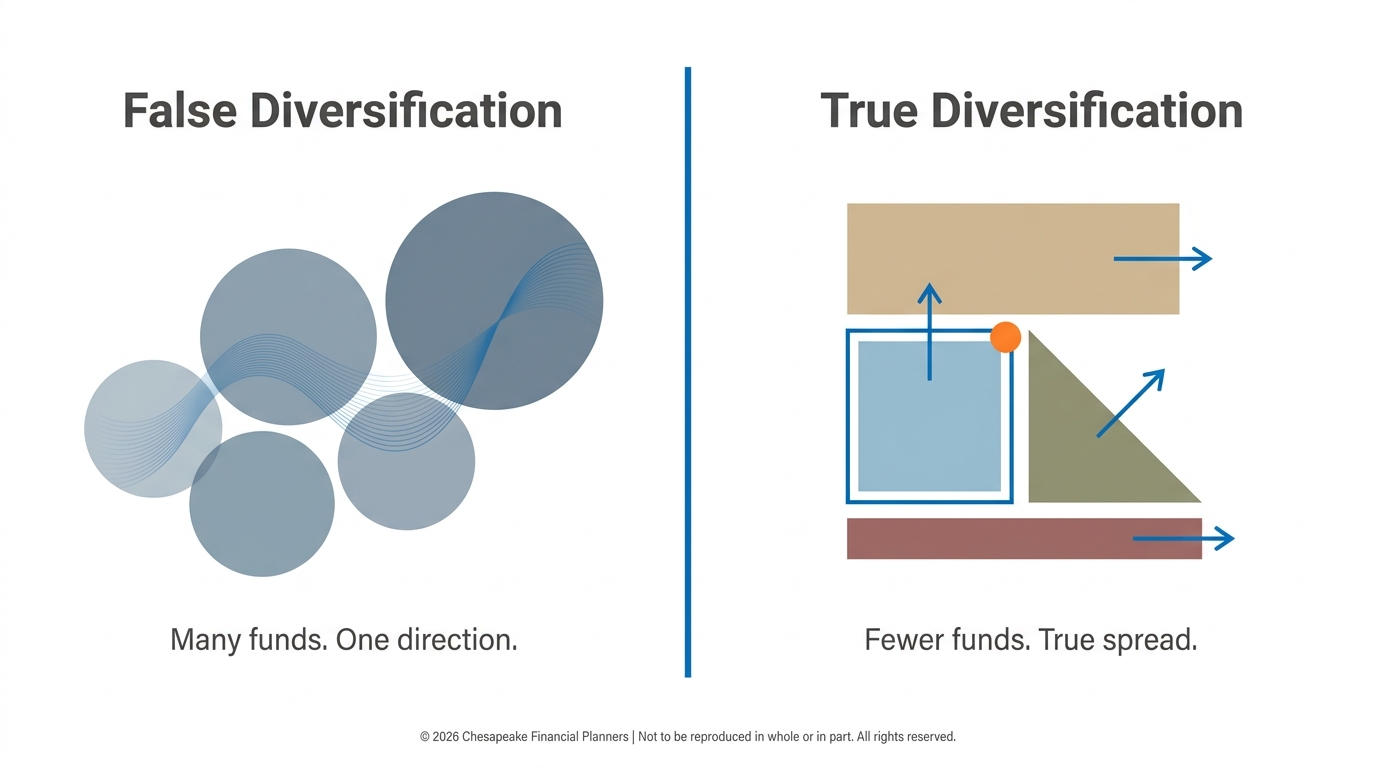
Your portfolio is diversified enough to handle market volatility when no single stock, sector, or asset class can sink it on its own, and when your holdings don't all drop together in a downturn. Real portfolio diversification means owning assets that move differently, across stocks, bonds, regions, and sectors. Most investors think they're diversified when they actually own five funds holding the same handful of giant tech stocks.
Key Takeaways
- True diversification means holding assets that don't all move the same direction at the same time, not just owning many funds.
- No single stock, including your employer's, should exceed 5% to 10% of your total portfolio.
- The largest 10 stocks made up over 40% of the S&P 500 by early 2026, creating hidden concentration in many "diversified" funds.
- International stocks represented roughly 36% of global market value in 2026, yet many U.S. investors hold almost none.
About the Author: Jeff Judge, CFP®, AEP®, ChFC®, CLU® is Managing Partner of Chesapeake Financial Planners in Forest Hill, Maryland. He has been helping families and business owners in Harford County and the Baltimore metro area navigate investment and portfolio decisions since earning his CFP® certification in 2013, by using Chesapeake Financial Planners’ signature process, the R.U.D.D.E.R. method™. Jeff's blunt take: most people who tell him they're diversified are actually holding three versions of the same large-cap growth bet without realizing it.
Diversification is one of the oldest rules in investing. Spread your money across different assets, and a bad year in one place doesn't wreck the whole plan. But knowing whether your portfolio is genuinely diversified enough to handle market volatility is harder than it looks. Many investors hold multiple funds that own essentially the same stocks, or they concentrate in a single sector, region, or asset class without noticing.
What Does True Portfolio Diversification Actually Look Like?
True portfolio diversification means holding investments that don't all move in the same direction at the same time. The goal is to reduce volatility and protect against the risk of any single investment, sector, or asset class dragging everything down. A well-diversified portfolio still loses value in a bad market. It just loses less, and it recovers from a more stable base.
Diversification works at several levels at once:
- Asset classes: stocks, bonds, cash, real estate, commodities
- Geographic regions: U.S., developed international, emerging markets
- Sectors: technology, healthcare, financials, energy, consumer goods
- Individual holdings: dozens or hundreds of companies, not a concentrated few
- Time: investing consistently rather than all at once
Here's the catch most people miss. Owning many funds is not the same as owning many different things. By early 2026, the ten largest companies accounted for more than 40% of the S&P 500 by weight, the most top-heavy the index had been in decades. If you own three large-cap funds, they probably all lean on the same names. That's concentration wearing a diversification costume.
How Do I Know If My Portfolio Is Not Diversified Enough?
Your portfolio is likely under-diversified if it shows any of the warning signs below. Each one is common, and most investors carry at least one without realizing it.
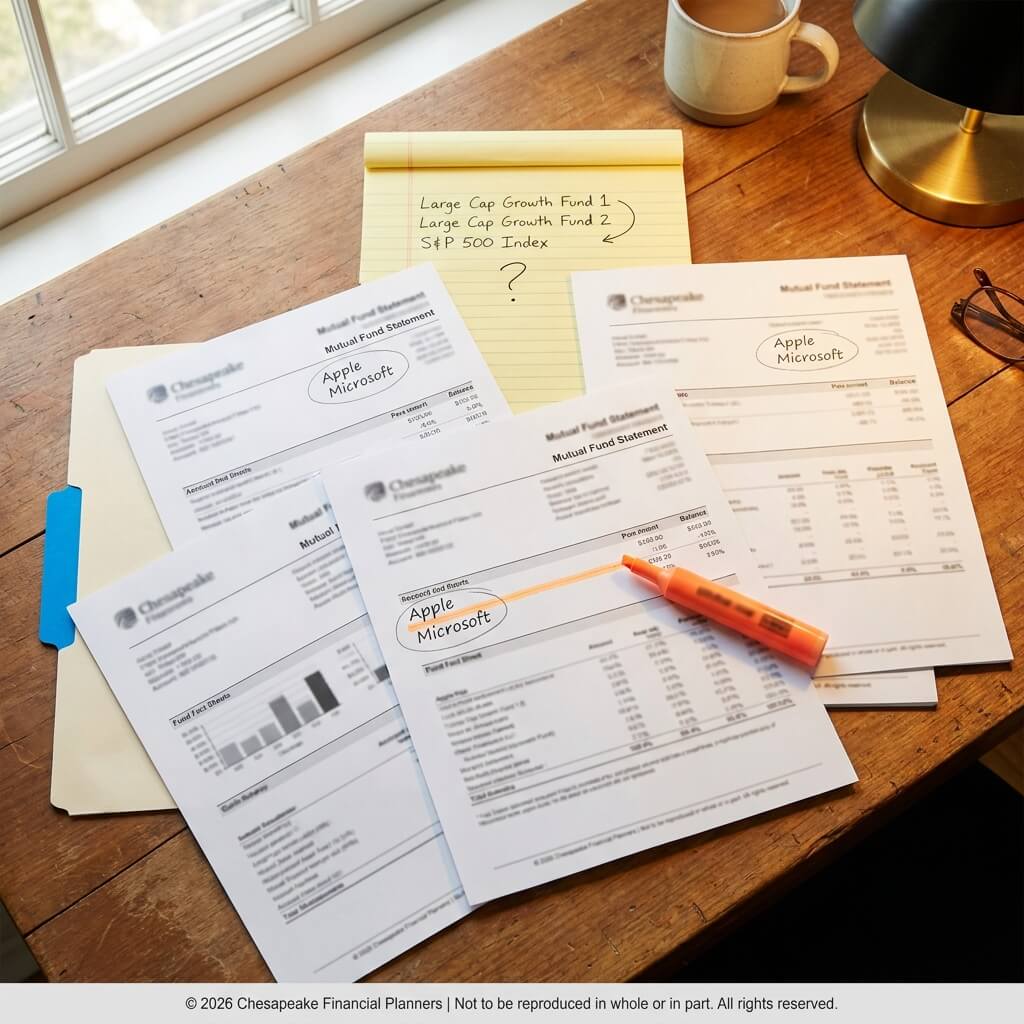
You hold multiple funds that own the same stocks. Owning five large-cap growth funds isn't diversification, it's redundancy. If all five list the same megacap technology companies as top holdings, they move in lockstep. Use a fund overlap tool to check.
You're overweight a single sector. If you work in technology and load up on tech stocks too, your paycheck and your portfolio are tied to the same fortunes. When that sector struggles, both your income and your savings fall at once. Jeff Judge calls this the double-down problem, and he sees it most often with software engineers and healthcare professionals.
You hold too much employer stock. Company stock in a 401(k) or equity compensation can quietly take over a portfolio. Employees at companies that collapsed learned how fast concentrated employer stock can wipe out savings. As a rule of thumb, no single stock should exceed 5% to 10% of your portfolio.
You own only U.S. stocks. International markets made up roughly 36% of global equity value in 2026, according to MSCI, yet plenty of investors hold 90% to 100% domestic. That's a big bet on one country's economy and currency.
You own no bonds. A 100% stock portfolio rides the full swing of equity markets. That can suit a young investor with decades to recover, but most people benefit from bonds to cushion the drops.
For investors carrying a single oversized position, the math gets sharp fast. How Much of My Portfolio Should Be in One Stock? breaks down why that one holding deserves a hard look.
How Do I Assess My Portfolio's Diversification?
Assessing your diversification takes six concrete steps. You can run all of them in an afternoon with free tools most brokerages already offer.
- List every holding. Pull together 401(k), IRA, taxable brokerage, and HSA accounts, then every position inside them. Diversification is measured across your whole picture, not one account.
- Calculate your asset allocation. Figure out the percentage in stocks, bonds, cash, and real estate, then compare it to a target based on your age, goals, and risk tolerance.
- Check sector exposure. If any single sector exceeds 20% to 25% of your equity holdings, you're likely overconcentrated.
- Evaluate geography. Determine the split between U.S. and international stocks. A common starting point is 60% to 70% U.S. and 30% to 40% international.
- Review individual positions. Confirm no single stock exceeds 5% to 10% of the total.
- Stress test it. Model a 30% market drop or a sector crash. If one scenario would devastate you, you're not diversified enough.
This is the kind of review that benefits from a repeatable framework. At Chesapeake Financial Planners, we run portfolio reviews through the R.U.D.D.E.R. Method™, our six-step planning process: Review and Recognize, Uncover and Understand, Design and Develop, Discuss and Decide, Execute and Empower, and Reassess and Refine. It keeps the analysis honest and forward-looking rather than reactive. If you'd rather not do this alone, Should I manage my own investments or hire a financial advisor? walks through that decision.

How Do I Build Better Diversification?
You build better diversification by simplifying, broadening, and rebalancing. Three or four broad index funds often do the job better than a dozen overlapping ones.
Start with broad market index funds. A total U.S. stock fund, a total international stock fund, and a total bond fund give you instant breadth at very low cost. Investment expense matters here; small fee differences compound into real money over decades, which How Do Investment Fees Impact My Long-Term Returns? covers in detail. Add international and a modest emerging markets slice (5% to 15% of equities) for exposure beyond U.S. borders.
Then rebalance on a schedule. Markets push your allocation off target over time, and rebalancing forces the discipline of trimming winners and adding to laggards. Your mix should also shift as you age, which How should my investment mix change as I get closer to retirement? explains decade by decade. Jeff often reminds clients that the best diversification plan is the one you'll actually stick with when the market turns ugly.
Frequently Asked Questions
How many stocks do I need to be diversified?
Most research suggests owning 25 to 30 individual stocks across different sectors captures the bulk of diversification benefits within equities. That said, a single broad index fund gives you exposure to thousands of companies instantly and at lower cost. For most investors, low-cost index funds achieve better diversification than hand-picking individual stocks ever could.
Can a portfolio be too diversified?
Yes, a portfolio can be over-diversified, often called "diworsification." Holding ten overlapping funds that own the same stocks adds complexity and fees without adding real protection. The goal is to own genuinely different assets, not simply more funds. If two of your funds hold 80% of the same companies, the second one isn't earning its place.
Does diversification protect me in a market crash?
Diversification reduces how much you lose in a crash, but it does not prevent losses entirely. In severe downturns, many stock categories fall together. The cushion usually comes from bonds and cash, which tend to hold up better than equities. A diversified portfolio recovers from a more stable base than a concentrated one. For more, see what to do when markets fall sharply.
How often should I rebalance to stay diversified?
Most investors should rebalance once or twice a year, or whenever an asset class drifts more than 5% from its target. Rebalancing too often triggers extra costs and taxes in taxable accounts. The point is discipline: trimming what has grown and adding to what has lagged, so your risk level stays where you intended it.
Is international diversification still worth it if U.S. stocks keep outperforming?
Yes, international diversification still matters even during stretches of U.S. outperformance. Leadership between U.S. and international markets rotates over time, and no investor can reliably predict the turn. Holding international stocks reduces dependence on a single country's economy and currency. The years U.S. stocks lag are exactly when that exposure pays off.
Ready to Stress-Test Your Own Portfolio?
If this gave you a few things to check, our free guide on building a resilient, diversified portfolio walks through the full review process step by step. Download it at chesapeakefp.com and see where your current mix stands before the next bout of volatility tells you the hard way.
Want to go deeper? Our R.U.D.D.E.R Audit for DIY Investors walks through this step by step.
This material is for educational purposes only and should not be considered tax or legal advice. Please consult with your tax advisor or attorney regarding your specific situation.
Investing involves risk including loss of principal. No strategy assures success or protects against loss. There is no guarantee that a diversified portfolio will enhance overall returns or outperform a non-diversified portfolio. Diversification and asset allocation do not protect against market risk. Rebalancing may involve tax consequences.
Disclosures
The information provided is for educational purposes only and should not be construed as investment advice. Investment strategies should be tailored to individual circumstances, risk tolerance, and goals. Past performance doesn't guarantee future results. Consult with qualified financial professionals regarding your specific situation.
Advisors associated with Chesapeake Financial Planners may be either (1) LPL Financial Registered Representatives offering securities through LPL Financial, Member FINRA and SIPC, and investment advisor representatives offering investment advice through Great Valley Advisor Group; or (2) solely investment advisor representatives offering investment advice through Great Valley Advisor Group and not affiliated with LPL Financial. Great Valley Advisor Group, and Chesapeake Financial Planners are separate entities from LPL Financial.


