

What Is an ESOP and Is It a Good Exit Strategy?
Last reviewed: July 2026
An ESOP, or employee stock ownership plan, is a tax-qualified retirement plan that holds company stock in trust for the benefit of employees and gives a business owner a built-in buyer when it is time to sell the business to employees rather than to a third party. For owners of profitable, closely held businesses with no obvious strategic acquirer, an ESOP can be a viable business exit strategy that delivers substantial federal tax advantages, a market for shares without a broker, and continuity for the team that helped build the company. It is not the right answer for every business, and a poorly structured ESOP can leave the owner, the company, and the employees worse off than a clean third-party sale would have.
On This Page
- Key Takeaways
- How an ESOP Actually Works
- The Tax Benefits That Make ESOPs Attractive
- Leveraged vs Non-Leveraged ESOPs
- When an ESOP Makes Sense, and When It Doesn't
- Related Topics Worth Reading
- Frequently Asked Questions
- Disclosures
Key Takeaways
- An ESOP is a tax-qualified retirement plan that holds company stock and lets the owner sell shares to it at fair market value.
- The National Center for Employee Ownership reports 6,609 ESOPs holding over $2 trillion in assets in the United States.
- A Section 1042 election can let C-corporation owners defer capital gains entirely if proceeds are reinvested in Qualified Replacement Property.
- A 100% S-corp ESOP pays no federal income tax on profits, because the only shareholder is a tax-exempt trust.
- Transaction costs typically run $200,000 to $500,000, so an ESOP only makes sense for companies with steady cash flow and ready successor leadership.
About the Author: Jeff Judge, CFP®, AEP®, ChFC®, CLU® is Managing Partner of Chesapeake Financial Planners in Forest Hill, Maryland. He has been helping families and business owners in Harford County and the Baltimore metro area navigate exit planning, business succession, and the tax mechanics of selling a closely held company since earning his CFP® certification in 2013, by using Chesapeake Financial Planners’ signature process, the R.U.D.D.E.R. method™. His view on ESOPs: they reward owners who plan five to ten years ahead and frustrate owners who treat them as a last-minute liquidity option.
How an ESOP Actually Works
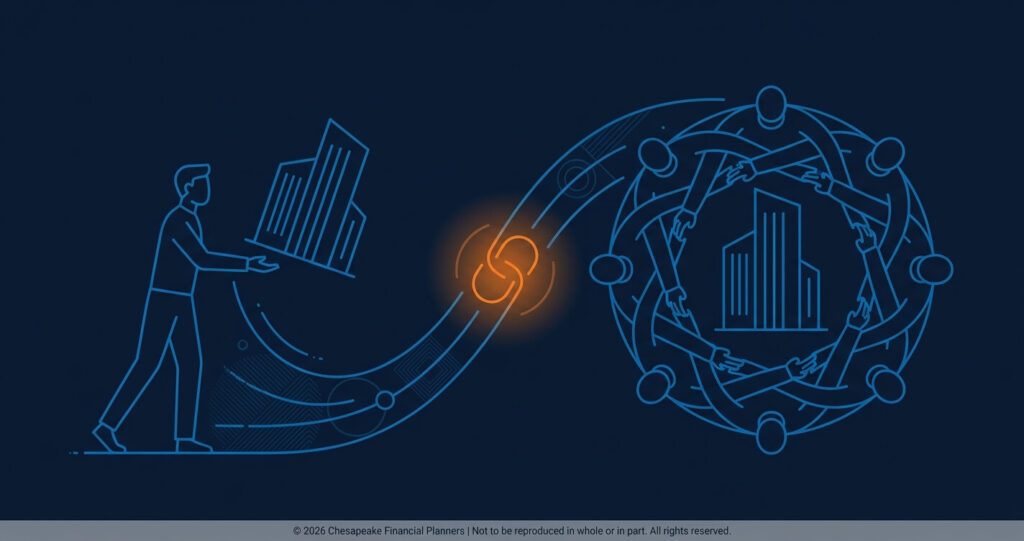
An ESOP is a qualified retirement plan, like a 401(k), but it is designed to invest primarily in stock of the sponsoring employer. The company sets up an ESOP trust, the trust buys company stock from the existing owner at a price set by an independent appraiser, and the company contributes cash, or sometimes more stock, to the trust each year. Those contributions are tax-deductible. Shares in the trust are allocated to individual employee accounts based on compensation, with a vesting schedule similar to a 401(k) match. When an employee retires or leaves, the company is obligated to buy back their vested shares at the most recent appraised value.
A few mechanics matter from day one. Annual independent valuation is required, and that valuation governs both employee allocations and any further owner sale transactions. Employees do not contribute their own money to the ESOP. They earn shares as a benefit. In a privately held ESOP, employees generally do not vote shares on most issues, but they retain voting rights on a short list of major corporate events such as a sale or merger of substantially all assets. This blend of ownership economics without day-to-day control is what separates a U.S. ESOP from a worker cooperative.
The plan is governed by ERISA. That means an independent trustee owes fiduciary duty to plan participants. The trustee, not the seller, decides whether a transaction price is fair to the employees. That single sentence drives most of the cost and complexity of setting one up.
The Tax Benefits That Make ESOPs Attractive
The ESOP tax benefits are the single biggest reason owners look at one in the first place. Three benefits stand out, depending on entity type.
For a C-corporation owner, IRC Section 1042 allows the seller to defer federal capital gains tax on the sale if specific conditions are met: the ESOP must own at least 30% of the company's stock after the transaction, the seller must have held the shares for at least three years, and the proceeds must be reinvested in Qualified Replacement Property (broadly, U.S. operating-company securities) within a 15-month window straddling the sale. Holding the QRP until death can step up basis and remove the deferred gain entirely. The IRS published guidance on ESOPs walks through the qualifying transaction structure in detail.
For an S-corporation, the benefit is different and arguably bigger. The portion of S-corp earnings allocated to the ESOP-owned share of the company is not subject to federal income tax. In a 100% ESOP-owned S-corp, that means no federal income tax at the entity level on operating profits. According to the NCEO, 67% of privately held ESOPs are organized as S-corporations, a share that has grown steadily since the structure was first allowed in 1998.
Contributions by the company to the ESOP, whether cash to buy shares or stock contributed directly, are deductible within Section 404 limits. In a leveraged ESOP, principal payments on the acquisition loan are also deductible, which is a feature no other corporate-finance buyer has. Stacked together, these benefits often let an ESOP pay a competitive price for the company even though the buyer is internal.

Leveraged vs Non-Leveraged ESOPs
Most ESOP transactions are structured as leveraged buyouts, where the ESOP trust borrows the purchase price (often through a back-to-back loan with the company) and uses future company contributions to repay the debt. About 59% of privately held ESOPs are currently leveraged, according to NCEO data on plan characteristics. The alternative is a non-leveraged ESOP, where the company makes annual cash contributions and the trust buys shares from the owner gradually.
| Dimension | Leveraged ESOP | Non-Leveraged ESOP |
|---|---|---|
| Liquidity to seller | Lump sum at close (often with seller financing) | Gradual, over many years |
| Owner involvement after sale | Can step back faster | Owner typically stays on for years |
| Company balance sheet impact | Significant debt at close | Minimal incremental debt |
| Best fit | Mature company with strong cash flow | Owner with no rush; conservative balance sheet |
| Section 1042 eligibility | Yes, if structured to qualify | Yes, but staged sales complicate QRP timing |
| Share of privately held ESOPs | About 59% | About 41% |
The choice is less about which is "better" in the abstract and more about how much liquidity the owner needs at close, how comfortable the company is carrying the debt, and whether the next layer of management is ready to run the business under tighter cash flow. Many deals start as partial-leveraged transactions, where the ESOP buys 30% to 49% of the company in year one, and convert to 100% ESOP-owned over five to ten years through a second-stage transaction.
When an ESOP Makes Sense, and When It Doesn't
An ESOP is a strong fit for a specific kind of company. It works best when the business has stable, predictable cash flow that can comfortably service ESOP debt; a management team capable of running the company without the founder; an owner who wants to phase out gradually rather than walk away on day one; and a real shortage of strategic buyers who would pay full price. Most of the businesses that fit that profile are profitable, middle-market companies in manufacturing, professional services, construction, or finance, which together account for roughly 69% of all ESOP companies, per NCEO industry data.
It is a poor fit when the company has thin or volatile margins, no internal succession bench, heavy customer concentration that buyers price down anyway, or an owner who needs all liquidity at close to fund retirement. In those cases, the ESOP debt service can squeeze the company, the leadership vacuum makes the trustee uncomfortable, and the deal either does not get approved or gets structured so conservatively that the owner ends up with less cash than a strategic sale would have produced.
Jeff Judge often puts it this way to closely held owners: "The question to answer first is not whether you want an ESOP. It's whether you want to be paid out over ten years from the cash flow this business produces, or whether you want a check next quarter. Owners who would take the check almost always shouldn't pursue an ESOP." Owners who say they want to protect what they built and stay close to the team for a while almost always should at least price one out.
This is where Chesapeake Financial Planners uses the R.U.D.D.E.R. Method™, our six-step planning process (Review and Recognize, Uncover and Understand, Design and Develop, Discuss and Decide, Execute and Empower, and Reassess and Refine), to walk owners through the comparison side by side: third-party sale, private equity recapitalization, ESOP, family transfer, and management buyout. A side-by-side often shows that the ESOP is competitive on net after-tax proceeds and superior on legacy considerations, but only when the company can support the financing.
The setup is not cheap. A feasibility study and initial valuation typically run $30,000 to $75,000. A full transaction (legal, financial advisory, trustee, plan design, lender fees) routinely costs $250,000 to $500,000 for a mid-size company. Annual administration runs $20,000 to $50,000 per year after that, mostly driven by the required annual independent valuation, recordkeeping, and Form 5500 filing. Those are real numbers that need to be weighed against the tax savings and the after-tax proceeds from alternative deal structures.
The single most common mistake Jeff has seen in advisory work is underestimating the repurchase obligation. Because the company is contractually required to buy back vested shares from departing employees at fair market value, a maturing ESOP can build up a multi-million-dollar annual cash demand for share redemptions over time. Companies that did not pre-fund this obligation through life insurance, a sinking fund, or operating cash flow modeling often find themselves cash-strapped a decade after the transaction, even as the underlying business is healthy. A repurchase obligation study should be commissioned at the same time as the feasibility study, not five years after the close.
Other recurring failure patterns: over-leveraging the company so that a single bad year breaks loan covenants; appointing an internal trustee without the independence to challenge a high seller price; ignoring the cash and tax implications of the warrants often issued alongside the seller note; and rushing the transition without making sure operating leadership is ready to run the business without the founder. The NCEO reported 309 new ESOPs in 2023, and the ones that struggle most are almost always the ones built around a timeline rather than around the company's actual readiness.
Related Topics Worth Reading
If an ESOP is part of a broader exit conversation, a few neighboring topics tend to come up in the same planning sessions:
- When Should Business Exit Planning Start Before a Sale? The timing of ESOP feasibility work should be coordinated with the broader exit timeline. Most successful ESOPs are pre-planned five to ten years out.
- How should I invest the proceeds after selling my business? A Section 1042 election creates a multi-decade portfolio decision, not just a tax election. The Qualified Replacement Property choices have long tails.
- LLC or s-corp: which saves me more in taxes? Entity choice years before the exit decision drives which ESOP path is available. C-corp owners get 1042 deferral; S-corp companies get the federal income tax exemption.
- What does a buy-sell agreement need to cover for a co-owned business? Co-owned companies thinking about an ESOP often have to redraft the buy-sell first so the ESOP transaction works for all parties.
- What is a cash balance plan, and how can high-income owners save more? Combining an ESOP with a cash balance plan is one of the strongest retirement savings setups available to owners in the years leading up to a transaction.
Frequently Asked Questions
Can an owner sell only part of the company to an ESOP?
Yes, partial sales are common and often the most practical first step. An owner can sell 30%, 49%, 60%, or any other percentage to an ESOP in a first-stage transaction, then sell the balance years later in a second stage. The 30% threshold matters because Section 1042 deferral for a C-corporation seller requires the ESOP to hold at least 30% of the company's shares after the transaction. Many owners use a staged structure to keep operating control while starting the tax-advantaged transition.
How does an ESOP pay for the shares it buys?
The ESOP usually pays for shares with a combination of bank debt, seller financing, and ongoing tax-deductible company contributions. In a leveraged ESOP, the trust borrows the purchase price, often through a back-to-back loan with the company, and the company makes annual contributions that the trust uses to repay the debt. Those contributions are deductible to the company. Employees do not contribute their own money. The transaction is funded by future company cash flow, not by employee paychecks.
What happens when an ESOP participant leaves the company?
When a vested participant retires, dies, becomes disabled, or otherwise terminates employment, the company is required to buy back their allocated shares at the most recent appraised fair market value. This is called the repurchase obligation. Payments can be made in a lump sum or, more commonly, over installments of up to five years (longer for very large balances). The participant receives cash; the company books a use of capital. Pre-funding the repurchase obligation is one of the most important long-term financial planning decisions an ESOP company makes.
Do employees pay anything to be in an ESOP?
No. ESOP shares are contributed by the company as a benefit, similar to an employer match in a 401(k). Employees do not write a check, take a paycheck deduction, or buy shares to participate. Their allocation grows as the company contributes shares to the trust each year, and their account value goes up or down based on the annual independent valuation of the company. The trade-off employees accept is that their retirement savings concentration in one stock is significantly higher than a diversified 401(k).
How long does it take to set up an ESOP?
A typical first-stage ESOP transaction takes nine to fifteen months from the start of a feasibility study to closing, with another two to three months of post-close plan administration setup. The feasibility study runs roughly 60 to 90 days. Selecting a trustee, valuation firm, lender, and legal counsel, plus negotiating the transaction documents, takes the rest. Owners who try to compress this timeline below nine months almost always pay for it in higher fees and weaker structural protections.
Can an ESOP own 100% of an S-corporation?
Yes, and a 100% ESOP-owned S-corporation pays no federal income tax on operating profits because the only shareholder is a tax-exempt trust. This is one of the most powerful tax structures available to a U.S. operating business. Of privately held ESOPs, 67% are organized as S-corporations, per NCEO research. Anti-abuse rules under Section 409(p) restrict how much of the company a small group of owners or relatives can hold individually, so the structure is built for broad-based employee ownership, not for one founder to capture the benefit alone.
If you found this helpful, our Business Owners' Exit Planning Guide walks through the full sequence of decisions, from valuation and entity choice to ESOP transaction structure to post-sale investment of proceeds. Download it at chesapeakefp.com.
Want to go deeper? Our Business Exit Path Comparison walks through this step by step.
This material is for educational purposes only and should not be considered tax or legal advice. Please consult with your tax advisor or attorney regarding your specific situation.
All investing involves risk including loss of principal. No strategy assures success or protects against loss.
The opinions voiced in this material are for general information only and are not intended to provide specific advice or recommendations for any individual.
There is no guarantee that a diversified portfolio will enhance overall returns or outperform a non-diversified portfolio. Diversification does not protect against market risk.
Disclosures
The information provided is for educational purposes only and should not be construed as investment advice. Investment strategies should be tailored to individual circumstances, risk tolerance, and goals. Past performance doesn't guarantee future results. Consult with qualified financial professionals regarding your specific situation.
This information is not intended to be a substitute for specific individualized tax, investment or legal advice. We suggest that you discuss your specific situation with a qualified tax, legal or financial advisor.
Advisors associated with Chesapeake Financial Planners may be either (1) LPL Financial Registered Representatives offering securities through LPL Financial, Member FINRA and SIPC, and investment advisor representatives offering investment advice through Great Valley Advisor Group; or (2) solely investment advisor representatives offering investment advice through Great Valley Advisor Group and not affiliated with LPL Financial. Great Valley Advisor Group, and Chesapeake Financial Planners are separate entities from LPL Financial.


