

How Should I Invest the Proceeds After Selling My Business?
Last reviewed: July 2026
The right way to invest proceeds from a business sale is to start with cash management, finish with a plan, and resist the urge to do either alone. In the first 90 days after closing, set aside 12 to 24 months of personal cash needs in short-term Treasuries or a high-yield account. The investment plan for the rest of the proceeds should be built around your tax bill, your time horizon, and the life the sale was supposed to make possible.
On This Page
- Key Takeaways
- What Should You Do First After Selling Your Business?
- How Do Taxes Shape Where You Invest the Proceeds From a Business Sale?
- How Should the Long-Term Portfolio Be Structured After a Sale?
- When Does Concentrated Cash Become Its Own Risk?
- Related Topics Worth Reading
- Frequently Asked Questions
- Disclosures
Key Takeaways
- After a sale, set aside 12 to 24 months of living expenses in short-term Treasuries before any market exposure.
- Federal long-term capital gains can hit a top federal rate of 20%, with an additional 3.8% NIIT on many large sale gains.
- Section 1202 QSBS treatment may exclude up to 100% of qualified gain on the first $10 million per issuer.
- The first portfolio mistake after a sale is treating new wealth like old wealth; it often needs a different glide path.
- A 2026 estate plan refresh is warranted for many sellers because the federal exemption now sits at $15 million per person under OBBBA.
About the Author: Jeff Judge, CFP®, AEP®, ChFC®, CLU® is Managing Partner of Chesapeake Financial Planners in Forest Hill, Maryland. He has been helping families and business owners in Harford County and the Baltimore metro area work through post-sale planning since earning his CFP® certification in 2013, by using Chesapeake Financial Planners’ signature process, the R.U.D.D.E.R. method™. After watching dozens of sellers either deploy cash too quickly or sit on it for years out of fear, Jeff treats the first 18 months after a sale as a planning project, not a portfolio project. The hardest part of the work is rarely the investment decision; it's separating decisions that look urgent from decisions that actually are.
What Should You Do First After Selling Your Business?
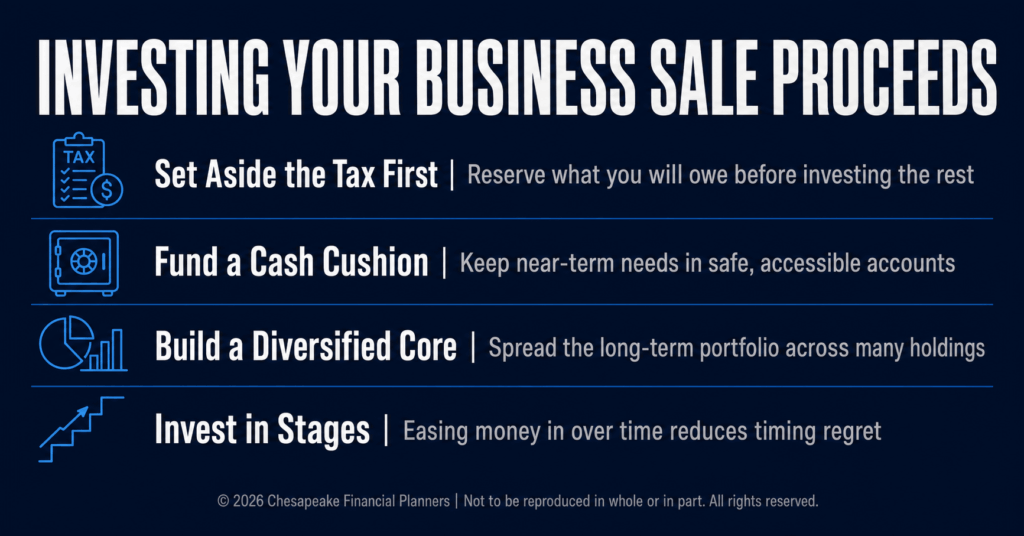
The first move after a sale is not investing. It is separating the proceeds into three working buckets: tax, cash, and "everything else." Many owners conflate these and end up either short on the IRS check or short on flexibility eight months in.
Start with the tax bucket. Federal long-term capital gains generally run from 0% to 20% on the gain portion of the sale, plus the 3.8% NIIT for many owners with high MAGI in the sale year. Maryland adds state income tax on top of that. If the sale closed in 2026 and you're on the cash method, the estimated-tax check is due quarterly. The federal safe harbor lets you pay either 110% of last year's tax or 90% of the current year's expected tax in quarterly installments, whichever is smaller. The math gets complicated when the sale represents the bulk of this year's tax, so a conversation with a CPA in the first 30 days after closing can head off underpayment penalties that compound through the year.
Sellers who treat the gross sale price as available cash are the ones who get a margin call from the IRS in April. As Jeff puts it, "You can always invest tomorrow. You can't undo a tax bill you didn't see coming."
Next is the cash bucket. Jeff Judge has watched newly liquid sellers make their first big mistake within 30 days of closing: deploying a meaningful chunk of the proceeds before the tax check clears. The working rule he uses with clients is 12 to 24 months of total personal cash needs (lifestyle plus known obligations) parked in short-term Treasuries, a Treasury money market, or a high-yield account. This bucket is not really an investment decision. It is a flexibility decision. Adequate post-sale liquidity means you don't have to sell anything at a bad time to fund a vacation, a tax bill, or a family emergency.
The "everything else" bucket is the planning project. Don't deploy it until you've worked through three questions: what is the post-tax number, what is the life the sale was supposed to enable, and what is the time horizon for each piece of it.
How Do Taxes Shape Where You Invest the Proceeds From a Business Sale?
Tax structure determines roughly 30% of what's left to deploy. That makes business sale tax planning the highest-leverage decision in the first six months, not the asset allocation.
The headline number is the federal long-term capital gains rate, topping out at 20% for income above the top bracket. Add the 3.8% net investment income tax, and a seven-figure sale gain can be taxed at an effective federal rate of 23.8% before the Maryland tax bite. State adds another 5% to 6.5% for many Forest Hill and Harford County clients (Maryland added 6.25% and 6.5% brackets on high incomes for 2026 under HB 352), plus a new 2% Maryland surtax on net capital gains for filers with federal adjusted gross income over $350,000.
A second lever is Section 1202 of the Internal Revenue Code, known as the Qualified Small Business Stock (QSBS) rules. For C-corp founders who held their stock for at least five years, this provision can exclude up to 100% of qualified gain on the first $10 million per issuer (or 10x basis, whichever is greater). The rules are narrow and require careful documentation, but where they apply, they can reshape the entire investment plan.
If the sale was structured as an installment sale, the math changes again. Reporting gain across several years can keep you under the NIIT threshold and the 20% capital gains bracket. The trade-off is buyer credit risk on the deferred payments. Charitable strategies in the sale year provide another set of levers; a donor-advised fund contribution or a charitable remainder trust funded with appreciated assets can offset taxable gain while spreading philanthropic intent across years.
Once the tax structure is clear, the investment decision starts to look different. Tax-deferred space (existing 401(k), IRA, Roth IRA) keeps working as it always has. The new dollars are taxable money. That argues for tax-efficient strategies: index funds, ETFs, municipal bonds where the math works, and a careful eye on capital gains distributions. Concentration in dividend stocks held in a taxable account, common in older portfolios, often doesn't fit a post-sale balance sheet.
The estate planning side moves with the sale, too. As of 2026, the federal estate and gift tax exemption sits at $15 million per person under OBBBA. The 2026 annual gift exclusion is $19,000 per donee. A sale that lifts your net worth above the lifetime exemption changes what your estate plan needs to do; older trusts often assume an older, lower exemption.
How Can I Reduce Taxes When Selling My Business?
How Should the Long-Term Portfolio Be Structured After a Sale?
Once the tax provision is set and the cash bucket is funded, the rest of the proceeds gets a structured allocation. The mistake to avoid is treating the post-sale portfolio like a continuation of the pre-sale 401(k). It rarely is.
The framework Chesapeake Financial Planners uses with post-sale clients is built on time horizon, not risk tolerance alone. The R.U.D.D.E.R. Method™ is Chesapeake Financial Planners' six-step planning process: Review and Recognize, Uncover and Understand, Design and Develop, Discuss and Decide, Execute and Empower, and Reassess and Refine. Steps one and two are where many sellers find their actual answer; the portfolio just executes it.
Inside that framework, the proceeds typically split into three time-coded sleeves.
The lifestyle sleeve covers the next five to seven years of planned spending. This is the sleeve designed to absorb market volatility without forcing a behavior change. Short and intermediate Treasuries, investment-grade bonds, and a small equity ballast. The point of this sleeve is psychological as much as financial. Sellers who know the next five years are funded can stay invested through the next downturn without panic.
The growth sleeve handles years 7 through 20. This is mostly equity exposure, globally diversified, in tax-efficient wrappers. Index funds and broad ETFs in taxable accounts; active managers only where the after-tax case is real. Sellers who came out of a single industry should be deliberate about reducing exposure to that industry inside the growth sleeve. A tech founder doesn't really benefit from a portfolio overweight in tech.
Asset location matters as much as asset allocation. Treasuries, REITs, and corporate bonds generally fit in tax-deferred accounts where their interest income isn't taxed each year. Broad equity index funds and tax-managed ETFs work well in the taxable proceeds bucket because they generate fewer distributions. Direct indexing in the taxable bucket can take this further, harvesting losses each year to offset capital gains from the sale itself.
The legacy sleeve handles the years past 20, plus generational planning. This is where charitable strategies, trusts, and concentrated long-duration positions can live. It is also where many sellers benefit from looping the estate attorney back in. The 2026 estate planning math has changed enough under OBBBA that many plans written before 2024 deserve a review. When evaluating advisors and money managers along the way, FINRA's BrokerCheck can verify credentials and disciplinary history. Jeff Judge notes: "A tech founder who just sold a company and then buys a growth-heavy index fund hasn't really diversified, they've just moved the industry concentration off their cap table and onto their brokerage statement."
How do I diversify a concentrated company stock position without a huge tax bill?
What is the R.U.D.D.E.R. Method™ in financial planning?
When Does Concentrated Cash Become Its Own Risk?
The other failure mode is the opposite of the first. Some sellers, often the patient and disciplined operators who built the business in the first place, freeze. They park 90% of the proceeds in short-term cash on day one, and three years later, they still haven't moved any of it.
Jeff Judge has watched this play out repeatedly. The same instincts that worked operating a company can lock founders up after a sudden wealth business sale. The risk feels asymmetric. If they invest and the market drops, that is a visible loss. If they sit in cash, it feels like nothing happened.
The math says otherwise. Cash earning 4% in a year when broad equities return 12% is an 8-point opportunity cost. If inflation comes in at 3%, real cash returns shrink to roughly 1%. Over five years, the gap between a fully cash position and a globally diversified portfolio can rival the original tax bill the seller already paid. Picture a $5 million post-tax balance sitting in cash for 36 months. A hypothetical 8% annual equity return that wasn't captured would have added roughly $1.3 million in opportunity cost. That's a real number, even if it never appeared on a brokerage statement.
The fix is structural, not motivational. Stage the deployment. A typical schedule moves the growth sleeve into the market over 12 to 18 months in scheduled tranches. This isn't market timing. It is a decision framework that removes the daily question of "is today the right day to buy." It also acknowledges that the brain treats a sudden lump sum differently than a steady savings stream; the staged approach respects both the math and the psychology.
Done well, the staged-deployment plan gets the seller fully invested inside two years without the regret cycle of either dumping it all in at a market peak or watching it sit while a market run-up happened without them.
When Should Business Exit Planning Start Before a Sale?

Related Topics Worth Reading
Several adjacent decisions intersect with the post-sale investment plan. Each is worth its own deeper read.
The first is the tax-side architecture: the specific planning moves that can shape a better effective rate around the closing year. How Can I Reduce Taxes When Selling My Business? covers installment sales, QSBS, and charitable bunching in depth.
The second is the personal financial planning system that sits underneath the portfolio. Sellers often discover that the pre-sale planning was thin because so much was tied to the business. Does the $15M Estate Planning Exemption Mean You Can Stop Planning? walks through how the 2026 exemption changes traditional A-B trust planning.
A third area worth reviewing is the concentration question. Many sellers come out of the deal with concentration in one sector, region, or asset class. How do I diversify a concentrated company stock position without a huge tax bill? looks at exchange funds, charitable remainder trusts, and direct indexing as common approaches.
Frequently Asked Questions
How long should I wait before investing proceeds from a business sale?
Many owners should wait at least 60 to 90 days before deploying any portion of the proceeds into the market. That window covers the time needed to nail down the federal and state tax provision, fund a 12 to 24 month cash bucket, and write a written investment plan with a real time horizon for each dollar. Rushing past these steps tends to multiply mistakes.
What is the smartest tax strategy after selling a business?
The smartest move is to settle the tax structure before the close, not after. Confirm whether the sale qualifies as Section 1202 QSBS for up to 100% federal exclusion, whether an installment sale spreads the gain across years to stay under thresholds, and whether charitable bunching in the closing year offsets income. After closing, the available levers narrow quickly.
Should I pay off debt or invest the proceeds first?
For many sellers, pay off high-rate debt above 6%, fund the cash bucket, then invest the rest. Low-rate mortgage debt is often worth keeping because historical investment returns over a long horizon have tended to exceed the after-tax mortgage cost. Personal guarantees and business-related debt should generally be cleared at closing regardless of rate.
How much of the proceeds should stay in cash?
Roughly 12 to 24 months of personal cash needs is the working rule, held in short-term Treasuries, a Treasury money market, or a high-yield account. This is separate from the federal and state tax provision. Sellers with concentrated risks (a buyer earnout, a non-compete that limits future income, planned major purchases) should sit closer to the 24-month end of that range.
What's the biggest mistake business sellers make with their proceeds?
A common mistake among sellers is deploying too much, too quickly, in vehicles that feel familiar from the pre-sale years. A taxable account allocated like a 401(k) can create avoidable tax drag, and a portfolio concentrated in the same industry the seller just exited carries the same risk profile they spent decades managing inside the company.
Can I avoid capital gains tax on a business sale?
Some sellers can reduce or defer much of the federal tax. C-corp founders who held qualified small business stock for more than five years may exclude up to 100% of qualified gain on the first $10 million per issuer under IRC Section 1202. Installment sales, charitable remainder trusts, and opportunity zone investments may defer or reduce remaining gain, but each has trade-offs that need an advisor and a tax professional to model.
Should I keep my money with the same advisor who handled the sale?
Not automatically. The advisor or banker who structured the sale and the advisor who builds the long-term post-sale portfolio are often different professionals with different specialties. Use the 60 to 90 day cash window to interview at least two independent fiduciaries. Confirm credentials through FINRA's BrokerCheck and review each firm's Form ADV before transferring assets.
Investing proceeds from a business sale starts with a written plan. The portfolio comes second. If you're working through the first 12 months after a sale, our planning guide covers cash structure, tax timing, and portfolio glide-path examples in depth. Download it at chesapeakefp.com.
Want to go deeper? Our First 90 Days After a Windfall walks through this step by step.
This material is for educational purposes only and should not be considered tax or legal advice. Please consult with your tax advisor or attorney regarding your specific situation.
All investing involves risk including loss of principal. No strategy assures success or protects against loss.
The opinions voiced in this material are for general information only and are not intended to provide specific advice or recommendations for any individual.
There is no guarantee that a diversified portfolio will enhance overall returns or outperform a non-diversified portfolio. Diversification does not protect against market risk.
Asset allocation does not ensure a profit or protect against loss.
Bonds are subject to credit, market, and interest rate risk if sold prior to maturity. Bond values will decline as interest rates rise and bonds are subject to availability and change in price.
Government bonds and Treasury bills are guaranteed by the US government as to the timely payment of principal and interest and, if held to maturity, offer a fixed rate of return and fixed principal value.
ETFs trade like stocks, are subject to investment risk, fluctuate in market value, and may trade at prices above or below the ETF's net asset value (NAV). Upon redemption, the value of fund shares may be worth more or less than their original cost. ETFs carry additional risks such as not being diversified, possible trading halts, and index tracking errors.
Disclosures
The information provided is for educational purposes only and should not be construed as investment advice. Investment strategies should be tailored to individual circumstances, risk tolerance, and goals. Past performance doesn't guarantee future results. Consult with qualified financial professionals regarding your specific situation.
This information is not intended to be a substitute for specific individualized tax, investment or legal advice. We suggest that you discuss your specific situation with a qualified tax, legal or financial advisor.
Advisors associated with Chesapeake Financial Planners may be either (1) LPL Financial Registered Representatives offering securities through LPL Financial, Member FINRA and SIPC, and investment advisor representatives offering investment advice through Great Valley Advisor Group; or (2) solely investment advisor representatives offering investment advice through Great Valley Advisor Group and not affiliated with LPL Financial. Great Valley Advisor Group, and Chesapeake Financial Planners are separate entities from LPL Financial.


