

What is a cash balance plan, and how can high-income owners save more?
Last reviewed: July 2026
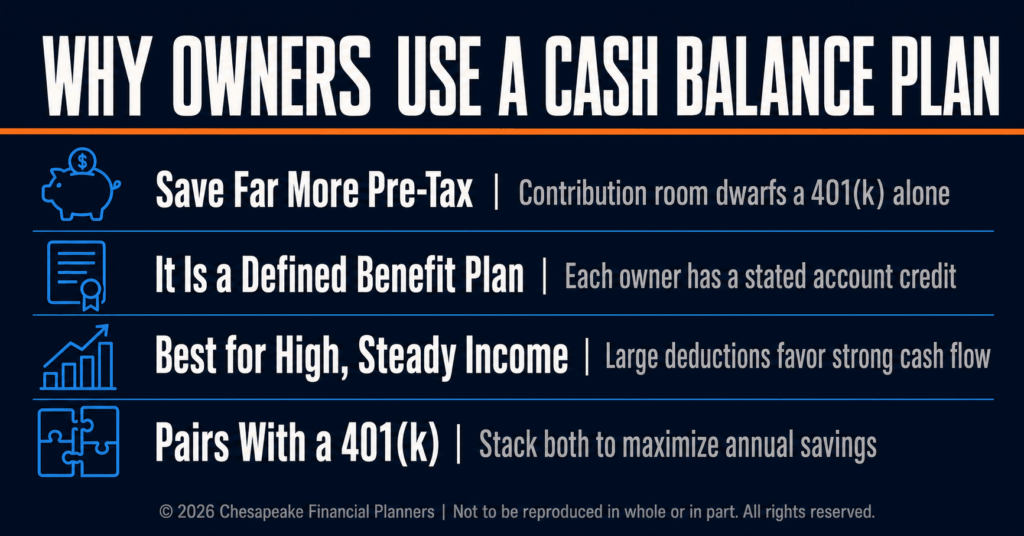
A cash balance plan is a defined benefit retirement plan that lets a high-income business owner shelter far more pre-tax income each year than a 401(k) alone allows. In 2026, the maximum benefit a cash balance plan can promise reaches $290,000 per IRS Notice 2025-67, and stacking a cash balance plan on top of a 401(k) and profit-sharing arrangement can push total annual contributions well past $300,000 for an owner in their 50s or 60s. The trade-off: actuarial setup, mandatory employee contributions in most cases, and a multi-year funding commitment.
On This Page
- Key Takeaways
- What Is a Cash Balance Plan?
- How Much Can a High-Income Owner Contribute to a Cash Balance Plan in 2026?
- Who Should Consider a Cash Balance Plan?
- How Does a Cash Balance Plan Stack With a 401(k) and Profit-Sharing?
- What Does a Cash Balance Plan Cost, and Who Has to Be Covered?
- Related Topics Worth Reading
- Frequently Asked Questions
- What's Next
- Disclosures
Key Takeaways
- A cash balance plan is a defined benefit plan with a stated "account balance" that grows by an annual pay credit plus an interest credit.
- The 2026 §415(b) maximum benefit a defined benefit plan can promise is $290,000 per year, per IRS Notice 2025-67.
- Stacking a cash balance plan on a 401(k) plus profit-sharing can lift total annual owner contributions above $200,000 once age and compensation are factored in.
- Cash balance plans require an actuary and Form 5500 filings every year, and most plans must cover rank-and-file employees too.
- These plans fit consistently profitable owners aged roughly 45 and older who can commit to funding for at least three to five years.
About the Author: Jeff Judge, CFP®, AEP®, ChFC®, CLU® is Managing Partner of Chesapeake Financial Planners in Forest Hill, Maryland. He has been helping families and business owners in Harford County and the Baltimore metro area design high-income retirement plans since earning his CFP® certification in 2013, by using Chesapeake Financial Planners’ signature process, the R.U.D.D.E.R. method™. Jeff often points out that the owners who get the most out of a cash balance plan are the ones already maxing out every other tax-advantaged account and still have $200,000 or more of taxable income left over.
What Is a Cash Balance Plan?
A cash balance plan is a defined benefit pension plan that looks like a 401(k) on a participant statement and works like a traditional pension under the hood. Each participant gets a hypothetical "account" that grows two ways: a pay credit (a stated percentage of compensation, set in the plan document) and an interest credit (a fixed rate or a rate tied to a benchmark like the 30-year Treasury). The employer is obligated to fund whatever it takes to make those promised balances real, which is what makes it a defined benefit plan rather than a defined contribution plan.
The IRS classifies a cash balance plan as a defined benefit plan, so the §415(b) annual benefit limit applies, not the §415(c) annual additions limit that controls 401(k)s and profit-sharing plans. That distinction is the entire reason cash balance plans matter to high earners. A 401(k) plus profit-sharing combination caps contributions at $72,000 in 2026, but a cash balance plan can promise a benefit worth up to $290,000 per year of retirement income, and the contribution needed to fund that promise scales with age.
You'll hear cash balance plans called "cash balance pension," "hybrid defined benefit plan," or "DB/DC combo plan" when one sits next to a 401(k). All three describe the same animal: a defined benefit plan small business owners can use to push their pre-tax savings past what any defined contribution plan permits.
Jeff Judge has seen the confusion this naming causes. Owners assume "cash balance" means a savings account, then bristle when they learn they cannot withdraw the money without triggering taxes and penalties, and that the funding schedule is set by an actuary rather than chosen year by year.
How much salary do I have to pay myself in an S-corp?
How Much Can a High-Income Owner Contribute to a Cash Balance Plan in 2026?
The contribution is not a flat dollar figure. It's an actuarial calculation driven by three inputs: the owner's age, compensation, and target benefit at retirement age (usually 62 or 65). Older owners with high compensation get the largest contribution because the plan has fewer years to fund the promised benefit.
According to IRS Notice 2025-67, "the limitation for defined contribution plans under section 415(c)(1)(A) is increased in 2026 from $70,000 to $72,000." That defined contribution ceiling is the figure to compare against. A cash balance plan stacked on top of it can multiply what an owner shelters in a single year.
Using the 2026 limits, a rough ladder looks like this. For a 45-year-old targeting the full §415(b) benefit, the annual cash balance contribution lands in the $115,000 to $140,000 range on top of a maxed 401(k) and profit-sharing. For a 55-year-old, the same target usually requires $185,000 to $230,000. By 60, the number can reach $260,000 to $290,000. Combined with the 401(k) employee deferral of $24,500 in 2026, the age 50+ catch-up of $8,000, and an annual additions cap of $72,000 on the defined contribution side, a 55-year-old owner can shelter well over $250,000 in a single year. SECURE 2.0 added a super catch-up of $11,250 for ages 60-63 in 2026, layering on top of the existing 50+ catch-up.
The compensation that drives the calculation is also capped. The 2026 annual compensation limit under §401(a)(17) is $360,000, so an owner earning $700,000 is treated as if they earn $360,000 for plan funding purposes. That cap rises with inflation, but it puts a ceiling on a single-participant cash balance plan no matter how profitable the business.
Cash balance plan contribution limits also flex with the interest crediting rate. Plans using a low fixed rate (say, 4%) generate larger required contributions because more dollars are needed to grow into the promised benefit. Plans tied to a Treasury rate move with the market. Most owners coming to Jeff want the predictability of a fixed rate, even at a slightly higher annual funding burden.
Who Should Consider a Cash Balance Plan?
A cash balance plan fits when three conditions line up. The owner is already maxing out a 401(k) and profit-sharing plan and still wants to defer more. The business throws off enough free cash flow to fund a multi-year actuarial commitment, not just one bonus year. And the owner is at least in their mid-40s, because the actuarial math rewards age.
The classic profile is a professional services firm with one to three high-income owners and a handful of younger, lower-paid staff. Medical and dental practices, law firms, accounting firms, engineering shops, consultancies, and real estate sponsors all fit this profile. Family-owned manufacturers with stable margins and a small workforce often qualify too. Solo owners with no W-2 employees (other than a spouse) can run a solo cash balance plan paired with a Solo 401(k), which removes most of the coverage complexity.
Jeff Judge has watched plenty of owners try to start a cash balance plan the year they're planning to sell the business. The IRS scrutinizes plans that exist only to shelter one outsized year of income and then terminate. As a rule of thumb, expect a five-year minimum funding commitment, even if the plan document allows earlier termination. Setting one up the year before a sale is rarely the move.
This is where the R.U.D.D.E.R. Method™ comes into play. The R.U.D.D.E.R. Method™ is Chesapeake Financial Planners' six-step planning process: Review and Recognize, Uncover and Understand, Design and Develop, Discuss and Decide, Execute and Empower, and Reassess and Refine. A cash balance plan touches every step: reviewing the cash flow commitment, uncovering the employee census, designing the pay credit and interest crediting rate, discussing trade-offs with a CPA and an actuary, executing the plan document and Form 5500 setup, and reassessing the funding level annually.
How should I invest the proceeds after selling my business?
How Does a Cash Balance Plan Stack With a 401(k) and Profit-Sharing?
The most common structure is a "DB/DC combo": a cash balance plan layered on top of a 401(k) plus profit-sharing plan. The two plans are tested together under IRS combined plan rules, which is what makes this high-income retirement strategy work. The defined contribution side carries the employee deferral and the profit-sharing allocation; the cash balance plan carries the bulk of the owner's tax-deferred contribution.
The IRS allows the combination, but it caps the defined contribution profit-sharing piece. When a cash balance plan is in place, employer profit-sharing contributions are typically limited to 6% of compensation rather than the standalone 25% limit. The trade is straightforward: the owner gives up some profit-sharing room to unlock the much larger cash balance room. For a 55-year-old earning $360,000, that swap pays off because the cash balance contribution can run three to five times what the lost profit-sharing room would have been.
A common allocation pattern with rank-and-file staff: the owner takes the full §415(b) cash balance benefit; the staff receives a 7.5% profit-sharing contribution (the typical "minimum gateway" needed to pass nondiscrimination testing); and the staff also receives any 401(k) match. This profit sharing 401k combo passes coverage testing, the owner shelters the most, and the staff walks away with a meaningful employer-funded benefit.
The actuary runs a coverage and nondiscrimination test every year. If the workforce shifts, the plan may need to be amended. Jeff often pairs cash balance plans with cross-tested profit-sharing to direct the bulk of the contribution to the owners while keeping employee costs predictable. It's a yearly review, not a one-time setup.
Should I Choose a Solo 401(k) or SEP IRA for My Business?

What Does a Cash Balance Plan Cost, and Who Has to Be Covered?
Setup typically runs $2,000 to $5,000, and annual administration runs $2,000 to $5,000 on top of that for plans under $5 million in assets. The annual cost covers the actuarial valuation, the Form 5500 filing, plan document maintenance, and nondiscrimination testing across the combo plan. Investment management fees are separate.
Coverage is the question owners want to skip. Cash balance plans are ERISA plans, so the same coverage and nondiscrimination rules apply as to any 401(k). Rank-and-file employees who meet eligibility (commonly one year of service and age 21) receive a contribution to the defined contribution side, often around 7.5% of compensation as the minimum gateway. Whether they also get a cash balance benefit depends on plan design; many plans give employees a small pay credit (1% to 2%) to simplify testing.
The investment side deserves attention. The plan needs to earn close to the promised interest crediting rate each year. Overperform, and the next year's required contribution drops; underperform, and the next year's contribution rises to make up the shortfall. Most cash balance plans run conservatively (think a 30/70 stock/bond mix targeting a 4% to 5% net return) to avoid these swings.
Termination has rules. The IRS generally expects a cash balance plan to operate for at least five years. Earlier termination is allowed for valid business reasons (a sale, a closure, a material change in financial condition), but a pattern of one-year plans can result in retroactive disqualification. Vested participant benefits are insured by the Pension Benefit Guaranty Corporation for plans covered under Title IV of ERISA.
What does a buy-sell agreement need to cover for a co-owned business?
Related Topics Worth Reading
A cash balance plan rarely lives alone. It sits inside a broader retirement and tax strategy, and three adjacent areas tend to come up in the same conversation.
Family payroll planning interacts directly with retirement plan design when the business is an S-corp or LLC. Hiring Your Children Tax Strategy: Can I Legitimately Hire My Kids? explains how to layer a family salary against owner contributions.
Charitable giving lines up well with the years a cash balance plan is funded most heavily, since high marginal tax brackets make deductions more valuable. See How does bunching charitable donations help me clear the standard deduction? for how to time donations against high-income years.
Roth conversion strategy matters late in the working career. If a 60-year-old shelters $250,000 a year for five years in a cash balance plan, that money lands in a traditional pre-tax bucket at retirement. Should High Net Worth Individuals Consider Roth Conversions? walks through sequencing conversions against a cash balance distribution plan.
Frequently Asked Questions
What is a cash balance plan in plain English?
A cash balance plan is a defined benefit pension plan where each participant has a stated "account balance" that grows each year by a set pay credit (a percentage of pay) plus an interest credit (a fixed or benchmark-tied rate). The employer is obligated to fund those promised balances. It looks like a 401(k) on a statement but is governed by defined benefit rules under IRS §415(b).
How much more can I contribute to a cash balance plan than a 401(k)?
A 401(k) caps employee deferrals at $24,500 in 2026, with an $8,000 catch-up at age 50 and a super catch-up of $11,250 at ages 60-63 per IRS Notice 2025-67. A cash balance plan adds contributions sized by an actuary against the §415(b) benefit limit of $290,000, which often translates to $100,000 to $290,000 a year in cash balance contributions for an owner aged 45 to 65, on top of the 401(k) deferral.
Do I have to make contributions for my employees?
In almost every cash balance plan with W-2 employees, yes. Cash balance plans are ERISA qualified plans, so the same coverage and nondiscrimination rules apply. Most combo plans give rank-and-file employees a profit-sharing contribution of about 7.5% of compensation as the minimum gateway, and some plans add a small cash balance pay credit (1% to 2%) to ease testing. Solo owners with no employees are the exception.
What happens to my cash balance plan if I close the business?
If you terminate the plan, participants receive their accrued cash balance benefit, which can be paid as a lump sum or rolled to an IRA or another qualified plan. The IRS generally expects a cash balance plan to operate for at least five years. Earlier termination is allowed for legitimate business reasons (a sale, retirement, closure), but a pattern of one-year plans can trigger an audit and risk plan disqualification.
Can I roll a cash balance plan into an IRA?
Yes. At termination, retirement, or another distributable event, the cash balance account can be rolled into a traditional IRA without immediate tax. From there, you can manage the assets, take RMDs starting at age 73 under current rules, or run Roth conversions over time. The rollover is the most common path for owners closing a plan after a business sale.
Is a cash balance plan better than a SEP-IRA for a solo owner?
For a solo owner under about age 45 with no employees, a SEP-IRA (capped at $72,000 in 2026 per IRS Notice 2025-67) is simpler and often sufficient. Above age 45 and earning $300,000-plus consistently, a solo cash balance plan paired with a Solo 401(k) typically shelters two to four times as much as a SEP-IRA alone, but only at the cost of an actuary and a five-year funding commitment.
What's Next
If you want to know whether a cash balance plan makes sense for your business, the next step is a side-by-side look at your current 401(k) deferrals, profit-sharing contributions, and what a cash balance plan would add at your age and income. We've put together a one-page guide on retirement plan design for high-income owners that walks through the math. Download it at chesapeakefp.com.
Want to go deeper? Our Tax Strategy Readiness Quiz walks through this step by step.
Disclosures
The information provided is for educational purposes only and should not be construed as investment advice. Investment strategies should be tailored to individual circumstances, risk tolerance, and goals. Past performance doesn't guarantee future results. Consult with qualified financial professionals regarding your specific situation.
This information is not intended to be a substitute for specific individualized tax, investment or legal advice. We suggest that you discuss your specific situation with a qualified tax, legal or financial advisor.
Advisors associated with Chesapeake Financial Planners may be either (1) LPL Financial Registered Representatives offering securities through LPL Financial, Member FINRA and SIPC, and investment advisor representatives offering investment advice through Great Valley Advisor Group; or (2) solely investment advisor representatives offering investment advice through Great Valley Advisor Group and not affiliated with LPL Financial. Great Valley Advisor Group, and Chesapeake Financial Planners are separate entities from LPL Financial.


