

What Happens to Your Digital Assets When You Die?
Last reviewed: July 2026
When you die, your digital assets do not automatically pass to your heirs the way a bank account or house does. Most online accounts are governed by terms-of-service agreements and password protection, which means your family may have no legal right or technical ability to access them without proactive digital asset planning. Without a plan, photos, cryptocurrency, domains, and business files can be locked away or deleted permanently.
Key Takeaways
- Digital asset planning names a digital executor and grants legal authority to access your online accounts after death or incapacity.
- The IRS treats cryptocurrency as property, so it is part of your taxable estate.
- The Revised Uniform Fiduciary Access to Digital Assets Act has been adopted in nearly every state, giving fiduciaries a legal path to access.
- Self-custodied crypto with lost private keys is gone forever; no provider can recover it.
About the Author: Jeff Judge, CFP®, AEP®, ChFC®, CLU® is Managing Partner of Chesapeake Financial Planners in Forest Hill, Maryland. He has been helping families and business owners in Harford County and the Baltimore metro area navigate estate planning since earning his CFP® certification in 2013, by using Chesapeake Financial Planners’ signature process, the R.U.D.D.E.R. method™. Jeff sees the same gap over and over: a perfect will, beneficiaries all current, and not one line about the crypto wallet or the 50,000 photos in the cloud.
Your physical estate plan can be airtight. Will, beneficiaries, power of attorney, the works. But what about your email account, your crypto wallet, or the business tax returns sitting in a cloud folder? This is the side of estate planning most people, and plenty of attorneys, skip right past. The fix is straightforward once you know what to organize.
What Is Digital Asset Planning?
Digital asset planning is the process of inventorying everything you own or control in electronic form, granting someone legal authority to access it, and giving instructions for what should happen to each account when you die or become incapacitated. It sits inside your broader estate plan, not separate from it.
Digital assets fall into a few buckets. Financial accounts include online banking, brokerage logins, cryptocurrency wallets, payment apps, and reward points. Personal files cover cloud photos, documents, and email archives. Creative and business assets include domain names, source code repositories, websites, customer databases, and SaaS subscriptions. Then there are sentimental items: family photos, message threads, and social media memories that carry no dollar value but matter enormously to the people you leave behind.
Here is the part people miss. The IRS treats digital assets like cryptocurrency as property, which means they are part of your taxable estate and need to be valued and reported. A wallet you forgot to document does not stop being an estate asset just because nobody can find it.
For more on coordinating these pieces with the rest of your plan, see What is a will and do I need one for my estate? and What Is a Financial Power of Attorney and Why Do I Need One?.
Why Do Digital Assets Get Overlooked?
Traditional estate planning was built for physical property: real estate, bank accounts, jewelry, vehicles. Digital assets do not fit that mold, so they slip through the cracks for four reasons.
First, no one knows they exist. Unlike a house, a crypto wallet or an old domain portfolio is invisible. Your executor cannot distribute what they cannot find. Second, access is locked behind passwords, and the password manager itself often sits behind a single master password nobody else has. Third, terms-of-service agreements create legal walls. Many platforms restrict or block account access after death, and some delete inactive accounts after a set period whether your family is ready or not.
Fourth, cryptocurrency is uniquely fragile. According to a widely cited Chainalysis analysis reported by major outlets, millions of bitcoin are considered permanently lost, much of it tied to forgotten or inaccessible private keys. If you self-custody crypto and no one has your keys, there is no reset-password button. The asset simply vanishes.
Jeff Judge often tells clients that the most expensive thing they own may be the one nobody knows about. He has watched families spend months and legal fees trying to prove an account even existed, only to lose it to a deletion policy.
How the Law Handles Digital Assets
Most states have adopted the Revised Uniform Fiduciary Access to Digital Assets Act, known as RUFADAA. The Uniform Law Commission reports adoption in nearly every state, which gives your executor or agent a legal pathway to access digital assets, but only if your estate documents grant that authority explicitly.
That last part is the catch. RUFADAA follows a priority order. An online tool the provider offers, such as Google's Inactive Account Manager or Apple's Legacy Contact, comes first. Your will, trust, or power of attorney comes next. Only if neither exists do the provider's default terms of service take over, and those terms rarely favor your family.
Here is how the three layers compare:
| Access Layer | Who Controls It | Strength |
|---|---|---|
| Provider online tool | You, set in advance | Strongest; honored first under RUFADAA |
| Estate documents (will, POA, trust) | Your attorney drafts language | Strong if digital authority is explicit |
| Provider terms of service | The platform | Weakest; may block or delete |
The takeaway: set up the provider tools where they exist, and make sure your estate documents name a digital fiduciary with clear authority. A standard power of attorney from a decade ago likely says nothing about digital assets at all.
What Is a Digital Executor and Do You Need One?
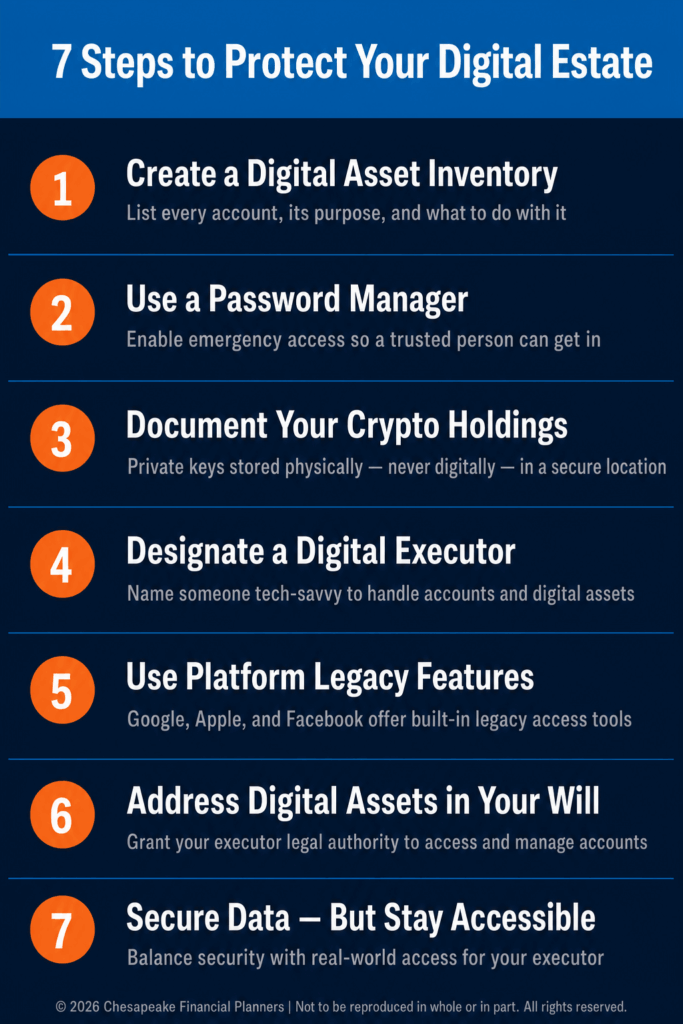
A digital executor is the person you name to manage your online accounts and digital property after you die. The role can be the same person as your traditional executor, but it does not have to be, and often should not be. Managing a crypto wallet, a domain portfolio, or a software business takes technical comfort that not every family member has.
In Jeff's experience, the best digital executor is someone who is both trustworthy and tech-literate. He has seen families name a well-meaning sibling who could not tell a seed phrase from a spam email, which defeats the purpose. Give that person, in writing, the legal authority your estate documents and RUFADAA require, plus a secure way to reach your credentials.
You also want this to coordinate with the rest of your plan. If you are reviewing beneficiaries or fiduciary roles after a life change, see Do I need to update my beneficiary designations after a divorce or major life change? so your digital and financial directives do not contradict each other. High-net-worth families layering in trusts and governance should review How do you create a family wealth governance structure for long-term success?.
Frequently Asked Questions
What happens to my online accounts when I die?
When you die, most online accounts do not transfer automatically. They are governed by provider terms of service and stay locked behind your passwords. Without a digital executor and explicit legal authority in your estate documents, your family may be unable to access or close them, and some platforms delete inactive accounts entirely.
Is cryptocurrency part of my estate?
Yes, cryptocurrency is part of your taxable estate. The IRS treats digital assets like crypto as property, so it must be valued and reported alongside your other holdings. The practical problem is access: if you self-custody and no one has your private keys, the value is part of your estate on paper but unrecoverable in reality.
How do I include digital assets in my estate plan?
Start by inventorying every account and asset, from banking logins to crypto wallets to domain names. Name a digital executor, grant them explicit authority in your will or power of attorney, and store credentials in a secure password manager your fiduciary can reach. Then activate provider tools like Apple Legacy Contact where they exist.
Should I put my passwords in my will?
No, never put passwords directly in your will. A will becomes a public document during probate, so anything in it is exposed. Instead, use a secure password manager and give your digital executor access to the master credentials through a separate, private arrangement that your estate documents reference but do not disclose.
What is RUFADAA and why does it matter?
RUFADAA is the Revised Uniform Fiduciary Access to Digital Assets Act, adopted in nearly every state. It gives your executor or agent a legal pathway to access your digital assets, but only if your estate documents grant that authority explicitly. Without that language, providers can fall back on default terms that block your family.
Can my family recover lost cryptocurrency private keys?
No, lost private keys for self-custodied cryptocurrency cannot be recovered by anyone, including the family or any provider. Unlike a bank account, there is no password reset and no customer service line that can restore access. This is why documenting wallet locations and key storage during your lifetime is the only protection.
Ready to Close the Gap?
Your digital life is probably more valuable and more complex than your estate plan reflects. The fix starts with an inventory and a few signatures, not a crisis after you are gone. If this was useful, our estate planning guide walks through digital asset planning and the rest of your documents step by step. Download it at chesapeakefp.com.
Disclosures
The information provided is for educational purposes only and should not be construed as investment advice. Investment strategies should be tailored to individual circumstances, risk tolerance, and goals. Past performance doesn't guarantee future results. Consult with qualified financial professionals regarding your specific situation.
Advisors associated with Chesapeake Financial Planners may be either (1) LPL Financial Registered Representatives offering securities through LPL Financial, Member FINRA and SIPC, and investment advisor representatives offering investment advice through Great Valley Advisor Group; or (2) solely investment advisor representatives offering investment advice through Great Valley Advisor Group and not affiliated with LPL Financial. Great Valley Advisor Group, and Chesapeake Financial Planners are separate entities from LPL Financial.


