

What Are Profit-Sharing Plans and How Do They Work?
Last reviewed: July 2026
A profit-sharing plan is a defined contribution retirement plan that lets a business owner make discretionary contributions to employees' accounts each year, with no requirement to contribute in any given year. You decide annually whether to put money in and how much, the contribution is tax-deductible to the business, and the money grows tax-deferred. For owners with uneven cash flow, profit-sharing plans are one of the most flexible ways to shelter income and build retirement wealth at the same time.
Key Takeaways
- A profit-sharing plan is a discretionary employer-funded retirement plan, so you choose how much to contribute each year, including nothing.
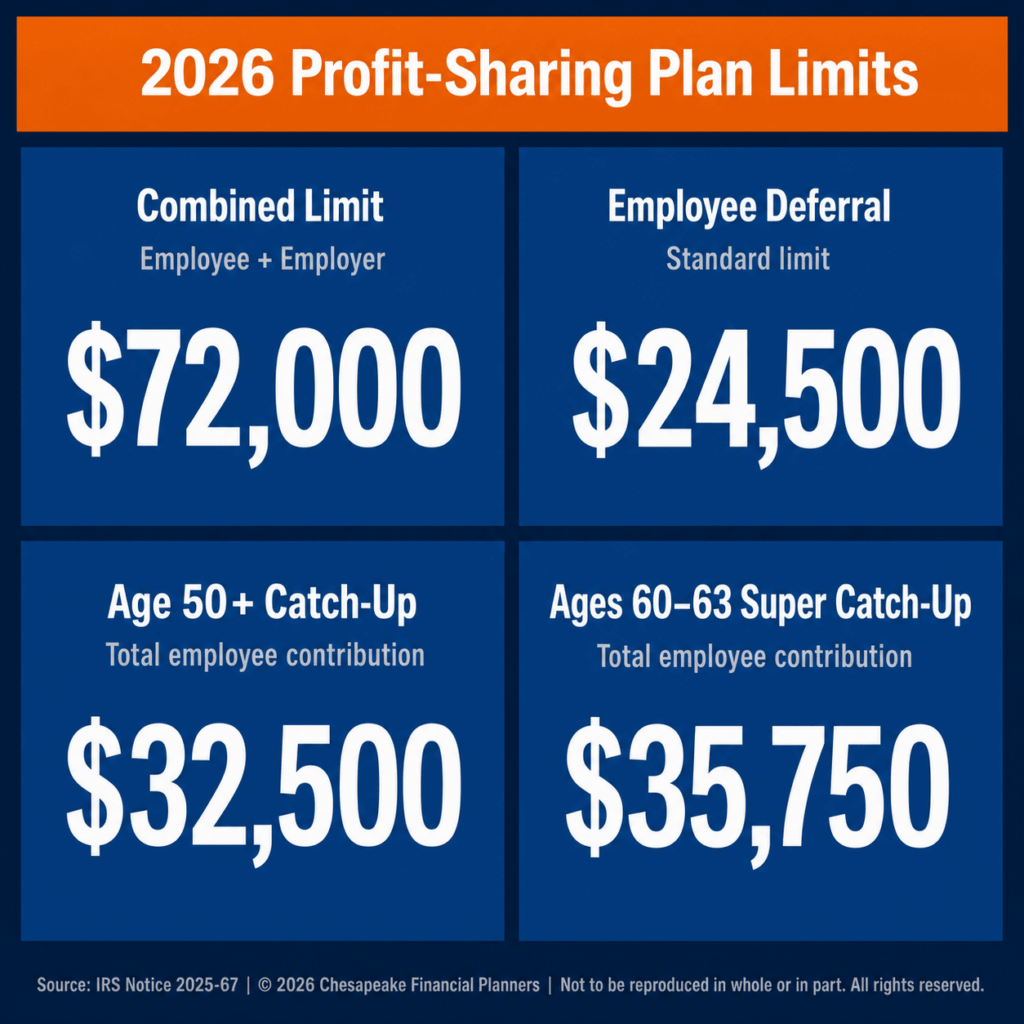
- For 2026, total contributions can reach the lesser of 100% of pay or $72,000, per the IRS.
- Pairing profit-sharing with a 401(k) is the most powerful structure available to small business retirement plans.
- Contributions are tax-deductible to the business, lowering taxable income dollar-for-dollar.
- Vesting schedules turn the plan into a real employee retention strategy, not just a tax tool.
About the Author: Jeff Judge, CFP®, AEP®, ChFC®, CLU® is Managing Partner of Chesapeake Financial Planners in Forest Hill, Maryland. He has been helping families and business owners in Harford County and the Baltimore metro area navigate business retirement plans since earning his CFP® certification in 2013, by using Chesapeake Financial Planners’ signature process, the R.U.D.D.E.R. method™. Jeff often tells owners that the flexibility of a profit-sharing plan is exactly what makes it underused: people assume retirement plans lock them into a fixed bill, and this one simply doesn't.
What Is a Profit-Sharing Plan?
A profit-sharing plan is a defined contribution retirement plan in which the employer makes discretionary contributions to employee accounts. The name trips people up. You don't need profits to contribute, and contributions don't have to track profitability. The defining feature is discretion: each year you decide whether to fund the plan and by how much.
Contributions are tax-deductible to the business and grow tax-deferred until withdrawal, generally after age 59½. Employees owe no tax on contributions or earnings until they take distributions in retirement. The plan can stand alone or pair with a 401(k). When combined, it allows employee salary deferrals and employer profit-sharing contributions in the same plan, which is why most owners who get serious about retirement end up running the two together. Jeff Judge notes: "Pairing a profit-sharing plan with a 401(k) is one of the most efficient retirement funding structures available to a business owner, because it lets you stack the employer contribution on top of your own salary deferral within a single plan."
A profit-sharing plan is one of several tax-deductible retirement contributions strategies an owner can use, and it tends to be the one that scales best as the business grows. For a broader look at how owners approach this, see How do business owners plan for retirement differently?.
How Do Profit-Sharing Plan Contribution Limits Work in 2026?
For 2026, total contributions to a defined contribution plan can reach the lesser of 100% of compensation or $72,000, according to the IRS. When the plan is paired with a 401(k), the employee elective deferral limit is $24,500 for 2026, with an additional catch-up contribution for those age 50 and older. The catch-up raises the total an older owner can reach above the standard cap.
That ceiling is far higher than what an IRA allows, which is the whole point. A business owner contributing near the maximum over a career can accumulate well into seven figures of tax-deferred savings. The U.S. Department of Labor describes profit-sharing as a defined contribution arrangement precisely because the benefit at retirement depends on contributions and investment results, not a promised payout.
Jeff has watched owners leave real money on the table by treating these limits as theoretical. When a high-income year shows up, the difference between contributing $20,000 and contributing the maximum can be tens of thousands in deferred tax, and that decision has a deadline.
How Are Profit-Sharing Contributions Allocated to Employees?
Once you decide the total contribution, you allocate it among eligible employees using one of several formulas:
- Pro-rata: Each employee receives the same percentage of compensation. Simple and easy to administer.
- Age-weighted: Factors in both age and pay, directing more to older employees who have less time to save.
- New comparability (cross-tested): Allows different contribution rates for different groups, subject to IRS nondiscrimination testing.
The method you pick follows your goal. Owners trying to maximize their own contribution while controlling staff cost often look at new comparability, while owners focused on broad fairness lean pro-rata. The IRS requires that the formula be written into the plan document and applied consistently, so this isn't a year-by-year improvisation.
Vesting is the other lever. You can require employees to work a set number of years before they fully own employer contributions. Cliff vesting grants 100% after three years; graded vesting phases in over six. Vesting is what turns profit-sharing into one of the more durable employee retention strategies available to a small employer, since money walks out the door with people who leave too early only if they're already vested.
Profit-Sharing vs. 401(k): Which Structure Fits?
Owners often ask whether to run a profit-sharing plan, a 401(k), or both. The answer usually depends on who you want carrying the savings load and how much you want to control the annual cost.
| Feature | 401(k) Plan | Profit-Sharing Plan | Combined 401(k) + Profit-Sharing |
|---|---|---|---|
| Who contributes | Employees (deferrals), optional employer match | Employer only | Both employees and employer |
| Contribution control | Employees choose deferrals | Fully discretionary by employer | Employer controls profit-sharing portion |
| 2026 deferral limit | $24,500 employee | N/A (no employee deferral) | $24,500 employee deferral |
| Best for | Employee-driven saving | Variable cash flow | Owners maximizing total savings |
The combined structure is the one Jeff Judge points most owners toward. Employees defer their own salary into the 401(k), and the business layers profit-sharing contributions on top, letting an owner push toward the full $72,000 (more with catch-up) while keeping the staff cost discretionary. If you're weighing this against simpler owner-only plans, Should I Choose a Solo 401(k) or SEP IRA for My Business? walks through that comparison, and How do business owners save for retirement without a 401(k)? covers the alternatives.
This is also where the R.U.D.D.E.R. Method™ earns its keep. The R.U.D.D.E.R. Method™ is Chesapeake Financial Planners' six-step planning process: Review and Recognize, Uncover and Understand, Design and Develop, Discuss and Decide, Execute and Empower, and Reassess and Refine. Choosing an allocation formula and plan structure is a Design and Develop decision that should follow a clear-eyed look at cash flow, not the other way around.
Who Benefits Most from a Profit-Sharing Plan?
Profit-sharing plans fit specific situations well. Owners with variable income gain the most from the discretion, because they can fund generously in strong years and pull back when revenue dips. Consistently profitable owners use the plan to shelter income, since contributions reduce taxable income dollar-for-dollar. A meaningful contribution in a high-bracket year produces an immediate, real tax benefit while the money keeps compounding.
Small businesses with a handful of employees also benefit, because profit-sharing plans are relatively inexpensive to administer compared with a defined benefit pension. There's no mandatory annual funding obligation hanging over the business. Coordinating the plan with how you pay yourself matters too; How Should Business Owners Pay Themselves Salary vs Distributions? affects how much you can contribute.
Frequently Asked Questions
Do I have to contribute to a profit-sharing plan every year?
No. A profit-sharing plan is discretionary, which means you decide each year whether to contribute and how much. You can fund it heavily in a strong year, contribute a small amount in a slow year, or skip it entirely. That flexibility is the main reason owners with uneven cash flow choose this plan over a defined benefit pension.
How much can I contribute to a profit-sharing plan in 2026?
For 2026, total contributions to a defined contribution plan can reach the lesser of 100% of compensation or $72,000, according to the IRS. If the plan is paired with a 401(k), an employee can defer up to $24,500 of that total, with an added catch-up amount available at age 50 and older, which raises the overall ceiling for older owners.
Are profit-sharing contributions tax-deductible?
Yes. Profit-sharing contributions are deductible business expenses, which lowers the company's taxable income dollar-for-dollar in the year you contribute. The contributions then grow tax-deferred, and employees owe no income tax on them until they take distributions in retirement, generally after age 59½. This combination of an upfront deduction and deferred growth is the plan's core tax advantage.
Can I combine a profit-sharing plan with a 401(k)?
Yes, and pairing them is the most powerful structure available to most business owners. Employees defer their own salary into the 401(k), and the business adds profit-sharing contributions on top. Together they let an owner push toward the full 2026 limit of $72,000 per person while keeping the employer-funded portion discretionary and tied to how the business performs.
How do vesting schedules work in a profit-sharing plan?
Vesting schedules require employees to work a set number of years before they fully own employer contributions. Cliff vesting grants 100% ownership after three years, while graded vesting phases in ownership over roughly six years. Vesting helps retain employees and reduces cost when someone leaves early, because unvested contributions return to the plan rather than walking out the door.
If you'd like a deeper walkthrough of how a profit-sharing plan fits your specific numbers, our guide on tax benefits for business owners covers it in detail. Download How Can Business Owners Use Profit-Sharing Plans for Tax Benefits? at chesapeakefp.com to see whether one of these profit-sharing plans belongs in your retirement strategy.
Want to go deeper? Our Tax Strategy Readiness Quiz walks through this step by step.
Disclosures
The information provided is for educational purposes only and should not be construed as investment advice. Investment strategies should be tailored to individual circumstances, risk tolerance, and goals. Past performance doesn't guarantee future results. Consult with qualified financial professionals regarding your specific situation.
This information is not intended to be a substitute for specific individualized tax, investment or legal advice. We suggest that you discuss your specific situation with a qualified tax, legal or financial advisor.
Advisors associated with Chesapeake Financial Planners may be either (1) LPL Financial Registered Representatives offering securities through LPL Financial, Member FINRA and SIPC, and investment advisor representatives offering investment advice through Great Valley Advisor Group; or (2) solely investment advisor representatives offering investment advice through Great Valley Advisor Group and not affiliated with LPL Financial. Great Valley Advisor Group, and Chesapeake Financial Planners are separate entities from LPL Financial.


