

Can I Afford to Keep My House After Divorce?
Last reviewed: July 2026
Whether you can afford your house after divorce comes down to one number: what the home truly costs to run on your single income, not your old two-income household budget. Add the mortgage, property taxes, insurance, utilities, and a maintenance reserve, then compare that total to your take-home pay. If keeping the house consumes more than roughly a third of your income and leaves nothing for retirement or emergencies, the answer is usually no, even when the emotional pull says yes. Figuring out whether you can afford [your] house after divorce starts with honest math, not hope.
Key Takeaways
- Affording a house after divorce means covering the full carrying cost on one income, not just the mortgage payment.
- Most lenders cap qualified mortgages near a 43% debt-to-income ratio, per the CFPB.
- Buying out a spouse's equity often requires a cash-out refinance, raising your monthly payment for years.
- Budget 1% to 2% of the home's value annually for maintenance you now cover alone.
- Selling and splitting proceeds is sometimes the strongest financial reset, even when it hurts emotionally.
About the Author: Jeff Judge, CFP®, AEP®, ChFC®, CLU® is Managing Partner of Chesapeake Financial Planners in Forest Hill, Maryland. He has been helping families and business owners in Harford County and the Baltimore metro area navigate divorce financial planning since earning his CFP® certification in 2013, by using Chesapeake Financial Planners’ signature process, the R.U.D.D.E.R. method™. Jeff has watched more clients regret keeping a house they couldn't truly afford than regret letting one go.
What Does It Actually Cost to Keep the House After Divorce?
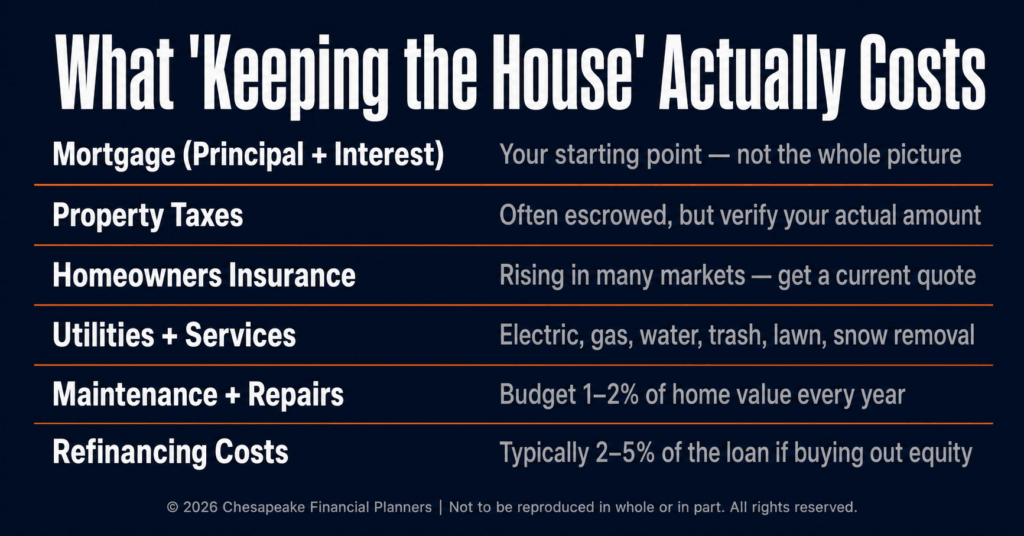
The mortgage payment is the headline number, but it's rarely the real one. To know if you can afford the house after divorce, you have to total every recurring cost and then test it against your single income.
Here's the full picture of monthly carrying costs:
- Mortgage principal and interest
- Property taxes (often escrowed, but verify the amount)
- Homeowners insurance, which has climbed sharply in many markets
- HOA fees, if you have them
- Utilities: electricity, gas, water, sewer, and trash
- Maintenance and repairs, budgeted at 1% to 2% of the home's value each year
- Lawn care, snow removal, and other services you may have split before
On a $400,000 home, that maintenance reserve alone runs $4,000 to $8,000 a year. According to Freddie Mac, the average 30-year fixed mortgage rate has hovered in the high-6% range, which makes any new financing more expensive than the loan you may already hold. Jeff tells clients to run this number against their new take-home pay before they sign anything, because the old household budget no longer exists.
If keeping the house leaves no room for retirement contributions, an emergency fund, or your kids' expenses, you have your answer even if the mortgage technically fits. This is where good divorce financial planning separates a survivable choice from a slow financial leak.
Do I need to update my beneficiary designations after a divorce or major life change?
Can You Qualify for a Refinance on Your Own?
You usually cannot keep the house cleanly without refinancing it into your name alone. A divorce decree saying your ex gives you the house does not remove their name from the mortgage. The lender is not a party to your settlement, so refinancing after divorce is typically the only way to release the other borrower from the debt.
To qualify on your own, lenders examine four things:
- Debt-to-income ratio, generally needed below 43%
- Credit score
- Employment and income stability
- Cash reserves
The Consumer Financial Protection Bureau notes that 43% is the common ceiling for a qualified mortgage. If your single income can't clear that bar, you may be trapped owning a house while your ex stays liable on the loan. That is a bad outcome for both people, because their credit rides on your payments. Jeff often sees clients assume a quitclaim deed solves this; it doesn't, and that misunderstanding can blow up a settlement months later.
What Is a Financial Power of Attorney and Why Do I Need One?
How Do You Handle the Equity Buyout?
If your home has equity, keeping it usually means paying your ex for their share. Say the house is worth $500,000 with a $300,000 mortgage. That's $200,000 in equity, so a 50/50 split means you owe your ex $100,000. The question is where that money comes from, and every option has a cost.
| Funding Source | Trade-Off |
|---|---|
| Cash savings | May drain the emergency fund you'll need most after divorce |
| Cash-out refinance | Raises your monthly payment and total interest for decades |
| Trading other assets | Giving up retirement or investment accounts to keep the house |
| Offsetting with support terms | Complicates alimony and can backfire if circumstances change |
Trading a retirement account for home equity deserves extra caution. A dollar of pre-tax retirement money is not worth a dollar of home equity once you account for future taxes. The IRS home sale exclusion lets a single filer exclude up to $250,000 of gain when you eventually sell, which changes the math on whether to keep or sell now versus later. People consistently underestimate the true cost of a buyout, and that miscalculation is one of the most common divorce financial planning mistakes Jeff corrects.
How Do I Protect My Children's Inheritance in a Blended Family?

What Hidden Costs Catch People Off Guard?
The traps that sink post-divorce homeowners are rarely the mortgage itself. They're the costs that used to be shared and now land entirely on you.
Maintenance is the big one. Furnaces fail, roofs leak, and water heaters quit on their own schedule, not yours. When you were married, one person handled repairs or you split them. Now every emergency is yours alone. Budget for it or risk real strain.
Then there's lifestyle creep. A payment that looks affordable on paper can quietly eat 40% to 50% of your take-home pay once everything is included. That leaves little for retirement savings, your children's activities, or simply rebuilding. Sound post-divorce budgeting means stress-testing the house against every other goal, not just the loan. Jeff Judge notes: "When housing eats 45% of your take-home pay, there is nothing left to rebuild savings, fund the kids' activities, or handle the furnace that will fail on the coldest night of the year, so we stress-test every number before we ever call the house affordable."
At Chesapeake Financial Planners, we use the R.U.D.D.E.R. Method™, our six-step planning process: Review and Recognize, Uncover and Understand, Design and Develop, Discuss and Decide, Execute and Empower, and Reassess and Refine. For a divorcing client, that means uncovering the true carrying cost before designing a decision around it.
What is a will and do I need one for my estate?
Frequently Asked Questions
Can I afford to keep my house after divorce on one income?
You can afford the house after divorce only if its full carrying cost, including mortgage, taxes, insurance, utilities, and maintenance, fits comfortably within your single take-home income while still leaving room for retirement and an emergency fund. If the home consumes more than roughly a third of your income, keeping it usually strains everything else.
Do I have to refinance to keep the house in a divorce?
Yes, in most cases you must refinance to keep the house in your name alone. A divorce decree or quitclaim deed transfers ownership but does not remove your ex-spouse from the mortgage. Only a refinance releases the other borrower from the loan, and you must qualify for that new mortgage on your own income.
What credit and income do I need to refinance after divorce?
Lenders typically want a debt-to-income ratio below 43%, a solid credit score, stable employment, and cash reserves. The CFPB identifies 43% as the common qualified-mortgage ceiling. If your single income cannot clear that bar, you may need to sell, find a co-signer, or renegotiate the settlement entirely.
How do I pay my ex for their share of the home equity?
You usually fund an equity buyout through cash savings, a cash-out refinance, trading other marital assets, or offsetting with support terms. Each has a cost: cash drains reserves, refinancing raises your payment, and trading retirement accounts can leave you with less than the buyout appears to be worth after future taxes.
Is it better to sell the house or keep it after divorce?
Selling is often the cleaner financial reset because it splits the proceeds, removes shared liability, and lets both people start with cash rather than carrying costs. Keeping the house can make sense when one spouse can comfortably afford it alone and has strong reasons to stay. The math, not the emotion, should lead.
How much should I budget for home maintenance after divorce?
Budget 1% to 2% of your home's value each year for maintenance and repairs. On a $400,000 home, that's $4,000 to $8,000 annually. After divorce, you cover these costs alone, so set the money aside in a dedicated reserve before an emergency forces you to use credit you may not be able to repay.
If you're weighing whether to keep your home, a clear-eyed look at the numbers usually settles the question faster than another sleepless night. At Chesapeake Financial Planners, we work through the afford house after divorce decision with clients regularly, mapping the full cost against your single income and your long-term goals. If you'd value a second opinion before you sign anything, visit chesapeakefp.com to learn more.
Want to go deeper? Our Financial Considerations Before Your Divorce walks through this step by step.
Disclosures
The information provided is for educational purposes only and should not be construed as investment advice. Investment strategies should be tailored to individual circumstances, risk tolerance, and goals. Past performance doesn't guarantee future results. Consult with qualified financial professionals regarding your specific situation.
Advisors associated with Chesapeake Financial Planners may be either (1) LPL Financial Registered Representatives offering securities through LPL Financial, Member FINRA and SIPC, and investment advisor representatives offering investment advice through Great Valley Advisor Group; or (2) solely investment advisor representatives offering investment advice through Great Valley Advisor Group and not affiliated with LPL Financial. Great Valley Advisor Group, and Chesapeake Financial Planners are separate entities from LPL Financial.


