

What Should I Plan for Years Before I Sell My Business?
Last reviewed: July 2026
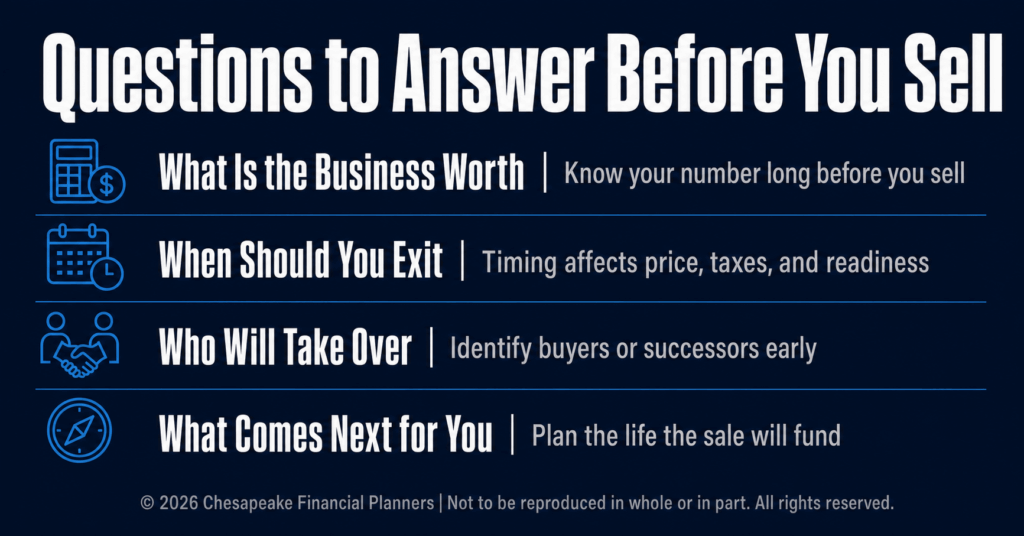
Years before you sell your business, you need to answer four questions: what the business is actually worth, how much of your net worth depends on it, what you will do with the proceeds and your time after the sale, and who is going to run it without you. Business exit planning is the work of answering those questions early enough that you can change the answers. Most owners start two years out. The ones who keep the most money start five to ten years out.
Key Takeaways
- Business exit planning works best when started 5 to 10 years before a sale, giving you time to raise value and lower taxes.
- Roughly 80% of small businesses listed for sale never actually sell, according to BizBuySell data.
- The federal estate and gift tax exemption rose to $15 million per person in 2026, made permanent under the One Big Beautiful Bill.
- Most owners overestimate value and underestimate taxes, which is why a baseline valuation should come first.
- A business that cannot run for 90 days without the owner is harder to sell and sells for less.
About the Author: Jeff Judge, CFP®, AEP®, ChFC®, CLU® is Managing Partner of Chesapeake Financial Planners in Forest Hill, Maryland. He has been helping families and business owners in Harford County and the Baltimore metro area navigate business exit planning since earning his CFP® certification in 2013, by using Chesapeake Financial Planners’ signature process, the R.U.D.D.E.R. method™. Jeff's blunt observation: most owners spend 30 years building a business and 30 days planning the most important transaction of their lives, then wonder why the number at closing disappoints them.
On This Page
- What business exit planning actually means
- Why you should start years before you sell
- How to find out what your business is really worth
- How much of your net worth is tied up in the business
- What you will do with the money and your time after the sale
- How to make the business run without you
- The tax questions that decide how much you keep
- Your exit options besides an outright sale
- The R.U.D.D.E.R. Method™ applied to a business exit
- Frequently asked questions
What Is Business Exit Planning?
Business exit planning is the process of preparing a privately held business and its owner for the transfer of ownership, whether through a sale, a transition to family, an employee buyout, or another path. It covers the business value, the owner's personal financial readiness, the tax consequences of the transfer, and the operational changes that make the company sellable. It is not the same as listing the business for sale. The sale is the last step. The planning is everything that happens before it.
Think of it this way. Exit planning answers two separate questions at once. First, can the business be sold for what you need? Second, can you afford the life you want after it is gone? Owners who only answer the first question often discover too late that the after-tax proceeds do not fund their retirement. Owners who only answer the second question sometimes sell a business that was not ready, and leave money on the table.
Jeff Judge often tells clients that exit planning is really retirement planning for people whose retirement account happens to be a company. The mechanics are different. The goal is the same: turn an asset you built into income you can live on, with as little lost to taxes and mistakes as possible.
Is Exit Planning Only for Owners Who Are Ready to Sell Now?
No. Exit planning is most valuable for owners who are five to ten years away from a sale, because that is the window where you can still change the outcome. The further out you start, the more levers you can pull on value, taxes, and management depth. An owner ready to sell next quarter has very few moves left.
Why Should I Start Years Before I Sell?
You should start years before you sell because the things that raise your sale price and lower your tax bill take years to put in place. You cannot manufacture three years of clean, growing financial statements in the month before you list. You cannot build a management team that runs the company without you in a single quarter. You cannot restructure ownership for tax efficiency the week before closing without triggering scrutiny.
The data backs up the urgency. According to research summarized by the Exit Planning Institute, the majority of business owners have no formal transition plan, even though a large share of their net worth sits inside the business. And on BizBuySell, industry data consistently shows that a large majority of small businesses listed for sale never close at all. A business that is not prepared is a business that often does not sell.
Here is the pattern Jeff has watched cost owners real money. They decide to sell because they are tired, or because a health event forces the question. They go to market in their weakest year, with no successor identified and no tax plan. The buyer senses the urgency and discounts the price. The seller takes the deal because the alternative is no deal. Starting early removes the desperation that buyers exploit.
How Many Years of Lead Time Do I Really Need?
Most owners need three to ten years of lead time for a clean, optimized exit. Three years gets you defensible financials and a basic tax plan. Five years lets you build management depth and grow value deliberately. Ten years opens advanced moves like gifting equity to family while values are lower. For a deeper look, see When Should I Start Planning My Business Exit Strategy?.
How Do I Find Out What My Business Is Really Worth?
You find out what your business is really worth by getting a professional valuation, not by guessing from a rule of thumb or a number a competitor sold for. Most owners carry a number in their head that is too high, anchored to what they need rather than what a buyer will pay. A baseline valuation, done early, replaces the fantasy number with a real one you can work to improve.
Valuation for a privately held business usually rests on some multiple of earnings, most often a measure called EBITDA, adjusted for owner-specific expenses. The multiple depends on your industry, your growth rate, your customer concentration, and how dependent the business is on you. Two companies with identical profit can sell for very different multiples based on quality of earnings and transferability.
What moves the number up over time:
- Clean, audited or reviewed financials. Buyers pay more for numbers they trust.
- Recurring or contracted revenue. Predictable income earns a higher multiple than lumpy project work.
- Customer diversification. If one client is 40% of revenue, that is a discount waiting to happen.
- A management team that stays. Buyers pay for a business that runs without the seller.
- Documented systems and processes. Tribal knowledge in the owner's head is a liability at the closing table.
Jeff has seen two owners in the same trade, with similar revenue, sell years apart for wildly different prices. The difference was not luck. One had spent five years making the business less dependent on him. The other was the business. To understand what drives your specific number, start with How much is my business actually worth if I want to sell? and When should I start valuing my business for a future sale?.
What Is the Most Common Valuation Mistake Owners Make?
The most common valuation mistake is anchoring to the price you need for retirement rather than the price a buyer will pay. Your financial needs do not set market value. A baseline valuation tells you the gap between the two, while you still have years to close it through growth, tax planning, or a longer runway.
[business exit planning valuation worksheet on a desk]
How Much of My Net Worth Is Tied Up in the Business?
For most owners, the business represents the single largest piece of their net worth, often well over half. That concentration is the central financial risk of an exit. If most of your wealth is one illiquid, hard-to-value asset tied to one industry and one economy, a bad sale or a failed sale does not just cost you a transaction. It can cost you your retirement.
This is where exit planning and personal financial planning have to merge. Before you can decide how to sell, you need to know how much you actually need from the sale to fund the rest of your life. That number depends on your spending, your other assets, your age, and how long you expect the proceeds to last. According to the Social Security Administration, a 65-year-old man today can expect to live into his early 80s on average and a woman into her mid-80s, with many living well beyond. Your proceeds may need to last 25 years or more.
The exercise is straightforward but uncomfortable. Add up what you will need to live on each year, subtract reliable income like Social Security, and you arrive at the gap the proceeds must cover. Compare that to your baseline valuation, after taxes and costs. If the after-tax proceeds cover the gap, you have flexibility. If they do not, you have a problem you want to find five years early, not five weeks before closing.
What If My Business Is Worth Less Than I Need to Retire?
If your after-tax proceeds will not fund your retirement, you have four levers and time is the one that makes the others work. You can grow the business value, lower the tax hit through structure and timing, spend less in retirement, or delay the sale to do more of the first three. Discovering this gap early is the entire point of starting years ahead. Business owners also have retirement-saving options outside the sale itself, covered in How do business owners save for retirement without a 401(k)?.
What Will I Do After the Sale, With Both My Money and My Time?
You need a plan for the proceeds and a plan for your life, and the second one trips up more owners than the first. The money problem is solvable with a portfolio. The identity problem is harder. Owners who sold a business they built often describe a flatness in the months after, when the thing that organized their days and their sense of purpose is suddenly gone.
On the money side, the central task is converting a single large lump sum into durable income without making expensive mistakes in the first year. New liquidity attracts bad ideas, aggressive salespeople, and the temptation to make big bets. The disciplined move is to slow down, park the proceeds somewhere safe, and build an income plan before deploying anything. We walk owners through this in How do I invest the proceeds from selling my business? and Can I retire after selling my business for $2-5 million?.
On the life side, Jeff pushes clients to answer a simple question before they sign anything: what will you do on the first Monday after the business is no longer yours? The owners who answer that question well, with a board seat, a nonprofit, a consulting role, travel, grandchildren, or a second venture, transition far more smoothly than the ones who assume free time will sort itself out.
Is It Normal to Regret Selling a Business?
Seller's remorse is common, and it is usually about identity and purpose rather than money. Owners who plan their post-sale life, with specific activities and a sense of what comes next, report far less regret than those who only planned the financial side. Build the life plan with the same rigor you bring to the deal terms.
How Do I Make the Business Run Without Me?
You make the business run without you by deliberately removing yourself from daily operations over a period of years: building a management team, documenting how things get done, and shifting key relationships from you to your people. A business that depends entirely on the owner is worth less and is harder to sell, because the buyer is really buying a job, not an asset.
The test Jeff uses with clients is blunt. Could the business operate for 90 days if you disappeared tomorrow? For most owner-operated companies, the honest answer is no, and that answer is a direct discount on the sale price. Transferability is one of the biggest drivers of value, and it is entirely within your control if you start early.
Practical steps that build transferability:
- Hire or promote a true second-in-command who can make decisions when you are out.
- Document core processes so that knowledge lives in systems, not just in your head.
- Move key customer and vendor relationships so they are loyal to the company, not only to you.
- Step back deliberately from areas you can delegate, and resist taking them back.
- Put a buy-sell agreement in place if you have partners, so an exit does not create chaos. See What Is a Buy-Sell Agreement and Why Do Business Partners Need One?.
This is also the area owners most often forget until it is too late. For the common blind spots, read What Do Business Owners Most Often Forget to Plan Before Exiting?.

[business owner training a successor manager in an office]
How Long Does It Take to Make a Business Owner-Independent?
Making a business genuinely owner-independent usually takes two to five years. You need time to hire the right people, let them prove themselves, document processes, and transfer relationships without losing customers. This is the single best argument for starting exit planning early, because transferability cannot be rushed in the final months.
What Are the Tax Questions That Decide How Much I Keep?
The tax questions decide the difference between your sale price and your take-home, and that difference can be enormous. How the deal is structured, whether you sell assets or stock, how the price is allocated, how the entity is set up, and when you sell all change the tax bill. These are decisions you want to make years ahead, with a CPA and a planner, not on the closing call.
A few of the levers that matter most:
Asset sale versus stock sale. Buyers usually prefer asset sales for tax reasons; sellers often prefer stock sales. The structure changes how proceeds are taxed and is negotiated, not assumed.
Capital gains treatment. Long-term capital gains are taxed at lower federal rates than ordinary income. According to the IRS, the top long-term capital gains rate is 20%, and higher earners may also owe the 3.8% net investment income tax. How your sale is structured affects how much of it qualifies for these lower rates.
Qualified Small Business Stock. Certain C-corporation stock may qualify for a significant exclusion of gain under Section 1202 of the tax code, a powerful break that requires planning years in advance to use. This is exactly the kind of move you cannot make in the final months.
Estate and gift planning. If you intend to pass wealth to family, the federal estate and gift tax exemption sits at $15 million per person in 2026. Gifting equity in the business while values are lower can move future appreciation out of your taxable estate. This is advanced work and belongs in a multi-year plan.
Jeff's standing rule with owners: never let the tax tail wag the deal dog, but never ignore the tail either. A deal structured without tax planning can hand 25% to 35% of the proceeds to the government that disciplined planning would have kept in your pocket. To see how owner compensation choices feed into this, read How Should Business Owners Pay Themselves Salary vs Distributions?. Jeff Judge notes: "I've seen owners walk away from a $3 million sale with $600,000 less than they expected simply because the deal structure wasn't reviewed until the letter of intent was already on the table — at that point, most of the planning options are gone."
Can I Reduce Taxes on a Business Sale If I Wait?
Yes, in many cases waiting and planning reduces the tax bill, sometimes substantially. Multi-year strategies like installment sales, charitable structures, qualified small business stock, and gifting all require lead time. An owner who plans the tax side three to five years out keeps far more than one who structures the deal at the closing table.
What Are My Options Besides an Outright Sale?
An outright sale to a third party is one path, not the only one. Depending on your goals, your family, and your team, you might transfer the business to children, sell to your employees through an ESOP, sell to your management team, bring in a partner, or recapitalize and keep a stake. Each option has different tax, financing, and timing implications, and the right one depends on what you want for the business and the people in it.
A quick comparison of the most common paths:
| Exit Path | Best When | Trade-Off |
|---|---|---|
| Third-party sale | You want the highest price and a clean break | Less control over legacy and employees |
| Family transition | You want the business to stay in the family | Family may lack capital or readiness |
| Management buyout | You trust your team to run it | Team often needs seller financing |
| Employee ownership (ESOP) | You want to reward employees and gain tax benefits | Complex and costly to set up |
| Recapitalization | You want partial liquidity and continued involvement | You stay financially exposed to the business |
There is no universally best answer. An owner who wants top dollar and a fast exit chooses differently than one who wants the company to survive in the family for another generation. For a fuller breakdown, see What are my options for exiting my business besides selling outright? and What are the best exit strategies for business owners?.
Is Selling to My Employees a Good Idea?
Selling to employees through an ESOP or a management buyout can work well when you want continuity and your team is capable, and it carries real tax advantages. The trade-offs are complexity, cost, and the fact that employees often need seller financing. It is a strong option for the right owner, but it is not simple, so plan it years ahead.
How Does the R.U.D.D.E.R. Method™ Apply to a Business Exit?
The R.U.D.D.E.R. Method™ is Chesapeake Financial Planners' six-step planning process: Review and Recognize, Uncover and Understand, Design and Develop, Discuss and Decide, Execute and Empower, and Reassess and Refine. Applied to a business exit, it gives the messy, emotional work of selling a company a structure you can actually follow.
It works like this for an exit. You Review and Recognize where the business and your finances stand today, including a baseline valuation. You Uncover and Understand what you truly need from the sale and what you want for your life and your people afterward. You Design and Develop the strategy, choosing the exit path, the tax structure, and the value-building moves. You Discuss and Decide the plan with your advisors, your family, and your team. You Execute and Empower by building management depth, cleaning up financials, and preparing the business for transfer. Then you Reassess and Refine as markets, tax law, and your own goals change over the years before the sale.
The point of running an exit through a defined process is that it keeps you from skipping the uncomfortable steps. Most failed exits skip the early ones. Owners jump straight to "find a buyer" without ever doing the honest review of what they need and whether the business is ready.
Why Use a Defined Process Instead of Just Hiring a Broker?
A broker sells the business; a defined planning process makes sure the business is worth selling and that the sale funds your life. Brokers are paid to close a transaction, not to optimize your taxes or build your management team. A planning process owns the years of work that happen before a broker is ever involved.

Frequently Asked Questions
When should I start business exit planning?
Start business exit planning three to ten years before you intend to sell. The earlier you start, the more you can do to raise the sale price, lower the tax bill, and build a business that runs without you. Owners who begin only months before listing have very few levers left to pull and usually sell in a weaker position.
What is the first step in planning a business exit?
The first step is getting a baseline professional valuation so you know what your business is actually worth today. Most owners overestimate value, and a real number replaces the guess. From there, you compare the after-tax proceeds to what you actually need to retire, which reveals the gap you have years to close.
How much is my business worth?
Your business is worth what a qualified buyer will pay, usually some multiple of adjusted earnings that varies by industry, growth, customer concentration, and how dependent the company is on you. A professional valuation gives you a defensible number. Rules of thumb and competitor sale prices are starting points, not answers, and often mislead owners.
How can I reduce taxes when I sell my business?
You reduce taxes through deal structure, entity planning, and timing, most of which require years of lead time. Capital gains treatment, asset versus stock structure, qualified small business stock, installment sales, and gifting strategies all matter. The IRS sets a top long-term capital gains rate of 20%, and planning determines how much of your proceeds qualify for lower rates.
What happens if my business does not sell?
A business that is not prepared often does not sell, and industry data from BizBuySell shows most listed small businesses never close. If yours fails to sell, you may be forced to lower the price, accept worse terms, or keep running it longer than planned. Preparing years ahead is the best protection against a failed sale.
Can I retire on the proceeds from selling my business?
You can retire on the proceeds only if the after-tax amount funds your spending for the rest of your life, which for many owners spans 25 years or more. Compare your retirement income gap to the after-tax sale price early. If they do not match, you have time to grow value, cut the tax bill, or adjust your plans.
Should I tell my employees I am planning to sell?
Timing the conversation with employees is delicate, and there is no single right answer. Telling them too early can spark anxiety and departures; too late can feel like a betrayal that hurts the transition. The right approach depends on your team, your buyer, and your industry, which is why it belongs in your exit plan from the start.
Do I need an advisor to plan a business exit?
You do not legally need one, but a business exit touches valuation, tax, legal structure, estate planning, and personal finance at once, and few owners have all of that expertise in-house. A planner who coordinates with your CPA and attorney keeps the pieces aligned. The cost of good advice is usually a fraction of the taxes and mistakes it prevents.
If you own a business and a sale is anywhere on your horizon, the best time to start planning was years ago and the second best time is now. Our guide for business owners walks through the questions to answer before you exit, and you can download it free at chesapeakefp.com to see exactly where your business stands today.
Want to go deeper? Our Business Exit Path Comparison walks through this step by step.
Disclosures
The information provided is for educational purposes only and should not be construed as investment advice. Investment strategies should be tailored to individual circumstances, risk tolerance, and goals. Past performance doesn't guarantee future results. Consult with qualified financial professionals regarding your specific situation.
This information is not intended to be a substitute for specific individualized tax, investment or legal advice. We suggest that you discuss your specific situation with a qualified tax, legal or financial advisor.
Advisors associated with Chesapeake Financial Planners may be either (1) LPL Financial Registered Representatives offering securities through LPL Financial, Member FINRA and SIPC, and investment advisor representatives offering investment advice through Great Valley Advisor Group; or (2) solely investment advisor representatives offering investment advice through Great Valley Advisor Group and not affiliated with LPL Financial. Great Valley Advisor Group, and Chesapeake Financial Planners are separate entities from LPL Financial.


