

Can I Retire After Selling My Business for $2-5 Million?
Last reviewed: July 2026
Yes, you can usually retire after selling a business for $2 to $5 million, but the sale price is not the number that decides it. What matters is what you net after taxes and debt, how old you are when you stop working, and what your real annual spending will be. A clean $3 million sale can fund a 30-year retirement for one owner and run dry in 12 years for another. The gap is planning, not luck.
On This Page
- Key Takeaways
- How Much Do You Actually Need to Retire After Selling a Business?
- What Will You Net From Your Business Sale After Taxes?
- How Does Your Age at Sale Change the Retirement Math?
- What Other Income Sources Support Your Retirement?
- How Do You Cover Healthcare Before Medicare?
- How Should You Invest the Proceeds to Make Them Last?
- What Is the Biggest Mistake Business Owners Make After Selling?
- Frequently Asked Questions
- Ready to See If Your Sale Can Fund Your Retirement?
- Disclosures
Key Takeaways
- The 2026 federal long-term capital gains rate tops out at 20%, plus a 3.8% net investment income tax, so taxes can claim a large share of your sale proceeds.
- Your net investable assets, not your gross sale price, determine retirement income; a $3 million sale often nets closer to $1.7 million after taxes, debt, and reserves.
- Retiring before 65 means buying private health insurance until Medicare eligibility, a cost many sellers underestimate.
- The 2026 maximum Social Security benefit at full retirement age is $4,152 per month, a meaningful income floor for high-earning owners.
- A sustainable withdrawal rate of 3% to 4% of investable assets, not the sale headline, sets your realistic annual income.
About the Author: Jeff Judge, CFP®, AEP®, ChFC®, CLU® is Managing Partner of Chesapeake Financial Planners in Forest Hill, Maryland. He has been helping families and business owners in Harford County and the Baltimore metro area navigate business sales and retirement transitions since earning his CFP® certification in 2013, by using Chesapeake Financial Planners’ signature process, the R.U.D.D.E.R. method™. Jeff has watched more sellers get tripped up by the tax bill and the gap before Medicare than by the sale price itself; the owners who plan two to three years ahead of the closing almost always keep more of what they built.
How Much Do You Actually Need to Retire After Selling a Business?
You need enough invested capital to generate your real annual spending for the rest of your life, adjusted for inflation and taxes. For most sellers, that means working backward from your spending, not forward from your sale price. The question is never "Is $3 million a lot?" It is "Does $3 million, after everything, produce the income my household actually uses?"
What is a safe withdrawal rate after a business sale?
A safe withdrawal rate is the percentage of your investable portfolio you can spend each year with reasonable confidence the money lasts 30 years. The widely cited starting point is the 4% rule, which traces back to financial planner William Bengen's 1994 research. At 4%, a $1.7 million portfolio produces about $68,000 in the first year, then rises with inflation.
That rule assumes a diversified portfolio, not proceeds parked in cash, and it assumes you retire around 60 to 65. Retire at 55 and your money must last 35 to 40 years, which pushes a prudent rate down toward 3% to 3.5%. At 3.25%, that same $1.7 million produces about $55,000. The difference between 4% and 3.25% is roughly $13,000 a year, every year, for life. Small percentage shifts move real dollars.
How do you calculate your real retirement spending?
Calculate your true number by starting with current household spending, then adjusting it for retirement reality. Most owners guess that they will spend less after they stop working. In Jeff's experience, the first few years of retirement often cost more, not less, because the time you finally have gets filled with travel, hobbies, grandchildren, and projects.
Build the number this way:
- Total current annual household spending, line by line, not from memory.
- Subtract genuine work costs: commuting, business meals, the wardrobe you will stop buying.
- Add private healthcare premiums if you retire before 65.
- Add a realistic "freedom budget" for travel and pursuits you deferred for years.
- Apply 3% annual inflation across a 30-year horizon.
- Model your money lasting to age 90 to 95, not to average life expectancy.
According to the Bureau of Labor Statistics, household spending patterns shift in retirement but rarely collapse the way owners expect. The household that spends $130,000 working often still spends $115,000 to $125,000 in early retirement.
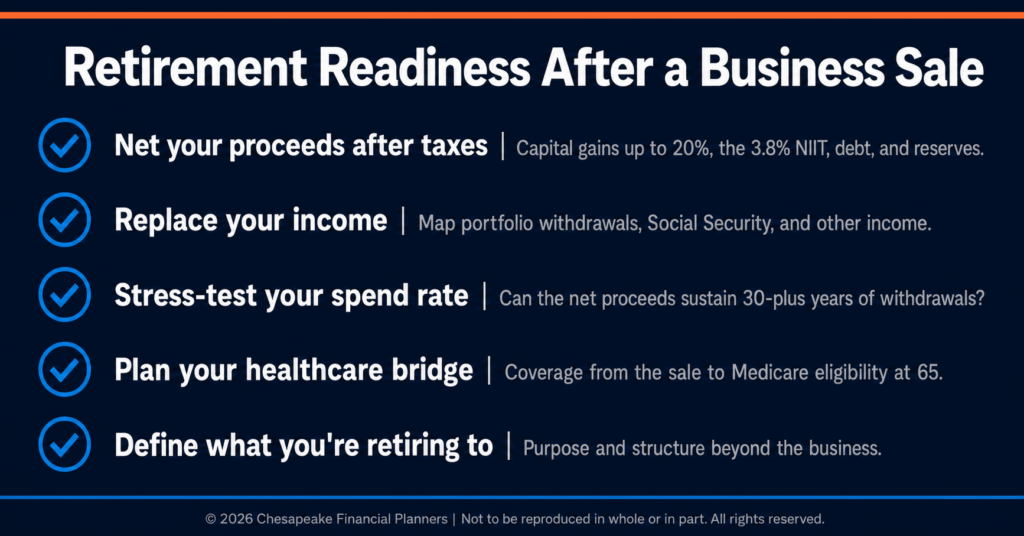
What Will You Net From Your Business Sale After Taxes?
Your gross sale price is not your retirement fund. After federal and state capital gains tax, debt payoff, transaction costs, and reserves, the number you actually invest is meaningfully smaller. This single gap is where business sale retirement planning succeeds or fails, and it is the part most owners discover too late.
How much tax will you owe on a business sale?
Most business sale gains are taxed as long-term capital gains, and the 2026 federal long-term capital gains brackets run 0%, 15%, and 20% depending on taxable income. A multimillion-dollar sale almost always lands in the 20% bracket on most of the gain. On top of that, the 3.8% net investment income tax applies to high earners, and your state may add its own rate.
The structure of the deal matters enormously. An asset sale and a stock sale produce different tax outcomes, and allocation between goodwill, equipment, and inventory shifts what is taxed at capital gains versus ordinary income rates. If your company qualifies as a C corporation that meets the Qualified Small Business Stock rules under Section 1202, the 2026 expanded exclusion can shelter a substantial portion of the gain from federal tax entirely. That single planning item can be worth hundreds of thousands of dollars, which is why structure should be decided years before the closing, not at the negotiating table.
What does a realistic net look like on a $3 million sale?
Here is a representative reality check on a $3 million sale for an owner with some business debt:
| Line item | Amount |
|---|---|
| Gross sale price | $3,000,000 |
| Federal and state capital gains tax (est. 26%) | -$780,000 |
| Business debt payoff | -$300,000 |
| Transaction and advisory costs | -$120,000 |
| Cash reserve set aside | -$100,000 |
| Net investable assets | $1,700,000 |
At a 4% withdrawal rate, that $1.7 million produces about $68,000 in year one. If your household needs $120,000, you face a $52,000 annual gap that other income must fill. Jeff Judge often tells clients that the $3 million headline and the $68,000 paycheck are two different conversations, and the second one is the one that determines whether you can actually stop working.
How Does Your Age at Sale Change the Retirement Math?
Your age at the closing table changes everything, because it sets how long your money must last and how much guaranteed income you can layer in. Selling at 55 and selling at 65 are not variations on the same plan; they are different plans entirely.
Why is retiring before 65 more expensive?
Retiring before 65 costs you in three ways at once: you give up additional earning years, you add years of spending, and you delay access to Social Security and Medicare. Each year you retire early stretches your portfolio across a longer horizon while pushing back the guaranteed income that would otherwise reduce the draw on your investments.
A 55-year-old seller needs the money to last potentially 40 years, which prudently caps the withdrawal rate near 3% to 3.5%. A 65-year-old seller plans for 25 to 30 years and can reasonably use a rate closer to 4%. The same $1.7 million portfolio supports roughly $55,000 a year at 55 and roughly $68,000 a year at 65. The earlier you walk away, the more capital each dollar of lifestyle requires.
Does selling later always mean a better retirement?
Not always, but it usually buys flexibility. Selling at 63 instead of 58 gives you five fewer years to fund privately, five more years of potential earnings, and closer proximity to Social Security and Medicare. It also shrinks the most dangerous stretch of any early retirement, the gap years before age 65 when health coverage comes entirely out of pocket. The R.U.D.D.E.R. Method™ is Chesapeake Financial Planners' six-step planning process: Review and Recognize, Uncover and Understand, Design and Develop, Discuss and Decide, Execute and Empower, and Reassess and Refine. We use the Review and Recognize step specifically to pressure-test whether your target sale age and your target retirement actually fit together, before a buyer ever makes an offer.
When Should I Start Planning My Business Exit Strategy?
How do business owners plan for retirement differently?
What Other Income Sources Support Your Retirement?
Your sale proceeds rarely stand alone. Social Security, pensions, real estate, and a spouse's benefits all layer on top of your portfolio, and each guaranteed dollar reduces how hard your investments have to work. Sellers who map every income source before the closing almost always find the picture is stronger than the portfolio alone suggests.
How much Social Security can a former business owner expect?
Most business owners who paid self-employment tax through the years qualify for Social Security, and the benefit can be substantial. The 2026 maximum Social Security benefit at full retirement age is $4,152 per month, or nearly $50,000 a year, for those who earned at or above the wage base across their career. The average retired worker benefit in 2026 runs roughly $2,000 per month.
For a high-earning owner and spouse, combined Social Security can realistically provide $60,000 to $80,000 a year in inflation-adjusted, guaranteed income beginning between ages 62 and 70. Delaying that claim raises the benefit, and the decision of when to claim is one of the highest-value choices a seller makes. According to the Social Security Administration, waiting from full retirement age to 70 increases the benefit by 8% per year of delay.
What role do other assets and a spouse's income play?
Assets outside the business, including real estate, brokerage accounts, and retirement plans, diversify your income and reduce reliance on the sale alone. If you ran a solo 401(k) or SEP IRA inside your business, those balances may already represent a meaningful share of your retirement capital separate from the sale proceeds.
A dual-income or dual-benefit household has far more room to maneuver. A working spouse can carry health coverage through the gap years, delay portfolio withdrawals, and let the sale proceeds compound. Jeff has seen the same sale price produce wildly different retirements depending on whether one income source or four are feeding the household.
How do business owners save for retirement without a 401(k)?
Should I Choose a Solo 401(k) or SEP IRA for My Business?
How Do You Cover Healthcare Before Medicare?
If you retire before 65, you must buy your own health coverage until Medicare eligibility begins, and this is the single most underestimated cost in early retirement. Sellers who plan around it sail through; those who ignore it watch it quietly drain the portfolio.
What does private health insurance cost before age 65?
Private coverage before Medicare typically runs through the Affordable Care Act marketplace, and premiums for a couple in their late 50s or early 60s can reach $20,000 to $30,000 a year before any out-of-pocket costs. Medicare eligibility begins at age 65, so an owner who retires at 58 faces seven years of fully self-funded coverage.
There is a planning wrinkle worth knowing. ACA marketplace subsidies are based on your modified adjusted gross income, not your assets. A seller with $2 million invested but modest realized income in a given year may qualify for premium tax credits that a working professional with the same lifestyle would not. This is one reason the timing of when you realize income, including the sale itself, deserves careful coordination with your tax advisor.
How much should you budget for healthcare across retirement?
Plan for healthcare to be one of your largest lifetime expenses, rising as you age. A widely referenced Fidelity retiree healthcare estimate puts lifetime out-of-pocket medical costs for a retired couple well into six figures, and that figure does not include long-term care. For a couple retiring at 58, the pre-Medicare premiums alone can total $140,000 to $200,000 before Medicare even starts. Building this line into the plan from the beginning is the difference between a budget that holds and one that springs a leak in year three.

How Should You Invest the Proceeds to Make Them Last?
The way you invest your proceeds determines whether your withdrawal rate holds for 30 years or breaks down in a bad decade. The goal is not maximum return; it is durable, tax-efficient income that survives market downturns without forcing you to sell at the bottom.
What is the right mix for sale proceeds?
The right mix balances growth, stability, and liquidity across the phases of your retirement. A common framework holds one to three years of spending in cash and short-term reserves, a middle layer of high-quality bonds for the next several years, and a growth layer of diversified equities for the long horizon. This structure lets you draw from cash and bonds during a market decline instead of selling stocks at a loss, which is the failure mode that breaks the 4% math.
Diversification away from concentrated risk matters most right after a sale. For years your wealth was concentrated in one illiquid asset, your company. The sale is your chance to fix that. Jeff Judge regularly reminds new clients that the riskiest moment is not owning the business; it is the few months after the sale when proceeds sit in a single account waiting on a plan.
How do taxes affect your withdrawal strategy?
Where your money sits changes how much of each withdrawal you keep. Coordinating draws across taxable, tax-deferred, and tax-free accounts can extend portfolio life by years. Pulling from the right account in the right year, harvesting losses, and managing your taxable income to control Medicare premiums and ACA subsidies are ongoing decisions, not one-time choices.
The IRS requires minimum distributions from traditional retirement accounts starting at age 73, which can push you into higher brackets later if you do not plan for it. The years right after a sale, when your earned income drops, are often the best window for Roth conversions and other proactive tax moves that lower lifetime tax.
How do I invest the proceeds from selling my business?
How do business owners plan for retirement differently?
What Is the Biggest Mistake Business Owners Make After Selling?
The biggest mistake is treating the sale as the finish line instead of the starting line of a new financial life. The deal closes, the wire hits, and the planning that should have started years earlier gets postponed until a tax bill or a market drop forces it. The owners who keep the most are the ones who planned the exit and the retirement as one connected project.
Why does planning before the sale matter so much?
Planning before the sale matters because the highest-value decisions, deal structure, QSBS qualification, timing of income, and Roth strategy, can only be made before the ink dries. Once the closing happens, those levers are gone. The Uncover and Understand and Design and Develop steps of our process exist to get these decisions made on your timeline, not the buyer's.
What Do Business Owners Most Often Forget to Plan Before Exiting?
How Do I Exit My Business and Maximize Value?
What questions should I ask before hiring a financial advisor?

Frequently Asked Questions
Can I retire after selling my business for $2 million?
Yes, you can often retire after selling a business for $2 million, but it depends on your net after taxes and debt, your age, and your spending. A $2 million sale might net $1.3 million invested, producing about $52,000 a year at a 4% rate, which works for a modest lifestyle paired with Social Security but may fall short for an affluent one.
How much tax will I pay when I sell my business?
Most business sale gains are taxed at the 2026 federal long-term capital gains rate of up to 20%, plus a 3.8% net investment income tax for high earners and any state tax. Deal structure, asset allocation within the sale, and Qualified Small Business Stock eligibility can change the bill dramatically, sometimes by hundreds of thousands of dollars, so plan the structure well before closing.
Is $3 million enough to retire on after selling a business?
For many owners, $3 million is enough to retire, but the gross price is misleading. After taxes, debt payoff, and reserves, a $3 million sale often nets around $1.7 million invested, generating roughly $68,000 a year at a 4% withdrawal rate. Whether that suffices depends entirely on your real spending and your other income sources.
How early can I retire after selling my business?
You can retire as early as your net proceeds and other income allow, but retiring before 65 raises the bar significantly. Earlier retirement means a longer time horizon, a lower safe withdrawal rate near 3% to 3.5%, and years of private health insurance before Medicare eligibility at 65. Many owners find retiring at 60 to 63 strikes a workable balance.
What is a safe withdrawal rate from my business sale proceeds?
A safe withdrawal rate is typically 3% to 4% of your invested proceeds, depending on your age and horizon. A 65-year-old can reasonably use 4%, producing about $68,000 a year from $1.7 million. A 55-year-old facing a 40-year retirement should lean toward 3% to 3.5% to reduce the risk of outliving the money.
Will I still get Social Security if I sold my business?
Yes, if you paid self-employment or payroll taxes through your business, you qualify for Social Security. The 2026 maximum benefit at full retirement age is $4,152 per month for top earners, and delaying past full retirement age to 70 increases the benefit by 8% per year, making it a valuable income floor that reduces pressure on your portfolio.
How do I cover health insurance if I retire before Medicare?
You cover health insurance before 65 mainly through the ACA marketplace, where premiums for an older couple can reach $20,000 to $30,000 a year. Because marketplace subsidies are based on income rather than assets, careful management of your realized income, including the timing of the sale, can sometimes qualify you for premium tax credits that lower the cost.
Ready to See If Your Sale Can Fund Your Retirement?
The number that matters is not the offer on the table; it is what that offer becomes after taxes, debt, and a plan built to last 30 years. If you are weighing a sale or already have one in motion, the time to model your retire-after-selling-business numbers is now, not after closing. Jeff Judge and the Chesapeake Financial Planners team work with business owners across Harford County and the Baltimore metro on exactly this transition. Schedule a free fit call at chesapeakefp.com to see whether your sale proceeds can fund the retirement you have in mind.
Want to go deeper? Our Business Sale Tax Planning Guide walks through this step by step.
Disclosures
The information provided is for educational purposes only and should not be construed as investment advice. Investment strategies should be tailored to individual circumstances, risk tolerance, and goals. Past performance doesn't guarantee future results. Consult with qualified financial professionals regarding your specific situation.
Advisors associated with Chesapeake Financial Planners may be either (1) LPL Financial Registered Representatives offering securities through LPL Financial, Member FINRA and SIPC, and investment advisor representatives offering investment advice through Great Valley Advisor Group; or (2) solely investment advisor representatives offering investment advice through Great Valley Advisor Group and not affiliated with LPL Financial. Great Valley Advisor Group, and Chesapeake Financial Planners are separate entities from LPL Financial.


