

What Are My Options for Exiting My Business Besides Selling Outright?
Last reviewed: July 2026
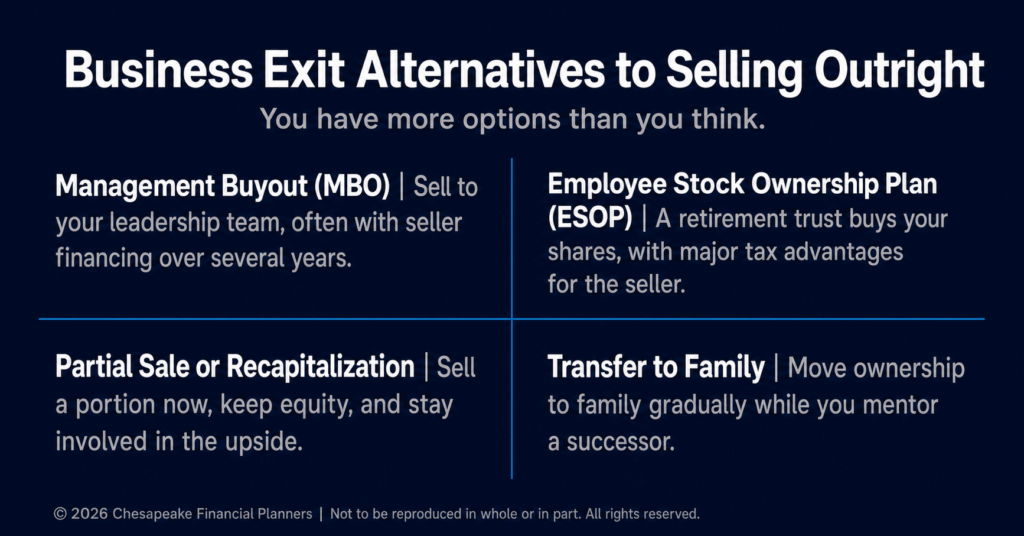
Business exit options beyond an outright third-party sale include a management buyout, an Employee Stock Ownership Plan (ESOP), a partial sale, gifting or transferring to family, and a gradual ownership transition. Each path trades off price, control, tax treatment, and legacy in a different way, so the right choice depends on what you actually want out of the exit, not just the highest number.
Most owners assume the decision is binary: sell or keep working. It isn't. The owners who walk away satisfied usually picked the structure that matched their goals first, then optimized the price within that structure.
Key Takeaways
- Business exit options besides selling outright include management buyouts, ESOPs, partial sales, and family transfers, each with distinct tax and control implications.
- A C corporation owner selling to an ESOP can defer capital gains tax under IRC Section 1042 by reinvesting in qualified replacement property.
- ESOP setup costs typically run well into six figures, so the National Center for Employee Ownership suggests they fit larger, profitable companies.
- A partial sale lets you take cash off the table now while keeping equity in future growth.
About the Author: Jeff Judge, CFP®, AEP®, ChFC®, CLU® is Managing Partner of Chesapeake Financial Planners in Forest Hill, Maryland. He has been helping families and business owners in Harford County and the Baltimore metro area navigate business succession and exit planning since earning his CFP® certification in 2013, by using Chesapeake Financial Planners’ signature process, the R.U.D.D.E.R. method™. Jeff has watched too many owners default to a third-party sale simply because no one walked them through the alternatives that would have preserved their legacy and cut their tax bill.
What Does It Mean to Exit a Business Without Selling Outright?
Exiting without an outright sale means transferring ownership through a structure other than a single cash sale to an unrelated third party. You might sell to your own management team, transfer shares to employees through a retirement trust, sell a partial stake, or move ownership to family over time.
The common thread is control over the timeline and the outcome. An outright sale to a strategic or private equity buyer is fast and often pays the most, but you hand over the keys and lose influence over the business, the employees, and sometimes your own role. The alternatives let you stay involved, reward the people who helped you build the company, or structure the transaction for a better tax result.
Jeff often tells clients that the question isn't "what's my business worth," it's "what do I want my life to look like the day after closing." That answer usually narrows the list of viable structures faster than any valuation does. This is also the kind of decision the R.U.D.D.E.R. Method™, Chesapeake Financial Planners' six-step planning process of Review and Recognize, Uncover and Understand, Design and Develop, Discuss and Decide, Execute and Empower, and Reassess and Refine, was built to work through.
How Do I Exit My Business and Maximize Value?
How Does a Management Buyout Work as a Business Exit Strategy?
A management buyout (MBO) is the sale of your company to your existing leadership team or key employees, usually funded through a mix of seller financing, bank debt, and sometimes private equity backing.
Because management rarely has the cash to pay in full at closing, you typically carry a portion of the price as a seller note, taking payments over five to ten years with interest. That structure makes the deal feasible and spreads your taxable gain across multiple years through installment treatment, which the IRS addresses under its installment sale rules.
The trade-off is price and risk. Management usually can't match what an outside strategic buyer would pay, so plan for a valuation below full market value. And because you become the lender, you carry default risk: if the business stumbles under new ownership, your remaining payments are at stake. An MBO fits owners who prioritize continuity and rewarding their team over squeezing out the last dollar, and who can stomach the financial exposure of seller financing.
What Is a Buy-Sell Agreement and Why Do Business Partners Need One?
What Are the ESOP Benefits for an Exiting Owner?
An Employee Stock Ownership Plan (ESOP) is a qualified retirement plan that buys your shares on behalf of employees, making them indirect owners through a trust. The ESOP benefits that draw owners in are heavily tax-driven.
A C corporation owner can defer, and potentially eliminate, capital gains tax under Section 1042 by selling at least 30% of the company to the ESOP and reinvesting the proceeds in qualified replacement property. An S corporation owned entirely by an ESOP pays no federal income tax on its earnings, since the trust is a tax-exempt shareholder. Those two provisions are why ESOPs remain one of the most tax-efficient succession tools available.
The catch is cost and complexity. Setup runs well into six figures, plus ongoing administration under ERISA and Department of Labor rules. The National Center for Employee Ownership notes that ESOPs generally make sense for profitable companies with enough value and headcount to absorb those costs, often businesses worth several million dollars with 15 or more employees. Shares must transact at fair market value set by an independent appraiser, so you can't price in a premium. Jeff Judge notes: "An ESOP can be a genuinely powerful exit for the right business, but owners are sometimes surprised to learn that the independent appraisal requirement means they won't capture a control premium the way a strategic buyer might pay — that trade-off has to be weighed against the Section 1042 tax deferral benefit."
"An ESOP is a tax-qualified retirement plan designed to invest primarily in the stock of the sponsoring employer," states DOL guidance. That tax-qualified status is exactly what creates the owner's deferral opportunity.
How Can Business Owners Use Profit-Sharing Plans for Tax Benefits?
Is a Partial Business Sale a Good Option?
A partial business sale means selling a portion of your company, often 30% to 80%, while keeping the rest. You take cash off the table now and stay invested in the upside.
This structure is common with private equity recapitalizations. You sell a controlling or significant minority stake, remain involved as an operator or board member, and agree to sell the remainder after a defined period, frequently three to seven years. The appeal is real liquidity today combined with continued participation in future growth, often with a reduced day-to-day burden.
The downside is shared control. New investors bring expectations, reporting requirements, and sometimes a different operating philosophy. The second sale, the "second bite of the apple," depends on the business performing well under partial outside ownership. Jeff has seen partial sales work beautifully for owners who wanted to de-risk personally without fully letting go, and he's seen them sour when the owner underestimated how much autonomy they'd give up.
A partial sale also pairs well with family succession or a future management buyout, giving you time to prepare successors while you've already secured personal liquidity.
What are the best exit strategies for business owners?
Frequently Asked Questions
What are the main business exit options besides selling outright?
The main business exit options besides an outright third-party sale are a management buyout, an Employee Stock Ownership Plan, a partial sale, and a transfer or gift to family. Each differs in price, control retained, tax treatment, and how much of your legacy stays intact, so the right fit depends on your personal and financial goals rather than price alone.
How does an ESOP help with business succession planning?
An ESOP supports business succession planning by buying the owner's shares through a retirement trust, transferring ownership to employees gradually without requiring them to pay out of pocket. It preserves jobs and culture, can offer substantial tax advantages including Section 1042 deferral for C corporation owners, and lets the owner exit all at once or over several years while staying involved.
Will a management buyout pay less than a third-party sale?
Yes, a management buyout usually pays less than a sale to an outside strategic or private equity buyer. Management teams rarely have the capital to match market offers and often need seller financing to close. Owners accept the lower price in exchange for continuity, rewarding loyal employees, and a smoother transition where they can stay involved as an advisor.
What is a partial business sale and who is it best for?
A partial business sale is the sale of a portion of your company, typically 30% to 80%, while you keep the remaining equity. It is best for owners who want immediate liquidity and reduced workload but still want to participate in future growth. It often precedes a second, larger sale after three to seven years once the business has grown under shared ownership.
Can I defer taxes when I exit my business?
Yes, certain exit structures allow tax deferral. A C corporation owner selling at least 30% to an ESOP can defer capital gains under IRC Section 1042 by reinvesting in qualified replacement property. Installment sales, common in management buyouts, spread the gain and tax liability across the years you receive payments rather than taxing everything at closing.
Choosing the Right Path
There is no universally best business exit strategy, only the one that fits your goals, your timeline, and the kind of life you want after the deal closes. A management buyout protects your team, an ESOP can erase a tax bill, and a partial sale lets you cash out without fully walking away. Each business exit option carries real tradeoffs in price, control, and risk.
If you're weighing these paths, our guide to mapping out a transition timeline walks through how to sequence the decision. Download it at chesapeakefp.com to start putting structure around your exit.
When Should I Start Planning My Business Exit Strategy?
Want to go deeper? Our Business Sale Timeline Planner walks through this step by step.
Disclosures
The information provided is for educational purposes only and should not be construed as investment advice. Investment strategies should be tailored to individual circumstances, risk tolerance, and goals. Past performance doesn't guarantee future results. Consult with qualified financial professionals regarding your specific situation.
This information is not intended to be a substitute for specific individualized tax, investment or legal advice. We suggest that you discuss your specific situation with a qualified tax, legal or financial advisor.
Advisors associated with Chesapeake Financial Planners may be either (1) LPL Financial Registered Representatives offering securities through LPL Financial, Member FINRA and SIPC, and investment advisor representatives offering investment advice through Great Valley Advisor Group; or (2) solely investment advisor representatives offering investment advice through Great Valley Advisor Group and not affiliated with LPL Financial. Great Valley Advisor Group, and Chesapeake Financial Planners are separate entities from LPL Financial.


