

When Should I Start Valuing My Business for a Future Sale?
Last reviewed: July 2026
Start the business valuation timeline five to seven years before your planned exit. Waiting until you're ready to sell is the most expensive mistake business owners make. An early valuation gives you the one thing money can't buy back: time to fix what's dragging down your price and build the value your retirement actually needs.
Key Takeaways
- Begin your first formal valuation five to seven years before exit, while you still have time to fix value detractors.
- A professional business valuation typically costs $5,000 to $15,000 and can reveal a six-figure value gap.
- About 73.4% of small business owners have no documented succession plan, according to SCORE data.
- Most owners overestimate what their business is worth, often by 30% or more, until a real valuation corrects them.
About the Author: Jeff Judge, CFP®, AEP®, ChFC®, CLU® is Managing Partner of Chesapeake Financial Planners in Forest Hill, Maryland. He has been helping families and business owners in Harford County and the Baltimore metro area navigate business exit planning since earning his CFP® certification in 2013, by using Chesapeake Financial Planners’ signature process, the R.U.D.D.E.R. method™. Jeff often tells owners that the business they think is funding their retirement is rarely worth what they assume, and the only way to find out in time to do anything about it is to look early.
Why Should You Value Your Business Years Before Selling?
You should value your business years before selling because a valuation is a diagnosis, not a price tag. The earlier you get it, the more you can do with what it tells you. Wait until you list, and the number is just the number.
Here's what typically happens when owners wait. A 62-year-old decides to retire at 65. They list the business expecting $3 million and discover it's worth $1.5 million. The retirement plan they built around that $3 million figure collapses, and there's no runway left to fix anything. The panic that follows is avoidable. It comes entirely from finding out too late.
An early valuation does the opposite. It tells you the realistic market range, the specific value detractors killing your multiple, which improvements carry the highest return, and whether your retirement plan even works on the real number. That last point matters most. Knowing your after-tax proceeds five years out is what separates a planned exit from a desperate one.
The cost of finding out is small. The cost of not finding out is your timeline.
What Are the Three Valuation Stages Before a Sale?
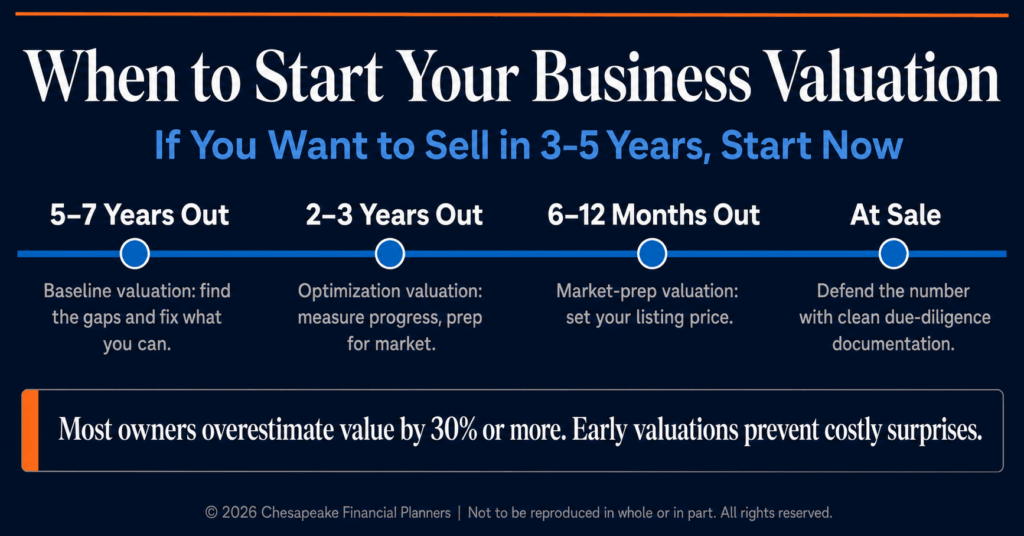
There are three valuation stages before a sale, each tied to how far out you are: the baseline valuation five to seven years before exit, the optimization valuation two to three years out, and the market-prep valuation six to twelve months before listing. Each answers a different question.
The baseline valuation (5-7 years out). This is your wake-up call. Its job is to establish where you stand and surface the gaps while you still have time to close them. You learn your realistic value range, the detractors dragging your multiple down, the highest-ROI improvements, and whether your retirement plan is viable on the actual number. Then you act: calculate after-tax proceeds, decide whether to build value or extend your working timeline, and build a five-year improvement plan with measurable milestones. A professional valuation here runs $5,000 to $15,000.
The return can be enormous. Consider an owner who learns the business is worth $1.8 million instead of the hoped-for $3 million. Over five years they reduce customer concentration, document systems, hire a COO, and lift EBITDA. The new valuation comes in at $2.7 million. A $5,000 valuation enabled a $900,000 value increase. That's the whole argument for starting early.
The optimization valuation (2-3 years out). Now you measure progress and fine-tune. You learn whether your improvement efforts are working, what weak spots remain, what current market conditions and buyers expect, and a realistic price for the upcoming sale. This is also when you start interviewing business brokers and M&A advisors, clean up lingering legal and financial issues, and optimize your compensation structure for exit. You're close enough that conditions are somewhat predictable, but far enough out to still move the needle.
The market-prep valuation (6-12 months out). This one sets your listing price and supports negotiations. You get a current fair market value, professional substantiation for your asking price, comparable sales data from your industry, and clean documentation for buyer due diligence. By this stage the work is done. The valuation is there to defend the number, not change it.
| Stage | Timing | Primary purpose | Typical cost |
|---|---|---|---|
| Baseline | 5-7 years out | Find the gaps, fix what you can | $5,000-$15,000 |
| Optimization | 2-3 years out | Measure progress, prep for market | $5,000-$10,000 |
| Market prep | 6-12 months out | Set price, support negotiation | $7,000-$15,000 |
This staged approach mirrors how Jeff structures exit work with clients. He'd rather an owner spend $5,000 to learn something uncomfortable with five years to respond than save it and find out with five weeks.
What Drives the Value of Your Business?
What drives the value of your business is recurring, transferable cash flow that doesn't depend on you personally. Buyers pay multiples for predictability and de-risk anything that looks fragile. The earlier you know your weak points, the longer you have to strengthen them.
The detractors that show up most often in early valuations are customer concentration, owner dependence, undocumented systems, and inconsistent financials. A business where one client represents 40% of revenue trades at a discount because that client walking away is a real risk to the buyer. A business that can't run without the owner in the building isn't a business a buyer wants, it's a job. Five years of lead time lets you diversify revenue, build a management layer, and document the operations that live only in your head.
This connects directly to your broader plan. The valuation feeds into retirement income, tax strategy on the sale proceeds, and how you'll reinvest the lump sum afterward. At Chesapeake Financial Planners, this is where the R.U.D.D.E.R. Method™ earns its keep: it's our six-step planning process of Review and Recognize, Uncover and Understand, Design and Develop, Discuss and Decide, Execute and Empower, and Reassess and Refine. An early valuation is the "Uncover and Understand" step made concrete.
If you want to go deeper, see How much is my business actually worth if I want to sell? and When Should I Start Planning My Business Exit Strategy?. For the planning side, How do business owners plan for retirement differently? covers why owner retirement looks nothing like a salaried employee's.
According to the U.S. Small Business Administration, small businesses make up 99.9% of all U.S. firms, and the vast majority will eventually need to transition ownership. Most owners reach that moment unprepared. You don't have to.
Frequently Asked Questions
When should I start valuing my business for a future sale?
Start your first formal valuation five to seven years before your planned exit. This timeline gives you room to identify and fix value detractors, build a realistic retirement plan around the actual number, and track measurable progress before you ever talk to a buyer. Waiting until you list removes every one of those options.
How much does a business valuation cost?
A professional business valuation typically costs $5,000 to $15,000, depending on business size, complexity, and the valuation's purpose. A baseline planning valuation sits at the lower end, while a defensible valuation for a sale or litigation runs higher. Compared to the six-figure value gaps these valuations routinely uncover, the cost is minor.
Can I just estimate my business value myself?
You can estimate it, but self-estimates are almost always wrong, usually too high. Most owners overvalue their business by 30% or more because they price the effort they put in rather than the cash flow a buyer would actually receive. A professional valuation corrects that gap while you still have time to respond to it.
What happens if I wait until I'm ready to sell?
If you wait until you're ready to sell, the valuation becomes a verdict instead of a roadmap. You lose the ability to fix customer concentration, owner dependence, or weak financials, all of which take years to address. Many owners discover their business is worth far less than their retirement plan assumed, with no runway left to adjust.
Does a business valuation help with retirement planning?
Yes, a business valuation is often the single most important input in a business owner's retirement plan. Your after-tax sale proceeds determine whether you can retire on schedule, need to keep working, or must build more value first. Without a real number, your retirement plan is built on a guess.
Ready to Put a Plan Around Your Exit?
The valuation isn't the goal. The goal is walking into your exit with the number you need and the years to get there. If you're three to seven years out from selling, now is exactly the right time to start. Jeff Judge and the Chesapeake team work with business owners across Harford County and the Baltimore metro on exactly this kind of planning. Schedule a free fit call at chesapeakefp.com to see where your business stands and what it would take to close the gap.
Want to go deeper? Our Business Sale Tax Planning Guide walks through this step by step.
Disclosures
The information provided is for educational purposes only and should not be construed as investment advice. Investment strategies should be tailored to individual circumstances, risk tolerance, and goals. Past performance doesn't guarantee future results. Consult with qualified financial professionals regarding your specific situation.
Advisors associated with Chesapeake Financial Planners may be either (1) LPL Financial Registered Representatives offering securities through LPL Financial, Member FINRA and SIPC, and investment advisor representatives offering investment advice through Great Valley Advisor Group; or (2) solely investment advisor representatives offering investment advice through Great Valley Advisor Group and not affiliated with LPL Financial. Great Valley Advisor Group, and Chesapeake Financial Planners are separate entities from LPL Financial.


