

How Do Estimated Tax Payments Work for Business Owners?
Last reviewed: July 2026
Estimated tax payments are quarterly payments business owners make directly to the IRS to cover income tax and self-employment tax that no employer withholds for them. If you expect to owe $1,000 or more in federal tax after credits and withholding, the IRS generally requires you to pay estimated taxes four times a year. Miss a payment or underpay, and you face penalties plus interest on top of the tax itself.
Key Takeaways
- Estimated tax payments cover both income tax and self-employment tax of 15.3% on your net business earnings.
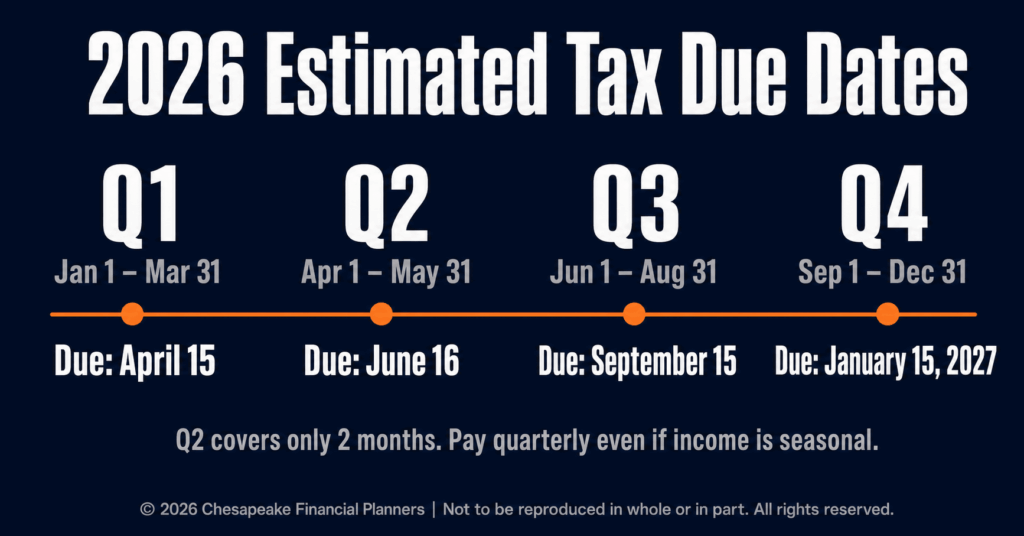
- The 2026 federal due dates are April 15, June 15, September 15, and January 15, 2027.
- You generally owe estimated taxes if you expect to owe $1,000 or more in federal tax for the year.
- The prior-year safe harbor lets you avoid penalties by paying 100% of last year's tax (110% if AGI exceeded $150,000).
About the Author: Jeff Judge, CFP®, AEP®, ChFC®, CLU® is Managing Partner of Chesapeake Financial Planners in Forest Hill, Maryland. He has been helping families and business owners in Harford County and the Baltimore metro area navigate small-business tax planning since earning his CFP® certification in 2013, by using Chesapeake Financial Planners’ signature process, the R.U.D.D.E.R. method™. The clients who struggle most with estimated taxes aren't the ones who don't understand the rules; they're the ones who spent the money before they set it aside.
Why Do Business Owners Have to Pay Estimated Taxes?
The U.S. tax system runs on a pay-as-you-go basis. The government wants its revenue throughout the year as you earn income, not in one lump at filing time. For employees, that happens automatically: the employer withholds income tax, Social Security, and Medicare from every paycheck.
When you own a business, nobody withholds anything for you. You're responsible for calculating what you owe and sending it in yourself. According to the IRS, you generally must make estimated payments if you expect to owe at least $1,000 in tax after subtracting withholding and refundable credits.
This applies whether you're a sole proprietor, independent contractor, freelancer, or own an LLC, S-corporation, or partnership. Jeff Judge has watched new business owners get blindsided by their first April after going solo. They were used to a refund. Now they owe five figures and have nothing set aside. The system itself isn't punitive, but it assumes you're paying attention every quarter.
What Do Estimated Tax Payments Actually Cover?
Estimated payments cover your full federal tax obligation, and that is more than just income tax. Two pieces drive the bill, and the second one surprises most first-year owners.
Income tax applies to your net business profit after expenses, calculated at your personal tax bracket if you're a sole proprietor, single-member LLC, or S-corp owner whose profit flows through to your 1040.
Self-employment tax covers Social Security and Medicare. As a self-employed person, you pay both the employer and employee halves: 15.3% total, made up of 12.4% for Social Security and 2.9% for Medicare. The Social Security portion applies to net earnings up to the 2026 wage base of $184,500, set by the Social Security Administration; the Medicare portion has no cap.
That 15.3% is why profitable self-employment can mean a bigger tax hit than a W-2 job at the same income. Many states also require quarterly estimated payments for state income tax, with their own thresholds and due dates.
When Are Estimated Tax Payments Due in 2026?
Federal estimated taxes are due four times a year, but the periods aren't even three-month blocks, and that catches people off guard. For the 2026 tax year, the IRS schedule is:
- Q1 (January 1 to March 31) is due April 15, 2026
- Q2 (April 1 to May 31) is due June 15, 2026
- Q3 (June 1 to August 31) is due September 15, 2026
- Q4 (September 1 to December 31) is due January 15, 2027
Notice Q2 covers only two months and Q3 closes just two weeks before its deadline. If a due date lands on a weekend or federal holiday, the payment moves to the next business day. Jeff tells clients to schedule payments a few days early. Missing a deadline by one day still triggers a penalty, and a small buffer protects you from a bank delay you didn't see coming.
How Do You Calculate Estimated Tax Payments?
Calculating estimated taxes means projecting your annual income and tax liability, then dividing across the four periods. For steady businesses this is simple. For seasonal or variable income, it takes more judgment. Two methods do the heavy lifting.
| Method | How it works | Best for |
|---|---|---|
| Prior-year safe harbor | Pay 100% of last year's total tax (110% if AGI exceeded $150,000) in equal installments | Growing businesses; avoids penalties even when this year's tax is higher |
| Current-year projection | Estimate this year's income, deductions, and tax, then divide by four and update quarterly | Stable or declining income; tighter accuracy |
The prior-year safe harbor is the cleaner path early in the year. Pay 100% of last year's liability (110% if your prior-year adjusted gross income topped $150,000) and you dodge underpayment penalties even if you end up owing far more at filing. Most owners Jeff works with use the safe harbor for the first half of the year, then switch to current-year projections once actual revenue is clear. The IRS Form 1040-ES includes a worksheet, and most accounting software can run the numbers from your year-to-date profit.
What Mistakes Trigger Underpayment Penalties?
The IRS assesses an underpayment penalty when you haven't paid enough during the year. A few patterns cause most of the damage.
Not paying enough in total. Pay less than 90% of this year's tax or less than the 100%/110% safe harbor, and a penalty follows.
Uneven payments across quarters. Each period is evaluated on its own. Skip Q1 and Q2, then catch up in Q3 and Q4, and you can still owe penalties for the early shortfall, even if your year-end total is correct. This hits seasonal businesses hardest.
Forgetting self-employment tax. Calculating only on income tax and ignoring the 15.3% self-employment tax produces a chronic underpayment. This is the single most common error Jeff sees with first-year owners.
Sloppy recordkeeping. Mixing business and personal spending makes accurate profit impossible to pin down, and without accurate profit you can't compute an accurate payment.
How Do You Manage Cash Flow Around Estimated Taxes?
For most owners the hard part isn't the math; it's having the cash ready on the due date. A simple system fixes that.
Set aside a fixed percentage of every dollar that comes in. Open a separate savings account just for taxes and move 25% to 30% of each payment into it the day you get paid. When the quarter closes, the money is already waiting. No scramble to find $15,000 in two weeks.
Stay conservative in year one. You won't know your effective rate yet, so set aside 30% and adjust after your first return. An extra few points saved beats a penalty. Some owners prefer transferring with every deposit rather than calculating quarterly, which smooths the feast-or-famine cycle. And track deductions all year: retirement plan contributions, health insurance premiums, equipment, and the home office deduction all lower taxable profit, which lowers what you owe.
How Do You Actually Send the Payment?
The IRS offers several methods that differ in cost and lead time.
IRS Direct Pay is free and pulls from your bank account in one to two business days. You provide basic identifying information and your SSN or EIN.
EFTPS (the Electronic Federal Tax Payment System) requires enrollment in advance but lets you schedule payments weeks or months ahead. Many owners schedule all four payments in January and adjust amounts as the year unfolds.
Card payments go through IRS-approved processors but carry convenience fees of roughly 1.75% to 1.99% of the payment. On a $10,000 payment, that's nearly $200 in fees, which makes cards an expensive habit for recurring quarterly payments.
If you want a structured way to fold estimated taxes into a broader plan, this is exactly the kind of decision the R.U.D.D.E.R. Method™™, Chesapeake Financial Planners' six-step planning process (Review and Recognize, Uncover and Understand, Design and Develop, Discuss and Decide, Execute and Empower, and Reassess and Refine), is built to organize. For broader context, see our guides on How do business owners save for retirement without a 401(k)? and How Should Business Owners Pay Themselves Salary vs Distributions?. Jeff Judge notes: "Paying quarterly estimates by credit card might feel convenient, but at nearly 2% per payment you're essentially paying a fee to pay your taxes, and for a business owner making four payments a year that adds up to a meaningful and unnecessary expense."
Frequently Asked Questions
Do I have to pay estimated taxes in my first year of business?
Yes, if you expect to owe $1,000 or more in federal tax for the year. The IRS does not waive the requirement for new businesses. If you have no prior-year return to lean on for the safe harbor, project your current-year income conservatively and set aside roughly 30% of profit until you know your real tax rate.
What happens if I miss a quarterly estimated tax payment?
You face an underpayment penalty calculated as interest on the unpaid amount for the period it was late, plus the tax itself when you file. The penalty isn't a flat fine; it accrues daily based on the federal short-term rate. Paying late is better than not paying, since the penalty stops growing once you catch up.
Can I just pay all my estimated taxes once a year instead of quarterly?
No. The IRS evaluates each quarter independently, so paying the full amount in Q4 still leaves you exposed to penalties for underpaying Q1 through Q3. The pay-as-you-go system requires roughly even payments across all four periods unless your income genuinely arrives unevenly and you file the annualized income method.
How much should a business owner set aside for estimated taxes?
A common starting point is 25% to 30% of net business profit, which covers both income tax and the 15.3% self-employment tax for many owners. Your exact rate depends on your bracket, state, and deductions. After filing your first return, recalculate your effective rate and adjust the percentage for future income.
Does the safe harbor rule protect me from all penalties?
The prior-year safe harbor protects you from underpayment penalties if you pay 100% of last year's total tax, or 110% if your prior-year AGI exceeded $150,000, in equal installments. It does not eliminate the balance due at filing; you still owe any additional tax. It simply prevents the penalty even when this year's income jumps.
Do estimated tax payments include state taxes?
Federal estimated payments cover only federal income and self-employment tax. Most states with an income tax also require separate quarterly estimated payments, often following similar rules but with their own thresholds, forms, and due dates. Check your state's requirements separately, since missing state payments triggers state-level penalties independent of federal ones.
If estimated taxes feel like guesswork, you're not alone, and a clear system fixes most of the stress. Our free guide for business owners walks through quarter-by-quarter planning, deduction tracking, and cash-flow setup so the next deadline is a non-event. Download it at chesapeakefp.com.
Want to go deeper? Our Tax Strategy Readiness Quiz walks through this step by step.
Disclosures
The information provided is for educational purposes only and should not be construed as investment advice. Investment strategies should be tailored to individual circumstances, risk tolerance, and goals. Past performance doesn't guarantee future results. Consult with qualified financial professionals regarding your specific situation.
This information is not intended to be a substitute for specific individualized tax, investment or legal advice. We suggest that you discuss your specific situation with a qualified tax, legal or financial advisor.
Advisors associated with Chesapeake Financial Planners may be either (1) LPL Financial Registered Representatives offering securities through LPL Financial, Member FINRA and SIPC, and investment advisor representatives offering investment advice through Great Valley Advisor Group; or (2) solely investment advisor representatives offering investment advice through Great Valley Advisor Group and not affiliated with LPL Financial. Great Valley Advisor Group, and Chesapeake Financial Planners are separate entities from LPL Financial.


