

What Is the Difference Between Marginal and Effective Tax Rates?
Last reviewed: July 2026
Your marginal tax rate is the rate you pay on your next dollar of income. Your effective tax rate is the total tax you actually pay divided by your total income. They are almost never the same number, and for most retirees the effective tax rate is far lower than the bracket they think they are "in." Getting this distinction right changes how you make withdrawal, conversion, and income decisions.
Key Takeaways
- Your marginal rate applies only to your top dollars; your effective rate is your average across all income.
- A married couple with $103,000 taxable income in 2026 sits in the 22% bracket but pays roughly 11.7% effectively.
- The 2026 standard deduction is $32,200 for married couples filing jointly, shielding the first dollars from tax entirely.
- Filling a low bracket with Roth conversions often costs far less than retirees fear.
- Social Security taxation can create a hidden marginal rate higher than your stated bracket.
About the Author: Jeff Judge, CFP®, AEP®, ChFC®, CLU® is Managing Partner of Chesapeake Financial Planners in Forest Hill, Maryland. He has been helping families and business owners in Harford County and the Baltimore metro area navigate retirement tax planning since earning his CFP® certification in 2013, by using Chesapeake Financial Planners’ signature process, the R.U.D.D.E.R. method™. Jeff has watched clients turn down smart Roth conversions because they confused their bracket with their actual tax rate, and that single misunderstanding has cost some of them five figures over a retirement.
What Is the Difference Between Marginal and Effective Tax Rates?
Your marginal tax rate is the percentage of tax you pay on your last dollar of income. It is the rate that sits at the top of your stack of income. Your effective tax rate is the total federal tax you owe divided by your total income, which gives you the average rate across everything you earned.
They differ because the United States uses a progressive tax system. You do not pay your top bracket rate on all of your income. Instead, different portions of your income fill up different brackets, and each portion is taxed at its own rate as it stacks.
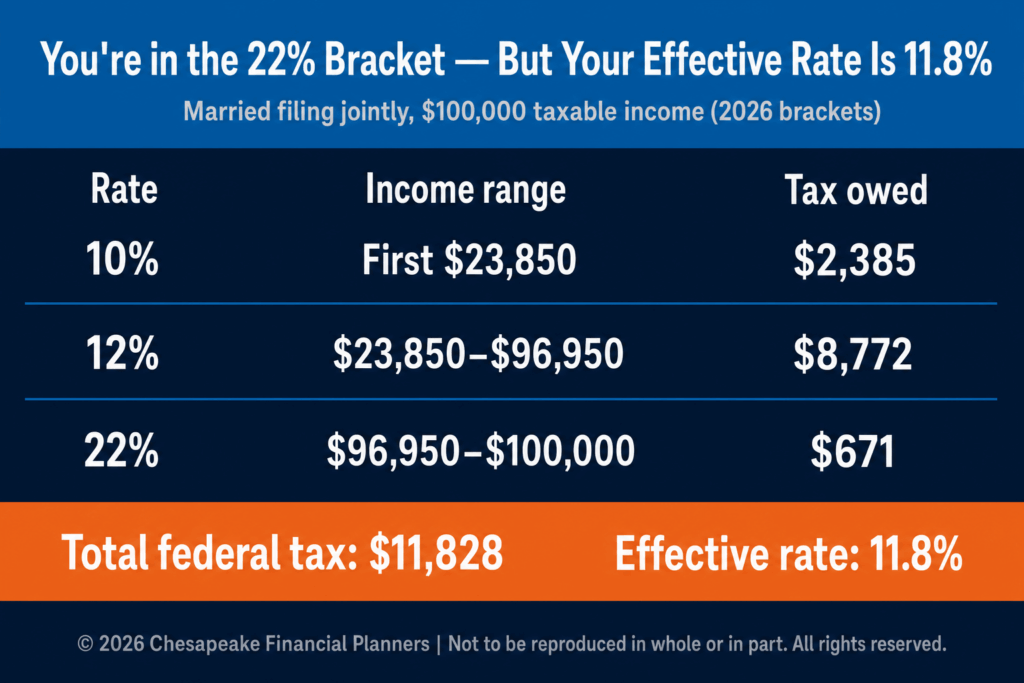
Consider a married couple with $103,000 of taxable income in 2026. They are in the 22% marginal bracket, which begins at $100,800 for married filing jointly according to the IRS 2026 inflation adjustments. Here is what they actually pay:
- 10% on the first $24,800 = $2,480
- 12% on income from $24,800 to $100,800 = $9,120
- 22% on income from $100,800 to $103,000 = $484
Total federal tax: $12,084. Divide that by $103,000 and you get an effective rate of 11.7%. They are "in" the 22% bracket, but they pay barely more than half that rate on average. That gap is the whole point.
Why Does This Matter for Retirement Withdrawals?
Understanding the distinction changes how you think about pulling money out of a traditional IRA or 401(k). Many retirees obsess about staying under a bracket line, refusing to take one extra dollar that would tip them into the next bracket. That instinct misreads how the system works.
Say you are at the top of the 12% bracket and a withdrawal would push $10,000 into the 22% bracket. You do not pay 22% on the entire withdrawal. You pay 12% on the dollars below the threshold and 22% only on the dollars above it. The blended cost of that withdrawal is far lower than the scary 22% headline number.
Jeff Judge often tells clients that the bracket line is a speed bump, not a wall. Sometimes the smart move is to deliberately fill up your current bracket with strategic withdrawals or conversions, even when it nudges you partway into the next bracket. The decision should be driven by your effective rate over time, not a fear of crossing a line.
How Does the Effective Rate Change a Roth Conversion?
A Roth conversion is one of the clearest places where marginal versus effective thinking pays off. When you convert traditional IRA money to a Roth, you pay tax at your marginal rate on the converted amount today. You then have to weigh that against the taxes you would owe on future required minimum distributions.
Suppose your current effective rate is 12%, but you can project that RMDs will eventually drag your effective rate up to 18% or 20% once they begin. Paying a marginal rate now, even 22% on the last dollars converted, can produce a lower lifetime tax bill than letting those balances grow and forcing larger taxable distributions later.
This is exactly the kind of trade-off the R.U.D.D.E.R. Method™, Chesapeake Financial Planners' six-step planning process of Review and Recognize, Uncover and Understand, Design and Develop, Discuss and Decide, Execute and Empower, and Reassess and Refine, is built to surface. The real question is not "what bracket am I in now" but "what effective rate will I pay across my whole retirement if I do nothing, versus if I convert strategically now."
How Do I Create Multiple Income Streams for Retirement?
How Does the Standard Deduction Lower Your Effective Rate?
The standard deduction is one of the most powerful and overlooked tools for reducing your effective tax rate, especially in retirement. For 2026, the standard deduction is $32,200 for married couples filing jointly and $16,100 for single filers. That first slice of income is completely free of federal tax.
Picture a married couple with $80,000 of gross income. After subtracting the standard deduction, only $47,800 is taxable. Here is the math:
- 10% on the first $24,800 = $2,480
- 12% on the remaining $23,000 = $2,760
- Total federal tax: $5,240
Divide $5,240 by their full $80,000 of gross income and their effective federal rate is 6.6%. Their marginal rate is 12%, but they pay less than 7% overall. This is why retirees with moderate incomes routinely pay far less than they fear when they look at a bracket chart in isolation.
How Can Maryland Retirees Reduce Their State Tax Burden?
How Does Social Security Affect Your Effective Tax Rate?
Social Security benefits add a layer that can quietly raise your real marginal rate above your stated bracket. According to the Social Security Administration, up to 85% of your benefits can become taxable depending on your combined income. The taxation of those benefits is itself progressive, which is where things get tricky.
In certain income ranges, taking one additional dollar of income does two things at once. It gets taxed at your stated marginal rate, and it also drags more of your Social Security into the taxable column. An extra $1,000 of income might trigger:
- Tax on the $1,000 at your 12% marginal rate = $120
- Tax on an additional $850 of Social Security that becomes taxable, another roughly $102
- A combined effective marginal rate of about 22.2% on that $1,000
This "tax torpedo" is invisible on a standard bracket chart. It is also exactly why your true effective rate, with these hidden interactions included, matters more than the label on your bracket. Coordinating withdrawals around this zone can save real money.
How does my Social Security claiming decision affect my Medicare premiums?
How Does Social Security Work for Retirement Benefits?
Frequently Asked Questions
What is my effective tax rate?
Your effective tax rate is the total federal income tax you owe divided by your total income, expressed as a percentage. It represents the average rate you pay across all of your income, not the rate on your highest dollars. For most retirees, the effective rate runs well below their marginal tax bracket because lower brackets and the standard deduction shield much of their income.
Is my marginal tax rate the same as my tax bracket?
Yes, your marginal tax rate is the same as the tax bracket you fall into, because it is the rate applied to your next or last dollar of income. The common mistake is assuming that bracket rate applies to all of your income. It only applies to the portion of income that lands inside that specific bracket, while lower portions are taxed at lower rates.
Why is my effective tax rate lower than my tax bracket?
Your effective tax rate is lower than your bracket because of the progressive system and the standard deduction. Your income fills lower brackets first, taxed at 10% and 12%, before any of it reaches your top bracket. The standard deduction also removes the first $32,200 of income for married couples in 2026 from tax entirely, pulling your average rate down further.
Should I avoid moving into a higher tax bracket?
No, avoiding a higher bracket is not automatically the right goal, because you only pay the higher rate on the dollars above the threshold, not on your whole income. Sometimes intentionally filling a bracket with Roth conversions or withdrawals lowers your lifetime taxes. The smarter focus is your projected effective rate across retirement rather than a single bracket line.
How do I calculate my effective tax rate?
Calculate your effective tax rate by dividing your total federal income tax by your total income, then multiplying by 100. For example, $12,084 of tax on $103,000 of taxable income produces an effective rate of 11.7%. You can find your total tax on your Form 1040 and divide it by your taxable or gross income depending on which measure you want.
Where This Leaves You
The bracket you are "in" tells you almost nothing about what you actually pay. The effective tax rate is the number that should drive your withdrawal sequencing, your conversion timing, and your Social Security claiming decisions. If you want a clear picture of your own effective rate and a plan to lower it over retirement, our guide to building a tax-smart retirement income plan walks through the moves step by step. Download it at chesapeakefp.com.
Want to go deeper? Our Tax Strategies in Retirement Checklist walks through this step by step.
Disclosures
The information provided is for educational purposes only and should not be construed as investment advice. Investment strategies should be tailored to individual circumstances, risk tolerance, and goals. Past performance doesn't guarantee future results. Consult with qualified financial professionals regarding your specific situation.
This information is not intended to be a substitute for specific individualized tax, investment or legal advice. We suggest that you discuss your specific situation with a qualified tax, legal or financial advisor.
Advisors associated with Chesapeake Financial Planners may be either (1) LPL Financial Registered Representatives offering securities through LPL Financial, Member FINRA and SIPC, and investment advisor representatives offering investment advice through Great Valley Advisor Group; or (2) solely investment advisor representatives offering investment advice through Great Valley Advisor Group and not affiliated with LPL Financial. Great Valley Advisor Group, and Chesapeake Financial Planners are separate entities from LPL Financial.


