
What's the Most Tax-Efficient Way to Exit My Business?
Last reviewed: July 2026
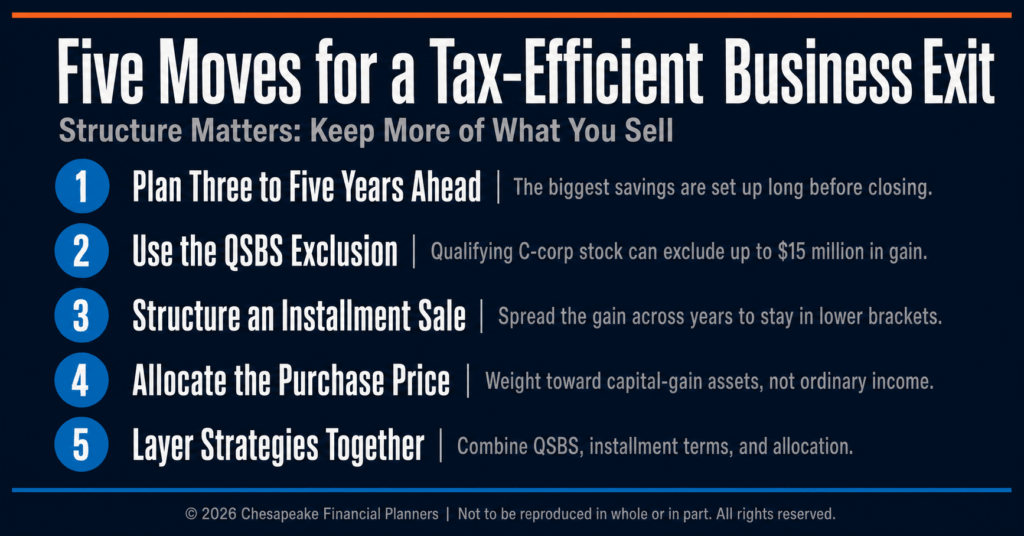
The most tax-efficient way to exit your business is to plan the structure of the sale at least three to five years before you sign anything. The biggest levers are Qualified Small Business Stock (QSBS) treatment, installment sales that spread gains across multiple tax years, and the way you allocate the purchase price between asset classes. A tax-efficient business exit is rarely about one clever move at closing. It comes from decisions you make years earlier.
Key Takeaways
- The gap between your sale price and what you keep can run 30% to 50% without planning, driven by federal and state taxes.
- The QSBS exclusion now shields up to $15 million in gains for qualifying C corporation stock acquired after July 4, 2025.
- Installment sales spread the gain across years, often keeping you in lower brackets and deferring tax.
- Most tax-saving exit strategies require setup years before the sale, not at closing.
About the Author: Jeff Judge, CFP®, AEP®, ChFC®, CLU® is Managing Partner of Chesapeake Financial Planners in Forest Hill, Maryland. He has been helping families and business owners in Harford County and the Baltimore metro area navigate business exits and capital gains planning since earning his CFP® certification in 2013, by using Chesapeake Financial Planners’ signature process, the R.U.D.D.E.R. method™. Jeff's blunt take: the owners who keep the most money are the ones who called him three years before the sale, not three weeks before.
What Taxes Hit You When You Sell a Business?
Here is the math that catches most sellers off guard. Sell your business for $3 million and realize a $2.5 million gain, and the tax picture looks like this.
| Tax | Amount on a $2.5M gain |
|---|---|
| Federal long-term capital gains (20% top rate) | ~$500,000 |
| Net Investment Income Tax (3.8%) | ~$95,000 |
| State tax (varies widely) | $0 to $250,000 |
| Approximate total | $595,000 to $845,000 |
The top federal long-term capital gains rate is 20%, and high earners add the 3.8% Net Investment Income Tax on top. Depending on your state, you keep somewhere between $1.65 million and $1.9 million of that $2.5 million gain.
That gap is the whole game. Selling a business with tax planning in place versus selling it cold can swing your net proceeds by hundreds of thousands of dollars. The frustrating part for most owners is the timing: the strategies that move the needle most have to be in place years before a buyer ever shows up.
How Does the QSBS Exclusion Work?
Qualified Small Business Stock is the single most powerful tool in the business sale taxes toolkit, and most owners have never heard of it. If your company is structured as a C corporation and meets the rules, you can exclude a large share of your gain from federal capital gains tax entirely.
Under the rules updated by the 2025 tax law, the QSBS exclusion now reaches up to $15 million (or 10 times your basis, whichever is greater) for stock acquired after July 4, 2025. Stock acquired before that date keeps the prior $10 million ceiling. The core requirements stay demanding.
- The company must be a C corporation at issuance.
- You must hold the stock for at least five years.
- The company's aggregate gross assets must stay under the statutory threshold when the stock is issued.
- It must be an active business, not a holding company for passive investments.
Here is what that can mean. Sell qualifying stock with an $11.5 million gain, exclude the first $15 million, and your taxable gain on that sale drops toward zero at the federal level. That is not a rounding error. That is the difference between a comfortable retirement and a transformational one.
The catch is the five-year clock. QSBS is a long-term planning decision, not a closing-table move. Jeff has watched owners learn about QSBS eight months before a sale and realize they missed a seven-figure opportunity by converting to a C corp too late. If you might sell in the next decade, this conversation belongs on your calendar now.
What Is an Installment Sale and When Does It Help?
An installment sale is when you receive the purchase price over several years rather than in one lump sum, and you pay tax only as you collect each payment. This installment sale strategy spreads the gain across multiple tax years, which can keep you out of the highest brackets and defer a meaningful chunk of your tax bill.
The installment method lets you report gain proportionally as payments come in. Instead of recognizing a $2 million gain all in one year, you might recognize $400,000 a year over five years. Spreading the income can pull more of your gain into lower brackets and keeps deferred tax dollars working for you in the meantime.
The tradeoff is real: you are effectively financing the buyer. If they default, you have a problem. Protect yourself with strong buyer vetting, a security interest in the business assets, personal guarantees, and escrow on future payments. Installment sales work best when you do not need all the cash immediately and the buyer is financially solid.
For owners juggling the sale alongside a bigger income picture, pairing this with broader How Can I Reduce Capital Gains Taxes on My Investments? and How Can I Reduce Taxes When Earning $200K to $500K? often matters more than the sale structure alone.
How Do You Allocate the Purchase Price in a Business Sale?
In an asset sale, how you and the buyer allocate the price across asset categories directly changes your tax bill. Goodwill and going-concern value are taxed at favorable long-term capital gains rates. Depreciated equipment can trigger ordinary-income recapture. Inventory is ordinary income. The allocation you negotiate is, in effect, a tax negotiation.
Buyers usually want allocations weighted toward assets they can depreciate quickly. Sellers usually want allocations weighted toward capital-gain treatment. This is a genuine point of negotiation with real dollars attached, and it is one place where having advisors at the table before the letter of intent is signed pays for itself. Coordinating the exit with your overall What is a year-round tax planning calendar for retirees and pre-retirees? keeps the timing of the sale aligned with the rest of your year.
This is exactly the kind of decision the R.U.D.D.E.R. Method™ is built for. The R.U.D.D.E.R. Method™ is Chesapeake Financial Planners' six-step planning process: Review and Recognize, Uncover and Understand, Design and Develop, Discuss and Decide, Execute and Empower, and Reassess and Refine. A business exit touches every step, because the sale is not just a transaction; it funds the rest of your life.
Frequently Asked Questions
How far in advance should I plan a tax-efficient business exit?
Plan your tax-efficient business exit at least three to five years before you intend to sell. The most powerful strategies, especially the QSBS exclusion, require a five-year holding period and entity decisions made years ahead. Last-minute planning at the closing table leaves most of the savings on the table.
Do I have to be a C corporation to use the QSBS exclusion?
Yes, the QSBS exclusion only applies to stock in a domestic C corporation that met the active-business and gross-asset requirements when the stock was issued. S corporations, LLCs, and partnerships do not qualify. Converting to a C corporation starts a fresh five-year holding clock, which is why the decision has to happen early.
Is an installment sale safe if the buyer defaults?
An installment sale carries real default risk because you are financing the buyer over time. Protect yourself with a security interest in the business assets, personal guarantees, escrow accounts for future payments, and thorough creditworthiness vetting before closing. The strategy works best when the buyer is financially strong and you do not need all the cash immediately.
How much tax will I pay when I sell my business?
Most business sales trigger federal long-term capital gains tax of up to 20%, plus the 3.8% Net Investment Income Tax for high earners, plus state tax that varies widely. On a $2.5 million gain, that often totals between $595,000 and $845,000. Strategic planning can reduce this meaningfully through QSBS, installment treatment, and price allocation.
Can I combine multiple exit tax strategies?
Yes, and the strongest exits usually layer several strategies together. You might use the QSBS exclusion for stock that qualifies, an installment sale for the remaining proceeds, and careful purchase-price allocation to favor capital-gain treatment. Coordinating them requires planning well before you sign, because each strategy has its own timing and eligibility rules.
If you want a clear-eyed look at what your exit could keep versus cost, our free guide to selling a business tax planning walks through each strategy with real numbers. Download it at chesapeakefp.com and start mapping your tax-efficient business exit before a buyer is ever at the table.
Want to go deeper? Our Business Sale Tax Planning Guide walks through this step by step.
Disclosures
The information provided is for educational purposes only and should not be construed as investment advice. Investment strategies should be tailored to individual circumstances, risk tolerance, and goals. Past performance doesn't guarantee future results. Consult with qualified financial professionals regarding your specific situation.
This information is not intended to be a substitute for specific individualized tax, investment or legal advice. We suggest that you discuss your specific situation with a qualified tax, legal or financial advisor.
Advisors associated with Chesapeake Financial Planners may be either (1) LPL Financial Registered Representatives offering securities through LPL Financial, Member FINRA and SIPC, and investment advisor representatives offering investment advice through Great Valley Advisor Group; or (2) solely investment advisor representatives offering investment advice through Great Valley Advisor Group and not affiliated with LPL Financial. Great Valley Advisor Group, and Chesapeake Financial Planners are separate entities from LPL Financial.


