

What is IRMAA, and how does income raise my Medicare premium?
Last reviewed: July 2026
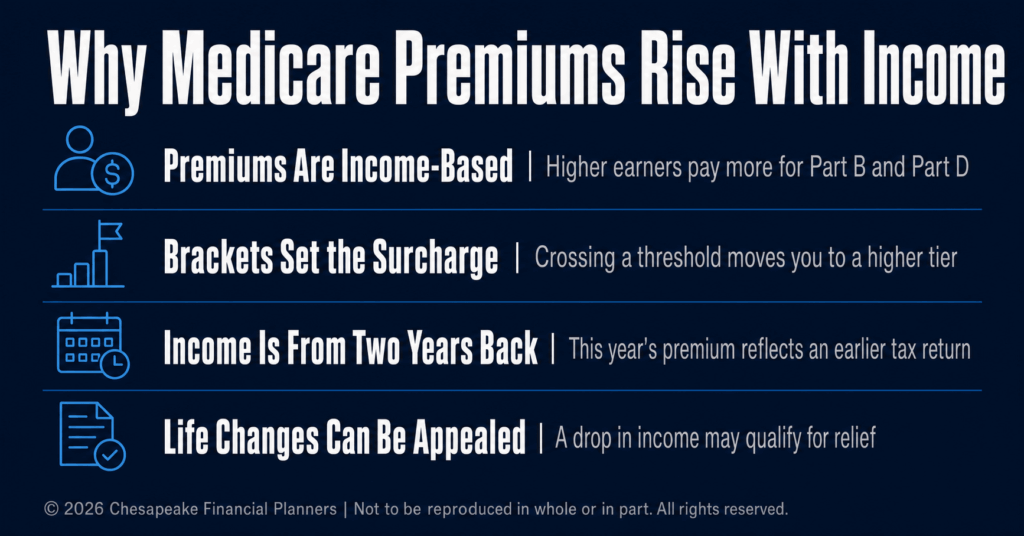
IRMAA stands for Income-Related Monthly Adjustment Amount, the extra money higher-income Medicare beneficiaries pay on top of standard Part B and Part D premiums. In 2026 the standard Part B premium is $202.90 per month, and the IRMAA Medicare surcharge can lift your combined monthly cost to nearly $700 per person, depending on the income you reported two tax years ago. Roughly 8 percent of Medicare Part B enrollees pay an income-related surcharge each year.
On This Page
- Key Takeaways
- What Is IRMAA, and Who Pays It in 2026?
- How Much Does the IRMAA Medicare Surcharge Cost?
- Why Does IRMAA Look at Income From Two Years Ago?
- How Do You Appeal IRMAA With Form SSA-44?
- Which Retirement Strategies Reduce IRMAA Exposure?
- Related Topics Worth Reading
- Frequently Asked Questions
- Plan Around IRMAA Before the Income Lands
- Disclosures
Key Takeaways
- The 2026 standard Medicare Part B premium is $202.90, an increase of $17.90 over 2025.
- IRMAA begins when individual MAGI tops $109,000 or joint MAGI tops $218,000 in the SSA lookback year.
- The Social Security Administration uses your tax return from two years prior to set this year's IRMAA.
- At Tier 5 in 2026, combined Part B and Part D IRMAA can add up to $578 per person each month.
- File Form SSA-44 within 60 days of an IRMAA notice when a life-changing event has reduced your income.
About the Author: Jeff Judge, CFP®, AEP®, ChFC®, CLU® is Managing Partner of Chesapeake Financial Planners in Forest Hill, Maryland. He has been helping families and business owners in Harford County and the Baltimore metro area work through Medicare and IRMAA planning since earning his CFP® certification in 2013, by using Chesapeake Financial Planners’ signature process, the R.U.D.D.E.R. method™. Jeff often points out that IRMAA is the most expensive surprise in retirement because the income that triggers it happened two years before the bill arrives.
What Is IRMAA, and Who Pays It in 2026?
IRMAA is the Income-Related Monthly Adjustment Amount that Medicare beneficiaries pay on top of standard Part B and Part D premiums when income crosses defined thresholds. The Social Security Administration determines whether you owe an IRMAA each year and adds the surcharge to your monthly cost. The Centers for Medicare & Medicaid Services estimates that about 8 percent of Medicare Part B enrollees pay an income-related surcharge.
The income figure that triggers IRMAA is your modified adjusted gross income, known as MAGI. MAGI is your adjusted gross income from your tax return plus tax-exempt interest, foreign earned income, and a few smaller add-backs. For most retirees, MAGI looks very similar to AGI on the front page of the 1040.
For 2026, the income brackets for Part B and Part D IRMAA are identical, according to Humana. A single filer with MAGI under or equal to $109,000, or a joint filer with MAGI under or equal to $218,000, pays no IRMAA. Anyone above those thresholds pays both surcharges.
IRMAA applies per person. A married couple where both spouses are on Medicare and both fall into Tier 2 each pays the Tier 2 surcharge. The household impact doubles, which is why coordinated planning matters more than thinking about IRMAA spouse by spouse.
Who actually gets hit by IRMAA?
People who pay IRMAA usually fall into a few groups. Still-working Medicare enrollees with high salaries. Retirees with large traditional IRA distributions or required minimum distributions. Business owners selling appreciated stock or a company in the lookback year. Beneficiaries with one-time income spikes from real estate sales, large stock option exercises, or Roth conversions. The medicare income surcharge does not care whether the income was recurring or a one-time event.
How Much Does the IRMAA Medicare Surcharge Cost?
The IRMAA Medicare surcharge ranges from $14.50 to $578 per person per month in 2026 when you combine Part B and Part D. The exact amount depends on the MAGI from your lookback tax return and which IRMAA tier you land in. Each tier carries a Part B IRMAA, a separate Part D IRMAA, and together they push your total Medicare cost well above the standard premium.
The full 2026 IRMAA bracket table from the CMS fact sheet is below. These are the irmaa brackets 2026 that govern this year's premiums.
| Tier | Individual MAGI | Joint MAGI | Total Part B | Part D IRMAA Add-On |
|---|---|---|---|---|
| 0 | Up to $109,000 | Up to $218,000 | $202.90 | $0.00 |
| 1 | $109,001 to $137,000 | $218,001 to $274,000 | $284.10 | $14.50 |
| 2 | $137,001 to $171,000 | $274,001 to $342,000 | $405.80 | $37.50 |
| 3 | $171,001 to $205,000 | $342,001 to $410,000 | $527.50 | $60.40 |
| 4 | $205,001 to $499,999 | $410,001 to $749,999 | $649.20 | $83.30 |
| 5 | $500,000 or more | $750,000 or more | $689.90 | $91.00 |
A few things to notice. First, the tier jumps are not gradual. Moving from Tier 0 to Tier 1 raises your Part B alone by $81.20 per month, or $974.40 per year per person. Second, Part D IRMAA is paid directly to Medicare, not to your Part D plan or your employer. Third, married filing separately uses a tighter table with sharper jumps because the brackets compress at lower income levels.
The 2026 increase compares unfavorably to inflation. The standard Part B premium jumped $17.90 over 2025, and the IRMAA tiers each climbed in tandem. The Tier 5 IRMAA alone now exceeds many retirees' monthly grocery budgets.
Why Does IRMAA Look at Income From Two Years Ago?
The Social Security Administration uses the most recent tax return on file when it sets your IRMAA each year, and for 2026 that means your 2024 tax return. Per Humana's IRMAA guidance, the SSA reaches back two years because the IRS does not certify the current year's tax data in time for premium calculations. This two-year lag is the most counterintuitive part of the rule and the part that catches the most clients off guard.
Here is what the lag means in practice. If you sold a business in 2024 and now live on a low fixed retirement income, your 2026 Medicare premium is still based on the 2024 sale. The opposite is also true. If you retired in 2025 with a much lower income, that drop will not show up in your IRMAA until 2027. The premium you see in 2026 reflects life two tax years ago.
The two-year lookback is also why IRMAA planning is forward-looking, not reactive. By the time you receive an IRMAA notice in the fall, the income event that triggered it has already happened and cannot be undone. Anything you change now affects the 2028 surcharge, not the 2026 one. That fact alone makes IRMAA different from almost every other tax surprise a retiree faces.
How does SSA notify you about IRMAA?
The Social Security Administration sends a Medicare premium notice each fall telling you what you will pay starting in January. The notice references your reported MAGI and identifies the tier. If you believe the figure is wrong, or if your income has dropped since the lookback year because of a life-changing event, you have a defined window to challenge it. That window leads directly into the SSA-44 appeal process.
How Do You Appeal IRMAA With Form SSA-44?
You appeal IRMAA by filing Form SSA-44, the Social Security Administration's "Medicare Income-Related Monthly Adjustment Amount Life-Changing Event" form. The ssa-44 appeal is intended for people whose current income is materially lower than the lookback-year income because of a qualifying event. Humana lists incorrect or outdated tax information, loss of income, death of a spouse, marriage, and divorce as common appeal reasons.
You have 60 days from receiving an IRMAA notice to file the appeal. That window is firm. Miss it and you generally must wait until the next year for SSA to recalculate based on a fresh tax return.
To file successfully, you need three things. First, documentation of the life-changing event, such as a death certificate, marriage certificate, divorce decree, employer separation letter, or pension change confirmation. Second, proof of your new income level: a recent pay stub, pension statement, or estimated tax return. Third, a clearly completed SSA-44 with a brief written explanation if the form's checkboxes do not capture your situation. The SSA reviews the appeal and adjusts the IRMAA retroactively if approved.
Common appeal scenarios Jeff sees with clients in Harford County include retirement during the lookback year, the death of a higher-earning spouse, a divorce, the sale of a business followed by lower steady income, and a pension loss after a plant closure or employer bankruptcy. A one-time income event from two years ago that has not recurred is not by itself a qualifying life-changing event under SSA's rules. The income has to have changed structurally, not just dipped for a single tax year.
"The IRMAA appeal succeeds when the documentation tells a clear story about why the income changed structurally, not just that it dropped one year," Jeff Judge tells clients in our planning meetings. "SSA is checking whether the event you cite actually happened and actually reduced your income going forward, not whether you wish your premium were lower."
What if your appeal is denied?
If SSA denies your SSA-44, you can request reconsideration in writing within 60 days. Beyond that, you can escalate to an administrative law judge. The earlier you file with strong documentation, the better your odds. Jeff Judge has seen appeals approved for clients who included a letter explaining the timing of a Roth conversion that the SSA initially misread as ongoing wages, and denied for clients who tried to appeal a one-time business sale without a corresponding qualifying event.
Which Retirement Strategies Reduce IRMAA Exposure?
The most effective way to manage IRMAA is to control MAGI during the two years before you turn 63, since 2024 income drives 2026 IRMAA and 2025 income drives 2027 IRMAA. The medicare income surcharge punishes large one-year income spikes more than steady moderate income, so the timing and sizing of distributions matter as much as the total dollar amount.
Several strategies show up regularly in client planning. None of them are tax advice, and the right mix depends on your full situation. Talk with your tax advisor before acting on any of them.
Roth conversions before age 63. A Roth conversion you complete the year you turn 62 is the last one that will not affect Medicare premiums. After that, any conversion adds to MAGI in the lookback year and can lift you into a higher IRMAA tier. Most pre-retirees we work with prefer to front-load conversions in the years between retirement and Medicare eligibility, when income is low and the bracket headroom is wide. Should High Net Worth Individuals Consider Roth Conversions? Jeff Judge notes: "The Roth conversion you do at 62 is the last one that won't show up as a lookback year for Medicare premiums, so the window between your retirement date and age 63 is often the most valuable planning real estate we have."
Tax-bracket-aware withdrawal sequencing. Pulling from Roth or basis-only sources in years when other income is high can keep MAGI under the next IRMAA threshold. The savings are concrete. A retiree at $215,000 of MAGI who manages down to $204,000 saves roughly $1,460 a year in Part B IRMAA per person and another $279 per person in Part D IRMAA. What is the right retirement withdrawal order for your accounts?
Qualified charitable distributions. A QCD from a traditional IRA after age 70½ counts toward your RMD but does not raise MAGI. For retirees who already give to charity, redirecting some giving through a QCD can keep them below an IRMAA threshold without changing their charitable footprint. How Can I Donate From My IRA Tax-Free?
Spreading large taxable events. Selling a business, exercising a large block of NSOs, or rebalancing a heavily appreciated brokerage account in one tax year can push MAGI into Tier 4 or Tier 5 for two years of premiums. Spreading the event across tax years, when feasible, smooths the IRMAA impact. What are the rules and strategies for required minimum distributions?
This is where the R.U.D.D.E.R. Method™ shows up in our planning work. The R.U.D.D.E.R. Method™ is Chesapeake Financial Planners' six-step planning process: Review and Recognize, Uncover and Understand, Design and Develop, Discuss and Decide, Execute and Empower, and Reassess and Refine. The Reassess and Refine step is where we revisit IRMAA exposure each year as actual income lands and the next lookback window opens.
Related Topics Worth Reading
If you found the IRMAA brackets useful, several adjacent topics in our retirement planning library will help you build the full picture.
Social Security and Medicare IRMAA Coordination. The age you claim Social Security feeds directly into MAGI, and a delayed claim can leave room for larger Roth conversions before IRMAA applies. How does my Social Security claiming decision affect my Medicare premiums?
Medicare Parts A, B, C, and D. Beyond IRMAA, the choice between Original Medicare with Medigap and Medicare Advantage interacts with how Part D IRMAA is calculated and billed. What Are the Different Parts of Medicare and What Do They Cover?
Social Security and Medicare Planning. Our broader pre-retiree guide ties IRMAA into the full claiming, enrollment, and supplemental coverage decision. How do you maximize Social Security and Medicare benefits in retirement?
Frequently Asked Questions
What income counts toward IRMAA in 2026?
IRMAA is based on your modified adjusted gross income, which is your AGI from your tax return plus tax-exempt interest, foreign earned income, and a few smaller add-backs. Taxable Social Security, traditional IRA and 401(k) distributions, Roth conversions, capital gains, and rental income all count. Qualified Roth IRA distributions, by contrast, do not count toward MAGI for IRMAA purposes.
How many years back does Social Security look for IRMAA?
The Social Security Administration looks back two years when setting IRMAA each year. For 2026 IRMAA, SSA uses your 2024 tax return. The lag exists because the IRS does not certify current-year tax data in time for fall premium calculations. This is why planning around IRMAA is forward-looking rather than reactive.
Does a Roth conversion trigger IRMAA?
Yes. The taxable amount of a Roth conversion counts toward MAGI in the year of the conversion and will affect IRMAA two years later. A $50,000 conversion in 2026 can push 2028 Medicare premiums into a higher IRMAA tier, depending on your other income. The sizing and timing of conversions before age 63 matters most, because that is the last lookback year that does not affect Medicare.
How do I appeal IRMAA after a life-changing event?
You file Form SSA-44 with the Social Security Administration within 60 days of receiving your IRMAA notice. The form lists qualifying events including marriage, divorce, death of a spouse, work stoppage, and loss of pension. Include documentation of the event and your new income level. SSA reviews the appeal and adjusts the surcharge retroactively if it is approved.
Does IRMAA apply to both spouses on Medicare?
Yes. IRMAA is calculated and billed per person. A married couple where both spouses are enrolled in Medicare and both fall into Tier 2 in 2026 will each pay the Tier 2 Part B premium of $405.80 plus the Tier 2 Part D IRMAA of $37.50. The household total at Tier 2 is roughly $886 per month before standard Part D plan costs are added.
Does IRMAA apply if I have a Medicare Advantage plan?
IRMAA applies to Part B and Part D premiums regardless of whether you are enrolled in Original Medicare or a Medicare Advantage plan, per Medicare.gov guidance. If your Advantage plan includes Part D coverage, the Part D IRMAA still applies and is billed separately by Medicare, not by your Advantage carrier.
Can I avoid IRMAA by withdrawing only from a Roth IRA?
Drawing only from a Roth IRA in retirement can keep MAGI below IRMAA thresholds, but only if you have enough Roth assets to cover your spending and avoid required minimum distributions from traditional accounts. Most retirees use a blended strategy that pulls from Roth, taxable, and traditional accounts in the order that minimizes lifetime tax cost.
Plan Around IRMAA Before the Income Lands
If your 2026 IRMAA Medicare premium is approaching the next bracket, or if you are weighing a Roth conversion between ages 59½ and 63, the timing of your decision this year will shape Medicare premiums through 2028. Chesapeake Financial Planners helps families across Harford County, Maryland, and the Baltimore metro think through these decisions before the income lands on a tax return. Download our Retirement Income Planning Guide at chesapeakefp.com to see how IRMAA brackets fit into a broader income plan.
Want to go deeper? Our Medicare and Social Security Guide walks through this step by step.
This material is for educational purposes only and should not be considered tax or legal advice. Please consult with your tax advisor or attorney regarding your specific situation.
The opinions voiced in this material are for general information only and are not intended to provide specific advice or recommendations for any individual.
This information is not intended to be a substitute for specific individualized tax, investment or legal advice. We suggest that you discuss your specific situation with a qualified tax, legal or financial advisor.
To qualify for tax-free withdrawals, you must generally be age 59½ and hold the converted funds in the Roth IRA for at least five years. Each conversion has its own five-year period, and early withdrawals may be subject to a 10% penalty unless an exception applies. Income limits still apply for future direct Roth IRA contributions.
Disclosures
The information provided is for educational purposes only and should not be construed as investment advice. Investment strategies should be tailored to individual circumstances, risk tolerance, and goals. Past performance doesn't guarantee future results. Consult with qualified financial professionals regarding your specific situation.
Advisors associated with Chesapeake Financial Planners may be either (1) LPL Financial Registered Representatives offering securities through LPL Financial, Member FINRA and SIPC, and investment advisor representatives offering investment advice through Great Valley Advisor Group; or (2) solely investment advisor representatives offering investment advice through Great Valley Advisor Group and not affiliated with LPL Financial. Great Valley Advisor Group, and Chesapeake Financial Planners are separate entities from LPL Financial.


